



This week’s issue of The Cairo Report covers Red Sea oil workers on hunger strike over wages and benefits while keeping production running, even as subcontracting quietly cuts pay and reclassifies jobs across the sector. Cairo water utility workers have renewed protests and strikes at Tebbin, Rod El-Farag, and Sahel over allowances unpaid since 2016, with five workers briefly detained by state security.
We also look at Egypt’s role as both a major source of migrant labor and a destination for refugees, with record remittances flowing in alongside deportations and deaths in detention, and at the country’s outsourcing boom, where nearly 200,000 tech workers export labor abroad at a fraction of global wages.
New rules for platform work are moving through the Labor Ministry, raising the question of whether platforms will be treated as employers, while in Tanta, 850 textile workers are resisting relocation as their factory’s land is cleared for investment, and workers in Samanoud have ended their strike after a partial wage payment, with an ultimatum for the rest.
Elsewhere, a coalition is pushing the stalled National Wages Council to raise the private-sector minimum wage, and fired Agricultural Bank employees staged a sit-in demanding reinstatement four years after mass contract terminations.
Red Sea oil workers go on hunger strike
Workers at a state-owned petroleum company in Red Sea Governorate launched a hunger strike without stopping production, demanding higher wages, overtime compensation, statutory leave, and the allowances and profit-sharing benefits common elsewhere in Egypt’s petroleum sector.
Workers told Al-Wafd on September 23 that some salaries start at around 15,000 Egyptian pounds (around 290 US dollars) despite years of experience, while shifts can reach 12 hours under a 15-days-on, 15-days-off rotation. But a source familiar with workers’ conditions told The Cairo Report on condition of anonymity that the problem extends beyond one company. Workers employed through subcontracting schemes across petroleum sites in the Red Sea have had salaries cut, been shifted on paper from their original occupations into nominal “security” jobs, and had their social insurance records altered to reflect those new titles, the source said, adding that “newly hired workers can meanwhile enter on substantially better pay.”
The source also said workers who previously slept at remote worksites have lost the associated overnight stay benefit even as some continue working until late hours, increasing the daily burden on both workers and their families. According to the source, the changes form part of a broader effort to reduce direct labor costs and headcount, with contractual relationships increasingly routed through subcontractors rather than the operating company itself. In this role, the intermediary does more than process payroll: it inserts another commercial claim between the company paying for labor and the worker receiving the wage.
The source described these arrangements as “varying between companies, including operations involving public-private partnerships,” but said the common result was “lower pay, changed occupational classifications and an additional margin captured by labor intermediaries.”
The dispute over annual profits is unfolding during a wider delay in petroleum-sector general assemblies. On September 8, the Petroleum Ministry authorized covered public, joint, and holding companies to pay workers 50% of their annual profit entitlement in advance, with the remainder due after accounts are approved, because delayed assemblies were postponing payments.
The demands have a long history in Egypt’s oilfields. In 2014, Egyptian Drilling Company workers struck over 12-hour shifts, annual leave, overtime, profit sharing, risk allowances and compensation for remote work. In February 2025, workers at the Egyptian-Chinese Petroleum Drilling Manufacturing Company struck for wage parity, annual raises, profit-sharing, and specialization allowances while working a 12-hour shift, with workers comparing their conditions with colleagues doing similar work elsewhere, while company structure and contractual status determine who receives what.
What distinguishes the current action is that workers are preserving output while carrying the immediate cost themselves. During the 2014 Egyptian Drilling strike, workers stopped more than 30 rigs and directly exercised leverage over production by shutting down production across several sites. The Red Sea workers, by contrast, continue working while they refuse food, and the petroleum companies continue extracting value while parts of the workforce absorb wage cuts, occupational reclassification, lost allowances and fragmented social-insurance rights through subcontracting.
As the ministry simultaneously seeks to raise South Valley Holding’s crude output from roughly 33,000 to 44,000 barrels a day and attract new Red Sea investment, its own expansion plans sharpen the labor question beneath them: not only how much petroleum Egypt produces, but which company employs the people producing it, which intermediary takes a cut, and how much of the sector’s revenue reaches the workers whose labor keeps extraction running.
A ten-year wage debt that keeps returning to the shop floor
Workers at Cairo’s water utility have renewed coordinated action over allowances and wage differentials left unresolved since 2016, with workers at Tebbin protesting while colleagues at Rod El-Farag and Sahel struck.
The latest escalation follows several days of protests at major Cairo facilities, and according to Al Manassa’s Ahmed Khalifa, five participating workers were summoned and held by state security for around three hours and told them to calm down and refrain from further demonstrations.
At Tebbin, workers said that some colleagues had already won court judgments ordering payment of the arrears, while others had filed new cases; they were also demanding higher current benefits, including a meal allowance of just 150 pounds a month.
The dispute has survived repeated efforts to contain it administratively, as The Cairo Report earlier this year reported that workers had escalated from branch-level actions to coordinated stoppages across seven Cairo facilities, while bill collectors in several districts stopped collections. The holding company responded with another promise: Chairman Mostafa El-Sheemy reportedly offered to pay two outstanding allowances and spread the remainder across three years, while a Housing Ministry committee had already been formed to study the legal and financial questions. By September, however, workers from different branches said that no substantive step had been taken on the historical allowance file.
Management’s own figures show why the conflict has persisted. In May, El-Sheemy told Parliament that incorporating the outstanding allowances “would cost more than 4.5 billion pounds,” while workers said that adding them to the wage structure could raise net pay by roughly 40–60%. The dispute is therefore not simply over a one-off arrears payment. Incorporating the allowances changes the wage base itself and, with it, the level from which subsequent increases and employment benefits are calculated. The company had previously claimed that it implemented a new periodic allowance in July, which it described as “the largest such increase in the sector’s history,” but its own announcement did not settle the 2016–2025 arrears claims.
Cairo’s water and sanitation system cannot defer pumping, maintenance, billing or collection for a decade, yet management has treated part of the compensation attached to that labor as something that can be postponed whenever its balance sheet cannot—ostensibly—absorb the cost. Workers have responded by repeatedly rebuilding collective leverage across branches, while management has answered with court-by-court settlements, committees, installment proposals and, now, security intervention.
Exporting labor, absorbing displacement & policing Europe’s border
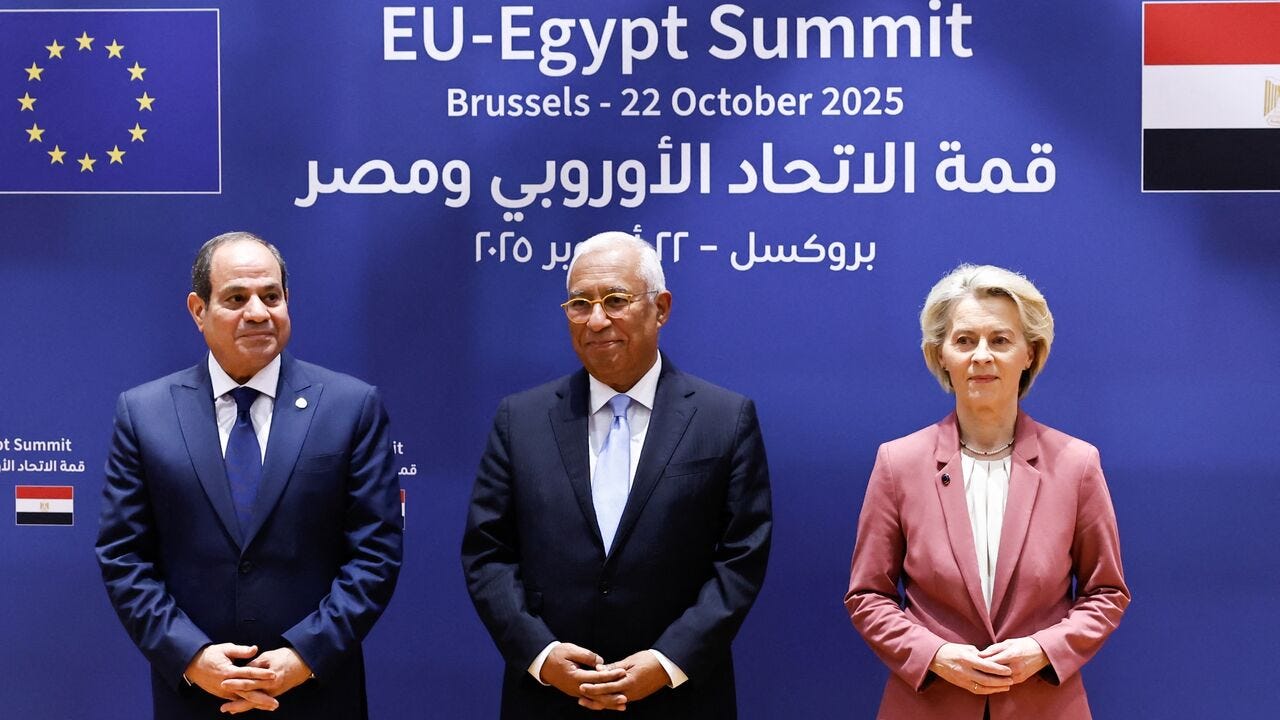
Egypt continues its growth trajectory as a major source of migrant labor, a workplace for more than a million refugees and asylum seekers, and an increasingly important outpost of Europe’s migration control regime.
The latest Atlas of Migration by Rosa Luxemburg Stiftung describes this contradiction directly, tracing how Sudanese and other refugees have historically found informal work in Cairo and Giza while tighter policing has increasingly exposed undocumented workers to detention and deportation.
At the other end of the movement, 17,451 Egyptian nationals reached Europe by sea or land in 2025, 50% more than in 2024, with almost 52% travelling through the central Mediterranean route, mainly to Italy, and 47% through the eastern route, principally to Greece, according to the International Organization for Migration (IOM).
For the Egyptian economy, however, workers who leave do not simply disappear from the labor market, as part of the value of their labor returns as foreign exchange.
Remittances from Egyptians working abroad reached a record 47.3 billion dollars in FY2025/26, up 29.6% from 36.5 billion dollars the previous year, according to data published last month by the Central Bank. Migration therefore performs two functions at once. Workers leave an economy that cannot provide all of them with wages and employment capable of sustaining their households, then reproduce those same households—and supply Egypt with scarce hard currency—through wages earned abroad. The economy exports labor power and receives part of its price back in dollars.
The movement in the opposite direction is governed by a far harsher reality of labor relations. Formally, Egypt hosted more than 1.098 million registered refugees and asylum seekers as of August, including 851,947 of them Sudanese, with UNHCR reporting in June of this year that many lack stable incomes and face limited livelihood opportunities amid rising living costs, adding that most live in urban areas including Greater Cairo and Alexandria.
The movement in the opposite direction is governed by a far harsher labor relation. A September 15 report by the Refugees Platform in Egypt (RPE) documented 24 forcibly displaced people who died in detention facilities or in connection with arrest, arbitrary transfers, and pre-deportation procedures between December 2025 and July 2026. Eighteen of the 24, or 75%, were registered with UNHCR or held documents connected to international protection procedures, while 16 were Sudanese.
RPE also documented “recurring indications of delayed or inadequate medical care, overcrowding, poor ventilation and unsuitable detention conditions.”
Similarly, Amnesty International had reported earlier in the year that since late 2025, police have detained refugees during identity checks on streets and at workplaces, while documenting refugees restricting or abandoning work to reduce their exposure to arrest and deportation.
Europe has helped construct that asymmetry. The atlas traces years of European support for Egyptian border policing, including police training, patrol boats, thermal imaging and satellite surveillance equipment. The European Union’s 2024 “strategic comprehensive partnership” with Cairo adds 7.4 billion euros for 2024–27—5 billion in concessional loans, 1.8 billion in investment and 600 million in grants, including 200 million specifically for migration management—while formally linking migration and mobility to “economic stability, investment and security.”
The resulting division is material rather than rhetorical: Egyptian labor abroad is encouraged and economically prized when it generates foreign currency, displaced labor inside Egypt remains concentrated in precarious employment under the threat of repression or removal, and the state receives European financing to police movement between the two. The same regional labor market thus integrates workers across borders while states increasingly differentiate their rights according to nationality, legal status, and which direction they are moving.
State policy of cheap labor outsourcing proves successful—for capital
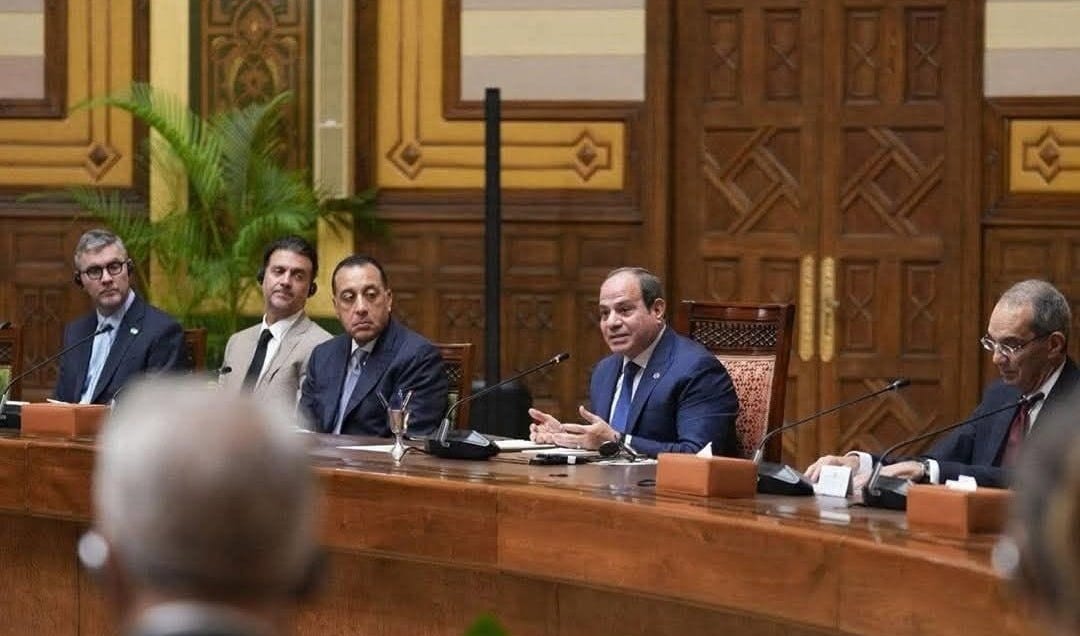
Egypt’s outsourcing boom has grown into a significant export industry built around selling skilled Egyptian labor abroad while workers remain at home. Communications Minister Raafat Hindy said on September 26 that “nearly 200,000 engineers, developers and other specialists now export digital services from Egypt,” broadly matching the June count of 195,300 workers employed by 252 exporting companies across 282 delivery centers, according to the Information Technology Industry Development Agency (ITIDA).
Outsourcing exports reached 5.2 billion dollars in FY2025/26, around 70% of Egypt’s 7.4 billion dollars in total digital exports, with ITIDA targeting more than $8 billion by FY2027/28. The sector creates formal skilled employment, but its comparative advantage is also unusually explicit: Egypt’s telecom regulator markets the country’s workforce as highly trained and available at “relatively low wages,” while ITIDA advertises potential operating-cost savings of up to 70% against competing locations and that by exploiting Egyptian labor, “business leaders can grow more efficiently without weighing down their budgets.”
The price differential is large enough to be measured directly. An Everest Group study commissioned by ITIDA in 2024 estimated annual compensation for an IT-services worker in Cairo at 8,000–10,000 dollars, compared with 15,000–17,000 dollars in India, 17,000–19,000 in the Philippines, and 38,000–40,000 in Poland, describing Cairo’s advantage as primarily driven by low salaries.
Currency depreciation has widened that arbitrage further. Last year, for example, Sutherland said its Egyptian business grew 25–30% in the first half of 2025, attributing the rise partly to the weaker pound as well as workers’ language skills. For wage earners, devaluation raises the domestic cost of food, rent, and transport; for the foreign client purchasing labor in dollars or euros, it can lower the international price of the same labor time.
The same macroeconomic adjustment therefore appears as declining purchasing power on one side of the employment relation and “improved competitiveness” and “value propositions” on the other.
The state reinforces that wage advantage by absorbing part of the non-wage cost of production. ITIDA offers investors tax reductions, subsidized facilities, training support, and other incentives, while public free zones have been opened to service exporting startups with customs and tax exemptions.
The government signed 55 outsourcing agreements in November 2025, which Sisi attributed to “stability despite regional challenges,” with the state projecting 75,000 additional jobs over three years, while companies continue expanding large Egyptian workforces. As The Cairo Report has argued in a previous dispatch, this is the white-collar side of an economy whose attractiveness to capital increasingly rests on the gap between workers’ productive capacity and the cost of purchasing it: metropolitan, multilingual, and technically trained labor is integrated into global production without receiving wages comparable with the markets in which its output is sold.
That contradiction may sharpen as the industry moves into AI and higher value services. Outsourcing export revenue is currently growing at about 23% annually while employment grows around 12%, according to ITIDA chief Ahmed El-Zaher, who expects automation to replace some routine tasks while creating more specialized ones. The cheap labor model therefore does not necessarily need to disappear as Egypt moves from call centers into software, engineering and artificial intelligence; it can migrate upward into more sophisticated work.
Regardless, under such arrangements, and thanks to official state policy, the sector’s development and present success remain tied to the international inequality it is supposed eventually to overcome, and as Sisi previously told US business figures: “We have labor whose cost is incomparable to any other place.”
Platform work enters formal rule making, but who counts as the employer?
Egypt’s Labor Ministry has moved regulation of work via online platforms and other nontraditional work into direct consultation with companies, opening a new stage in deciding whether digital labor will inherit conventional employment rights or remain organized primarily through individual contracting.
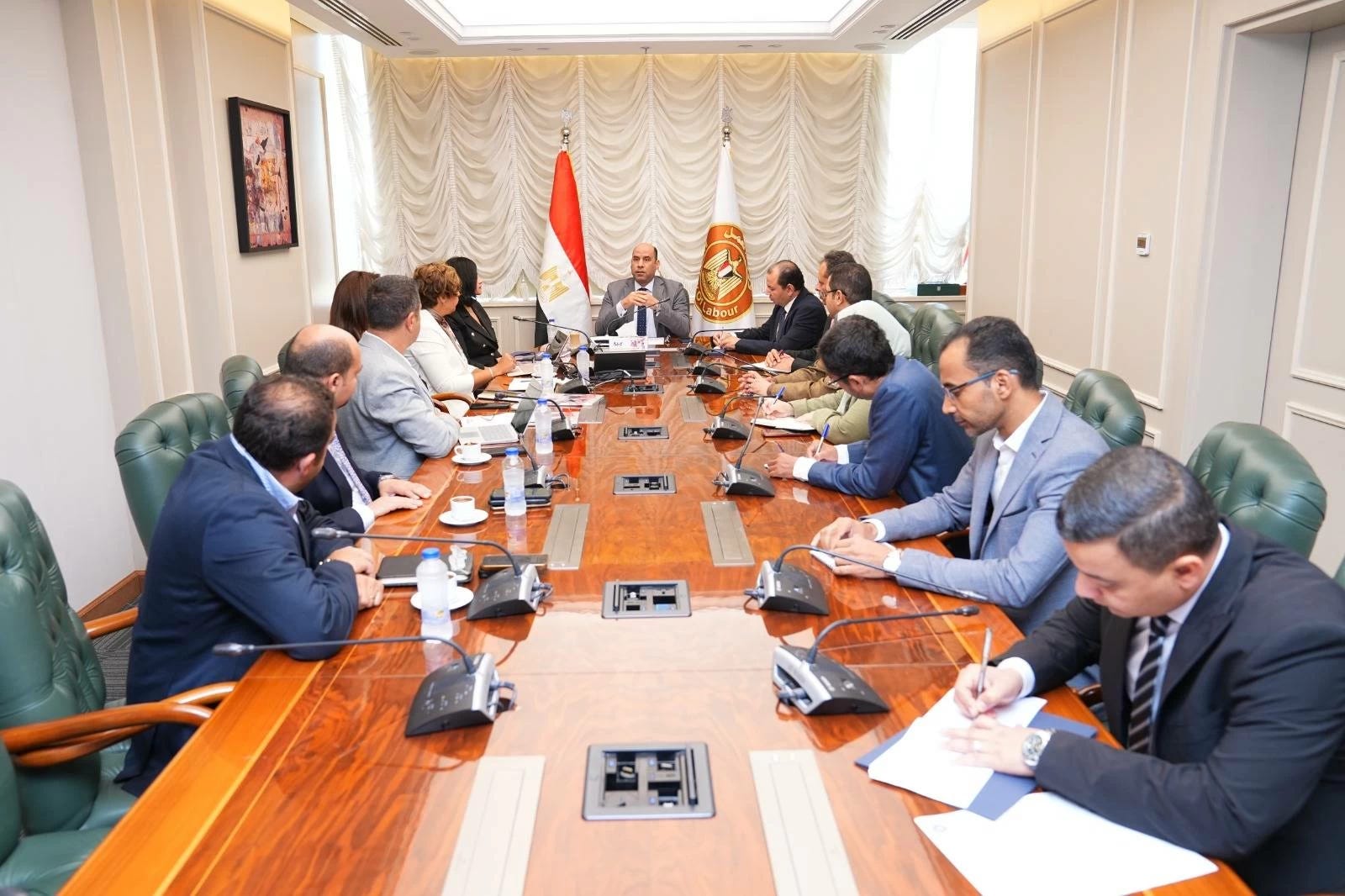
Labor Minister Hassan Raddad met representatives of recruitment and digital-work companies on September 24 to discuss rules covering electronic recruitment, platform work, freelancing, remote work, part-time work, flexible work and job-sharing, saying the government wants to move toward “clear regulatory frameworks.”
The development is already overdue under last year’s labor law, in which Article 100 required the minister, after consulting trade unions and employer organizations, to issue regulations governing new work patterns within six months of the law’s 3 May 2025 issuance.
The stakes lie less in whether platforms are regulated than in what labor relation the regulations recognize. Article 96 defines “new work” as labor performed for an employer, for pay and under that employer’s “management or supervision”; Article 97 then extends to those workers the rights attached to conventional employment, including the minimum wage, social protection, social insurance, and, at least on paper, collective bargaining and trade union freedoms.
Yet the final law does not separately list digital platform work among its enumerated categories, which is notable because parliament’s April 2025 version explicitly included “work through digital platforms” before the law was promulgated weeks later without that category. Still, the disappearance does not itself exclude platform workers, since the final definition is broader and the minister can add further categories through executive decisions, but it pushes the decisive question onto whether algorithmic control is treated as employer supervision.
The ministry now says conventional protections should extend to the new work patterns, while Egyptian Trade Union Federation vice president Khaled Eish separately said on the same day the meeting took place that “platform work requires explicit rights and social protection.”
But as was the case when the new labor law was being drafted, the government’s meeting was with company and platform representatives, not platform workers themselves or their representatives, making the composition of the remaining consultation process worth watching.
The international standard adopted only three months ago sets a clearer test. The ILO’s new Convention No. 193, to which Egypt is a signatory, covers platform workers regardless of whether they are employees or self-employed and requires governments to determine employment status mainly from the actual facts of how work and payment are organized, rather than the contractual label. It also addresses automated monitoring and decisions, human review, occupational safety, social protection, dispute mechanisms, and collective bargaining.
Notably, the convention does not require every platform worker to become an employee; rather, it requires the classification to reflect the real relation of control.
For wage earners, that is the material dividing line in Egypt’s forthcoming rules. The government can formalize the market by licensing platforms, recording transactions, and registering individual freelancers while leaving the costs of social insurance, equipment, idle time, occupational injury, and fluctuating demand with the worker. Or it can formalize the employment relation, requiring platforms that materially control labor to assume the obligations that conventional employers carry, and while the technology is relatively new, the underlying conflict is not.
What the regulations will decide is how a new form of organizing production redistributes—or maintains—an old set of relations.
Textile workers resist transfer as factory land is cleared for investment
Workers at the Delta Spinning and Weaving unit in Tanta have protested plans to move roughly 850 workers to the company’s Zefta unit and clear the 44-feddan Tanta complex for investment, turning a labor dispute over relocation into another test of how Egypt’s state textile restructuring distributes the costs of unlocking industrial land. Workers suspended further escalation while awaiting negotiations with the Cotton, Spinning, Weaving and Garments Holding Company, Safha1 reported. While the immediate issue is job transfer rather than redundancy, that understates what workers stand to lose, as relocating production transfers commuting time, transport costs, and care burdens onto employees while separating them from the workplace around which their lives have been organized.
The decision also marks a sharp turn from the state’s own plans for the site because Delta Spinning ceased to exist as a standalone company after the government merged it into Misr Shebin El-Kom Spinning and Weaving in 2021, alongside Eastern Spinning, Kom Hamada, and Meet Ghamr; the holding company owns effectively all of the enlarged firm.
Yet when Gharbia’s governor inspected Tanta in October 2022, officials described three operating factories across the same 44 feddans and said the now-abolished Public Business Sector Ministry had begun replacing obsolete machinery in one of the factories, with a second phase intended to expand production capacity. In 2023, the government’s wider textile strategy similarly listed a “New Delta” project covering Shebin El-Kom and Tanta among the plants awaiting redevelopment.
What has not been explained by the state, however, is when the Tanta modernization plan became a decision to remove production altogether.
The shift nevertheless follows the financial logic built into the textile restructuring program from the start. Years ago, public business sector officials said that modernization would be financed partly by selling and rezoning state textile land, using the proceeds to pay debts and purchase new machinery, and former minister Hisham Tawfik repeatedly stressed that the assets being sold were surplus or unused and that disposals “would not interfere with existing production.”
Tanta now exposes the boundary of that promise, as the asset being prepared for “investment” is the site of an operating industrial unit whose workers are being moved precisely so the land can be released, and restructuring therefore no longer means only selling property left behind by industrial consolidation; in this case, consolidation is what creates the “surplus” property.
Workers elsewhere in the same group have already forced the holding company to recognize that such transfers carry social costs. In 2023, roughly 1,000 workers at Eastern Spinning in Zagazig, another unit absorbed into Misr Shebin, occupied their workplace after being told they could be transferred to other holding company factories. Management ultimately placed them on open paid leave, preserved their wages and benefits, and agreed that they would remain administratively attached to the company without transfer outside their governorate.
Samanoud workers are back on strike for their wages
Update: Workers at the Samanoud Textile and Weaving Company ended their weeklong strike on September 24 after the company disbursed an additional 1,200 pounds of their delayed August wages, pledging to pay the remaining 1,000 pounds on September 28, Al Manassa’s Ahmed Khalifa reported. Management also promised to regularize pay to the first week of each month going forward — a pledge workers met with an ultimatum: pay September wages in full by October 10, or they will resume a factory-wide strike.
That promise came a day after a delegation from the Arab Investment Bank (aiBank)—a state-owned bank holding a minority stake in the company, which often handles negotiations in coordination with majority stakeholder National Investment Bank (NIB)—met with strikers on September 23 alongside board chairman Saad El-Din Abd Rabbo, according to Khalifa. Bank officials pledged to fix the payroll delays and invest capital in modernizing the plant, but workers dismissed the assurances as empty “painkillers.”
The standoff had already drawn outside pressure by then.
On September 22, the Center for Trade Union and Workers Services (CTUWS) filed a complaint with the prime minister, warning that management was refusing to communicate with workers or negotiate directly, and that the labor ministry’s local office still hadn’t visited the factory to mediate. CTUWS noted that workers had so far received only 900 pounds of wages totaling roughly 3,100 pounds, and urged the cabinet to order the ministry to visit the company, hear out workers’ representatives, and compel both sides into serious talks; covering full wage payment, minimum-wage enforcement, periodic allowances, food stipends, and settlement of all overdue dues.
That 900-pound payment had come a day earlier, on September 21, when the company tried to end the strike by disbursing part of the owed August wages, an offer workers rejected. The same day, a coalition of political parties, unions, and rights groups issued a joint solidarity statement demanding full and timely wage payment, minimum-wage compliance, remittance of withheld insurance deductions, and an end to retaliation against strikers.
New ‘Wage Council’ framework, an old enforcement problem
Update: On September 24, the CTUWS submitted a memo to the Minister of Planning and Economic Development, who chairs the National Wages Council (NWC), calling for an urgent council meeting to raise the minimum wage for private-sector and informal workers, arguing it should match the floor already set for government employees.
The memo was co-signed by dozens of political parties, civil society groups, unions, public figures, and workers.
It notes that Cabinet Decision No. 2170 of 2026 set the public-sector minimum wage at 8,000 Egyptian pounds, while Law No. 75 of 2026 extended that floor to public-business-sector workers and others outside the Civil Service Law, alongside new allowances, incentives, and bonuses for state and public-sector employees. Yet more than two months after those measures took effect, the NWC has neither convened nor issued a corresponding increase for private-sector workers.
The memo also cites the prime minister’s remarks in March, when he attributed the roughly 14% increase in the public-sector minimum wage to rising inflation. Signatories argued that inflation has continued climbing since then, eroding workers’ purchasing power, while the private-sector minimum has not moved.
Private-sector workers, the memo states, are contending with rising prices and living costs, including higher fuel prices that have driven up transport costs and, in turn, the prices of goods and services generally.
The delay in convening the council and the absence of a scheduled date for it to meet perpetuates unequal treatment of workers across sectors, the CTUWS stated.
On the council’s legal standing, the memo argues it may convene even though it has not yet been reconstituted under the new Labor Law No. 14 of 2026, since the council formed under prior cabinet decisions remains in effect, in the signatories’ view, until a new formation decree is issued.
They further invoked Article 103 of the Labor Law, which requires the NWC to meet at least every six months, or whenever necessary. The council’s failure to convene since March 2025 violates that provision.
Fired Agricultural Bank employees stage sit-in inside Dokki branch
On September 25, a group of employees fired from Egypt’s Agricultural Bank staged a 10-hour sit-in inside the bank’s main branch in Dokki, demanding reinstatement and the reversal of their contract terminations, Al Manassa’s Ahmed Khalifa reported.
Police forces detained two of the protesters after the bank filed a complaint against them, releasing both at 3 a.m. the following day, three colleagues told Khalifa.
One of the three said the fired employees had sent telegraphs to the presidency, the Interior Ministry, and the Public Prosecution ahead of the sit-in, notifying them of the action. They also requested a meeting with the bank’s chairman or a deputy, which was denied.
A second source said the employees resorted to the sit-in after more than a year of unsuccessful attempts to be reinstated, including efforts to meet bank officials and a series of protests raising the same demand. The source added that Agricultural Bank CEO Mohamed Abu El-Saud had canceled a meeting scheduled with a number of the dismissed employees in June 2025.
A third source said bank security tried to force the protesters to leave the branch, but they refused to do so before meeting an official and learning the fate of their demands.
The dispute dates back to contract-termination decisions issued between 2020 and 2022, affecting roughly 2,000 employees across various branches and departments, according to previous accounts from dismissed staff given to Al Manassa. Employees have said the terminations came without prior notice or investigation, despite some holding open-ended contracts, including staff with more than 20 years of service.
Some employees have linked the start of the terminations to Alaa Farouk, Egypt’s current agriculture minister, taking over as the bank’s board chairman in February 2020, saying management pursued a workforce-reduction policy at the time.
The decisions also affected employees who had filed lawsuits over a delayed 20% raise and won court rulings in their favor around the same time they were dismissed.
Over the past four years, the fired employees have filed multiple complaints and organized protests demanding reinstatement and the reversal of their arbitrary dismissals.
On April 27, 2025, dozens staged a protest outside the bank’s Dokki headquarters, followed by three more in May of that year.
Prison Watch
Egypt’s pretrial detention machinery churned through several cases this week.
Anthropologist and investigative journalist Ismail El-Eskandarani has completed a full year in pretrial detention on Supreme State Security Case No. 6469 of 2025, facing charges including spreading false news and joining a terrorist group.
He has again been renewed into pretrial detention at Badr 1 Rehabilitation and Correction Center, according to the Khaled Ali Law Firm, which included his case in its “Ages on Hold” campaign documenting 27 defendants held in freedom-of-expression cases, demanding their release.
On September 26, 16 rights organizations issued a joint statement calling for the immediate release of photojournalist Hamdi Ali, known as Hamdi El-Zaeem, ahead of a trial hearing scheduled for September 27.
The statement marks ten full years since El-Zaeem’s initial arrest; a decade spent cycling through pretrial detention, precautionary measures, and ongoing proceedings without a final conviction.
Meanwhile, the First Circuit of Cairo’s Criminal Court adjourned the case of Ultras White Knights Capo, Sayed “Moshagheb” Fahim, and five co-defendants to October 20, in Boulaq El-Dakrour Felonies Case No. 7304 of 2026, registered as Case No. 4375 of 2026 with the Supreme State Security Prosecution, according to the Egyptian Commission for Rights & Freedoms (ECRF).
The adjournment followed testimony from a fourth prosecution witness, with the court seeking to hear remaining witnesses, defense witnesses, and confirmation from the traffic authority on whether a celebration event disrupted traffic.
The State Security Prosecution ordered the release of 10 defendants of five nationalities, four Yemeni, one Saudi, one New Zealander, one Libyan, and one Syrian, in Case No. 5635 of 2026, known publicly as the “Shia case,” which involves charges of joining and financing a terrorist group, per the ECRF.
State security update

So, what?!
What’s striking this week isn’t just that workers are absorbing costs so production can continue, it’s how many of this week’s disputes turn on reclassification rather than open confrontation. The Red Sea drillers aren’t being fired, they’re being moved onto “security” job titles that erase their actual pay scale.
The Tanta workers aren’t being laid off but “transferred” in a way that lets the company call an eviction a relocation. Even the platform work debate comes down to whether algorithmic control counts as “supervision,” because Egypt’s labor law grants some protections, but only to whoever can be “correctly named” an employee of a legible employer. The mechanism of the week isn’t the absence of rights so much as the redrawing of who legally qualifies for them.
Again, rights that exist mainly as text cost the state nothing to defer, and everything to enforce, which is why enforcement has never come from the text itself.
What this dispatch shows, like every dispatch, is that the only thing that has ever moved the number—the wage, the allowance, the compensation, the reinstatement—is workers making the cost of ignoring them higher than the cost of paying them.