




This issue of The Cairo Report covers hundreds of Samanoud workers striking, once again, over delayed wages; Misr Phosphate workers demanding direct negotiations over pay and conditions at desert mining sites; and 1,200 Arab Polvara Spinning and Weaving Company workers protesting over wages, social insurance deductions, and the future of the factory.
It also documents renewed clashes between security forces and Warraq Island residents, which resulted in injuries and arrests, and Tora residents—from Tora El-Balad to Kozzika—preparing legal cases to defend their homes.
Meanwhile, per-class teachers can join Egypt’s teachers’ syndicate but remain barred from its “Fellowship Fund” retirement, death, and disability benefits; thousands of teacher candidates, separately, were excluded from a fifth batch of government teaching appointments after failing to meet a “qualitative weight” scoring threshold set by the Military Academy.
We also explore private-sector wage growth slowing sharply and hiring remaining flat in Q2, even as Egyptian businesses report shortages of qualified labor, and the government’s preparations to shift control of six public holding companies as part of a state-ownership restructuring, while failing to name a buyer or confirm any sale, among other things.
Misr Phosphate workers demand talks over pay & conditions
Workers at state-owned Misr Phosphate are demanding direct negotiations over pay, risk allowances, and conditions at desert mining sites, according to a source who spoke to The Cairo Report on condition of anonymity, adding that workers approached a senator from the state security-backed Nation’s Future party after struggling to get their concerns before senior management.
Their demands include revised incentives, improved healthcare, better accommodation, meals and transport, and changes concerning wages and promotions.
The demands mainly concern how workers benefit from a profitable, expanding public enterprise. The company’s owners are the National Investment Bank (NIB), Egyptian Mineral Resources Authority, Egyptian General Petroleum Corporation, and Ganoub El Wadi Petroleum Holding Company. The company reported 7.9 billion Egyptian pounds (around 153 million US dollars) in sales, and 3.3 billion pounds in after-tax profit for 2024, with profits rising 194% from the previous year.
At its May 2026 general assembly, management announced production of 4.02 million tonnes and a fifth consecutive year of production growth, in which the company leads the phosphate production sector with a 40% market share.
Those gains make allocating resources to compensation and mine site services a central question.
Management is also changing how it deploys the workforce. On August 17, chairman Nasser Shaheen ordered workers redistributed between departments at Abu Tartour, Egypt’s largest phosphate mine, to “meet operational requirements and fill shortages of trained staff.”
His instructions accompanied plans for solar power, ore conveying infrastructure, technical training and expanded exploration, supporting construction of a phosphoric acid plant, which is why workers are now seeking a regular means of negotiating the conditions under which they provide their labor in a changing work environment.
Demands for access to management, however, have surfaced repeatedly at the company. In July 2011, workers conditionally ended a sit-in following “military-mediated negotiations,” securing promises of management meetings, revised leave arrangements and renewed worker transport. Then, in January 2013, about 500 workers protested at Abu Tartour, demanding changes to the financial and administrative structure and worker representation on the board.
Several present demands overlap with explicit duties under the labor law. Article 271 requires employer-funded transport where ordinary services are unavailable, and suitable food and housing in qualifying remote areas. Article 196 requires negotiations when a collective labor dispute arises and provides a route for administrative intervention if either side refuses. Article 197 requires any resulting agreement to be recorded as a collective labor agreement.

Wages cool, hiring stalls, employers say they cannot find workers
Private sector wage growth slowed sharply, and hiring remained essentially flat in the second quarter of the year, even as Egyptian businesses continued to complain about shortages of qualified labor, according to the latest Egyptian Center for Economic Studies (ECES) Business Barometer. The quarterly survey of 120 private companies found that only 14% of large firms and 9% of small and medium-sized enterprises (SME) reported increasing wages between April and June, while 86% and 91%, respectively, said wages were unchanged.
The wage index for large companies consequently fell to 54 from 92 in the previous quarter, while the SME index dropped to 52. Firms expect even less movement between July and September, with expected wage indices of 50 for large businesses and 51 for SMEs, effectively signalling that almost all respondents expect wages to remain unchanged, according to the survey.
Hiring is showing much of the same pattern.
Large businesses recorded an employment index of 51 during April–June, only marginally above the neutral level, while SMEs remained at 50, as both groups expect employment to sit at 50 in the current quarter. Yet companies continued raising their selling prices much more broadly than their workers’ pay: final product price indices reached 70 among large firms and 69 among SMEs.
ECES also recorded annual headline inflation rising to 14.6% in the second quarter from 13.5% in the first, highlighting a private sector in which price rises remained pervasive while further wage and employment expansion largely stopped.
At the same time, employers continue to identify a lack of “qualified labor” as a constraint. SMEs told ECES that improving training through public schools and universities should be a “government priority” because of what they described as a “mismatch between education and labor market requirements,” while telecommunications firms separately listed qualified labor among their priorities.
The complaint, however, is not new.
ECES has recorded it repeatedly in its Business Barometer series, and its earlier research into manufacturing found recurring difficulty recruiting “suitable technicians, machine operators and assembly workers” alongside high worker turnover.
A 2019 ECES survey of manufacturing labor demand became the basis for proposals to overhaul technical and vocational education, and subsequent ECES analysis continued to describe skills shortages and turnover as central employer concerns.
The latest results complicate an explanation based only on the education system. Employers say they struggle to obtain the labor they need while, collectively, reporting almost no expansion in hiring and expecting wages to remain essentially frozen. The barometer does not ask workers why they leave jobs or reject vacancies, so it cannot establish how much of the reported shortage reflects skills, pay, working conditions, transport costs or other factors.
But its own figures make those questions difficult to separate, since a persistent recruitment and retention problem exists alongside weak wage growth and little anticipated job creation.
That tension also reaches beyond the workplace. ECES says manufacturing sales weakened partly because households’ purchasing power fell, while higher energy, raw material and shipping costs squeezed firms from the other side. For individual employers, holding wages down may reduce one production cost, but across the economy, however, wage earners are also the purchasing power sustaining domestic demand.
The barometer therefore captures both sides of the same problem: businesses report difficulty finding the workers they want, while the labor market they describe is offering little additional employment and, after an earlier adjustment, little further wage growth.
Tax breaks sought to turn property debts into market assets
The Egyptian Exchange (EGX) has asked the government to grant a full income tax exemption to transferable asset funds, prioritizing vehicles that buy mortgage, lease, and other receivables as a way to channel capital market money into stalled real estate projects, according to Enterprise. The proposal, now under Tax Authority review, would extend tax privileges beyond the five investment fund categories already covered by Article 50 of the Income Tax Law; officials reportedly told the outlet the EGX ultimately wants the exempt list expanded to 38 fund types, and because additional categories can be added through executive decisions by the finance minister, the change would not require parliament to amend the law.
The immediate target is real estate, but the instrument is financial rather than physical. Transferable asset funds buy future payment claims—mortgage installments, lease-backed receivables, and similar obligations—allowing the originator to receive cash today while investors collect the future income stream. The Financial Regulatory Authority (FRA) created the regulatory basis for such funds in 2020, explicitly allowing non-bank lenders to transfer portfolios of future customer installments to investment funds in return for their present value, but the model only began acquiring scale recently after two companies raised 443 million pounds in October 2025 through the mortgage fund, followed by another 633 million pounds this month, taking the program to about 1.08 billion pounds.
The exemption would therefore extend an existing policy of using the tax system to deepen capital markets. Law No. 30 of 2023 already gave “conditional income tax exemptions” to specified investment funds, including debt instruments, listed equity, venture capital and real estate funds.
Transferable asset funds sit outside those categories, even where the receivables they purchase originate in housing, and bringing them inside would increase investors’ after-tax returns and, in theory, encourage more capital to purchase the debts sitting on mortgage companies’ and other financiers’ balance sheets.
Notably, the request arrives as financing strains have become visible on the other side of those payment claims. According to Al Manassa, a preliminary Housing Ministry inventory found about 450 developers behind schedule on unit deliveries, from roughly 15,000 projects and project phases under review, and a previous report had documented buyers continuing to service installment obligations even where construction slowed or stopped, leaving households financing projects whose promised homes remain undelivered.
Packaging those receivables into investment funds can technically provide fresh liquidity and potentially restart construction, sustaining contractors and construction employment; but the public intervention operates first through improving the economics of the financial claim, rather than securing guarantees from real estate companies, financing unfinished buildings, protecting buyers, or supporting workers.
That is the labor question beneath what otherwise looks like a technical tax change. The proposed exemption would allow the state to surrender future tax revenue so that claims on households’ future income become more attractive to financial investors, with the irrational expectation that this liquidity then travels back through lenders and developers into the property economy.
Polvara’s wage dispute becomes a fight over factory’s survival

An independent auditor has warned that Alexandria’s UNIRAB Polvara Spinning & Weaving Co. may no longer be able to continue operating, days after its roughly 1,200 workers protested over wages, social insurance deductions, and the future of the factory.
The auditor’s review of the June accounts found accumulated and current losses equal to 91.72% of shareholders’ equity and 92.88% of paid-in capital, while management had provided no disclosed plan for addressing the going concern risk. It called for an extraordinary general meeting to consider whether the company should continue or be dissolved.
The warning gives a balance sheet basis to fears workers raised during their latest action. They staged a day-long sit-in followed by stoppages across two shifts, while the Egyptian Commission for Rights and Freedoms (ECRF) said some employees receive only 5,500 pounds a month, lack a transparent wage scale and continue to have social insurance contributions deducted without their rights being properly secured.
Management’s immediate concession was reportedly limited to raising the food allowance to 600 pounds, according to ECRF, while workers also called for an independent examination of claims that machinery has gone unrepaired and parts of the productive assets have been scrapped or sold.
The insurance dispute, however, is demonstrably older than the current stoppage. In October 2025, The Cairo Report covered how health insurance services were suspended for 1,200 Polvara workers, including workers with chronic illnesses and cancer, after debts to the National Organization for Social Insurance (NOSI) surpassed 158 million pounds. Workers and the company union said that the company had stopped remitting contributions in 2018, even while workers said their own shares continued to be deducted from wages. An ensuing November strike ended on promises that the debt would be settled, while ECRF said at the time that the company was also still paying below the state-mandated minimum wage.
That recurring transfer of financial distress onto labor sits within a longer post-privatization decline. Polvara was privatized in 1997, although the state-owned Holding Company for Cotton, Spinning, Weaving and Garments still holds 16.259% of its shares, and as early as 2014, the textile union sought to return the company to state ownership, claiming that asset sales and control over roughly 110,000 square meters of Alexandria land threatened the productive enterprise and thousands of jobs.
The latest audit makes those asset questions newly material: it records fixed assets with an acquisition cost of about 406 million pounds, including land valued at 252 million pounds, while all the company’s current bank accounts are under attachment because of unpaid external liabilities, most owed to government bodies including the tax and social insurance authorities.
For workers, the going concern question is therefore more than whether a listed company survives on paper. Polvara’s losses have already been accompanied by illegal wages, interrupted healthcare, and unpaid social insurance obligations, meaning part of the enterprise’s financial crisis has been absorbed through workers’ present income and future social entitlements.
Government reviews control of six public holding companies
Egypt’s government is preparing to change the institutional control of six public holding companies, advancing a restructuring program tied to “higher asset returns” and private investment as part of the State Ownership Policy and “commitments to international development partners.”
The official account of a government meeting said Prime Minister Mostafa Madbouly chaired discussions covering construction, tourism and hotels, metals, pharmaceuticals, textiles and chemicals, without identifying either the proposed destination of the companies or an approved transfer, sale, or workforce reduction.
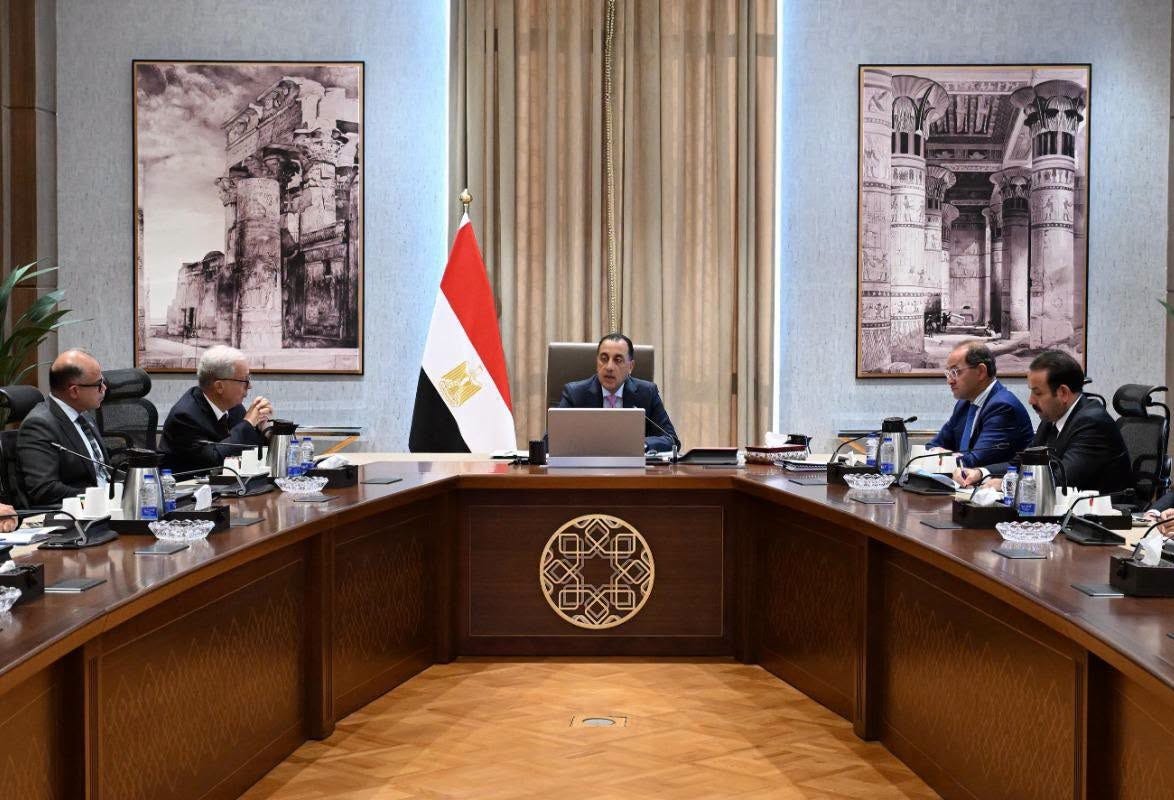
Most notable among the attendees, alongside the finance and investment ministers and the government's State-Owned Enterprises Unit, was Colonel Bahaa el-Ghannam, chairman of the military-run Future of Egypt Authority, which is materially worth recording because the restructuring is specifically about where ownership of these companies will sit, and these companies possess extensive land portfolios.
Last month, the government had already disclosed that it was considering transferring ownership of holding companies as part of its strategy to “maximize asset returns and use the resulting resources to reduce public debt.” Officials were simultaneously compiling inventories of “unused land” and “preparing individual plots and assets as investment opportunities.”
Moreover, at a June government meeting reviewing the same six groups, Madbouly connected restructuring to selling stakes and legislative changes facilitating offerings, but the latest discussion adds control over the holding companies themselves to that agenda, which would significantly change who decides investment, subsidiary management, and asset disposal, with consequences for employment and the resources available to meet accrued entitlements.
Several subsidiaries of these holding companies have shaped Egypt’s labor movement through struggles over precisely those decisions.
At Ghazl El-Mahalla’s Misr Spinning and Weaving, for example, strikes in 2006, 2007, and labor riots in 2008 secured commitments on bonuses, allowances, and management changes, while workers’ demands in 2024 included the minimum wage, opposition to asset sales, and restoring operations.
In the chemicals group, Tanta Flax workers challenged privatization, in part, through sustained legal action, which won them a judgment annulling the sale in 2011, but a settlement returning the investor’s shares to the state holding company came only in 2021.
Public ownership has also accommodated cuts and insecure employment. At CID Pharmaceuticals, workers struck in October 2021 over reduced profit payments under new rules, prompting management to suspend operations. Workers at the public contractor El Nasr General Contracting, historically known as Hassan Allam, demanded overdue profits, better healthcare and permanent appointments in 2015. At Misr Travel’s Magawish resort in 2018, striking workers said they had spent ten years on temporary contracts.
These disputes demonstrate that corporate restructuring is bound to affect income and security through employment rules and benefit payments, even without an outright sale.
A more severe precedent can be seen in Egyptian Iron and Steel in Helwan, whose workers maintained production during their landmark 1989 sit-in, stopped production in 2021 amid liquidation. Its closure dismantled a workplace that had sustained employment, social services, and generations of collective organization. That outcome explains why workers’ participation and guarantees matter before restructuring becomes binding.
The government has specified objectives for investors and asset returns, but its published account deliberately leaves unanswered how it would preserve jobs, benefits, and workers’ influence over the enterprises they sustain.
New ‘Wage Council’ framework, an old enforcement problem
The cabinet approved a new operating framework for the “National Wage Council” (NWC) on September 16, giving its technical apparatus an explicit role in tracking whether wage decisions are actually implemented as workers continue to face a private sector minimum wage of 7,000 pounds.
The announcement landed the same day the Center for Trade Union and Workers’ Services (CTUWS) called on unions, civil society groups, political parties, and private-sector and informal workers to sign a memorandum demanding the NWC convene immediately and raise the private-sector minimum wage, over two months after a government-set minimum took effect for public employees.
The memorandum, addressed to the Minister of Planning and Economic Development as NWC chair, argues the council’s inaction breaches Labor Law No. 14 of 2025, which requires it to meet at least every six months; it has not met since March 2025.
In comments to Lbraly’s Hassan El-Qabbani on September 16, CTUWS director Kamal Abbas called it “strange” that the council still has not convened to approve a private-sector increase, saying the delay affects all workers amid difficult economic conditions, and warned that if it continues to fail to convene, the group will send the Minister of Planning a formal notarized warning.
Much of the institutional architecture in the cabinet's announcement, however, is older than the announcement suggests.
Under the new decision, the council will “set and periodically review” national minimum wages, determine the minimum annual raise and examine wage structures across occupations and sectors, while a permanent technical secretariat led by the Planning Ministry will track economic, social and labor market indicators, assess the effects of wage decisions and, crucially, follow their implementation with the Labor Ministry and other agencies. The secretariat must meet at least quarterly and report to the council chair every six months.
The NWC dates to 2003, when Prime Ministerial Decision No. 983/2003 already empowered it to set a national wage floor according to living costs and the relationship between wages and prices, study wage structures and productivity, periodically reconsider the minimum wage, and operate through a specialized technical secretariat.
The weakness was implementation and consistency in meetings. A later reconstitution again required regular meetings, yet the council then went six years without meeting between September 2013 and November 2019.
The institution became more consequential after its 2020 revival. In 2021, it set a 2,400 pounds private sector minimum wage, the first generally applied private sector floor under the revived system, although distressed businesses were allowed to “request exemptions,” and expectedly, the council received thousands of such applications.
The floor subsequently rose to 2,700 pounds in January 2023, 3,000 pounds in July 2023, 3,500 pounds in January 2024, 6,000 pounds in May 2024, and 7,000 pounds from March 2025, when the council also set a 250 pounds minimum annual raise and a 28 pounds net hourly floor for part-time work.
The more important legal shift actually preceded this week’s cabinet decision, since labor law already requires the council to meet at least every six months, makes its wage decisions binding on covered establishments, and places responsibility on Labor Ministry inspectors to monitor compliance.
The new framework therefore does not invent regular wage setting or enforcement—it potentially links enforcement data back into a permanent body that is supposed to evaluate how wage decisions work in practice.
For wage earners, then, the question is less whether Egypt has another formal wage setting mechanism than what that mechanism measures and whether its decisions reach the workplace.
The framework instructs the council to consider changing economic and social conditions, but it also embeds the longstanding requirement to balance workers’ claims against employers’ interests and higher productivity.
That tension has run through the council since its creation, with wages treated simultaneously as the income from which workers reproduce everyday life and as a cost to businesses whose profitability the state also seeks to protect.
Pensioners still waiting as MPs demand payment & compensation
Update: Egyptian retirees remain without pensions six months after leaving work, according to MPs pressing the National Organization for Social Insurance (NOSI) to settle overdue benefits.
In the latest intervention, Manpower Committee deputy chair and Egyptian Social Democratic Party (ESDP) MP Ehab Mansour questioned the government on September 15, saying he had referred cases concerning more than 2,000 citizens to the authority but received only 26 replies.
He added that retirement, survivors’ and disability pensions remained outstanding despite successive promises to make payments between May and August.
Two days earlier, ESDP MP Amir El-Gazzar, a member of Parliament’s Economic Affairs Committee, said people who retired approximately six months ago had received nothing. He acknowledged “improvements in processing newer retirees’ pensions” but described older cases remaining unresolved while households faced rent, medicine, and other bills.
Compensation for those delays also remains contested. On September 1, Justice Party MP Abdel Moneim Emam asked whether NOSI had implemented a parliamentary committee recommendation to pay compensation automatically where the authority was responsible for withholding benefits, but Mansour’s subsequent intervention said clear arrangements were still absent and demanded payment without requiring pensioners to return to insurance offices with fresh applications.
The delays follow the institutional imbalance previously covered in The Cairo Report’s August 30 dispatch, when NOSI reduced the minimum upfront payment for employers rescheduling contribution arrears from 15% to 5%, easing their immediate financial obligations while pensioners continued pursuing unpaid entitlements.
Pensioners are also organizing over the adequacy of that income. Last week’s coverage followed the General Federation of Pensioners’ Unions’ campaign for a 6,400 pounds monthly minimum, equivalent to 80% of the state’s 8,000 pounds minimum wage.
Until overdue benefits and compensation reach recipients, affected households continue bearing the immediate cost of the authority’s delays.
Piece meal teachers gain syndicate services, remain outside insurance fund
Teachers paid by the class can join Egypt’s Educational Professions Syndicate but still remain excluded from its supplementary retirement, death and disability benefits, syndicate head Khalaf El-Zanati said, but clarified that only currently employed per-class teachers could access the syndicate’s health scheme, holiday accommodation, excursions and certain financial services.
However, membership excludes the “Fellowship Fund” and its insurance payment, preserving a divide in protection between teachers within the same professional organization.
The Fellowship Fund is the syndicate’s private supplementary insurance scheme, whose principal benefit is a lump sum payable upon retirement, death or total disability. Its value recently rose from 50,000 pounds to 60,000 pounds, with the fund announcing payment of the additional 10,000 pounds following Financial Regulatory Authority approval.
El-Zanati’s remarks clarify an arrangement already operating a year earlier.
The latest statements confirm that teachers younger than 45 can also enroll, which is particularly important when viewed alongside the seasonal contracts covered in The Cairo Report’s September 6 dispatch. The Education Ministry’s arrangements for per-class teachers older than 45 specify 4,800 pounds monthly remuneration, an eight-hour working day, and employment from September through June, all of which expire automatically unless renewed and require teachers to acknowledge that repeated service creates no entitlement to permanent appointment.
Syndicate membership covers a broader age group, but both arrangements recognize teachers’ continuing work without granting the security attached to a regular teaching position.
The services available through membership can reduce some household expenses, yet the exclusion carries employment insecurity into the institution meant to support teachers collectively. As the Egyptian public education system continues to suffer from shortages, schools rely on per-class hires to fill vacancies, while their temporary status limits both continuity of earnings and access to supplementary protection.
Emergency fund moves from law toward implementation
Egypt’s Labor Ministry has begun the preparatory implementation phase for a new national fund for non-regular workers, but the fund is not yet fully operational and has not replaced the existing benefit system.
Labor Minister Hassan Raddad chaired a meeting on September 16 to begin the executive preparations required to activate the “Emergency Aid and Social and Health Services Fund for Non-Regular Workers,” and officials were instructed to set initial priorities, expand and update worker databases, link records across state agencies, digitize services, and develop performance indicators.
The fund was initially created by last year’s labor law and subsequently given its institutional framework under Prime Ministerial Decision No. 2403/2026. Its mandate goes beyond the existing welfare account: it can provide emergency income during economic crises, epidemics, disasters, and temporary work stoppages, finance health and social services, and contribute toward social insurance payments. The law also requires the government to enumerate non-regular workers and build linked national databases, making registration part of the infrastructure through which those protections will be delivered.
The new institution nevertheless builds on an older Labor Ministry welfare system, in which registered non-regular workers already receive periodic grants, medical assistance and social benefits through a central ministry account assembled from earlier provincial schemes. That account remains the operative mechanism during the transition.
What changes with the new decision is the attempt to turn that narrower, registration-dependent welfare apparatus into a permanent statutory institution capable of absorbing risks attached to insecure work itself.
Emergency support during a work stoppage, assistance with medical costs and possible contributions toward social insurance could shift part of the cost of illness, interrupted employment and workplace insecurity away from individual workers and their households. But those functions remain largely prospective until the fund completes its organizational and administrative setup and begins delivering them in its own name.
Access will therefore be as important as the formal launch. The ministry’s immediate priorities—expanding databases, linking them across government and digitizing services—determine which workers become visible to the system in the first place.
What remains unanswered is whether the new fund ultimately widens protection beyond workers already captured by contractors and ministry records, and whether its broader legal mandate becomes predictable social protection rather than an expanded mechanism for administratively targeted assistance.
Samanoud workers are back on strike for their wages
Workers at the Samanoud Textile and Weaving Company, a textile company majority-owned by the state’s NIB, launched a fresh strike on Thursday, September 17, after management failed to act on demands over delayed wages, a frozen bonus, and unpaid social insurance contributions, a textile worker, speaking on condition of anonymity, told The Cairo Report.
The textile worker told The Cairo Report that clothing-department workers, numbering between 380 and roughly 400, remain on strike demanding their pay, and that their action followed the earlier textile-department strike, whose workers secured their back pay while clothing-department staff did not. The unresolved wage gap prompted female clothing-department workers to hold a sit-in inside the plant, timed to coincide with the start of the school year and the added costs it brings families.
According to the textile worker, management has justified withholding the clothing department’s pay by arguing the department “doesn’t bring in money,” with the company’s executive director reportedly claiming the department’s revenue does not exceed 200,000 pounds.
A striking worker, speaking on condition of anonymity, told The Cairo Report that the revenue stands against wage costs between 1 and 2 million pounds.
The textile worker added that the director blamed the shortfall on the women workers themselves “for driving away customers”.
“We cannot feed our children,” the striking worker told The Cairo Report. “All we want is to know when we will be paid, even if we’re paid in installments. We have financial responsibilities: rent, food, clothing; we cannot remain in limbo.”
“We don’t even know who is responsible for our wages,” she added.
ECRF’s Wednesday and Thursday statements outline a broader set of violations: a periodic bonus that has gone unpaid for three years despite being a legal annual entitlement worth at least 3% of a worker’s insured wage (minimum 250 pounds a month); some temporary-contract workers earning between 3,000 and 5,000 pounds a month, well under the 8,000 pound private-sector minimum wage; and continued deductions of workers’ social insurance contributions that the company has not forwarded to the NOSI.
Those unpaid contributions have left the company more than 15 million pounds in arrears, according to the ECRF; however, a company source who spoke previously to The Cairo Report put the figure at over 85 million pounds.
This prompted the General Authority for Health Insurance (HIO) to stop renewing insurance cards or covering treatment for roughly 500 workers, including some with chronic conditions.
Still, the textile worker said workers are still receiving health insurance services despite their cards not being renewed on instructions from National Security, as a result of the July strike, and that personnel remain stationed around the company alongside the ongoing strike.
“We were told we are going to get paid on Monday, but nothing is concrete,” the striking worker said. “Most of us are already not working. If you walk into the factory on any day, you’ll find about a quarter of the women working, while most of us are sitting ducks.”
“Work is scarce. The company’s clothing department is struggling, unlike the textile department. But we deserve our wages; it is not our fault that there is no work to be done,” she added.
The commission argues the pattern effectively makes wage payment contingent on striking rather than legal entitlement, rewarding departments that escalate while leaving others unpaid, and said continued use of security intervention and threats to suspend striking workers, rather than addressing the underlying wage issues, compounds the pressure on employees.
ECRF drew a pointed contrast with the company’s own public claims.
The NIB announced on the company’s social media page that a restructuring plan had successfully injected more than 74 million pounds to modernize production lines, double wages, and settle insurance debts.
Workers dispute this, telling ECRF that no new machinery has arrived and maintenance has been inadequate. ECRF also cited the bank’s own disclosed figures, total wages of about 1.87 million pounds in October 2024 for 563 workers, averaging roughly 3,300 pounds per worker monthly, as evidence that the restructuring claims warrant independent financial and technical scrutiny, with results made public.

Prison Watch: More renewals, more postponements
The Committee for the Defense of Prisoners of Conscience stated on September 13 that prosecutors ordered a further 15-day detention for lawyer Mohamed Abu al-Diyar pending investigation in case No. 4502 of 2026. Defense lawyers attended the renewal hearing and requested his release under any bail terms the prosecution deemed appropriate. The committee called for his immediate release, saying continued pretrial detention renewals have prolonged his suffering and kept him from his family.
A day later, Supreme State Security Prosecution renewed the pretrial detention of director and screenwriter Omar Salah Marei for an additional 15 days on September 14, on charges of “publishing false news inside the country” via social media posts, his family stated. The family said this marks the tenth and final 15-day renewal available to the prosecution under law, bringing Marei’s pretrial detention to four months. His case will now move to an advisory chamber, which can renew detention in 45-day increments.
Egypt’s Second Terrorism Circuit, meanwhile, renewed the detention of 19 building-materials merchants from Qalyubia for 45 days, on charges including joining a terrorist group, unlawful assembly, and spreading false news. ECRF said the merchants were presented to the Supreme State Security Prosecution in batches between December 23 and 25, 2025, following periods of enforced disappearance, and that the arrests stemmed from allegations they helped Warraq Island residents obtain construction materials.
The ECRF welcomed, on September 15, a September 10 acquittal by a Damietta criminal court in the case of Faraj Mohamed, who had previously been sentenced in absentia to 25 years. Taha was deported to Egypt in February after German authorities rejected his asylum application; ECRF said he was held for 15 days by the Egyptian consulate before deportation and then subjected to enforced disappearance upon arrival at Cairo airport. His family sent a telegram to the Public Prosecutor through an ECRF lawyer and filed a complaint with Mansoura’s appellate prosecution before he reappeared days later and retrial proceedings began, concluding in his acquittal.
The Second Terrorism Circuit at Badr Court postponed a series of unrelated cases to set future dates for evidence consolidation, witness testimony, or document review. Among them is the case of Haitham Ahmed Abdelaziz, known as “Haitham Dabour,” postponed to November 9 for witness testimony, the ECRF stated on Tuesday. Other postponed cases involve defendants facing charges of joining and financing a terrorist group, with hearings rescheduled across late October through mid-December.
It also postponed the case against lawyer Huda Abdel Moneim, recycled into a new case after completing a sentence in a separate case, to November 23, for evidence consolidation, per the ECRF. Most defendants in the broader batch of postponed cases, which spanned dozens of case numbers, face charges of joining and financing a terrorist group; hearings were rescheduled across September through December for defense arguments, witness testimony, or document review.
On the same day, the Cairo Criminal Court’s Second Terrorism Circuit reviewed a detention renewal for Abdullah Amer in the seventh case in which he has been “recycled” into continued detention, despite acquittals in other cases, per the ECRF. Amer is currently held on a 15-year sentence from a separate 2020 emergency state security case. ECRF said he was unexpectedly summoned from prison on August 26, 2024, for interrogation in a new case despite having been held since 2017, and was referred to trial alongside others. He was originally arrested from his home in April 2017 and, ECRF said, subjected to enforced disappearance and torture before first appearing before prosecutors more than a month later.
In tandem, Egypt’s Court of Cassation ruled Tuesday to uphold the Public Prosecution’s decision to place Strong Egypt Party leader Dr. Abdel Moneim Aboul Fotouh permanently on the country’s terrorist lists, rejecting an appeal filed by his defense team, according to Al Manassa’s Mohamed Napoleon.
The listing, published in March in Egypt’s official gazette, also included Muslim Brotherhood deputy supreme guide Mahmoud Ezzat and student leader Moaz El-Sharqawi, based on final criminal convictions.
Warraq islanders reorganize against expropriation
Update: Security forces clashed with residents of Cairo’s Warraq Island on September 14 near the Qallini ferry crossing after a dispute over security checkpoints restricting access to the ferry escalated into violence, a resident who witnessed the events told Al-Manassa’s Beesan Kassab.
The witness said the confrontation began with young residents protesting security personnel narrowing the route to the ferry with barriers, and quickly escalated when police officers used batons, prompting both sides to throw stones.
The clashes left several residents injured, including a confirmed skull fracture suffered by a relative of the source, and led to an unconfirmed number of detentions, the witness estimated seeing three to four people taken.

The source told Kassab that the clashes, which coincided with the end of the school day and heavy foot traffic at the ferry crossing, complicated efforts to establish a precise toll of injuries and detentions, and continued until around 6:30 p.m. Afterward, a limited demonstration moved through the island toward the position of security forces, with participants condemning the renewed use of force against residents.
The Qallini ferry area has long been a flashpoint between security forces and residents, who rely on it as a main access point subject to strict inspections aimed at blocking construction materials from entering the island, and it was an incident in the area that sparked the renewed resistance efforts in early August.
Monday’s clashes came three days after signs of an apparent de-escalation effort by security agencies, covered in last week’s labor dispatch, as the “We Are Staying in Warraq Island” group had announced extracting a series of commitments on compensation and basic services from security services.
On September 18, the movement held a general meeting of island residents, issuing a statement reaffirming their position. According to the statement, attendees reaffirmed their core and non-negotiable demand of “a home in place of a home, with no alternative.”
They also called on officials to station a fire truck on the island and establish an emergency contact number for fires, and asked island residents working with the housing authority, companies, or projects in the Ghafara area or elsewhere to suspend that cooperation until a final resolution guarantees residents’ right to remain on the island.
The group announced it would hold a collective Friday prayer for island residents on September 25 under the slogan “Lift the siege on Warraq Island,” and “Residents’ right to a home in place of a home in a planned, modern area within the island,” with the exact location to be announced later.
It set its next general meeting for October 2 at 5 p.m. at the Warraq Island Youth Center.
More land expropriation, more resistance
Update: Residents of Tora, including the Tora El-Balad and Kozzika areas south of Cairo, are pushing back against a wave of demolition and eviction notices tied to a redevelopment plan, with local lawyers threatening legal challenges and residents appealing directly to President Abdel-Fattah El-Sisi to intervene.
Jalal Nassef, a lawyer and former head of the Tora local council who also previously served as deputy head of Maadi’s local council, criticized “the heavy security presence along the Tora corniche,” saying in a Facebook post that residents had shown restraint while “the state looked bad in front of everyone.”
He said passersby were left asking what was happening after seeing the scale of security forces deployed, and argued that if the work underway is genuinely development, it should not require force or police involvement in a matter he said concerns landowners’ rights that must be respected.
He questioned how a redevelopment project could begin with a “seizure of land before any plan was made public explaining residents’ fate,” and cited Cairo’s governor as having said compensation would be offered without residents receiving housing in the same area, a position Nassef stressed should not stand in 2026.
He drew a distinction between “genuine development” and “a deliberate reshaping of the area’s demographic makeup,” and laid out an argument under international human rights law: that when a state relocates citizens or replans residential areas within its borders, the move is governed by its human rights obligations rather than by laws applicable to armed conflict or occupation.
He distinguished lawful expropriation for genuine public benefit, carried out through transparent legal procedures, prior consultation, and fair, immediate compensation that does not lower residents’ standard of living, from what international law classifies as forced eviction: displacement carried out without residents’ consent, without adequate compensation or suitable alternative housing, or through pressure and coercion.
He cited the United Nations (UN) Committee on Economic, Social and Cultural Rights’ (CESCR) definition of forced eviction as the permanent or temporary removal of individuals, families, or communities from their homes or land against their will, without access to legal protection.
Nassef said lawful development requires proof no alternative to relocation exists, genuine negotiation with residents, replacement housing in the same geographic area to preserve the social fabric and residents’ livelihoods, and access to judicial appeal before any eviction is carried out, adding that exceeding these safeguards through pressure or coercion constitutes an abuse of power and a clear violation of citizens’ basic rights.
A day before Kozzika residents’ statement, Tora El-Balad resident and lawyer Sayed Afifi wrote on Facebook that residents needed to move past slogans, saying an appeal challenging “unlawful procedures” was drafted and ready, with numerous Tora lawyers cooperating to support it pro bono.
He said anyone seeking legal recourse should bring identification to grant power of attorney, and cautioned against venting only in comments rather than taking formal action.
Afifi also expressed concern for younger residents, saying he and others were trying to “calm them out of fear for their safety,” and pushed back at suggestions online that the community lacked “men” or “heroes” willing to act, saying the community should show restraint rather than be provoked online.
On Thursday, residents of Kozzika, a neighborhood adjacent to Tora El-Balad, shared an urgent statement and appeal addressed to Sisi, the cabinet, and Nation’s Future MP Wael Saada.
The statement said the Tora area was gripped by grief over field demolition decisions and attempted forced evictions threatening to uproot families from homes they had lived in for decades. It said residents’ homes represent their ancestors’ history, their memories, and their social and economic stability.
Residents stressed that they are not opposed to the public interest but reject “a policy of imposing facts on the ground, fragmenting families, and destroying the area’s social fabric without real alternatives that preserve residents’ constitutionally and legally protected dignity and rights.”
The statement demanded an immediate halt to the procedures, the opening of transparent dialogue with residents, and a search for alternative solutions that allow development without displacement.
Thousands of teachers excluded from hiring wave over Military Academy ‘weight’ scoring
Thousands of teacher candidates were excluded from a fifth batch of government teaching appointments after failing to meet a “qualitative weight” scoring threshold set by the Military Academy, reviving criticism over conditions rights groups say have little bearing on teaching competence.
The controversy resurfaced publicly on September 11, a day before the new school year began, when a Facebook post by math teacher Mona El-Sayed went viral, expressing anger after she was excluded from the fifth phase of the Ministry of Education’s 30,000-teacher competition over her weight, despite saying she had worked to lose it.
El-Sayed’s account echoed complaints raised repeatedly in earlier phases of the competition, drawing criticism from rights advocates and some government job-seekers over the requirement that all civil-service hires first complete a qualifying course at the Military Academy.
In an interview by Sada El-Balad’s Thabet Abdel-Ghaffar, published on September 12, El-Sayed said she applied for the fifth phase of the 30,000-teacher competition hoping for a government appointment, and passed an electronic exam in the New Capital roughly two weeks after giving birth, while still recovering.
She said she then completed pedagogical training while traveling with her six-month-old, before moving to medical exams, for which she paid a newly introduced 1,008-pound fee. She said the medical phase required her to meet a weight threshold stricter than in previous rounds, prompting her to diet while breastfeeding, reducing her weight from around 83 kg post-pregnancy to 58 kg, and later to 55 kg.
She described the physical exam, which included sprinting, jumping, and a basketball throw, as difficult given she had recently had a cesarean delivery, and said an evaluator praised her performance, leading her to expect she would be hired.
She said she was then informed her final result was “not accepted,” without explanation, and said she does not understand the relevance of these tests to her qualifications as a teacher.
According to a September 13 report by fact-checking platform Matsada2sh, El-Sayed’s case surfaced against the backdrop of a widening gap between Egypt’s student population and its teaching workforce: the number of public-school students rose 38.3%, from 16.8 million in the 2013/2014 school year to 23.245 million in 2025/2026, while the number of teachers rose only 20.1% over the same period, from roughly 874,000 to 1.05 million.
That gap has pushed the student-to-teacher ratio from 19.2 students per teacher in 2013/2014 to 22.1 in 2025/2026.
The platform said 29,000 candidates were excluded from the fifth-phase results and 43,000 accepted, despite many excluded applicants having already passed exams administered separately by the Central Agency for Organization and Administration (CAOA).
Two candidates identified by pseudonyms, Samar and Souad, told Matsada2sh they met the “ideal weight” requirement but were excluded anyway for scoring below 71 out of 100 on the “qualitative weight” metric, a composite score covering academic grades, medical exam results, physical test performance, and a board evaluation.
Souad said she lost 25 kg over ten months through a strict diet to meet the requirement; both said they received no explanation for their exclusion, and both noted that some candidates initially asked to repeat medical or physical exams later appeared on accepted lists, while they did not despite receiving no negative feedback during any stage.
Matsada2sh’s investigation traced the qualifying-course requirement to an April 2023 decision by Madbouly restricting government hiring to candidates who completed a Military Academy course, a condition not included among the eleven original criteria announced when the hiring initiative launched in 2022.
Sisi had announced in early 2022 a plan to hire 150,000 teachers over five years, at a rate of 30,000 annually, to address a teacher shortage.
In January 2025, Madbouly said a backlog of 12,000 unfilled teaching positions had accumulated due to candidates failing to clear these requirements, and announced the government would move to hire 72,000 teachers at once, combining the backlog with two years’ worth of targets.
On September 6, 2026, the Military Academy’s director presented fifth-phase results to the president; three days later, the Prime Minister announced only 43,000 of the hoped-for 72,000 would be hired, without explanation for the remaining 29,000 positions, prompting objections from candidates.
The EIPR, which published a February report titled “Screened Out: How Military Academy Requirements Discriminate Against Teachers,” documenting candidates’ experiences in the first phase of the 150,000-teacher initiative, said the recurring complaints raise renewed questions about the value of the Military Academy’s exams, given that candidates have already cleared separate medical, pedagogical, and technical evaluations administered by the CAOA, and that many excluded candidates already work in schools on an hourly basis.
Security sector update

So, what?!
The question running through this dispatch is not whether Egypt’s institutions exist on paper, but whether ordinary people can make those institutions answer to them before the damage is done.
A textile worker needs her insurance card renewed before she gets sick, not after a court rules on 15 million pounds in arrears; a teacher needs to know why she failed before she can appeal it; a family on Warraq or in Tora needs a signed commitment before the bulldozers arrive, not compensation years into litigation.
The answer, meanwhile, keeps turning on who is made to organize, document, and wait.
Rights on paper cost the state nothing to grant and nothing to ignore; it is only organized, collective refusal—a strike, a sit-in, a signed petition, a body of residents that will not disperse—that has ever converted them into something people can actually hold.
What connects a wage floor, an apartment, a teaching post, and a factory paycheck is that all four sit downstream of decisions made without the people affected in the room, if at all considered; decisions made in the interest of capital and the officials who administer it on capital’s behalf.
And all four now depend on those same people organizing, in public, to be let back in.