



This issue of The Cairo Report covers mounting pressure across Egypt’s labor, industrial, and civil liberties landscape, from the removal of 262 railway workers following a fatal train collision and deeper gas cuts disrupting fertilizer production to renewed parliamentary scrutiny of temporary contracts and employer retaliation.
It also examines social insurance failures leaving private-sector workers unable to secure new jobs or access medical treatment, escalating legal pressure on Mada Masr and its editor-in-chief Lina Attalah, a new wave of pretrial detention renewals targeting journalists and activists, and protests by power plant workers over suspended bonuses, unpaid allowances, and worsening staff shortages.
Railway workers face security removals as minister escapes accountability
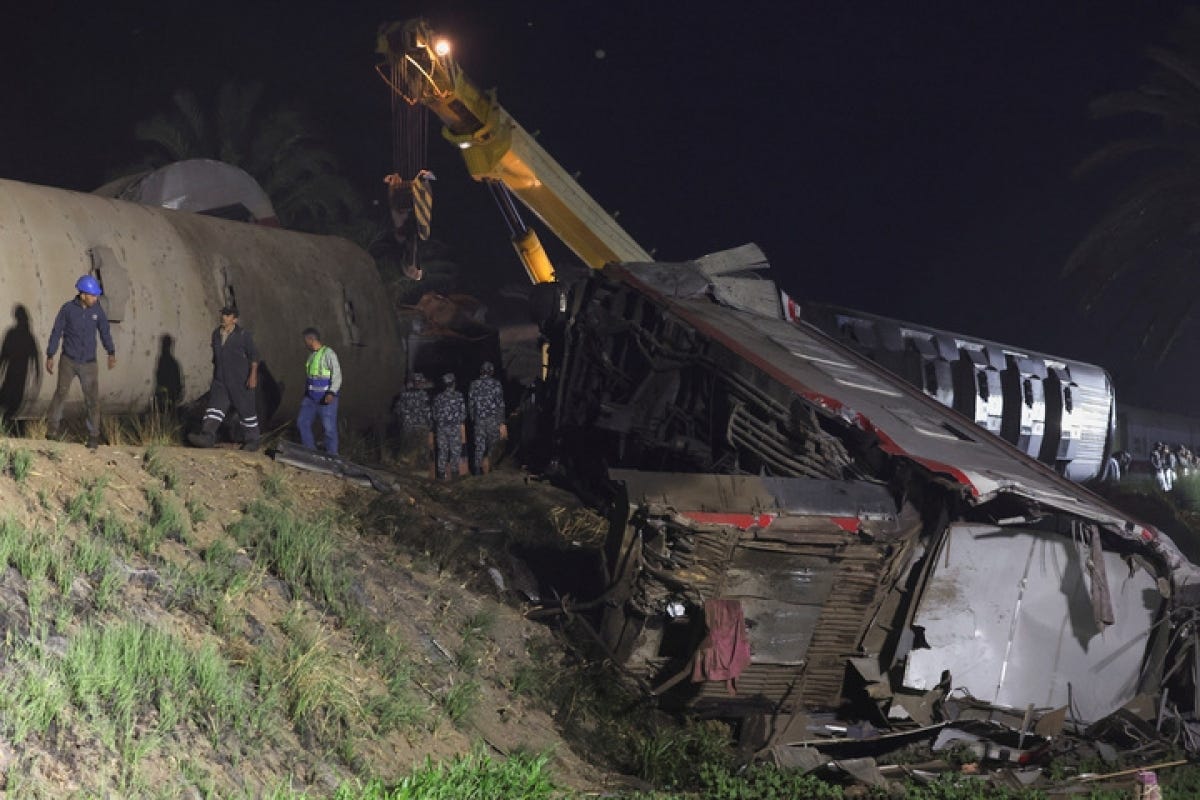
Transport Minister Lieutenant General Kamel al-Wazir said 262 railway employees had been removed over “security concerns” during a November 10 parliamentary hearing, where he also acknowledged that some signal tower staff worked 24 hours continuously.
The hearing followed the fatal Al-Ayyat collision that killed seven passengers and injured 124, ultimately ending with the detention of two railway workers and the mass layoffs, without any accountability faced by al-Wazir, despite resignation demands.
As usual, arms of the state were quick to throw around conspiracy theories to defend the minister, including an unnamed railway official who subsequently said security agencies were determining workers’ “affiliations” and whether it was the reason behind the deadly collision.
The Lieutenant General’s admission about working hours is, on its own terms, a failure to enforce existing protections. A railway instruction published in January already prohibited 24-hour shifts, prescribing eight hours’ work followed by 16 hours’ rest, with 12-hour shifts permitted exceptionally.
Deeper gas cuts force fertilizer plants to reorganize production
Update: One of the largest producers of nitrogen fertilizers in Egypt and the Middle East, Abu Qir Fertilizers announced that it’s concentrating production in two plants and rescheduling maintenance after its gas supply reduction increased from 20% to 33%.
As for the country’s largest nitrogen fertilizer manufacturer, Mopco, it confirmed a 33% reduction.
The disclosures advance last week’s account of restrictions on industrial gas: the deeper rationing is now changing how factories organize production.
The government’s effort to save foreign currency is constraining an industry that earns it. An unnamed Cabinet source told Al Manassa’s Mohamed Ibrahim that industrial gas restrictions would save approximately 500 million US dollars (around 26.7 billion Egyptian pounds) monthly over a couple of months.
Fertilizer exports generated about 2.53 billion dollars in January–September, according to export council figures, while industry insiders warned that reduced production would pressure export commitments.
The projected import saving therefore leaves a wider calculation unresolved: how much export revenue will be lost as factories receive less gas?
Parliament renews challenge to temporary contracts & reprisals against workers
MP Amal Asfour challenged the repeated use of fixed-term contracts for continuing jobs, warning that “workers risk dismissal or non-renewal” after demanding their rights.
Her request to the prime minister and labor minister concerns complaints about below-minimum wages, unequal treatment within companies and slow responses from labor directorates. She said limited employment alternatives “force workers to accept conditions they cannot effectively negotiate.”
Asfour previously raised the issue in June, making this a renewed warning about employment practices that leave workers’ livelihoods dependent on successive renewal decisions.
In Egypt’s labor law, Article 87 permits fixed terms where the nature of the work warrants them, while allowing agreed renewals. Article 88 treats continued employment after expiry as indefinite when there is no written agreement. Article 165 expressly identifies complaints and lawsuits as unlawful reasons for terminating indefinite contracts.

During the law’s drafting, the Center for Trade Union and Workers Services (CTUWS) warned that repeated temporary contracts for permanent work would weaken workers’ ability to complain, because employers could end their employment under the heading of non-renewal.
However, labor directorates already have a means of examining that pattern. Ministerial Decree No. 214 of 2025 requires employers to document renewals and report non-renewals or terminations within 15 days, alongside contract information covering wages, occupations and duration. In theory, those records would allow inspectors to trace repeated renewals and examine whether separations follow complaints.
Asfour subsequently called for regular inspections without waiting for workers to complain.
Former employers’ insurance records obstruct workers’ jobs & treatment
Private sector workers are losing job opportunities and facing obstacles to treatment because their social insurance records still list former employers, the Egyptian Center for Economic and Social Rights (ECESR) said on November 12.
The center’s legal unit examined complaints from workers unable to end their active registration, including cases where officials rejected requests despite documented evidence that employment had ended.
ECESR identified administrative and digital failures, refusals linked to employers’ contribution debts, and dependence on employers’ approval during labor disputes. Continued registration prevents workers from obtaining proof that they are no longer employed.
In one case, it said, a person with Crohn’s disease had been unable since March to obtain that proof to access monthly treatment costing more than 35,000 pounds.
The center urged the National Organization for Social Insurance (NOSI) to end registration upon evidence of departure, independently of employers’ signatures or debts, and establish a 48-hour route for treatment and pension cases.
Press crackdown escalates
Update: A Cairo court has postponed the first hearing in the retrial of Lina Attalah, editor-in-chief of critical outlet Mada Masr, until November 18, to consider the defence’s grounds for requesting the recusal of the court.
The case, registered under No. 3219 of 2024, concerns charges of publishing false news and operating a website without a licence. Attalah was unaware of an earlier in-absentia ruling sentencing her to one year in prison.
The case was referred to trial and the ruling issued without notifying Attalah or the Egyptian Journalists Syndicate for more than two years, according to the Egyptian Initiative for Personal Rights (EIPR).
Attalah only learned of the ruling on October 27, while being detained pending payment of a separate three million pound fine imposed by the New Cairo Misdemeanour Court in a case involving the “operation of an unlicensed website”.
That separate case also resulted in an order to shut down Mada Masr. The outlet’s appeal against the ruling is scheduled to be heard by the Misdemeanour Appeals Court on November 25.
Prison Watch: More renewals
Update: Egyptian prosecutors and courts have ordered renewed detention terms for journalists, activists and other defendants in several cases involving allegations of terrorism and publishing false news.
The Supreme State Security Prosecution renewed the pretrial detention of six journalists from fact-checking platform Matsda’esh for 15 days in case No. 8083 of 2026. The journalists, detained “officially” since October 4—following days of forced disappearance where they were subjected to torture, according to the EIPR, their legal defense team—face charges of joining and financing a terrorist organization and publishing false news.
In a separate case, Cairo Appeals Prosecution ordered the release of Aida Seif al-Dawla, co-founder of the El Nadeem Center for the Rehabilitation of Victims of Violence and Torture, on bail of 50,000 pounds. She faced accusations of broadcasting and publishing false news inside and outside Egypt and using an online account in case No. 30 of 2026, according to her lawyer, Haitham Mohamadein.
Meanwhile, the Cairo Criminal Court’s terrorism circuit renewed the detention of Romany Gharib for 45 days in case No. 4832 of 2026, despite his failure to appear before the reviewing judge because of communication problems between the court and the prison during a scheduled video-conference hearing, per the ECRF.
Gharib faces charges of joining a terrorist organization and publishing false news. He was arrested after posting a Facebook video in which he accused an airport officer of forcing him to transport someone against his will, confiscating his driving licence and obstructing his departure.
The Cairo Criminal Court also renewed the detention of al-Dostour journalist Haidar Kandil and five other defendants for 45 days in case No. 5635 of 2026, known as the “Shia case”. The defendants face accusations of joining and financing a terrorist organization.
The hearing, held in the court’s consultation chamber at Badr Court Complex, was their first before the criminal court. Prosecutors have previously ordered the release of 30 defendants in the same case, including 10 people of five different nationalities in September.
Separately, Sherif Wagih Fahmy was brought before prosecutors on October 9 in case No. 26308 of 2026, four days after he was arrested from his home in Alexandria, per the EIPR. According to his family’s account, two men in civilian clothes posed as gas company employees before taking him away on October 5.
Although the arrest report stated that he had been detained in the street on October 9, the EIPR reported that Fahmy told prosecutors he had been arrested at home four days earlier.
During questioning, he was asked about his personal religious beliefs and level of religious observance. He faces a case linked to his expression of religious views online.
Power plant workers stage sit-in over pay and conditions
Workers at the 2,250-megawatt Nubaria power station protested the suspension of performance bonuses, unpaid allowances and staff shortages on November 12, prompting warnings that deteriorating working conditions are threatening workers’ safety and the stability of electricity generation, according to the Egyptian Commission for Rights and Freedoms (ECRF).
The Nubaria Combined Cycle Power Plant, located in Beheira in northern Egypt, has an installed capacity of approximately 2,250 megawatts, making it one of the country’s major electricity generation facilities.
The gas-fired plant comprises three 750-megawatt units and uses combined-cycle technology, which combines gas and steam turbines to improve electricity generation efficiency. It is operated by Middle Delta Electricity Production Company, part of the state-owned Egyptian Electricity Holding Company.
According to workers’ testimonies documented by the ECRF, the protest began as a peaceful gathering inside the station before developing into a sit-in. It ended with an agreement to select seven representatives to meet the chairman of the Egyptian Electricity Holding Company and present their demands.
The commission said, however, that ending the protest did not resolve the underlying problems.
The protest is an expression of labor concerns across Egypt’s electricity generation companies, including low salaries, shortages of technical staff and growing workloads for employees who remain at operational facilities.
The dispute began after the holding company introduced a new performance incentive calculated according to employees’ professional grades and responsibilities. The bonus was paid between September 30 and October 10, before being suspended the following month without prior notification or negotiations with workers, according to the commission.
Workers told the ECRF that the alternative financial improvements offered included increasing the shift allowance from 75% to 100% and doubling the daily food allowance from 20 pounds (~0.37 dollars) to 40 pounds (~0.75 dollars)—a paltry sum by all measures. The combined increase would amount to approximately 1,500 pounds (~28 dollars) per month, less than the value of the suspended performance incentive.
This comes against the backdrop of a prolonged loss of technical personnel across Egypt’s electricity generation sector.
According to estimates provided by workers, some production facilities have lost around 70% of their technical workforce over several years, with departures exceeding 80% in certain operations and maintenance departments.
Security sector update

So, what?!
The New Republic insists on making workers bear the cost of its institutional failure, economic mismanagement, and deteriorating public services. Across governorates, sectors, and institutions, wages and job security are squeezed, experienced workers are discarded, and those who demand their rights face persecution.
In tandem, the journalists and activists confronting these conditions—on a very small scale even, given the nigh insurmountable weight of repression—are now facing one of the most brutal crackdowns since 2019.
The only way out is through organized class struggle.