



This issue of The Cairo Report covers factory closures, mass layoffs, and unpaid wages at factories across the country.
Meanwhile, a government spending freeze and reduced gas supplies are putting industrial production under pressure, while new data highlights women’s continued underrepresentation in management.
On the rights front, 28 pretrial detainees have been ordered released, a detained filmmaker’s wife has announced a hunger strike over medical neglect, and human rights defender Aida Seif al-Dawla faces a new prosecution summons.
Courts have also issued fresh decisions on terrorism listings, while a labor court awarded compensation in an unfair dismissal case and Mada Masr prepares to appeal a closure ruling.
Spending cuts put production under pressure
Egypt’s Cabinet approved spending cuts on November 5, including a freeze on at least 20% of remaining goods-and-services allocations and delays to public investment, as fertilizer producers reported lower gas supplies.

Kima, a major Egyptian fertilizer and chemical producer, said it had implemented a 20% reduction from the beginning of the month. As for Mopco, the country’s largest nitrogen fertilizer manufacturer said it was “adjusting production to available gas” without quantifying its own reduction.
The squeeze, however, is the result of an energy system weakened before the latest price shock. Last month the Ministry of Petroleum and Mineral Resources linked investment recovery to settling foreign arrears and described new drilling as “necessary to counter declining field output.” Greater reliance on imports then exposes domestic production to international prices: Reuters reported in July that Egypt’s gas import bill had nearly tripled for unchanged volumes in March compared with before the US–Israeli war on Iran.
The World Bank now forecasts a 32% rise in global energy prices in 2026, and fertilizer producers were already paying more for gas, with the industry minister confirming an 8.50 dollar-per-million-Btu price floor in April.
Workers are bound to bear such an “adjustment” through reduced overtime and production-linked earnings if utilization falls, while procurement freezes and project delays could reduce work for contractors and their employees. Tighter fertilizer supplies could also raise farmers’ costs and transmit pressure into food prices, which the OECD said has already been happening due to Egypt’s failing farm policies.

Unpaid Workers dismissed at deadly solar plant, ECRF says
About 250 workers employed by subcontractor Smart at the Abydos Solar II, the International Finance Corporation (IFC)-funded solar and battery storage project in Aswan, were dismissed without warning after going unpaid since August, the Egyptian Commission for Rights and Freedoms (ECRF) said on November 5.
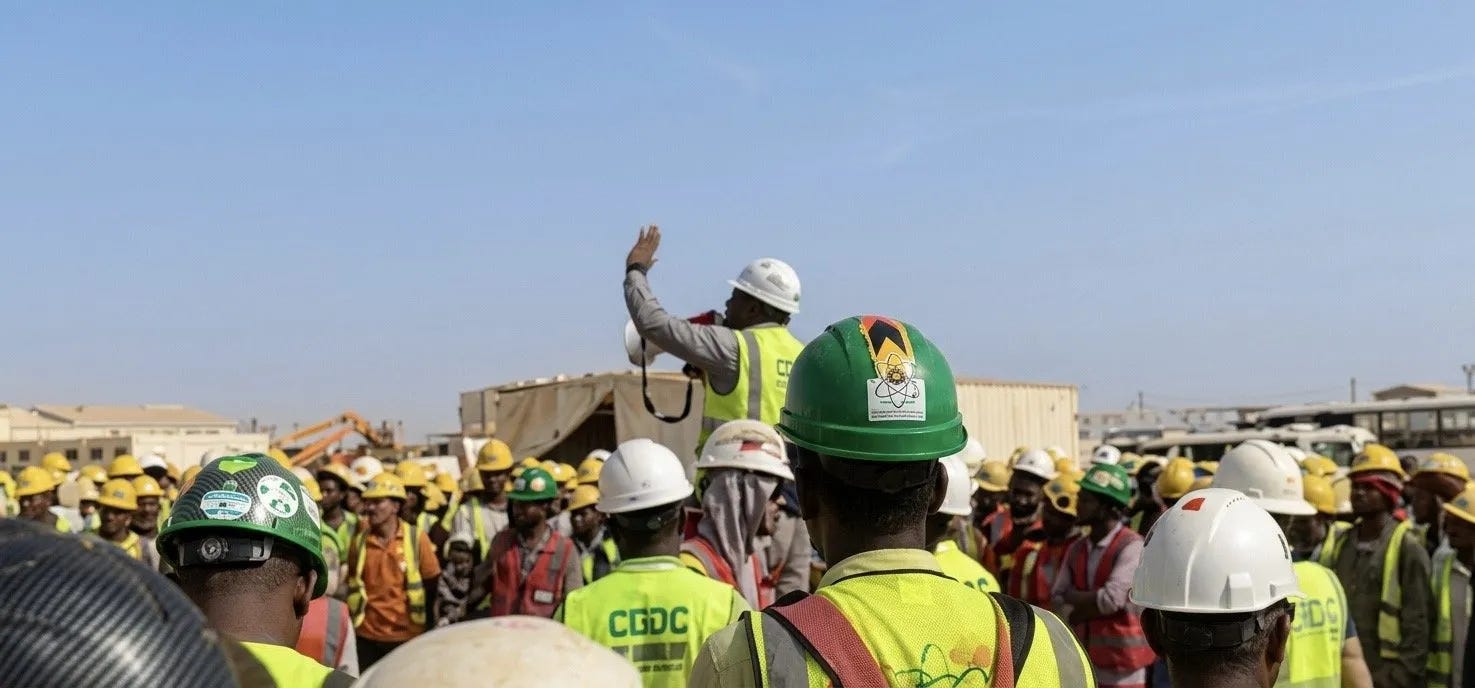
Workers told ECRF they received neither an explanation nor settlement of their outstanding wages and other entitlements. The layoffs follow an earlier statement in the same week describing unpaid daily workers, engineers and suppliers elsewhere in the subcontracting chain, alongside threats against people demanding payment. ECRF also reported that two workers were run over inside the site in June.
The plan is jointly owned by the UAE’s AMEA Power and Japan’s Kyuden International, with stakes of 60% and 40%, respectively, and occupies state-owned desert land allocated to the New and Renewable Energy Authority under a usufruct agreement, while its 25-year electricity purchase agreement carries a Finance Ministry guarantee.
IFC had led a 571.8 million US dollar financing package, including 23.1 million dollars in concessional loans intended to “reduce investment risk,” and protect the project’s financing and revenue prospects.
For workers, wages for construction already completed remain unsecured in practice.
Workers had already challenged conditions at the site months earlier.
Following a heat-related death in the summer, they protested for safer hours, adequate water, medical facilities and regular wages, which was previously covered by The Cairo Report. ECRF subsequently reported management’s reversal of the shorter hours introduced after his death.
On the employment side, IFC’s own project plan anticipates employment falling from approximately 4,000 construction workers to around 90 operational staff, and requires “departure planning, contractor monitoring and an independent labor review.”
ECRF documents widespread wage violations and insecure employment
The Egyptian Commission for Rights and Freedoms documented roughly 980 labor rights violations across 275 incidents in all 27 governorates in its first semiannual labor report, covering December 2025 to May 2026. Incidents where affected workers could be counted involved approximately 25,061 people. ECRF recorded 61 cases of minimum wage noncompliance, alongside withheld earnings, arbitrary dismissals and unsafe workplaces.
Contractual abuses formed the largest category of violations, the organization says, reflecting workers’ vulnerability to dismissal and insecure employment. The report also shows how public bodies reproduce that insecurity through subcontracting.
In Luxor’s public healthcare facilities, for example, ECRF describes security and cleaning workers facing workforce reductions, restricted access to contracts, and 12-hour shifts without corresponding compensation after changing contractors. Workers demanding redress faced dismissal threats, while the healthcare authority and contractor each denied responsibility for extending their hours.
As has become an increasingly common occurrence in Egypt’s labor issues, dividing the employment relationship allows institutions to retain the workers’ services while disputing responsibility for their conditions.
That insecurity also limits workers’ ability to challenge violations. The report recorded 37 collective protests and mobilizations, and argues that workers’ inability to absorb lost income shortened their capacity to sustain pressure, and documented direct security intervention in three protests, involving arrests, detention, threats, or forced dispersal.
Egyptian women remain underrepresented in management positions
Women held roughly 13% of managerial positions in Egypt, according to a new report by the International Labour Organization (ILO) titled ‘Women in business and management: Scaling success’, released on November 3. Their share of senior and middle management was higher, at approximately 21%, but still far below parity.
Egypt contributed 169 enterprise responses to the survey, which covered nearly 12,000 enterprises in 99 countries. Its global findings show a gap between employers’ stated commitments and their practices: 74.8% reported having an equality and diversity policy, while only 26.5% implemented initiatives, down from 37.4% in 2018. Implementation declined even for maternity support and equal pay measures that enterprises identified as “effective”.
The ILO also noted “unequal care responsibilities” and “occupational segregation” as “barriers to women’s employment and advancement”, and called for stronger childcare and elder care provision.
Alexandria garment workers protest factory closure, unpaid wages and mass layoffs
About 1,400 garment workers have been left without wages or jobs following the abrupt closure of the Baby Coca for Wears & Textiles–Hela factory in Alexandria, prompting labor organizations to accuse investors of abandoning their obligations and security forces of suppressing workers demanding their rights.
The company, established in 1994, is led by Amr Abo El Ela and his wife, MP Sherine Eleish, of the state-aligned Nation’s Future party.
The factory, located in the Abis industrial district, closed on October 30 after the reported departure of a foreign investor, leaving employees without their October salaries or clarification of their employment status, according to the Center for Trade Union and Workers Services.
The ECRF said about 1,200 Hela employees faced dismissal, while another 200 workers employed under the Baby Coca name were placed on indefinite leave.
Workers began protesting November 1, demanding payment of overdue wages, reinstatement, compensation, and settlement of social insurance contributions reportedly unpaid for up to 16 months.
The Center for Trade Union and Workers Services (CTUWS) said management offered workers the equivalent of half a month’s wages in exchange for signing temporary work suspension agreements, warning that such documents could later be used to undermine their employment rights.
The Socialist Popular Alliance Party’s (SPAP) Alexandria branch said workers had previously been assured that the factory would continue operating after rumors of the foreign investor’s departure emerged in August. The party also said that workers’ actual wages fell below the legal minimum because of deductions under transportation allowances and miscellaneous expenses.
The protests were met with a security crackdown. The ECRF documented testimonies of forced searches and assaults against female workers. The SPAP also stated that workers were detained inside the factory, IDs were confiscated, access to food and water was restricted, and armored vehicles surrounded the premises.
The dispute has also raised questions about corporate accountability, as workers employed under the Hela and Baby Coca names face uncertainty over which entities are responsible for their contracts, wages and insurance contributions.
The ECRF called for disclosure of Eleish’s current relationship with the company and clarification of any responsibility for the factory’s decisions.
The SPAP demanded immediate payment of October salaries, compensation for arbitrary dismissal, settlement of insurance arrears and legal protection of factory assets, estimated by the party at 150 million pounds, to secure workers’ outstanding claims.
The party also proposed allowing workers to operate the factory themselves under state supervision if investors and management continue to abandon their responsibilities.
Worker wins 200,000-pound compensation in unfair dismissal case against charity
A South Cairo labor court has ordered the Jannat Al-Kholoud Association—a charity organization “dedicated to community development and shifting families from dependency to sustainable productivity”—to pay 200,000 pounds in compensation to a former projects manager for unfair dismissal, in addition to outstanding employment entitlements and 4% legal interest, the Egyptian Center for Economic and Social Rights (ECESR) stated on November 5.
The ruling, issued on October 26 in Case No. 417 of 2026, also requires the association to pay compensation in lieu of notice, unused annual leave and unpaid wages.
The employee joined the association as a projects manager in December 2024. He subsequently signed a fixed-term contract running from March 1, 2025, through February 28, 2026, with a monthly salary of 30,000 pounds.
According to the case documents, the association notified him by email on October 29, 2025, that his employment had been terminated, without providing clear reasons. When he attempted to return to work on November 2, he was denied entry to the workplace.
After unsuccessful attempts to resolve the dispute directly with management, the employee filed a complaint through Egypt’s Cabinet complaints system on November 10, 2025. He subsequently filed the lawsuit seeking compensation for unfair dismissal and payment of his outstanding employment entitlements.
Press crackdown escalates
Update: A Cairo appeals court has scheduled November 25 to hear an appeal by critical news outlet Mada Masr against a ruling imposing a fine, closure and confiscation measures against its editor-in-chief, Lina Attalah, according to the outlet.
The initial ruling was issued October 27, per Hassan al-Azhari, a lawyer representing the publication.
He said appeals against initial misdemeanor judgments suspend their enforcement until the appeal is considered under Egyptian law.
The November 25 hearing will determine the next stage in the legal challenge to the ruling against Attalah and the publication.
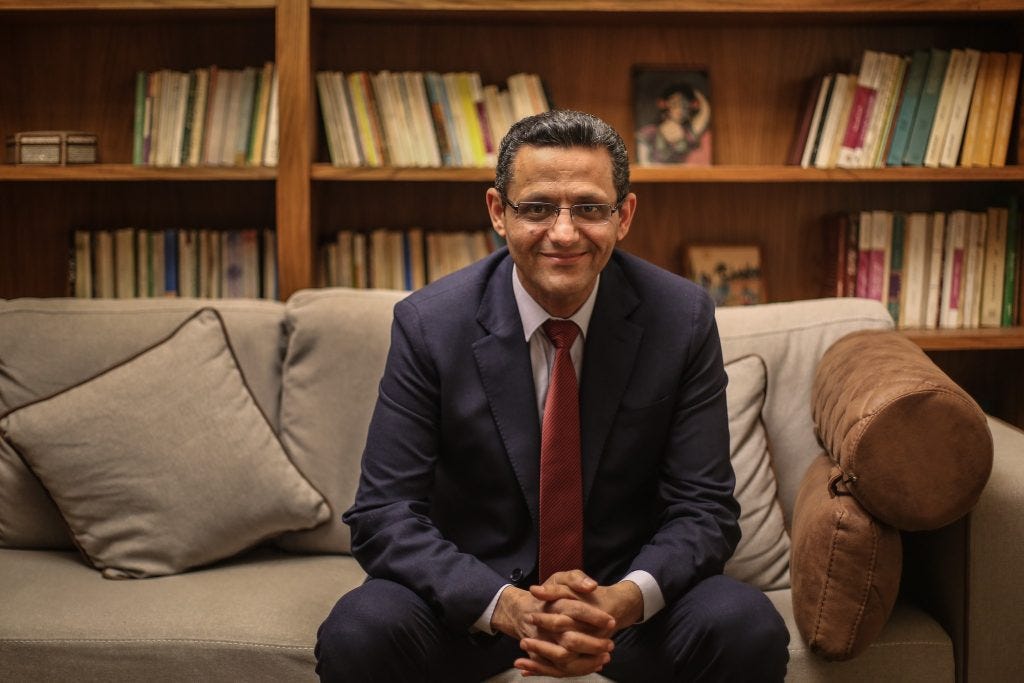
Mohamed Anwar Sadat, vice president of the National Council for Human Rights (NCHR), told Al Manassa’s Mona Mohamed that the council was contacting several authorities, including the prosecutor general’s office, over the crackdown.
The council reportedly held a joint meeting on November 4 with representatives of the Journalists Syndicate to discuss press freedom concerns, including unresolved licensing applications by news websites, detained journalists, blocked publications, and legislation affecting journalistic work.
Sadat said the council had also raised the licensing issue with Khaled Abdel Aziz, head of the Supreme Council for Media Regulation, during a meeting earlier in the week.
Journalists Syndicate President Khaled Elbalshy told Mohamed that licensing difficulties were a central issue at the meeting and that the syndicate called for transparent procedures, proper notification of missing documents, and a mechanism allowing applicants to submit and follow up on licensing paperwork directly.
Prison Watch: Terrorist designations and partial hunger strikes
Egypt’s State Security Prosecution has ordered the release of 28 people held in pretrial detention, lawyer Khaled Ali announced.
In a separate development, Nora El-Sayed, the wife of detained filmmaker and screenwriter Omar Salah Marei announced a three-day partial hunger strike beginning on November 8 to protest medical neglect and restrictions on her husband’s access to books and personal writings.
Marei is approaching his sixth month in pretrial detention in connection with case No. 3383 of 2026, involving the Supreme State Security Prosecution for criticizing the filmmaking industry.
His wife said he suffers from a swelling and persistent pain in his hand but has not been allowed to access his medical scans or obtain clear information about his condition. She also said he received thyroid test results verbally without being given access to the reports.
According to her statement, Marei voluntarily stopped taking his medication a week ago amid uncertainty over his medical condition. She added that prison authorities confiscated his books, manuscripts, papers, and creative work, preventing him from reading and writing.
Meanwhile, prominent psychiatrist and co-founder of the El Nadeem Center for the Rehabilitation of Victims of Violence and Torture, Aida Seif al-Dawla, has been summoned to appear before the Cairo Appeals Prosecution in Rehab on November 9 in case No. 30 of 2026, marking her second summons this year.
Seif al-Dawla previously appeared before the Supreme State Security Prosecution on Feb. 15 in case No. 809 of 2026, where she faced an accusation of spreading false news. She was released on bail of 100,000 pounds, according to the center.
Separately, Egypt’s Official Gazette published decisions extending the designation of the Muslim Brotherhood as a terrorist organization for another five years, alongside the extension of terrorism-listing decisions against 14 individuals.
In a separate decision published in the Official Gazette on October 1, Cairo Criminal Court’s second circuit ordered the removal of three individuals—Yara Yehia Abu al-Hassan Farag, Medhat Abu Bakr Mahgoub Awad, and Ragih Ahmed Mohamed Soliman—from both the terrorist entities and terrorist individuals lists, with all resulting legal consequences.
That decision, dated September 26, was issued following a request by the deputy attorney general in case No. 620 of 2018 before the Supreme State Security Prosecution.
The developments come amid continuing scrutiny of Egypt’s use of pretrial detention, national security investigations and restrictions affecting human rights defenders, journalists and independent civil society organizations.
Security sector update

So, what?!
It seems that every week, we arrive at the same conclusion.
The New Republic is built on the downward transfer of the costs of economic failure, corporate decisions and state policy: onto workers, ordinary citizens and those with the least power to resist. All the while, the state and capital retain the upper hand.
The state seems hellbent on tightening the noose, crushing every pocket of resistance that emerges, whether it is a workers’ protest, a human rights defender refusing to abandon their work, or a journalist insisting on the right to report, question and hold power to account.
And yes, every victory matters. There is something to celebrate in securing justice through the courts, in seeing a worker win compensation for an unlawful dismissal, or in seeing detainees (who should have never been imprisoned) finally walk free. But these remain individual victories, and, at times like these, they also serve as a measure of just how bleak things have become.
That an award of 200,000 pounds, a paltry sum against the scale of what workers are owed, can bring such a gust of joy says as much about the conditions we live under as it does about the victory itself.
We should celebrate these victories without mistaking them for structural change.
But we take comfort in knowing that there is a way out through the independent organization of the working class, and it begins with forging solidarity across workplaces and sectors, and connecting immediate economic struggles to the wider struggle against capitalist exploitation.
The worker locked out of a garment factory, the laborer denied wages at a billion-dollar energy project, the journalist facing prosecution and the human rights defender under investigation are all confronting different expressions of the same concentration of economic and political power.
The task, always, is to turn scattered resistance into organized class struggle, defensive battles into a sustained offensive for workers’ political and economic rights, and individual grievances into collective demands—and that is precisely why we practice socialist journalism, why this labor dispatch is the bedrock of our publication.
Our way out is organization, solidarity, and collective struggle from below.