


This issue of The Cairo Report covers the government’s transfer of ownership of textile factory land despite protests by Tanta workers; the cabinet’s plan to deal with “surplus” workers; pharmacists’ renewed push for elections to end the seven-year judicial guardianship imposed on their syndicate; and petroleum sector workers’ campaign for direct employment contracts.
We also examine escalating tensions in the electricity sector, where dozens of trade union representatives have resigned from union councils over pay and working conditions; former Alexandria Tram workers’ strike over unsafe conditions and the lack of health insurance; El-Gomhoriya Street residents facing a threat of expropriation; and renewed clashes between security forces and residents of Warraq Island.
Government transfers textile land ownership after Tanta workers contest move
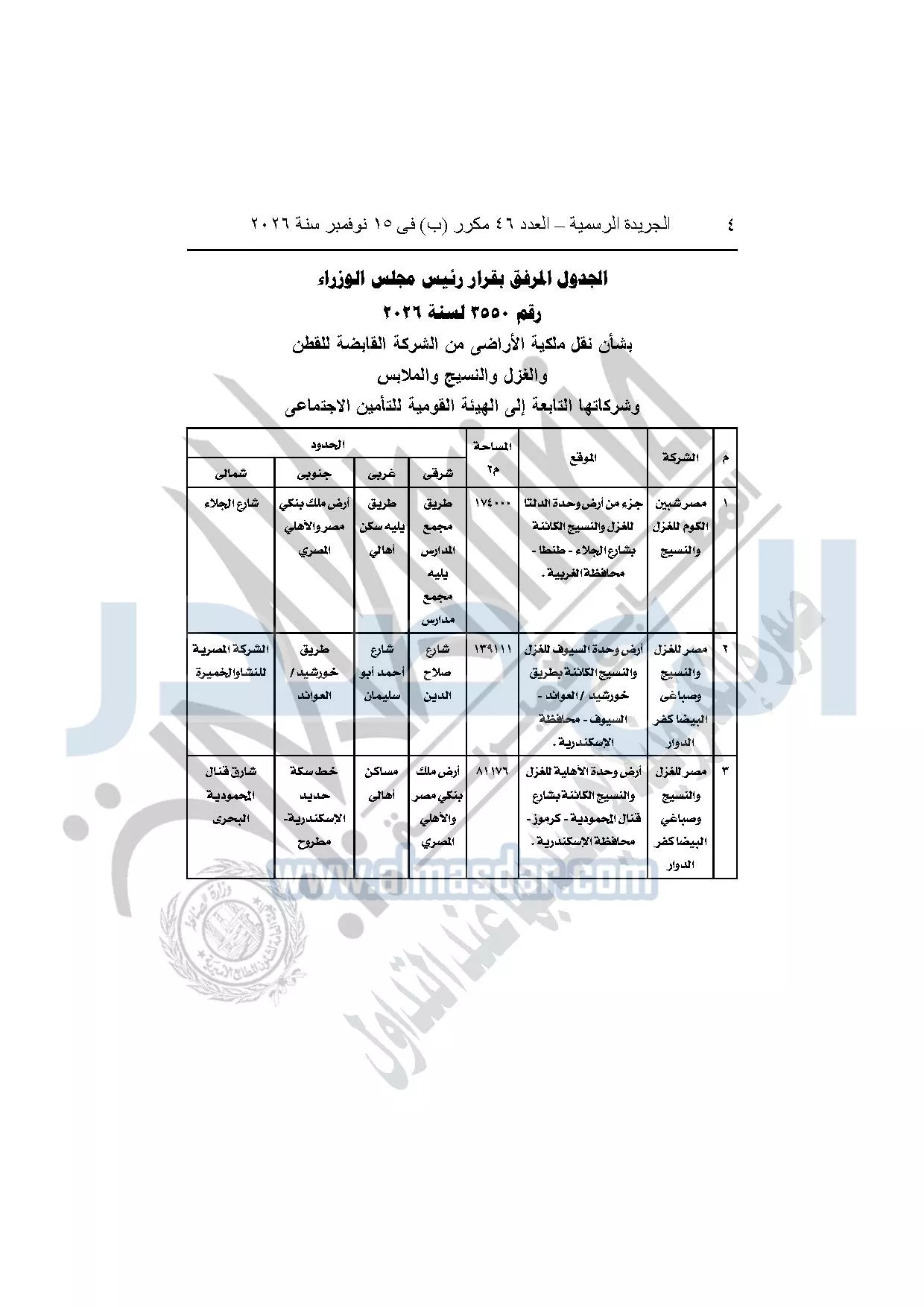
Update: The government has ordered the transfer of part of Delta Spinning and Weaving textile mill in Tanta to the National Social Insurance Authority (NOSI), two months after workers protested plans to move them to another factory. The decree, published in the official gazette on November 15, covers 174,000 square meters at the Delta mill in Tanta and two other mill sites in Alexandria, a total of 394,287 square meters.
The state textile holding company and the authority agreed in 2023 to use company property to settle debt and earn returns for pensioners. The decree, however, identifies the land but gives no valuation or figure for how much debt the transfer will settle.
In September, workers protested an order transferring some 850 employees and demanded that their pay and benefits continue through retirement, but management had proceeded without negotiating with workers or their representatives.
Workers also said they were being transferred to mills that lacked both the space to absorb the full workforce and jobs matching their trades, putting the production-linked portion of their wages at risk.
The Tanta mill was shut down and transfers went ahead anyway.
Cabinet draws up plan for workers deemed surplus at state companies
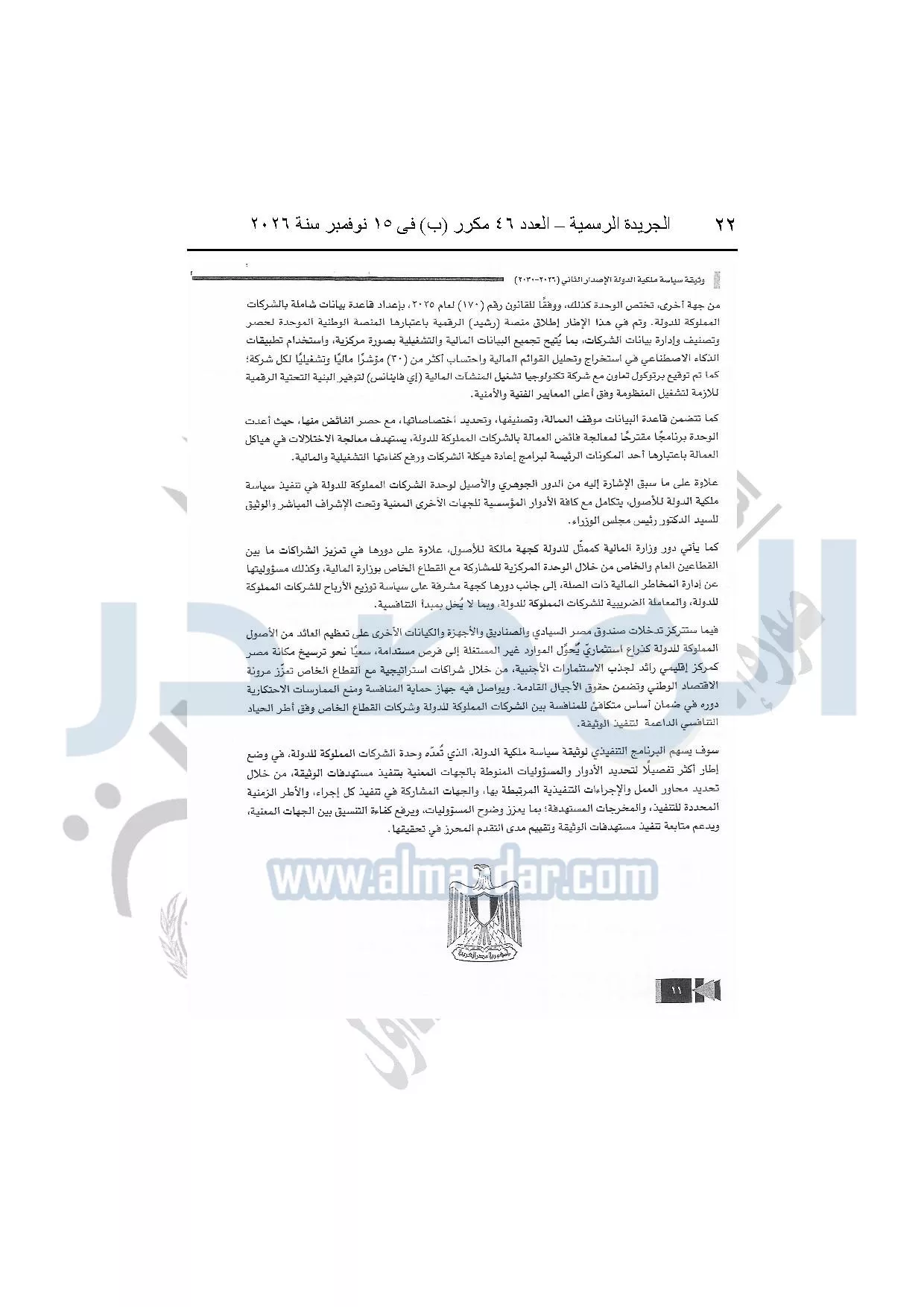
Egypt’s State-Owned Companies Unit has drawn up a program for workers it classifies as “surplus”, according to the 2026–30 State Ownership Policy officially adopted last week after persistent pressure from the International Monetary Fund (IMF).
A previous consultation draft described how the unit would identify those workers and the published policy says the unit now records staffing and skills in a central database and has prepared a proposal. Law 170 of 2025 gives the unit that responsibility when the state plans to sell its stake or bring in more private capital, but requires a separate decision from the prime minister, with Cabinet approval, and says the measures “must be financed without drawing on the general state budget,” without any obligations for redeployment, re-employment, retraining, or compensation.
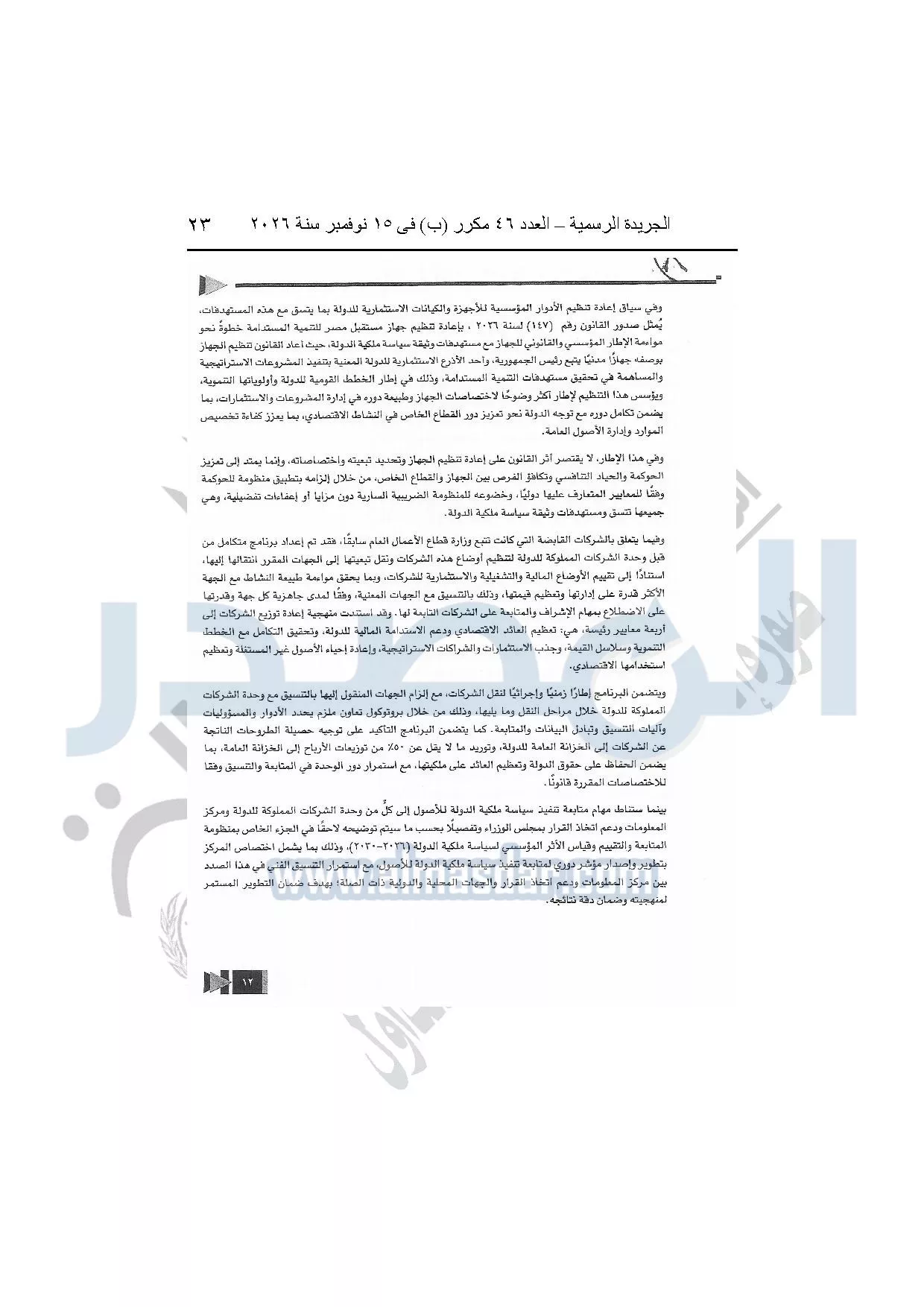
The government is already reorganizing the companies that reported to the now-abolished Public Business Sector Ministry. In September, the Cabinet discussed reassigning six holding companies, and on November 6, unit chief Hashem El-Sayed said four would move to the Sovereign Fund of Egypt, covering textiles, pharmaceuticals, tourism and construction.
The Finance Ministry’s October report records how much the sector had already changed. Employment across the companies it tracks fell from 152,397 in 2020/21 to 98,096 in 2024/25, as the number of state-owned subsidiaries dropped from 79 to 63 through changes that included mergers, liquidations and transfers out of the portfolio.
The ownership policy directs proceeds from share offerings and at least half of the dividends distributed by companies in the transfer program to the Treasury. Workers’ protections come from separate rules, particularly Article 11 of the labor law, which ostensibly keeps employment contracts in force through a sale or merger. However, where a workplace covered by the law scales back and no collective agreement sets the criteria for layoffs, a December 2025 decree requires employers to “consult the relevant union, where one exists, for at least seven working days” before implementing the cuts.
That arrangement is clearly weighted more in favor of capital and employers than workers, since consultation takes place only after the decision to cut back has already been made. Moreover, if consultations do even take place with the “relevant union,” they will likely be with the state-backed Egyptian Trade Union Federation (ETUF), which exists only to discipline workers.

The Ministry of Labor continues to refuse and delay paperwork for independent union committees, and despite constitutional provisions and laws that technically allow the formation of independent unions, administrative bodies frequently deploy State Council advisory opinions to halt their activities.
These advisory opinions argue that establishing an independent union is illegal if it exists in parallel with an “official” union affiliated with ETUF.
In the 2026 ‘Global Rights Index’, the International Trade Union Confederation (ITUC) has designated Egypt as among the worst in the world for working people, assigning the country a rating of five under the “no guarantee of rights” category.

Pharmacists renew push for elections after seven years under court control
A group of Egyptian pharmacists has called on November 17 for members to gather at the national syndicate in Cairo on December 17 to sign a petition for an extraordinary general assembly. The organizers want the assembly to press for an end to court-appointed guardianship and elections for a new council. They are also seeking the syndicate’s accounts and state audit reports for seven fiscal years, from 2019/20 through 2025/26.
Cairo’s court of urgent matters disbanded the elected council in February 2019 after a split in the leadership produced rival assemblies and a dispute over control of the syndicate, and appointed a guardian to run it pending elections. An administrative court initially suspended the ruling, citing the constitutional ban on placing professional syndicates under guardianship, and that disputes over enforcing the order belonged in the ordinary courts.
The syndicate’s founding law allows 200 eligible members to request an extraordinary assembly. In 2023, pharmacists collected 294 signatures, but the urgent matters court upheld the guardian’s cancellation on procedural grounds a day before the meeting.
The union of medical syndicates voted in July to back legal action to end the guardianship, and on November 15, Al Mal reported that a disciplinary panel had reprimanded the court-appointed guardian, Mohamed Fekry Ibrahim, for “exceeding his authority” by “authorizing payments to syndicate staff and to himself.”
Ibrahim challenged the ruling, the newspaper said.
Petroleum workers press for direct contracts
Workers hired through subcontractors in Egypt’s petroleum sector are renewing calls for the companies where they work to hire them directly, urging Petroleum Minister Karim Badawi to end the arrangement.
However, the issue of subcontracting is endemic in Egypt’s labor market, with state-owned petroleum companies playing no small part in it. As previously covered by The Cairo Report, poor working conditions pushed oil rig workers in the Red Sea to go on a hunger strike in September.
In April, the ministry reported 8.2 billion Egyptian pounds in the subcontracting business at the Egyptian Petroleum Services Company (EPSCO) in 2025, up 24% from 2024, and said it achieved “remarkable growth.”
Notably, Egypt’s labor law prohibits employers from using labor supply firms, subject to provisions that allow licensed employment agencies. For workers seeking direct contracts, who holds the staffing license and who supervises their work are central to establishing which company owes them pay and benefits.
The same demand led workers at Modern Gas in Sohag and Qena to protest last year, after they complained that the subcontractor deducted money from their wages. Security forces arrested 16 workers. Their colleagues ended the strike under an agreement that secured their release on bail.
Power plant workers stage sit-in over pay and conditions
Update: In a marked escalation from the protests at the Nubaria power plant, dozens of trade union representatives within Egypt’s electricity sector have resigned from their positions on union councils in protest against the refusal of Minister of Electricity and Renewable Energy Mahmoud Esmat and the leadership of the Egyptian Electricity Holding Company (EEHC) to reinstate monthly incentives, address low wages, and resolve the issue of frozen bonuses.
Although the Nubaria protest on November 12 ended after workers agreed to appoint representatives to negotiate with the EEHC, a subsequent meeting produced no firm commitments on their main demands, according to the Egyptian Commission for Rights and Freedoms (ECRF).
Among those who resigned was Mohamed El-Sayed Ragab, head of the Middle Delta Electricity workers’ union; the EEHC company that operates the Nubaria power plant.
If anything, the resignations point toward the workers’ mounting frustration, which has extended beyond their demand to their own union representatives well ahead of the conclusion of the current union term next July.
On November 14, EEHC chairman Ahmed Mahina met the seven worker representatives. According to workers’ accounts, documented by the ECRF, he promised to announce details of proposed financial bonuses within a week, with payments to be calculated separately by each company according to its performance indicators and operating results.
No guaranteed minimum amount was announced, while the separate dispute over annual leave was referred to Essmat without a final decision.
The proposed bonuses have not at all addressed workers’ central demand for the reinstatement of a performance incentive introduced in September and suspended after just one month. The ECRF said the original incentive was calculated according to employees’ professional grades and responsibilities, while the proposed alternative would depend on operating results that workers cannot fully control, including load reductions and technical breakdowns.
It is worth noting that the worker demands extend well beyond the original, central demand, including establishing consistent wage and incentive rules across subsidiary companies, raising incentive rates from 130% to 180%, settling delayed annual increments, restoring the senior-grade promotion and incentive allowance, and introducing additional incentives for maintenance and operations staff.
They have called for new recruitment to address shortages of engineers and technicians, as well as a timetable for implementing their demands.
Additionally, the crisis has reached parliament, with MP Rawia Mokhtar of the centrist Reform and Development party submitting a parliamentary briefing request concerning the financial entitlements of operations and maintenance workers, warning that the failure to resolve their grievances could increase resignations and accelerate the departure of experienced technical personnel.
Tram workers strike over unsafe working conditions
Fifteen former Alexandria Tram workers employed by Egypt’s General Authority for Roads, Bridges and Land Transport (GARBLT) have been on strike since November 15 to protest hazardous working conditions on the desert road following an accident that injured one of their colleagues, who has faced increasing difficulties accessing treatment through the health insurance system.
The ECRF said the workers, who were transferred from Alexandria’s tram system during its development, have been assigned duties outside their professional specializations without adequate safety equipment or training.
Their tasks involve walking seven to eight kilometers daily behind road-cleaning machinery to place and remove warning cones and triangles amid heavy traffic, including trucks and trailers.
Per the testimonies documented by the ECRF, the workers were originally trained in diesel mechanics, mechanical engineering and metalworking, and had spent years working in tram maintenance workshops before being transferred to different government entities, including the GARBLT, the Egyptian National Railways (ENR), and the Alexandria Port Authority.
On November 11, the worker tripped over gravel and stones while walking behind machinery on the desert road, sustaining significant bruising to his foot.
According to his colleagues, the unit manager refused to call an ambulance, forcing them to transport him themselves to Gamal Abdel Nasser Health Insurance Hospital.
However, the hospital could not provide treatment under his health insurance or issue an official medical leave certificate because his administrative status had not been regularized following his transfer between government entities.
The ECRF also reported that the administration had previously been aware of incidents in which trailers nearly struck workers performing the same duties, but had failed to introduce adequate preventive measures, with workers operating without escort vehicles, protective barriers, or specialized safety training.
Prior to its April 2026 shutdown, the Alexandria tram network spanned 32 kilometers across 140 stations and 20 lines, requiring hundreds of drivers, conductors, ticket inspectors, depot mechanics, and electrical maintenance technicians to move roughly 80,000 daily passengers.
Many of these workers have been transferred to other government entities. Evidently, the bureaucratic machine has eroded whatever remained of these workers’ rights.
Dozens of families, businesses at risk of expropriation on El-Gomhoriya Street
In Alexandria’s El-Amria district, El-Gomhoriya Street residents were notified by the Alexandria Survey Directorate, a regional branch of the Egyptian Survey Authority (ESA), to begin compensation procedures, despite the fact that their properties are not included in the state’s 2024 expropriation decrees—Prime Minister Decree No. 1563 of 2023, Public-Benefit Decrees No. 4077 and No. 4478 of 2024, and earlier transport expropriation decisions such as Decree No. 2181 of 2021—for the high-speed electric train project.
The street is home to over 160 commercial shops and approximately 100 residential apartments, housing dozens of families and offering hundreds of jobs. Per the residents’ lawyer, Mohamed Ramadan, the notices have raised the El-Gomhoriya residents’ concerns that they could be affected by the proposed expropriation.
The residents have since appointed the Alexandria Legal Protection Office (ALP) to legally represent them, which has begun taking legal measures in preparation for filing a lawsuit challenging the procedures.
The residents have also expressed concerns about the commercial significance of their street, suggesting that its value as an important local marketplace may be a factor behind the proposed acquisition. They allege that the state may intend to establish government-owned commercial premises on the site, potentially offering them for sale or rent at high prices.
Already, Alexandria’s al-Mursi Abu al-Abbas has succumbed to such plans.

Warraq islanders reorganize against expropriation
Update: Warraq islanders have called for the immediate release of dozens of people arrested following clashes between police and residents near the Damanhour ferry crossing over the past week, while demanding a clear government commitment to their right to remain on the island.
The arrests followed tensions that erupted after the death of Hany Roshdy, a young island resident who drowned in the Nile on Monday after jumping into the river while being pursued by police.
According to Al Manassa’s Beesan Kassab, security forces arrested approximately 40 people near the ferry crossing on November 17, including around 20 Warraq islanders. A lawyer representing island residents told Kassab that around 20 detainees were referred to the Shubra al-Kheima prosecution office the following morning.
The clashes began after police withdrew from the Damanhour ferry crossing, allowing a large number of construction-material shipments to enter the island despite longstanding restrictions. The subsequent attempt by security forces to reimpose controls triggered renewed confrontations between Central Security Forces (CSF), residents, and construction-material traders.
Warraq residents stated that the situation had deteriorated after Roshdy’s death, accusing security personnel of pursuing and threatening him in a manner that led him to jump into the Nile. Residents described his death as a source of widespread anger and grief across the island.
They also questioned the timing of the temporary easing of restrictions on construction materials, suggesting that allowing shipments into the island distracted people from demanding accountability for Roshdy’s death. They said construction materials had been restricted from entering the island for approximately nine years.
The residents condemned violence and called on authorities to exercise restraint, release those detained without involvement in the clashes, and avoid further escalation. It also urged island residents to refrain from internal disputes and maintain unity.
Warraq residents emphasized that their primary demand remains unchanged: to stay on their land and homes. They warned that further escalation could undermine their efforts and called on the government to replace unfulfilled promises with clear and decisive decisions guaranteeing their continued presence on the island.
They also announced plans to organize a community conference aimed at preventing further tensions, unifying residents, and reaffirming their commitment to peaceful action.
Prison Watch
Egyptian human rights organizations have raised concerns over prolonged detention, enforced disappearance, and prosecutions linked to religious beliefs and freedom of expression.
Writer and novelist Peter Tawfik Kamal has had his pretrial detention renewed for 45 days by the Minya Criminal Court over charges including contempt of religion and organizing a group allegedly promoting atheism. The ECRF warned of his deteriorating health, reporting inadequate medical care and restrictions on food, medication, books, and other basic necessities.
Meanwhile, Abdullah Ramadan, 30, was ordered detained for another 15 days in a new case despite a previous court-ordered release in August. According to the Egyptian Initiative for Personal Rights (EIPR), this is his sixth case over 11 years of detention. The organization says he was taken to an undisclosed location after his release order and remained missing until appearing before prosecutors in November.
In a separate development, Egypt’s Court of Cassation upheld Augustinos Samaan’s five-year prison sentence for contempt of religion under Article 98(f) of the Penal Code. EIPR criticized the proceedings, citing alleged violations of fair trial guarantees, including the failure to notify his lawyers of his referral to trial. The EIPR stated that it has documented at least 113 people prosecuted since early 2025 over atheism, non-religious beliefs, or unconventional religious views.
The EIPR has also called for an investigation into the enforced disappearance of Mohamed Naguib, who was reportedly arrested by National Security officers near Benha Bridge on July 6, 2026. More than four months later, his whereabouts remain unknown, and the organization says the investigation into his disappearance has made no progress.
State security sector

So, what?!
The fight against capitalism is one that is taking place on multiple fronts. Workers, residents, and really, everyday people, spend their days confronting The New Republic’s economic restructuring.
Daily, these people are fighting the state’s attempts at tightening the noose: from the transfer of industrial land and plans to dispose of “surplus” labor to the erosion of trade union representation, insecure employment, and the threatened expropriation of homes and shops.
Every act of resistance against this apparatus is part of a broader struggle over control of resources, the conditions of labor, and the right to shape the spaces and institutions in which people live and work.