


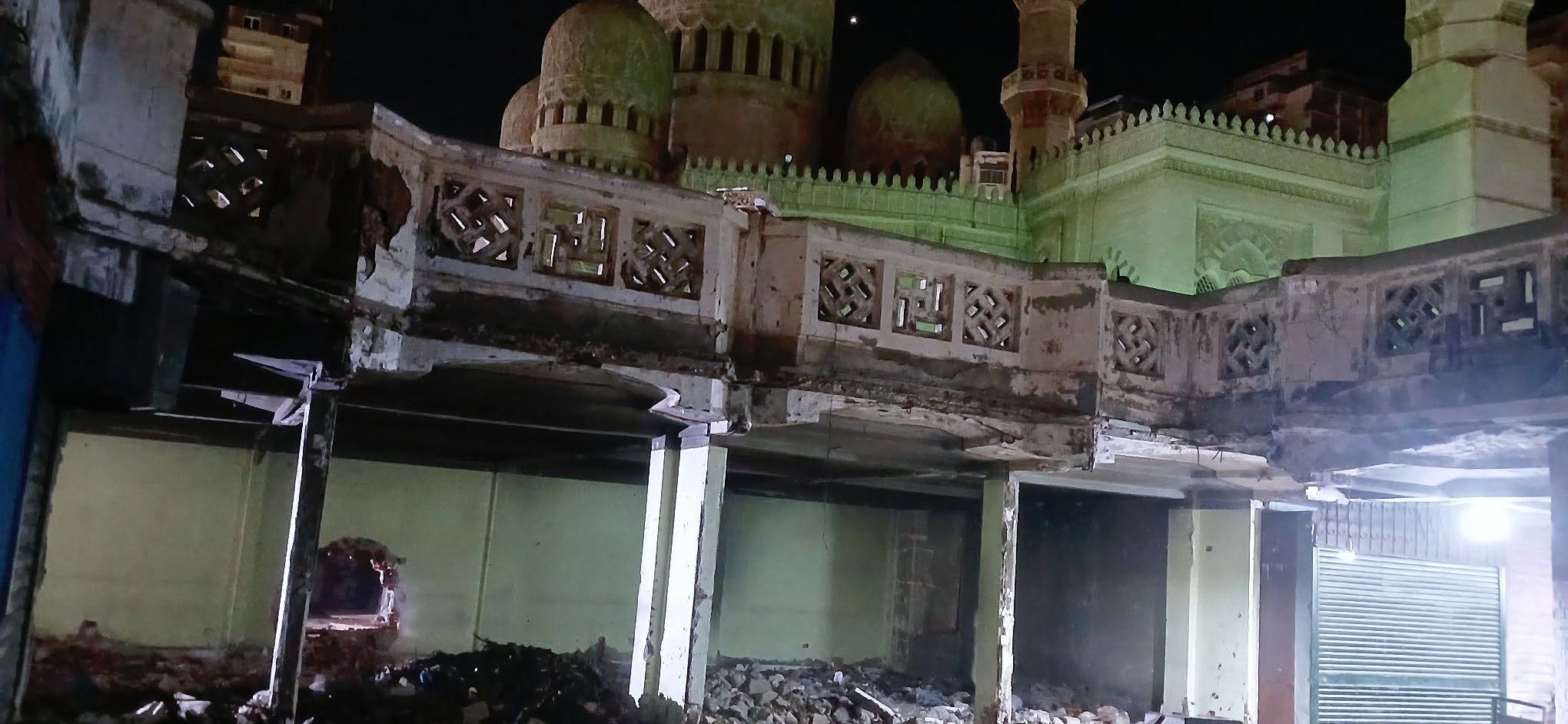
As the sun rises over the Mediterranean city of Alexandria, a group of middle-aged men, all of them former shop owners, get ready to leave their homes, trekking to a qahwa [coffeeshop] in Bahary, within walking distance of Midan El-Masajid, home to the historical mosque, mausoleum, and shrine of Sufi mystic, Abu al-Abbas al-Mursi, colloquially referred to as al-Mursi Abu al-Abbas.
It has been at least several years since most of them had shops of their own to open, ones they’d been occupying since at least the 1980s—until the governorate shuttered them.
On January 27, 2025, the Alexandria governor ordered the demolition of their shops in Midan El-Masajid, locally known as the “al-Mursi Abu al-Abbas shops,” without a court order or compensation.
Stripped of their only stream of income, the men now spend their days at the qahwa, sipping tea and chatting, in a routine that has hardened into habit.
The story of the square begins over a century earlier.
In 1919, the Municipality of Alexandria entrusted the remaking of the city to William MacLean, the prominent Scottish architect, Dr. Mohamed Adel Desouki, Assistant Professor of Architecture at the Arab Academy for Science, Technology & Maritime Transport (AASTMT), told Matsada2sh.
Two years later, in 1921, he presented what became known as the MacLean Report. Among its proposals were two new urban spaces: the Saad Zaghloul Square and what would come to be known as the al-Masajid Square.
For the area around the Sufi shrines, MacLean envisioned a broad square that would embrace the shrines within it. From this proposal came the distinctive name al-Masajid Square. Before that, the place had been known as Bab al-Bahr—the Gate of the Sea.
King Fuad I ordered the rebuilding of the Mosque of al-Mursi Abu al-Abbas and the surrounding square, entrusting the work to Italian architect Mario Rossi, who spent some sixteen years completing it before it opened to the public in 1943.
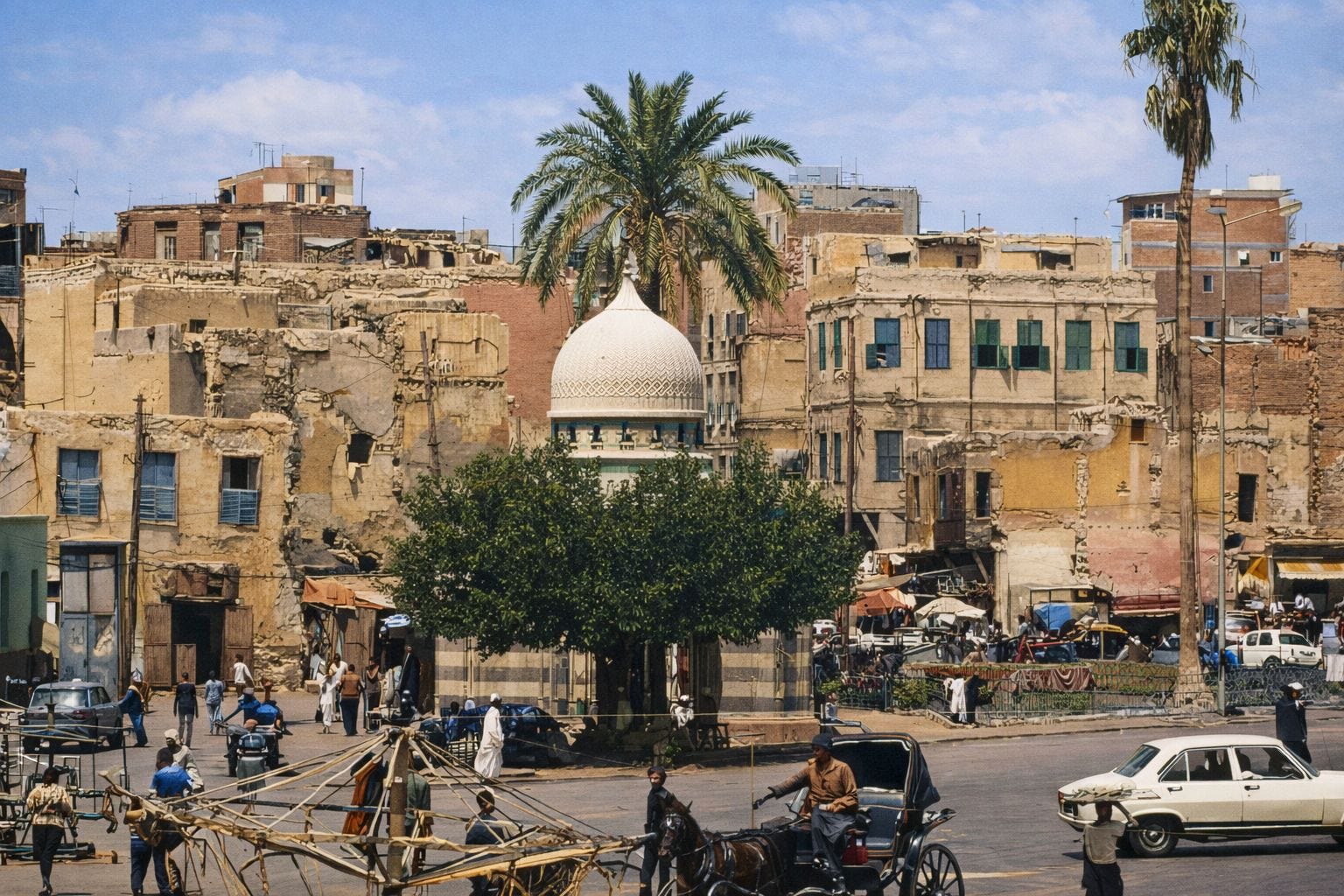
Over 30 years later, during the reign of assassinated president, Mohamed Anwar Sadat, the Alexandria governorate launched a “development project” in the al-Masajid square, demolishing several homes, including the house where prominent political activist and writer Abdullah El-Nadim hid during the Urabi Revolt, to reconfigure the space, according to Desouki.
During that period, the Alexandria Governorate decided to develop the al-Masajid Square and contracted the El-Maamoura Company for Construction and Touristic Development, established by Presidential Decree No. 2909 of 1964, to handle the project.
A state-owned joint-stock company affiliated with the Holding Company for Tourism and Hotels (HOTAC), which currently reports to the cabinet following the abolition of the Ministry of Public Business Sector, started offering ownership contracts for commercial shops to citizens in 1981.
While the land itself is historically owned by the governorate, granting and collecting payment for land use rights, El-Maamoura Company held a usufruct.
As part of the development, the company constructed at least 160 commercial shops as a planned and modern retail market, which were subsequently offered for sale to citizens, rights lawyer Mohamed Ramadan stated on Facebook.
At the time, purchasers were granted ownership contracts under which they were required to pay the purchase price of the shop structure itself, in addition to an annual fee representing the usufruct value of the underlying land paid to the governorate, he added.


For more than four decades, the 160 or so men and women who bought these shops made a life around them. They traded here, raised their children here, and, in the process, built a community that came to feed hundreds of people—their families, their workers, and the families of those workers. They occupied one of Alexandria’s oldest and most historically layered districts, a place of 26 mausoleums, each the resting place of a Sufi mystic. Over the years, their relationship with the place—and that of their children, many of whom had already inherited or taken over the shops—grew into something more intimate than commerce.
They began to call it, simply, “our place of barakah”—our blessed place.
Until March 1, 2023.
Then-Governor of Alexandria, Major General Mohamed El-Sherif, announced a 271-million-Egyptian-pound development project for the al-Masajid Square, including the shops, with a 24-month implementation period. It also terminated its contract with El-Maamoura Company for Construction and Touristic Development, according to affected shop owner Ahmed Khalifa.
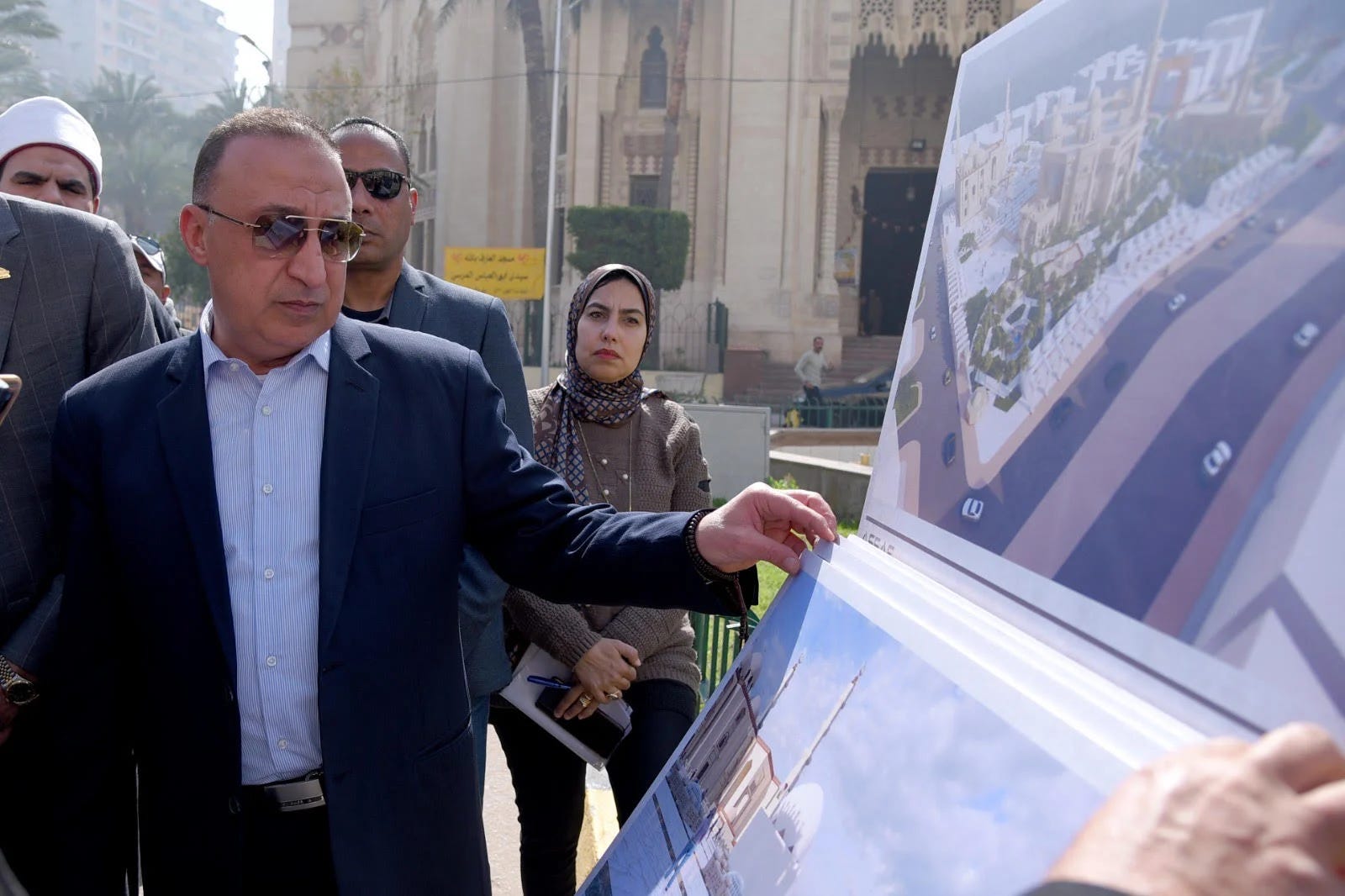
El-Sherif stated that the development project for the al-Masajid Square “aligns with Alexandria Governorate’s comprehensive development strategy and the state’s general policy of prioritizing historically significant sites,” adding that the area had not been developed since 1943, and while that is true for the mosque, it is not true for the square.
Per the statement, the project was taking place in coordination with the Ministry of Religious Endowments (Awqaf) and “other relevant authorities,” which remain unnamed.
“We spent a full year conducting comprehensive studies before starting the square’s development project, while being mindful of the square’s religious, cultural, and social value, and highlighting all its existing features,” then-deputy governor and current Beheira governor, Jacqueline Azer, said.
She said that “the consulting firm” worked on several concepts and visions until a unified vision was reached that reflects the religious, social, and cultural spirit of the square “for the benefit of all citizens,” and the consulting firm also remained unnamed.
The announcement was made in the presence of Sheikh Salama Abdel Razek, Undersecretary of the Ministry of Endowments in Alexandria, Engineer Noha Khalifa, then-Head of Al-Gomrok District, “the project consultant, and all concerned parties,” according to the statement.
The “concerned parties” did not, however, include any representatives from the shop owners, according to a shop owner, Mahmoud* (pseudonym), who spoke to The Cairo Report on condition of anonymity.
The development project would increase the number of shops and, consequently, generate more revenue for the government, Ramadan said. Although the project would reduce the space available to existing shop owners, they did not object.
However, the shop owners’ dispute with the governorate concerned not only the development but also their contractual rights to the shops and the land, per a source who spoke to journalist Beesan Kassab.
One shop owner told Kassab that, in the years preceding the launch of the development project, the governorate had created obstacles to the owners’ payment of their annual usufruct fees. As a result, most owners paid the fees into court rather than at the governorate’s offices, out of concern that accumulating unpaid installments could expose them to eviction. The source characterized the obstruction of payments as an indirect means of seeking to strip the owners of their rights to the shops and the land.
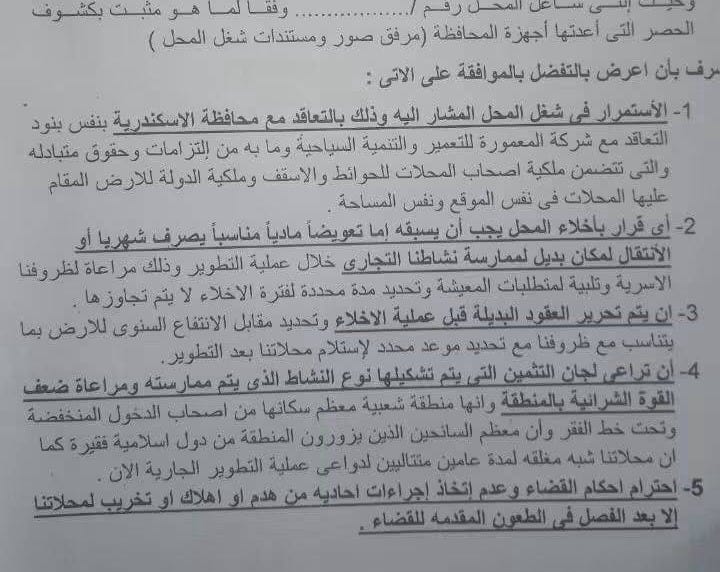
In November 2023, El-Sherif invited several representatives of the shop owners to discuss the project, and a consensus was reached. According to the meeting minutes, published by Ramadan, the shop owners would vacate their premises, while the governorate would provide temporary alternative shops in the Masr Station Square with reduced rent between 1,000–2,600 pounds until construction of the new shops was completed in six months.
The new shops would then be handed over to the original owners while a valuation expert would determine the usufruct fees for the new premises.
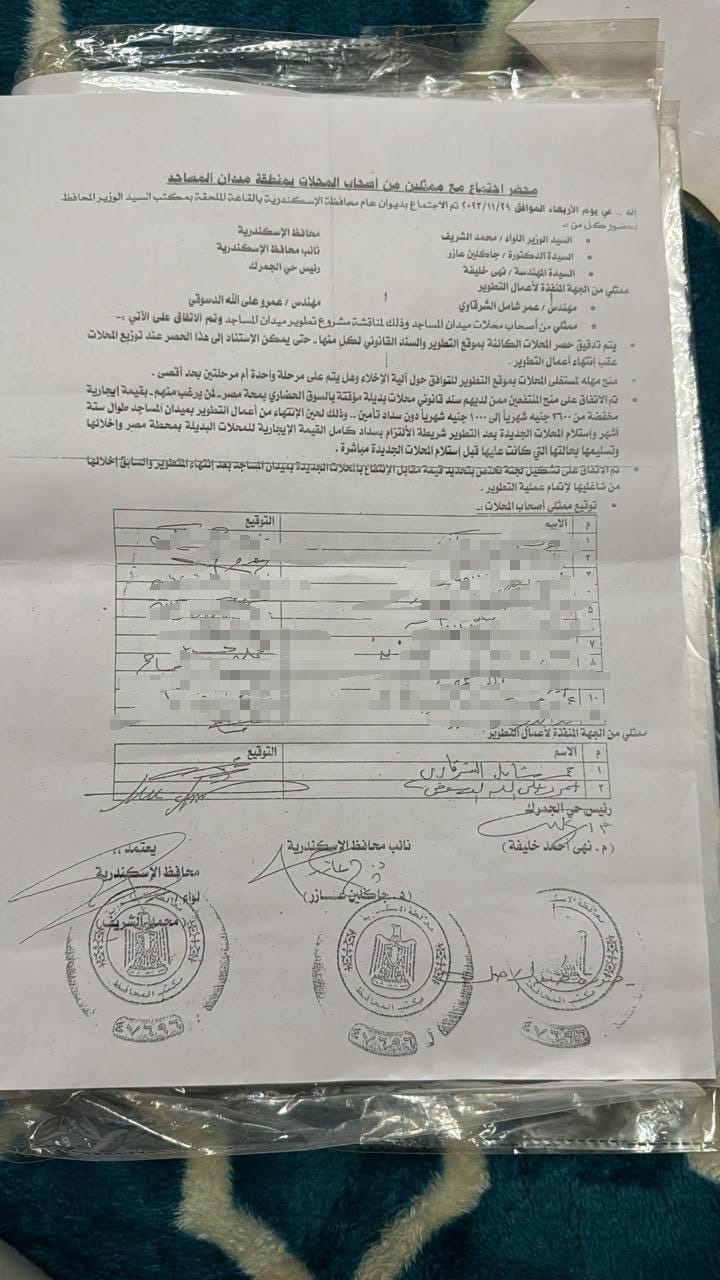
The shop owners’ understanding, according to their representatives, was therefore that the development constituted a temporary relocation rather than a termination of their existing rights.
However, in July 2024, President Abdel-Fattah El-Sisi appointed former commander of the Egyptian Navy, Lieutenant-General Ahmed Khaled, as the governor of Alexandria, replacing El-Sherif.
Approximately two months into Khaled’s tenure, the governorate sent formal notices to the shop owners stating that the contracts between them and El-Maamoura had been terminated, Kassab reported.
The notices instructed owners to settle any outstanding usufruct fees and to submit applications to continue occupying the shops while completing the necessary procedures with the governorate. Failure to do so would result in their “immediate eviction,” Ramadan told Kassab.
Under Khaled, the governorate also offered the 160 shop owners relinquishment deeds, and, initially, all 160 shop owners refused to sign, Mahmoud* told The Cairo Report. Dozens of shop owners demanded a meeting with governorate officials, and several were selected to represent the group.
Yet, Mahmoud* said that rather than engaging in a discussion, a governorate official, whom he did not name, threatened the representatives with the demolition of their shops if they “make a fuss.”
“The governor later informed us that our contracts would be terminated and that we owed outstanding dues for use of the premises,” Mahmoud* told The Cairo Report. “The amounts ranged from 900,000 pounds to 2 million pounds. We did not have that kind of money, and we certainly did not have any outstanding dues.” Owners were being asked to pay a retroactive difference in valuation, in what Mahmoud* described as “an attempt to force the owners out.”
“Khaled issued notices to the residents requiring them to vacate the shops and demanded a rental payment exceeding one million pounds as a condition for obtaining new premises,” Ramadan, a member of the shop owners’ legal defense team, wrote on Facebook. “When the residents objected and insisted on the implementation of the written agreement concluded between them and El-Sherif, he threatened to evict them by force.”
Some people had already vacated their shops, and a couple of shop owners started signing relinquishment deeds to the governorate, Mahmoud* said. Nevertheless, the majority held onto their shops and their rights, some of them going so far as to sue the governorate and the El-Maamoura Company, though efforts remained scattered.
On January 27, 2025, Khaled greenlit the first phase of the shop demolitions and bulldozed 12 of the 160.
The demolitions had no legal grounds, Ramadan told Kassab.
“The governorate demolished the shops that had been closed, their businesses having been suspended for years because of the supposed development project and because construction work carried out by the governorate had effectively shut down the market,” activist and shop owner Ahmed Khalifa wrote on Facebook at the time, adding that “all of the market’s entrances were also closed to the shop owners.”
“My family and I have a shop under a valid contract, and we have paid the governorate the annual usufruct fee for the land through 2025, as confirmed in court,” he said. “I was shocked today to discover that the governor had ordered the demolition of my shop and the rest of what they described as the ‘burned-out’ group of shops.”
“I tried to keep my composure and speak calmly amid the shouting, while shop owners were directly threatened—along with anyone trying to stand up for their rights or object to what was happening, which was being carried out without any legal justification,” Khalifa wrote.
During that time, Al-Gomrok district head, the newly appointed Mohamed Salah, informed the shop owners’ representatives that they needed to sign documents acknowledging they had received official letters to vacate their shops by February 6. Kassab reported that he promised to allow the shop owners to set up a tent to display their products until the shops were rebuilt and to establish a new contract with them, requiring payment of the reassessment value before receiving the new shops.
“However, there were no details about the new contract or any official guarantees regarding our rights to the new shops,” one of the shop owners’ representatives told Kassab.
Per the same report, two sources who attended the meeting with the district head stated that he threatened to demolish more shops during the meeting.
This came after another meeting between the representatives and then-deputy governor, Amira Salah, during which she denied them any rights, stating that the governorate was seeking to reach an agreement with them on solutions “taking into account the social dimension only.”
The deadline came and went, and the 160 shop owners did not sign the document.
Instead, they proceeded to file several police reports and lawsuits, the documents for some of which were obtained by The Cairo Report.
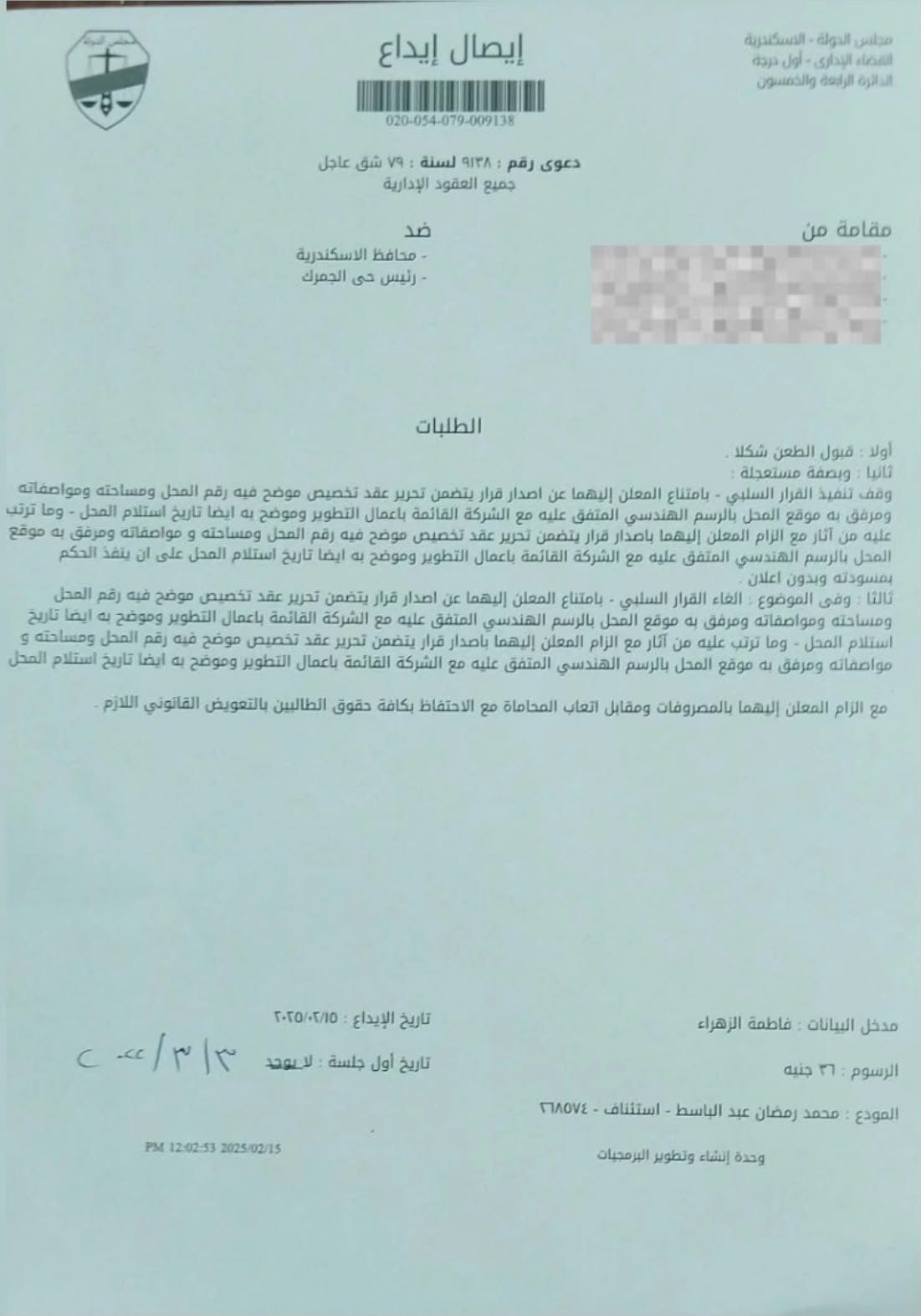
On Saturday, February 12, 2025, one of the shop owners filed a lawsuit with the State Council’s Court of Administrative Justice, Case No. 9138 for the 79th Judicial Year, against the Governor of Alexandria and the Al-Gomrok district head, seeking the issuance of a contract for a replacement shop to substitute for the one demolished, according to the lawsuit filing receipt obtained by The Cairo Report.
The lawsuit also demands that the contracts specify the replacement shop’s number, area, specifications, location, and handover date following the development’s completion.
Several shop owners filed two other lawsuits, Case No. 8895 for the 79th Judicial Year and Case No. 3753 for the 80th Judicial Year, before the Administrative Court against the Governor of Alexandria, the Al-Gomrok district head, and the El-Maamoura Company.
“We also filed a complaint for intentional property damage, but it was shelved,” Mahmoud* said.


The shop owners’ pressure worked, temporarily. While the cases were pending before the court, the retroactive difference in valuation demanded by the governorate was dropped, according to Mahmoud*.
But it was not enough to halt the demolitions. Nor did it force the governorate to adhere to its 2023 consensus with the shop owners, as they were provided with no alternative shops and no clear plan with a timeline for the project.
“Since January, we have failed to secure any legal protection for the commercial market shop owners against the thuggery of the company executing the so-called Abu al-Abbas Square Development Project,” Khalifa wrote on Facebook on July 29, 2025, which was simply signed “the Mursi Abu al-Abbas shop owners.”
“Lawsuits have been filed with the State Council challenging their actions, and police reports have been filed accusing the district head of willful destruction of property,” he added. “We tried to arrange for people to guard our shops at night, as the remaining open shops are at risk of theft and vandalism.”
“Their policy is to impose a fait accompli on people who are neither street vendors nor thugs—just ordinary, struggling individuals trying to protect their livelihoods, to which they have a legal right and the documentation to prove it,” Khalifa wrote.
Over the course of those eight months, the development company contracted to the governorate continued to demolish shops and often prevented owners of the open shops from conducting their business, Mahmoud* confirmed.
He added that, as a result, plenty of the open shops’ goods were vandalized or stolen, costing the owners tens of thousands of pounds, on top of the demolition.
The aforementioned development company has so far been largely unnamed by shop owners, the governorate, and local media reports.
However, a January 2024 report by Al-Ahram’s Shaimaa Abdel-Hady revealed that a committee comprised of the Ministry of Endowments’ General Administration of Engineering Affairs and the Alexandria Endowments Directorate, following complaints about damage done to the mosque’s dome, was investigating and preparing legal action against the contractor responsible for the mosque’s initial emergency restoration work, while terminating that work and moving to appoint a “new specialized company” for the mosque’s full restoration. The new contractor will restore the mosque, including its damaged historic ornamentation, to its original condition, per the report.
Two months later, Al-Masry Al-Youm’s Ragab Ramadan reported that Sheikh Salama Abdel-Razek stated that four companies officially submitted bids to execute the project, and the contract was awarded to “a sovereign-owned company,” which is a commonly used term for companies affiliated with the security apparatus.
Yet, Contrade Egypt for Construction and Trading, a private engineering and construction contracting firm founded in 2007, identifies itself as the contractor for the al-Mursi Abu al-Abbas Mosque and Square development project, naming the Alexandria governorate as its client.
The company lists its scope of work on the project as: “Civil and structural works; architectural finishing; hardscape and landscape; public plaza and pedestrian walkway construction; utility and infrastructure upgrades; urban enhancement elements and site furnishing.”
The Cairo Report could not independently verify if Contrade Egypt is “sovereign-owned” or backed, but the company has been contracted for at least one large project with a sovereign-backed company as a client.
Per the company’s public portfolio, it delivered “full civil, architectural, and MEP works; sports and recreational facility construction; utility networks; landscape and external works; community social and commercial spaces” across 18 City Club locations nationwide.
The client listed is City Club’s owner and operator, Estadat Holding, which frames itself as providing “advanced management systems … and professional design and operation of stadiums,” and which “owns the rights to manage the largest number of stadiums and sports bodies” in the country, and is owned by the General Intelligence Service’s (GIS) United Media Services (UMS) and Post for Investment (PFI), the investment arm of Egypt Post.
Between May and June 2025, the courts ruled in several of the cases that engineering experts, appointed by the Ministry of Justice Experts Department, must investigate the shop owners’ claims and aid the court’s investigations, Ramadan told The Cairo Report.
Experts have not yet been appointed at the time of publishing.
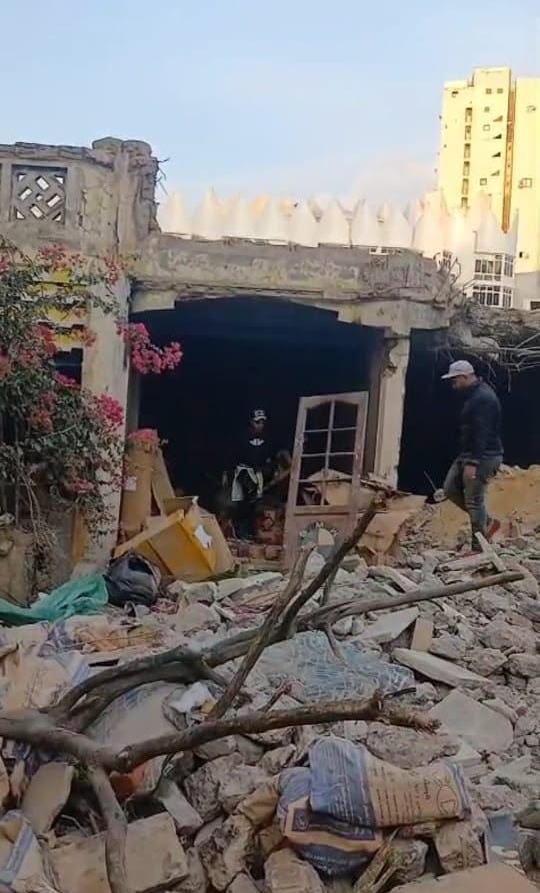
By December 2025, the rest of the 160 shops had been largely reduced to rubble, and beneath them lay not only the shop owners’ livelihoods, but the modest dreams they had carried for their children and the flicker of hope that their life might be easier than their own.
“The demolition violates the rights of hardworking citizens who purchased their units through official auctions—held in the presence of representatives from the local district and the Ministry of Endowments—after spending ten years of their lives paying off the installments,” Ranyah El-Anany, an affected shop owner who purchased one of the shops in the 2010s, wrote on Facebook on December 21, 2025.
“It was demolished under the guise of ‘development’ to pave the way for multimillionaire investors. The authorities unjustly targeted these struggling people, using legal pretexts and acting without a lawful demolition order. They explicitly told us: ‘By the time the court rules in your favor, we will have already demolished the place, rebuilt it, and installed someone else there.’ In other words: ‘Drop dead,’” she added.
In February 2026, El-Sisi appointed Engineer Ayman Attia as Governor of Alexandria, replacing Khaled, who was appointed Vice Chairman of the Board of Directors of the Suez Canal Authority (SCA).
Meanwhile, a charter amendment published on June 8 in the supplement to issue 112 of the Official Gazette expanded the El-Maamoura Company’s permitted activities, including operating hotels, marinas, commercial premises, cafes, and beaches.
Weeks later, on June 28, the Egyptian Exchange (EGX) approved El-Maamoura Company’s temporary listing, with an offering and additional regulatory requirements to be completed within six months, while restricting transactions before trading begins, subject to the Financial Regulatory Authority’s (FRA) approval.
All of this begs a single question: What has happened to the shop owners since?
“Some of them were able to start working again, others scraped together money to rent a shop in another area, few owned one or two other shops and were able to cut their losses, relatively speaking,” Mahmoud* said. “The majority are poor.”
The police complaints remained shelved, the court cases stalled, all while newer shops have been built on the ruins of the old.
As you are reading this, a group of tired men whose livelihoods were ripped away are sitting at a qahwa in Bahary, wondering what the future holds for them.
But they have not lost hope.
“Despite everything, they [the shop owners] still have hope in the justice system,” Ramadan told The Cairo Report.