




This issue of The Cairo Report covers mounting labor unrest over low wages and disputed pay, the growing gap between earnings and the cost of housing, and the continued reliance on underpaid workers across Egypt’s public services.
We also look at Parliament’s renewed scrutiny of wage violations and precarious employment, a series of legal victories for workers challenging arbitrary dismissal and reassignment, and the deadly crash that claimed the lives of young agricultural workers.
Meanwhile, the crackdown on independent journalism intensifies, with the closure of Mada Masr marking another blow to press freedom.
Press crackdown escalates
Update: A Cairo court ordered the closure of independent news site Mada Masr on Tuesday 27 October, detaining the editor Lina Attalah for several hours.

Attalah was convicted during the court hearing, as the judge handed down the maximum fine of 3 million pounds, ordered the website’s closure, and directed the confiscation of its equipment on charges of “operating without a licence”.
Mada Masr paid the 3 million pound penalty, which is the maximum penalty available under Article 105 of Egypt’s 2018 Press and Media Regulation Law, in full to secure Attalah’s release from court custody later that day.
During the hearing, the court rejected procedural requests from the defence, including demands to examine documents and hear witnesses, according to Mada Masr. The defence had sought additional time to review the case file and establish the circumstances surrounding the outlet’s licence application.
After deliberations, the judge ordered the courtroom cleared of everyone except Attalah and her defence counsel, according to an account by Hossam Bahgat, executive director of the EIPR, who was present and spoke to Mada Masr. Plainclothes officers and security personnel subsequently entered the courtroom, he said.
The defence refused to present its plea while its requests remained unanswered. The judge then appointed a lawyer who was not part of Attalah’s legal team, prompting objections from her eight chosen lawyers. Attalah also rejected the court-appointed lawyer’s representation, according to Mada Masr, which said the judge declined to record her objection in the session minutes.
The judge subsequently announced the conviction and imposed the fine, website closure, and ordered the confiscation of its property, the outlet reported.
During procedures to execute her release, judicial authorities revealed a separate one-year prison sentence previously handed down against Attalah in absentia in 2024 on charges of “publishing false news” and “operating an unlicensed website”. Her legal team immediately appealed the ruling, securing a retrial hearing set for 11 November.
The Egyptian Journalists Syndicate has also intervened in the dispute, saying it submitted a memorandum to the media regulator concerning the licensing issue and the associated prosecutions, citing alleged administrative irregularities, the failure to notify the applicant of the decision, and arguments that the dispute should be handled through administrative litigation rather than criminal proceedings.
Attalah’s conviction follows a rapid sequence of legal proceedings that began with her questioning by the Supreme State Security Prosecution on October 21. She was questioned for six hours over allegations of “operating a website without a licence” and “publishing false news”, then released on bail of 100,000 pounds, pending further investigation.
On October 22, prosecutors referred her to trial on charges of “establishing and operating a website without a licence”, while the charge of publishing false news was not included in the formal referral, according to Mada Masr and the Committee to Protect Journalists (CPJ). The first hearing was scheduled for October 27, less than a week after the referral.
The investigation reportedly included material compiled by the National Security Sector, which included a Mada Masr report on protests in Egyptian prisons following the postponement of changes to criminal procedure rules.
A group of 119 rights organizations and media outlets, including Amnesty International, Human Rights Watch, and the CPJ, also condemned the prosecution after Attalah was referred to trial last week, describing the case as an unprecedented attack on press freedom.
In tandem, the State Security Prosecution renewed the detention of the six Matsada2sh journalists.
School teachers strike over wages & disputed deductions
Teachers at Futures Language Schools, a private school in Cairo’s Maadi district, struck on October 29, demanding better pay and an investigation into alleged discrepancies between documented salaries and actual payments. Their collective complaint centered on monthly salaries of 6,400–8,000 Egyptian pounds following a recent increase from around 5,600 pounds. An unnamed Cairo Education Directorate official told Cairo24 that “a committee would investigate”.
The teachers want contracts, payroll sheets, bank transfers, and receipts reconciled, social insurance compliance checked, and deductions refunded where they lack a legal basis. Some said they were charged for school bus and child supervision services they did not use. They also sought a pay structure recognizing experience and responsibilities, a timetable for corrections, and protection from retaliation after repeated attempts at quiet settlement failed.
The private-sector minimum remains 7,000 pounds, and determining compliance would require distinguishing gross wages from take-home pay and examining deductions.
The dispute follows years of uneven wage protection in private education. Some distressed private schools received exemptions when the private sector minimum began in January 2022; by November 2024, the Education Ministry was explicitly ordering private and international schools to implement the then 6,000-pound floor and directing authorities to monitor compliance.
Yet these teachers have had to organize a stoppage and a collective complaint just to secure a promise of scrutiny, while their demand for protection from retaliation addresses the practical obstacle to enforcement: securing wages depends on workers being able to challenge management without putting their livelihoods at risk.
Cairo rents soar past the minimum wage
Cairo’s median advertised monthly rent stood at 10,000 pounds in the third quarter of 2026, exceeding both private and public sector minimum wages, standing at 7,000 and 8,000 pounds respectively, illustrating the distance between earnings and access to housing, according to the Built Environment Observatory, which analyzed approximately 5,000 advertisements for unfurnished apartments, treating gated developments separately.
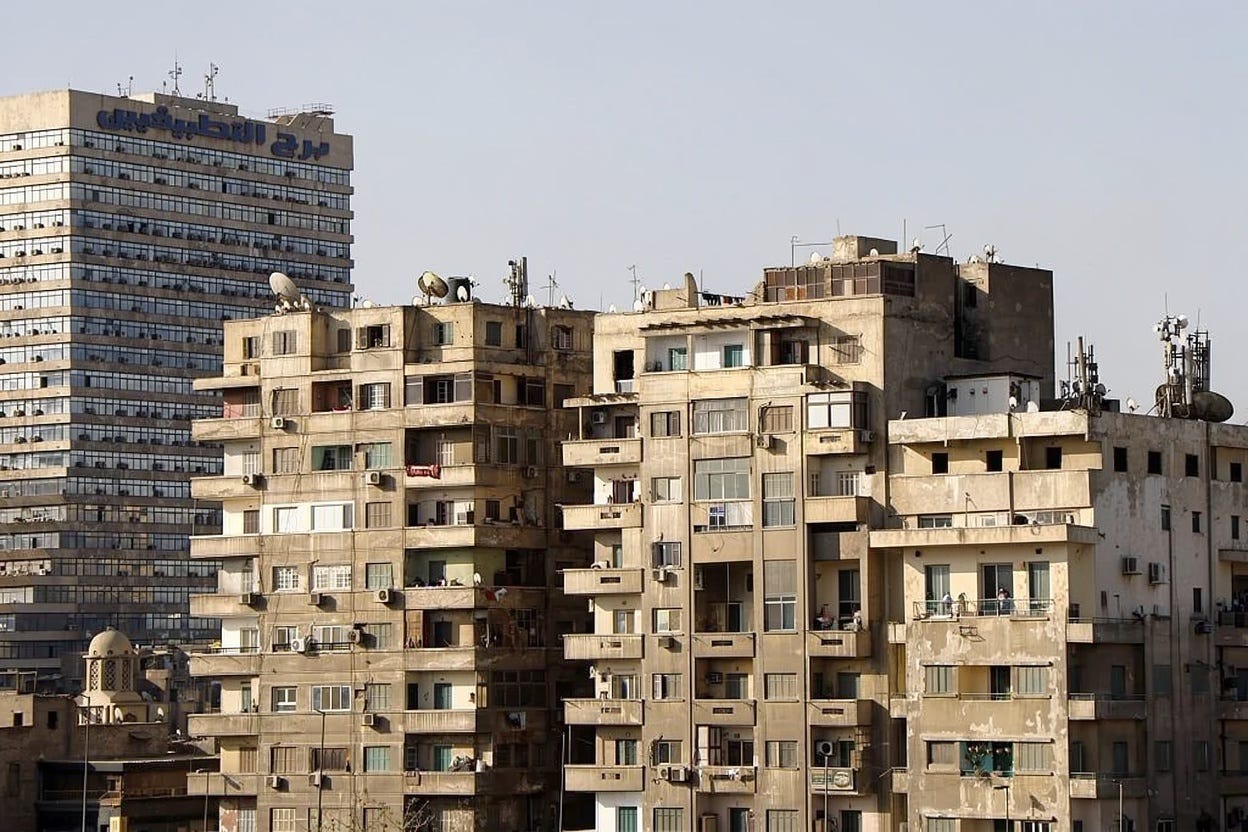
At that rent, two workers each earning the minimum would commit roughly 70% of their combined pay to housing before deductions, utilities, or transport.
The report’s annual comparison puts monthly asking rents in the first nine months of 2026 25% above 2025, at approximately 13% per square meter, indicating that changes in the properties advertised affect the headline increase.
Housing policy is also moving more tenants toward the market: Law 164/2025 ends covered residential old-rent contracts seven years after taking effect. Affordable alternatives have developed unevenly.
A World Bank review in October 2025 identified rental assistance as a lagging component of its housing program, citing legal and regulatory delays.
The current subsidized rental offer includes 15,000 homes nationwide but only 259 in Cairo. Its conditions require employee status and documented net family income, with minimum monthly thresholds of 5,000 pounds for governorate units and 8,000 pounds for new-town units, excluding self-employed applicants and families earning less.
Ostensibly, eligible tenants receive support toward a rent contribution of 25% of net income, but assistance is capped at 100,000 pounds; afterward, they owe the full contractual rent.
An initial 250 pounds monthly charge is additional. The scheme is supposed to offer little relief while filtering access by employment and income. For wage earners dependent on market housing, rent continues to determine how much of their earnings remains available for food, transport and care.
Six years of service & months without pay
Supply Ministry contract workers earning no more than 1,400 pounds a month face payment delays of three to four months and lack health insurance despite working since 2020, MP Ehab Mansour said in a new parliamentary request to the finance and supply ministers last week. Mansour, deputy chair of Parliament’s Manpower Committee, highlighted workers in Giza’s supply directorate.
Their reported monthly pay amounts to 17.5% of the 8,000 pounds minimum wage for the lowest government salary grade.
Mansour had previously raised the same pay, arrears, and insurance complaints in August.
The dispute concerns how continuing public work remains classified as “temporary assistance”. Finance Ministry regulations provide for payments to people outside the government employment apparatus under “rewards to non-employees for services rendered,” limiting engagements to 11 months per fiscal year. Its fiscal year 2026/27 budget circular says assistance work must be incidental and non-permanent. Yet a study published by the Institute of National Planning in 2022 described agencies using such arrangements to fill shortages in permanent staffing, undermining employment stability.
An unnamed ministry source told Al-Safha Al-Oula in August that late Finance Ministry allocations and lengthy funding procedures caused payment delays, while a worker described borrowing when wages failed to arrive.
Ehab Mansour’s latest request seeks regular payment, a wage review, and health coverage. Clearing the arrears would still leave workers on the reported 1,400 pounds pay level, without resolving their employment status.
ECRF challenges the state’s reliance on underpaid labor
Workers providing public services receive wages as low as 2,000 pounds a month, the Egyptian Commission for Rights and Freedoms (ECRF) said in a new analysis challenging the government’s record of enforcing existing wage rights. Following the 2030 wage promise covered in last week’s dispatch, ECRF cited 2,500 pounds monthly pay for security workers at Manfalut Central Hospital and 5,000 pounds for security guards serving the Agricultural Bank. Earlier subsidized bread-distribution reporting put wages at El Masryeen for Distribution & Services outlets at 2,000–3,000 pounds.
The employment arrangements are central to the dispute. At state-owned Egyptalum in Nag Hammadi, for example, workers said in March that they earned 2,250–3,500 pounds through intermediaries despite seven to ten years’ service.

Separately, Agriculture Ministry employees said in July that they remained unpaid five years after obtaining appointment judgments.
The government has meanwhile introduced last year a law requiring annual minimum wage reviews and National Wage Council meetings at least every six months. Yet an unnamed official told Tafsela on October 30 that the next meeting had no date.
Parliament revisits wages, insurance & temporary work
Parliament’s Manpower Committee, headed by the staunchly anti-worker Homeland Security-backed Nation’s Future MP Mohamed Saafan, is scheduled to examine wage violations, insurance collection, and daily-paid employment on November 2–3, including allegations that earlier recommendations have gone unimplemented.
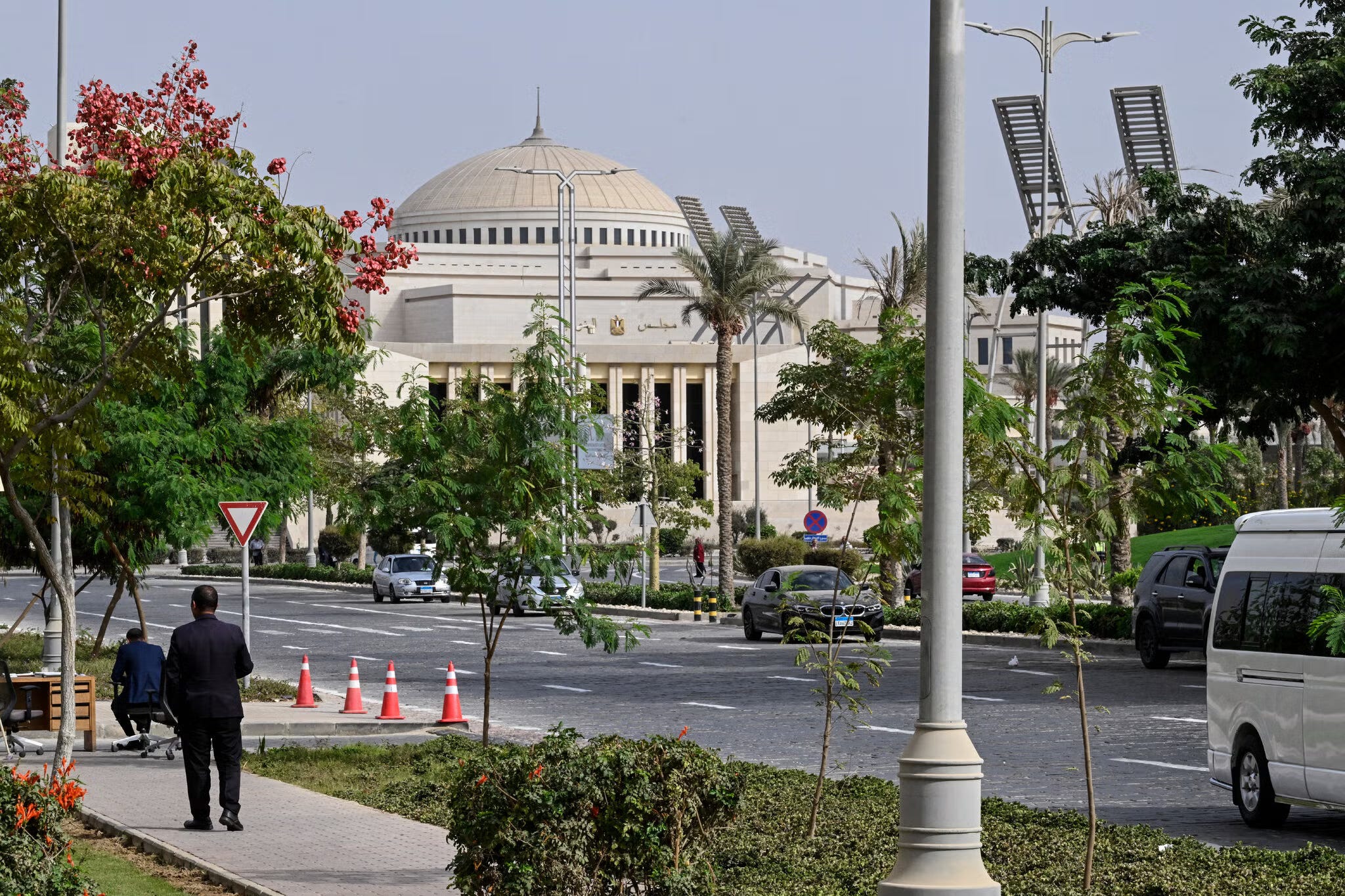
Tuesday’s agenda includes MP Abdel Rahman Beshary’s request concerning minimum wages and working hours in Luxor’s private sector, alongside Nabil Abu Warda’s demand for permanent status for daily-paid temporary workers. On Monday, the committee will consider MP Shereen Reda’s claims that the National Organization for Social Insurance (NOSI) has failed to collect money due.
The Luxor case already produced promises of intervention. In an earlier hearing, Beshary alleged monthly pay of just 1,500 pounds and 12-hour days without overtime at security and cleaning contractors, including firms serving the governorate and Luxor airport. The Labor Ministry acknowledged violations and promised targeted inspections; the committee requested a Cairo-based inspection team and a report back. An August inspection of a security contractor at hospitals and health units in Qurna subsequently examined wages, contracts and insurance, but the report disclosed no repayments or sanctions and did not establish whether the committee’s recommendations had been fulfilled.
Public institutions receiving these services are therefore part of the inquiry: responsibility extends to how their contractors’ labor conditions are monitored.
Teacher wins legal battle against arbitrary reassignment by education ministry
The Administrative Judiciary Court, 24th Circuit, ordered the Ministry of Education to cancel the transfer of a female Arabic-language teacher, ruling in her favor in Case No. 92250 of Judicial Year 79, challenging her arbitrary reassignment, according to the Egyptian Center for Economic and Social Rights (ECESR).
The teacher, identified in court documents as Nagat A.M., said she was summoned by the educational administration on April 15, 2025, and verbally informed that she had been removed from Al-Safa and Al-Marwa School and would be transferred to Mabrouk Ghattati School. She was not given an explanation for the decision or called in for an investigation, the center said.
She also discovered that an employee in the school’s financial and administrative affairs department had completed the procedures for receiving her new assignment on her behalf, without her knowledge or presence.
The teacher subsequently filed administrative police report No. 5593 of 2025, documenting that she had been prevented from signing the school’s attendance and departure register.
The State Commissioners Authority, in a report issued on November 24, 2025, recommended that the court accept the case procedurally and recognize the teacher’s right to have the transfer decision annulled.
Another labor win for former Al Bawaba News journalists
The North Giza Court of First Instance ordered on October 27 the privately-owned newspaper Al-Bawaba News to pay Wisam H.A., a former journalist, 295,600 pounds in compensation and unpaid wages after ruling that he was unlawfully dismissed, as reported by the ECESR.
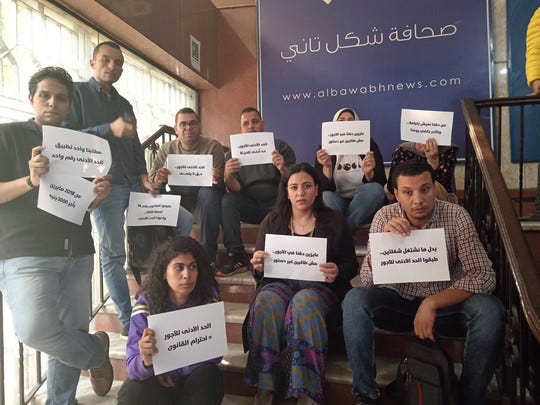
The court also rejected a counterclaim filed by the newspaper’s management and ordered it to cover legal costs and attorney fees.
The award includes 200,000 pounds in compensation for material and moral damages resulting from the dismissal, 21,000 pounds in lieu of notice, 54,600 pounds for unused annual leave and 14,000 pounds in unpaid wages for November and December 2025.
The court also ordered the newspaper to pay 6,000 pounds in outstanding minimum-wage differences for February 2025, along with additional wage differences for the period from March through October 2025. It ordered the newspaper to provide the journalist with an employment certificate and return his hiring documents.
The journalist joined Al-Bawaba News in 2014 as an editor under an open-ended employment contract. His monthly salary initially stood at 1,500 pounds and later increased to just 2,000 pounds, according to the ECESR, which represented him in court.
The dispute escalated after newspaper management failed to implement minimum-wage requirements, prompting the journalist to join 256 other journalists and employees in an open-ended sit-in at the newspaper’s offices on November 17, 2025.
The ruling is part of a series of labor judgments involving Al-Bawaba News employees. Other former journalists have secured compensation awards of 293,000 and 280,000 pounds in separate cases, according to the center.
AUC ordered to pay nearly 2 million pounds to dismissed worker
On October 25, the New Cairo Court of First Instance ordered the American University in Cairo (AUC) to pay 1.98 million pounds to a former employee who challenged his dismissal after nearly 18 years of service in Labor Case No. 3419 of 2026, according to the Egyptian Initiative for Personal Rights (EIPR).
The award includes 1.33 million pounds in compensation for material and moral damages resulting from the dismissal, 112,138 pounds in lieu of notice, and 538,292 pounds for unused annual leave. The court ordered annual interest of 4% on the respective amounts, according to the rights group.
The university was also ordered to issue the former employee an employment certificate, return his hiring documents, and cover court costs and legal fees.
The employee joined the university’s security department in 2009 under an employment contract and later advanced to an administrative position. He also served for several years as president of the university’s independent workers’ union.
According to his account, a dispute with a manager over security practices and policies preceded a series of measures he described as retaliatory. These included removing him from his office, restricting his responsibilities, disabling his work email, and instructing security personnel to prevent him from entering campus.
He said university management subsequently informed him verbally that he had been relieved of his duties immediately and confiscated his university identification card and work keys.
The employee also said the university attempted to pressure him into signing settlement and resignation documents, which he refused.
More bread martyrs
At least 10 people have been killed and 24 injured after a minibus carrying mostly young workers to agricultural jobs collided with a heavy truck at the intersection of the Middle Ring Road and the Dabaa Axis in Giza.
The workers were travelling from Senoures, Fayoum, towards a farm in the direction of Alexandria, according to preliminary Egyptian media reports.
Many of the passengers were young, with reported ages ranging from 15 to 20.
The Health Ministry said 20 ambulances were dispatched to the scene. The injured were taken to nearby hospitals, with 10 reported to be in unstable condition.
The deaths are the latest in an unfortunately lengthy list of bread martyrs; workers killed while trying to earn a living.
The scale of the country’s road safety crisis is reflected in the latest figures from Egypt’s Central Agency for Public Mobilization and Statistics (CAPMAS).
A total of 5,829 people were killed in road accidents across Egypt in 2025, an increase of 10.8 percent from 5,260 deaths in 2024, according to CAPMAS figures released in June 2026.
Road accidents also injured 84,553 people in 2025, up 10.7 percent from 76,362 the previous year.
The figures showed that 1,580 of those killed were under the age of 15, the highest number among the reported age groups.
The rising death toll in 2025 reversed a decline recorded the previous year, when fatalities fell by 10.3 percent compared with 2023.
Security sector update

So, what?!
Across both public and private sectors, workers are being asked to sustain essential services and economic activity on wages that cannot keep pace with the cost of living, often without reliable payment, adequate social insurance, or even basic job security.
The gap between Cairo’s soaring rents and workers’ wages is particularly telling. So too are the months-long payment delays, the reliance on temporary and daily-paid labor, and the persistence of salaries far below even the officially declared minimum wage.
For The New Republic, keeping labor costs low takes precedence over workers’ livelihoods, while the responsibility for absorbing economic pressures is pushed as far down the social ladder as possible, distancing the government from the consequences of its own economic policies.
The courts may occasionally offer workers a measure of redress, and parliamentary committees may revisit long-standing violations, but neither can substitute for meaningful collective bargaining, effective labor protections, or workers’ ability to organize independently.
The growing restrictions on critical media are telling in this regard, particularly as outlets like Mada Masr remain essential to documenting abuses, scrutinizing state policy, and giving visibility to peoples’ grievances.
The question remains: why are those who keep the country running so often denied the means to live with even a semblance of dignity?
In case you’ve missed it, catch up on our latest Deep Dive:
How debt swallowed Egypt’s budget & is there a way out?

Egypt has budgeted almost as much for interest as for everything else combined. Schools, hospitals and household support have to compete with that claim on public money.