


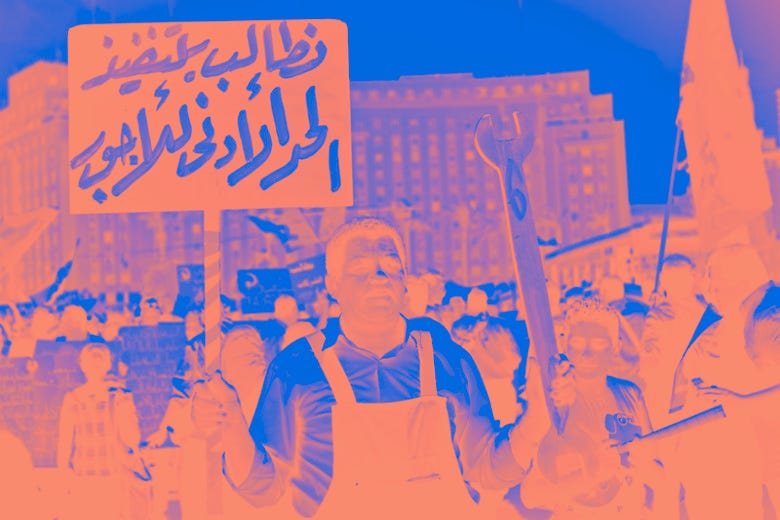
On February 26, the IMF injected $2.3 billion into Egypt’s state coffers, certifying that “macroeconomic stabilization has become more entrenched.” Four days later, Central Security Forces broke up a strike at the country’s only primary aluminum producer, which dismissed more than 500 workers the next morning. The workers had requested direct employment contracts & wages that met the state’s legal minimum. They received neither.
On March 10, inflation hit 13.4%, a seven-month high & the fastest monthly increase in two years. The government announced another round of fuel price hikes, its third in less than a year. The day before, 250 women workers at a state-owned textile firm had staged a sit-in over wages paid in fragments & healthcare suspended despite monthly insurance deductions from their paychecks.
Between January & mid-March, 41 labor-specific incidents took place across the country, 38 separate disputes after consolidating follow-up protests at the same sites. Blue-collar workers accounted for 35 of the 41 incidents. Wage pressure drove 27 of them. These numbers reflect not a failed policy but a functioning one, one that redistributes the cost of stabilization onto workers who lack the organizational power to refuse it.
Egypt’s macro recovery—rising GDP, record foreign currency reserves, a primary surplus that nearly doubled this fiscal year—rests on a specific labor regime that consists of subcontracting that routes workers out of legal protections, systematic evasion of the legal minimum wage, enforcement so thin it barely functions, & Central Security deployed when workers object.
President Sisi & Prime Minister Mostafa Madbouly consistently frame the current period as a hardship preceding the eventual “fruits of reform.”
This issue of The Cairo Report examines how, through four disputes this year, the cheapening of labor is not residual to The New Republic’s economic model. Rather, it is central to its very foundation.
The Sugar Sector: Fiscal Architecture as Labor Policy
Workers at the Egyptian Sugar & Integrated Industries Company had been here before. In August & September 2025, workers across four different factories staged three weeks of protests over wages, but to no avail, management & security pressured them to stand down.
Early in January of this year, however, the workers struck again, this time across nine facilities. Workers organized committees with representatives from each factory, drafted a unified demand list, & made clear they would not negotiate plant-by-plant. Their demands included retroactive application of the minimum wage, the monthly incentive raised, annual profit share raised from 42 to 60 months, the meal allowance raised to 1,800 pounds, the cash allowance to 1,500 pounds, the 2017 & 2018 raises added to base pay, temporary contracts converted to permanent employment, & a return to company-funded family healthcare coverage at 50 percent of costs without a cap.
At one site, workers blocked sugar trucks at the main gates for two days & turned back the head of the sugar sector when he attempted to enter the facility. When trucks rerouted through secondary gates, workers intercepted them at the weighbridge. The timing coincided with the annual production season, which starts in the second half of January, & workers knew it.
ESIIC posted revenue of EGP 44 billion in 2024/25, up from EGP 33 billion the previous year, with the CEO projecting EGP 50 billion in the current cycle. Workers at cane sugar factories disputed management claims of unprofitability & pointed to a structural arrangement that has held wages down since 2014; the Ministry of Supply purchases ESIIC’s output at a fixed price of 12 pounds per kilogram while the market price runs between 30 & 35 pounds. Workers are absorbing the cost of price controls designed to keep subsidized sugar cheap for consumers. Effectively freezing wages for over a decade.
Supply & Internal Trade Minister Sherif Farouk met ESIIC’s board on January 14 at the ministry headquarters in the ‘New Capital.’ The minister offered to raise annual profit payments from 42 to 45 months, increase the meal allowance from 1,000 to 1,500 pounds, & boost incentives by 25 percent. Workers rejected the package the same day.
The episode’s significance is what it makes legible. ESIIC operates under the Ministry of Supply & feeds into the Holding Company for Food Industries, where the ministry sets the output price & tolerates wages below the legal floor. Workers demanding the legal minimum were asserting a right the state has enshrined in statute & which the fiscal architecture of the IMF program, which demands “fiscal consolidation” & “reducing the state’s economic footprint,” systematically makes it difficult to fund at state-linked employers.
Jade Textile: Export Labor Arbitrage
Around 6,000 workers at Jade Textile’s garment factory struck in February over wages & unpaid overtime. Workers said they earned roughly 6,500 pounds a month & demanded at least 10,000. They rejected a proposed increase averaging 800 pounds.
Days before the walkout, the Secretary General of the Federation of Egyptian-European Chambers of Commerce addressed the Turkish-Egyptian Cooperation Forum & cited Egypt’s minimum wage, which he placed at “around $180” a month, compared with Turkey’s $800, as the primary incentive drawing Turkish manufacturers to Egypt. The actual figure at the time was approximately $148 (now at $133); he overstated Egypt’s wage floor by around $32 in a pitch designed to attract investment, which means the real wage gap was wider than even the official sales presentation acknowledged.
Jade Textile is owned by Turkey’s Yeşim Group & manufactures for globally renowned brands such as Tommy Hilfiger, Lacoste, Calvin Klein, Nike, & Under Armour. Workers were not making an abstract argument about global value chains. They were stating, from inside the supply chain, that the country’s attractiveness as a manufacturing destination rests on keeping their wages low.
Management’s response followed a pattern visible across multiple disputes in recent years— threats of arbitrary dismissals, warnings that names would be reported to National Security, the halting of company buses, & police vehicles at the gates. Former Labor Minister Mohamed Gobran intervened personally, & the strike ended with partial concessions & worker warnings that the dispute could resume if the company did not follow through. The intervention contained the dispute, but whether it resolved the wage logic that produced it is a different question.
Egyptalum: Precarity, Coercion, and the Restructuring Timetable
Egyptalum is the country’s sole manufacturer of primary aluminum. The company’s complex in Upper Egypt operates over 550 production cells in smelting, rolling, & carbon roasting. Forbes Middle East ranked it 14th among Egypt’s top 50 listed companies last year.
Thousands of workers at the complex are not on the company’s payroll; instead, those workers are contracted through privately-owned labor-supply intermediaries, which hold agreements with Egyptalum that workers have never seen & to which they are not party. Most of them graduated from the company’s own Industrial Technical Institute for Metals & Vocational Training Center, trained specifically for aluminum production &, by their own account, no other industry. Egyptalum stopped directly hiring its own institute graduates in 2011, when the shift to temporary labor contracts began.
Workers who completed that training have since spent between seven & ten years working inside the facility, earning between EGP 2,250 & EGP 3,500 a month, roughly a third to barely half of the legal minimum wage. They hold no social insurance, no health coverage, & no workplace injury protection. One worker told reporters that a colleague, an engineer, lost a foot on the job & received nothing because the subcontracting arrangement places them formally outside the employer-employee relationship that would trigger those entitlements. Another worker’s account corroborated the same issue, saying that in the case of workplace accidents, the workers are given first aid kits & told to treat themselves.
On February 28, roughly 3,000 “temporary” workers launched an open-ended strike & sit-in inside the premises, cutting the company’s output by approximately 70%. Permanent workers stepped in to feed the furnaces the powder used for burning, to prevent damage from a complete shutdown, illustrating both how close the strike came to halting operations entirely & the degree to which the two workforces, permanent & temporary, occupy structurally different positions in the same production process. The company’s management offered to raise wages to EGP 6,000 pounds as a condition of returning to work, but this offer was rejected. Workers understood that the structural problem lies not in the pay they received, but in their employment conditions. They demanded direct contracts first, before any wage negotiation.
On the third day of the strike, Central Security forces entered the premises & ordered workers to leave or face arrest. The dispersal was led by the governorate’s security director. The following morning, police vehicles remained stationed at the gate alongside company security, checking national IDs against dismissal lists. Workers whose names appeared were turned away & told verbally that their contracts had ended, arbitrarily dismissing more than 500 workers. No demand was met.
This was Egyptalum’s third major labor action in under eighteen months. In October 2024, temporary workers struck over profit shares, allowances, & the direct-hiring demand, suspending the action after the now-abolished Ministry of Public Business Sector promised to address their demands. The promises went unmet, & in September 2025, 4,000 permanent workers struck with identical demands. That strike ended after National Security summoned several workers & asked them to stand down.
At the time of the strike, reports circulated that the government was evaluating the transfer of Egyptalum to the Sovereign Fund of Egypt alongside six other companies, part of a broader restructuring covering approximately 40 state-owned companies. The mechanism would see the state treasury receive 50% of the transferred companies’ annual revenues, projected to generate up to 20 billion pounds annually, earmarked for debt reduction & interest-payment relief.
Whether or not the timing of the Egyptalum strike & the Sovereign Fund transfer plan is deliberate is almost entirely beside the point. The asset enters the restructuring pipeline in a more labor-disciplined condition—a workforce asserting permanent contract rights at a company being prepared for investor partnership is a workforce generating contingent liabilities, claims on wages, benefits, & job security, that complicate what the balance sheet needs to show before any transaction closes. The security apparatus resolved that complication in a single night.

Samanoud: Social Reproduction and the Limits of a Win
Samanoud Textiles has been stuck in near-permanent dispute since 2024. Workers at the spinning & weaving company struck for 35 days in August that year over minimum wage implementation. Multiple workers, including labor leader Hisham al-Banna, were arrested & accused of attempting to “disrupt one of the means of production with the intention of harming the national economy,” incitement to a demonstration to “breach security, disrupt production, & affect public utilities,” organizing a gathering of more than five people, putting “public peace in danger,” failure to comply with a police dispersal order, & deliberately harming the company’s funds & interests. To set an example, al‑Banna was later released & then dismissed, a decision the appeals court partially reversed when it ordered the company to pay him EGP 270,000 in compensation for retaliatory dismissal.
Fast forward to this year, the Health Insurance Authority had suspended medical services for roughly 600 Samanoud workers, citing company debts exceeding EGP 15 million, even though the company continued deducting insurance contributions from salaries while the insurer refused to renew health cards or issue treatment authorizations. Many of the affected workers, most of them women, live with chronic illnesses such as diabetes, hypertension, asthma, & cancer, & have had to pay out of pocket for monthly medication. The suspension was arbitrary in nature since the workers are not party to the debt dispute.
On March 9, roughly 250 women workers in the clothing division escalated to a protest inside the factory, staging a sit‑in over delayed wages, fragmented payments, & the suspended health coverage. For four months, the company had been paying salaries in three installments, a practice that left workers unable to manage rent, utilities, or food costs. Management compounded the pressure with bank-switch tactics where payroll was moved from one bank to another, & workers were required to open new accounts, then wages were rerouted back to the first bank again without notice, leaving some unable to access their pay until they navigated multiple bank systems.
The company simultaneously floated a change to the working day, moving from a long‑standing seven‑hour schedule to eight full working hours, excluding break time. The Egyptian Commission for Rights & Freedoms argued that the attempt is in direct conflict with the Labor Law, & workers read the move as an effort to squeeze more production out of the same wage bill under the cover of a ministerial decree, Decision 289 of 2025, issued by the Labor Ministry to “regulate” working hours.
National Security officers were present inside the factory throughout the protests &, according to workers, blocked the clothing division from turning the partial stoppage into a full plant‑wide strike by threatening arrest. Wage complaints & demands to restore health coverage were sometimes met with implied security threats & suggestions from management that workers take their grievances to the police station. The message effectively was that wage arrears & insurance theft were administrative issues; organizing to contest them was a security matter.
On the evening of Monday, March 16, after weeks of partial stoppages & failed complaints, workers moved to an open‑ended strike when management refused to pay the outstanding portion of February wages. Management’s first offer was EGP 1,000, which workers refused. By the next night, the company returned with EGP 1,300 immediately & EGP 2,300 the next morning. When the second payment was made on March 18, workers ended the strike & returned to their shifts.
Samanoud Textiles is perhaps institutionally & structurally the most revealing case because the employer failing its workers is the state itself. The company operates under a hybrid ownership model. Shareholders registered it as a private-sector firm in 2015, yet state & para‑state financial institutions hold approximately 65% of its shares.
And while the strike extracted the delayed wages, it changed nothing else. The insurance debt, the fragmented pay structure, & the threatened working-hour extension remain intact. Labor office officials mediated the dispute with vague pledges to address the healthcare suspension after the holiday. The sequence itself confirms the function of official mediation, where conflict is temporarily absorbed to restore production without resolving the underlying theft. Workers secured their February pay solely because they halted the factory. The law guarantees rights on paper, but under authoritarian capitalism, workers only receive what they have the organized power to take.

Why does this matter?
The dispute is not between a recovering economy & an aggrieved workforce. The dispute is, however, over what the recovery is actually built on & who pays for it. The IMF’s February review praised tighter monetary & fiscal policy, exchange-rate flexibility, higher tax revenue, & lower public investment, while also noting that the primary balance missed the target because expected divestment proceeds did not arrive on schedule. That contradiction is because the program’s measure of success is not whether production has been reorganized on a stronger social basis, but whether the state can keep meeting fiscal & external benchmarks while moving assets & containing costs.
The record-high foreign currency reserve story points in the same direction. Egypt’s external position was strengthened by remittances, foreign direct investment, external issuances, & record nonresident inflows into domestic debt markets. Those are inflows that improve liquidity & reassure creditors, but they do not by themselves amount to a productive transformation capable of lifting wages, stabilizing employment, or reducing dependence on low-cost labor as a competitive offer. Official talk of “reform” therefore conceals the reality that the state is trying to secure macro solvency & investor confidence without altering the labor regime that makes both possible.
This matters politically because it clarifies what kind of state is operating here. The state appears weak when workers invoke the minimum wage, labor protections, or insurance obligations, yet it has lately managed to appear more or less capable when debt service, divestment, & security management are at stake. The question is no longer whether workers are suffering during a temporary adjustment. The question is which social class is financing the adjustment, & through which institutions that burden is being enforced.

So What?!
Since most of the labor grievances this year are direct carryovers from last year, the immediate implication is that labor unrest will remain a structural feature of the “recovery” model, not an interruption of it. Wage settlements won under pressure will keep eroding as inflation, fuel-price adjustments, & the cost of basic goods continue to move way faster than most nominal gains. A labor regime can survive this for some time by distributing concessions narrowly, restoring production quickly, & isolating disputes site by site. It cannot eliminate the source of the disputes while the legal wage floor remains below the basic cost of living, & enforcement remains selective.
The deeper issue is organizational. Workers are encountering the same basic order through different legal forms, subcontracting, temporary status, hybrid ownership, ministry mediation, & security pressure, which means they experience a common class injury in atomized & segmented ways. That segmentation protects capital & the state alike; export manufacturers get wage discipline, portfolio investors get macro credibility, ministries get manageable fiscal obligations, & the security apparatus gets a fragmented field of conflict that is easier to contain. Every bloc has a vested interest in keeping labor costs low & tightly controlled.
That is the real stake of these disputes. They show that the central political question is no longer simply how much workers are paid, but whether workers can force recognition of themselves as a class with claims that exceed the terms set by creditors, investors, ministries, & the security apparatus. If they cannot, The New Republic’s “recovery” will keep advancing through fragmented concessions, selective repression, & the steady transfer of crisis costs downward.
History, however, has consistently pointed in a different direction & has consistently shown that the shop floor is where such social arithmetics stop looking abstract.