




This issue of What We’re Reading covers India’s cockroach movement, the anniversary of the Genoa G8 protests, the impact of Israel’s war on Lebanon on Lebanese workers, one of the many ugly, hidden aspects of China’s rise, Tel Aviv’s ongoing genocidal war on Gaza, and the changes happening within Egypt’s Civil Democratic Movement.
We also take a peek at some ghost stories, a portrait of an often-flattened enslaved abolitionist, the rise of human skin’s use in K-beauty, the discomfiting depths of Downtown Cairo’s gentrification à la Studio Samara, and the interesting tale of a Sudanese battalion in the Egyptian army fighting for France in Mexico.
And more, obviously.
The World
V.A.R. and the Rise of Our New Tech Overlords —Jay Caspian Kang, The New Yorker
Jay Kang takes the World Cup’s endlessly contested video-referee (V.A.R) system as a small but unusually clear model of how technological authority works. Kang’s central point is that V.A.R.’s promise of objective adjudication does not abolish power; it moves power behind an interface, then supplies lines, angles, and data visualizations to make its decisions appear beyond dispute.
What’s most useful here is the distinction between automation that settles a narrow technical question and automation that disguises a political judgement. The “Hawk-Eye” system can plausibly establish whether a tennis ball landed in or out. But football’s decisive questions, whether contact was enough to constitute a foul, how far back a “build-up” to a goal reaches, whether an arm was in a “natural” position, are not technical facts waiting to be extracted from reality. They are rules interpreted by people, within institutions with interests, hierarchies, and longstanding records of corruption.
Kang is right to linger on the peculiar theatre of the referee consulting the monitor: a performance of independent judgement after an unseen room has already framed the available evidence. The graphic is a receipt issued by an authority that asks spectators to distrust their own eyes. And when Donald Trump can apparently intervene to have an American player’s suspension rescinded, the fiction of machine-led neutrality collapses altogether: the system’s rigor applies downward, while political proximity supplies an appeal process for the powerful.
The article occasionally treats the resulting suspicion as a contemporary paranoia, but this understates what football supporters intuitively grasp. The issue is not that technology has made people irrationally distrustful; it is that institutions like FIFA have earned distrust, and the new machinery gives their discretionary power a more opaque, more technical form. V.A.R. is therefore less a glimpse of neutral “tech overlords” than another instance of human authority laundering itself through supposedly neutral systems.
The Other Face of China’s Rise: Plunder, Poison, and Exile in Southern Africa — Naiara Urraco, Left Voice
This piece is a forceful corrective to the campist reflex that treats China’s expanding presence in Africa as inherently emancipatory because it challenges US and European predominance. Its strongest material is the account of the 2025 Sino-Metals tailings-dam collapse in Zambia’s Copperbelt, which resulted in poisoned waterways, ruined crops, water shortages, derisory compensation, and a company reportedly demanding that affected farmers waive future claims in return for it.
The important point is not simply that Chinese capital behaves badly abroad, or that Beijing has failed to live up to the moral claims made for “South-South cooperation.” The article shows a more familiar relationship in which mineral wealth leaves the country in raw form, profits and strategic control accumulate elsewhere, and workers and communities inherit precarious work, displacement, contaminated land, and the costs of industrial catastrophe. China’s ownership of Zimbabwean lithium operations is particularly revealing here. A mineral central to the supposedly green transition is extracted through temporary contracts, anti-union intimidation, long shifts, and environmental destruction, the old colonial division of labour updated for batteries.
Urraco is also right to reject the false choice offered by Zambia and Zimbabwe’s ruling classes: Chinese investment or Western investment. The prospect of replacing Chinese partners with US ones, the author notes, is not a route out of dependency but a change of executioners. That is the article’s sharpest intervention against both liberal geopolitical moralism and the softer left version of it, which mistakes multipolarity for liberation. A weaker US-led order may be welcome to Beijing, but it does not make the Chinese state or Chinese firms allies of African workers.
Still, the argument could go further in distinguishing China’s state-led global expansion from a simple replica of nineteenth-century colonialism. The mechanisms of dependency are real, and so are the crimes documented here, but “Chinese imperialism” risks becoming a label that explains everything before the concrete structure of ownership, debt, local ruling-class collaboration, and worker resistance has been fully examined. The most politically useful question is therefore not which foreign power is less hypocritical, but what forms of democratic control over mines, land, finance, and production could allow the people living with extraction to determine its terms in the first place.
Striking miners refused to cheer for England — Judy Cox, Socialist Worker
This article offers a brief recollection that catches a striking moment from the 1986 England–Argentina World Cup quarter-final: in a South Yorkshire working men’s club, miners who had lost the 1984–85 strike chanted for Argentina and celebrated its goals. A year after police occupation, the violence at Orgreave, and a press campaign that cast strikers as “the enemy within,” the England team could not be separated from the establishment that had disciplined their communities.
The point is not that these miners had developed a sudden attachment to Argentina, nor that football nationalism was simply reversed into an equally uncomplicated internationalism. Their response was negative before it was anything else: a refusal to identify with the flag, the police, the government, and the media system that had just helped break their strike. In that setting, cheering Argentina was a small act of political estrangement and an insistence that “England” did not belong equally to everyone who lived in it.
It is precisely the usual insistence that sport should transcend politics that misunderstands how national feeling is produced. The patriotic spectacle around England did not arrive neutrally at the Empire Working Men’s Club; it came already saturated with Thatcherism’s claims about law, order, unity, and an internal enemy. The miners’ chant exposed the class content beneath that supposedly common national identity, and even at a football match, the strike remained alive as a way of seeing the country that had defeated them.
‘He became a sensation’: Manchester pays tribute to abolitionist Frederick Douglass — Chris Osuh, The Guardian

Osuh’s Guardian report on Manchester Literary and Philosophical Society’s new Frederick Douglass lecture series is worth reading past its heritage-industry framing, because underneath the “blue plaque” hook sits a genuinely useful history.
In 1845, Douglass began a nineteen-month tour of Britain and Ireland, starting in Liverpool, and for much of that time, Manchester was his base. The article rightly foregrounds the material stakes; much of the cotton moving through Manchester’s mills had been grown and picked by enslaved people in the US and Brazil, which is exactly why Douglass’s campaign there mattered, he was organizing inside the belly of the supply chain.
Unfortunately, Osuh only grazes the surface of the class content of the solidarity itself. He notes, in passing, that Lancashire cotton workers boycotted slave-produced cotton against their own economic interests, in solidarity with African Americans and the Union cause during the Civil War. Mill hands chose hunger to break an economic system built on someone else’s chains. That’s the heart of it.
However, the piece is also honest about the limits of liberal abolitionism as a movement. It records the argument over buying Douglass’s freedom; when abolitionist Henry C. Wright condemned the transaction outright, writing to Douglass that he was vexed by it because “you always were free,” a position of principle that nonetheless left Douglass legally exposed to re-enslavement. Douglass’s own reply, quoted at length in the article, cuts through the purism: he needed release not to concede the slaveholder’s claim but to escape it.
It’s a useful reminder that tactical compromise under an unjust legal order isn’t automatically capitulation; a debate that echoes well beyond abolitionism.
Parapsychology Is Coming in From the Cold — Lydia Wilson, Newlines Magazine
Lydia Wilson’s essay is a genial tour of Cambridge’s psychical research apparatus, archives, fellowships, Nobel laureates dabbling in telepathy, and it’s an entertaining read. But it’s also a useful specimen for anyone interested in how institutional prestige launders ideas, and it’s worth reading with an eye on class and material history rather than just the ghost stories (though, the ghost stories are fun).
The piece traces the field back to its founding: the Society for Psychical Research was established in 1882 by a circle of eminent academics aiming to investigate mesmeric, psychical, and spiritualist phenomena “in a purely scientific spirit,” with a founding roster that included the Cambridge philosopher Henry Sidgwick, physicists William Barrett and Lord Rayleigh, and the future Conservative prime minister Arthur Balfour.
There’s a joke buried in that list. For centuries, communion with spirits, prophecy, healing by unexplained means, the whole grab-bag the SPR now calls “psychical phenomena”, was coded as “the devil’s work” or “witches’ work”, which actually just meant “women’s work”: cunning women, wise women, the ones who ended up on trial or at the stake for exactly the kind of “gift” a Cambridge don could now investigate from the safety of a fellowship. As I’d add: the same can be said for the “uncivilized” people these men “conquered” and brutalized; the psychic is, first and foremost, a “science of the poor”.
Obviously, the society was not a grassroots movement into the unexplained, but a project of the Victorian professional-managerial elite.
The essay is candid about why: many members, including the scholar Frederic Myers, found the Christianity of their day morally objectionable while also recoiling from the materialism of contemporary science, and psychical research offered a third way between the two. In other words, this was a coping mechanism for a ruling class whose religious authority was crumbling and whose scientific worldview offered them no comforting place for the soul.
What’s most striking, though, is how little has changed about who gets to rehabilitate fringe research. The essay’s present-day cast is instructive: the fellowship in psychical research is housed at Trinity College, the wealthiest of Cambridge’s colleges and home to 34 Nobel laureates, and its current champions include a Nobel physicist and a cosmologist who trained under Stephen Hawking.
Wilson is upfront that mainstream science remains skeptical, and that a researcher’s credibility here is inseparable from institutional armor: the article notes that any attempt to unify psychical research with physics “must fly under the radar—or wait until the scientist’s reputation is rock-solid enough to withstand the side-eyed looks from their peers.”
That’s a remarkably clear statement of how intellectual legitimacy actually gets distributed, not by the strength of evidence alone, but by whether you’ve already banked enough institutional capital to survive ridicule. A working scientist without a Nobel Prize and a Trinity fellowship pursuing the same research would likely be laughed out of a job.
Read as a whole, the piece functions less as evidence that parapsychology is being vindicated and more as a case study in how unfalsifiable ideas move through class-stratified institutions; tolerated, and even indulged, when held by the already-credentialed, and pathologized everywhere else.
Human Skin Is the Newest Ingredient in the K-Beauty Boom — Sangmi Cha and Hyonhee Shin, Bloomberg
Marx opens Capital by asking why commodities appear to us as strange, autonomous things with lives of their own, when they’re really just congealed human activity wearing a mask. Cadaver skin is about as literal a version of that as reality is ever going to hand a reviewer. Here is a piece of an actual person, donated on the understanding that it would go toward saving a burn victim’s life, that ends up circulating as Re2O, a branded product with a tagline “Return to Your 20s”, a price point of $400–$530 a session, and a stock that’s more than doubled in a year.
The body, or a piece of it, doesn’t disappear in this process. It’s transformed into a thing that appears to have its own market value, detached from the human relation that produced it, which is exactly commodity fetishism, done with actual human tissue instead of Marx’s table that dances on its own legs.
The use-value/exchange-value split does the real work here. The donor and their family understood the use-value of what they were giving; skin that repairs a burn victim, restores function after trauma, something with concrete, bounded human purpose. What actually got extracted from that gift was its exchange-value, meaning its capacity to be sold, at whatever price the market for youth will bear, to whoever can pay.
L&C Bio’s shareholder letter, which frames its 917%-profit-growth quarter as evidence that “the noble meaning of donation is expanding,” is dressing up a relation of extraction in the language of the thing it has already stopped being, which Marx also explained.
And there’s a labor-adjacent question worth pushing on, even though tissue donation isn’t waged labor: whose body, exactly, is supplying the raw material, and who’s capturing the surplus?
The article doesn’t tell us the class position of AATB donors, but the underlying pattern is, well, the baseline under capital. The person whose body furnishes the actual material input receives nothing beyond the psychic wage of having “donated,” while every link downstream (biotech firm, certifying body, clinic, dermatologist) captures value from it.
That’s not so different, structurally, from a worker whose labor is embedded in a commodity they’ll never see the profit from. The donor doesn’t even get the worker’s consolation of a wage; they get institutional gratitude, once, and then the tissue moves through hands that all charge for handling it.
The Lo-Fi Way I Broke My Addiction to the Algorithm — Meher Ahmad, The New York Times
This lighthearted piece offers a gently absurd solution to the exhaustion of endless scrolling, the author explains how she banishes all social media to a designated “Scroll Phone” that can only be used while sitting in a specific “Scrolly Chair.” The setup acts as a spatial boundary, recreating the physical constraints of the early, desktop-bound internet and breaking the modern habit of carrying a permanent audience into the bathroom or the bed.
What is most striking is the admission that complete abstention isn’t the goal. Meher Ahmad recognizes that the desire for digital connection is real, comparing her occasional use of a friend’s phone to “getting a hit off someone’s vape at a party.” The piece effectively strips the moral panic away from smartphone use, treating it not as an evil to be vanquished by extreme Luddite purity, but as a minor vice that simply requires better architectural management.
The broader point, touched on lightly, is how thoroughly our devices have dissolved the boundary between leisure and self-surveillance. By making the act of scrolling physically awkward and stationary, Ahmad breaks the reflex of constantly documenting her own life. It is a humorous but useful reminder that sometimes the best defense against a trillion-dollar algorithmic architecture is a slightly uncomfortable chair.
The Genoa Protesters Were Right About Global Capitalism — Daniele Tavani, Jacobin

It has been 25 years since 300,000 people marched against the G8 summit in Genoa, the day after police shot and killed 23-year-old protester Carlo Giuliani and Italian riot police subsequently raided a school where activists were sleeping, torturing detainees in an improvised holding facility.
Tavani, who was there, uses the anniversary to argue that the “anti-globalization” movement wasn’t anti-trade at all, it opposed a specific model of globalization, which is not what’s actually interesting or useful about this piece.
The piece is most useful in explaining what happened after the movement lost.
Tavani’s sharpest claim is that the nationalist right didn’t defeat the movement’s diagnosis, but stole it, rotating a vertical class conflict (capital versus labor) into a horizontal one (national worker versus migrant). Trump’s tariffs alongside dismantled labor protections; European populists winning working-class votes while opposing minimum wage increases. Protectionism without redistribution. Borders closed to people, open to capital.
An essay on The Socialist discussing the July 19, 2026 killing of Abdelrahim Faqir in Bologna reads like a live demonstration of exactly that inversion, in the exact country where Tavani watched it begin. Faqir, a 42-year-old Moroccan contractor, died by asphyxiation after police restrained him during an arrest in the Bolognina district, which observers likened to George Floyd’s death. SI Cobas, the militant logistics union with a real record of winning wage and workplace gains through years of organizing, called a strike; protests spread to Turin, Milan, Genoa, and Alessandria.
The piece’s argument tracks Tavani’s almost point for point, arrived at independently. It holds Meloni’s government responsible not just rhetorically but structurally. It argues that her administration has scapegoated migrants for unemployment, housing costs, and strained public services while wages stagnate and corporate profits rise, and has backed that rhetoric with policy, most notably eliminating Italy’s reddito di cittadinanza welfare program under the banner of “labor market reform,” stripping income support from the very people most exposed to precarity.
At the same time, new security legislation has expanded police powers against strikes and protests, with SI Cobas specifically named as a target of that pressure. The piece’s closing argument is a direct echo of Tavani’s: the real conflict is not Italian against migrant, or Muslim against Christian, but those who hold wealth and power against those who live by their labor. And racism functions, concretely, as the mechanism that keeps the working class divided against itself rather than organized against capital.
Faqir’s death suggests that the world the Genoa movement predicted has not only arrived, but is still accumulating a body count, one worker at a time, exactly along the fault line Genoa tried to warn everyone about.
The Spectre of Socialism Haunting America — Rebecca Givan, Socialist Worker
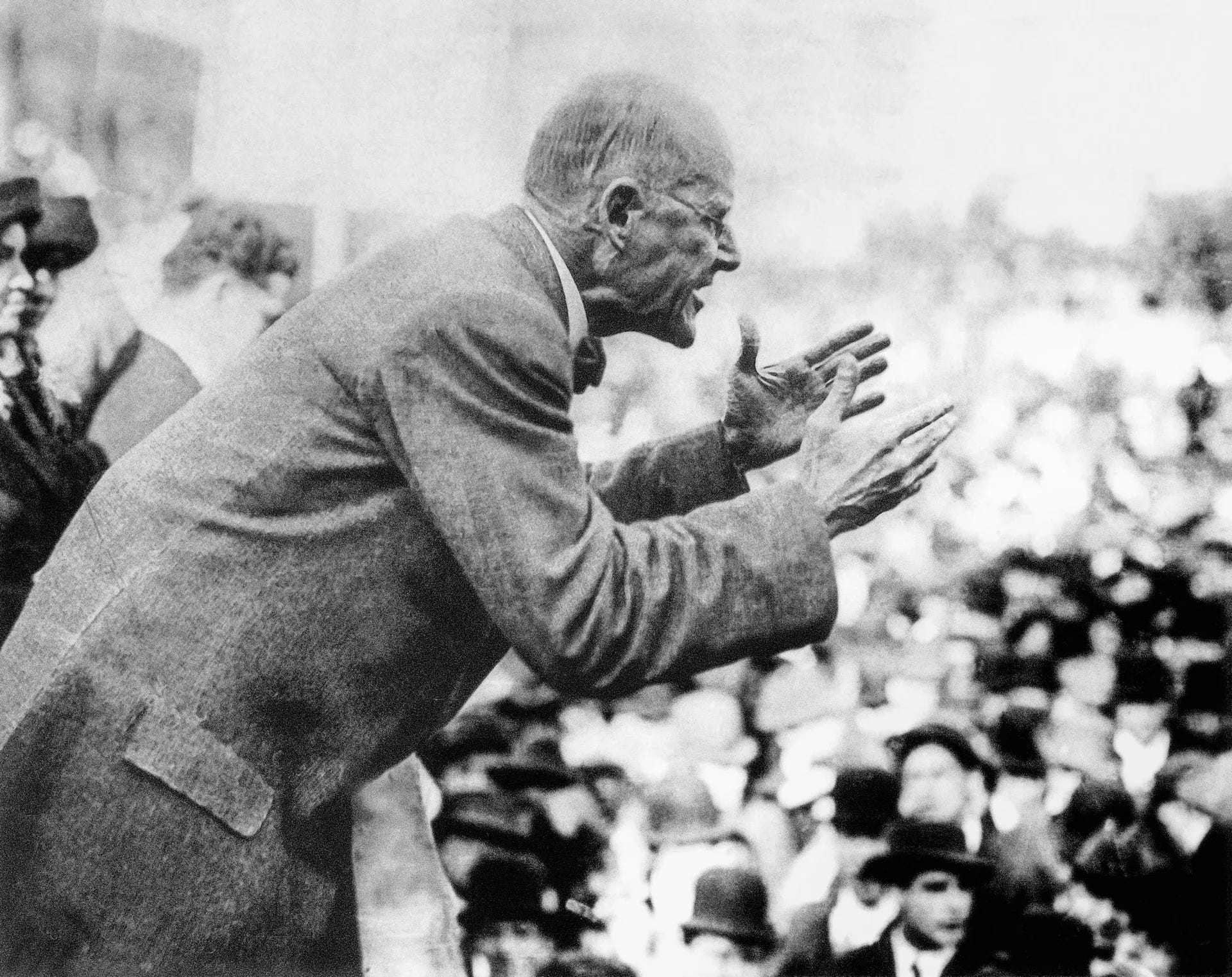
Givan’s piece is best read as a reportage. She opens with real numbers—39 percent of Americans now hold a positive view of socialism, rising to more than half among young people, and the Democratic Socialists of America (DSA) has grown to 120,000 members—and talks to a genuine cross-section of DSA, from Minneapolis co-chair Aminah to members of the further-left Mountain and Reform and Revolution caucuses, and lets them disagree with each other in their own words rather than flattening them into one message.
The disagreement that emerges is the classic one: is DSA building a movement or running a candidate-recruitment pipeline into the Democratic Party? The piece doesn’t resolve this, and to its credit doesn’t pretend to. Rather, Givan notes that while DSA describes its project as “building a party,” it runs its candidates on the Democratic ballot line, with the built-in risk that its elected officials drift rightward once in office, and offers Alexandria Ocasio-Cortez’s vote for “defensive” arms to Israel, and DSA’s subsequent withdrawal of her endorsement, as the cautionary case in point. Also, the piece refuses to let the coverage of Zohran Mamdani collapse into simple celebration.
Givan reaches for Eugene Debs’s own skepticism of electoralism. Debs argued there was “absolutely no difference” between the Democrats and Republicans on the fundamentals, and famously insisted “you’ll never vote the Socialist Republic into existence,” treating workers’ struggle rather than the ballot as the real engine of change, and closes on April’s call for a “class struggle electoral strategy” that treats elected socialists not as better individual politicians but as a catalyst for independent working-class organization.
Brilliant.
The Cockroach Protests Are Reviving India’s Ailing Democracy — Komal Mohite, Jacobin
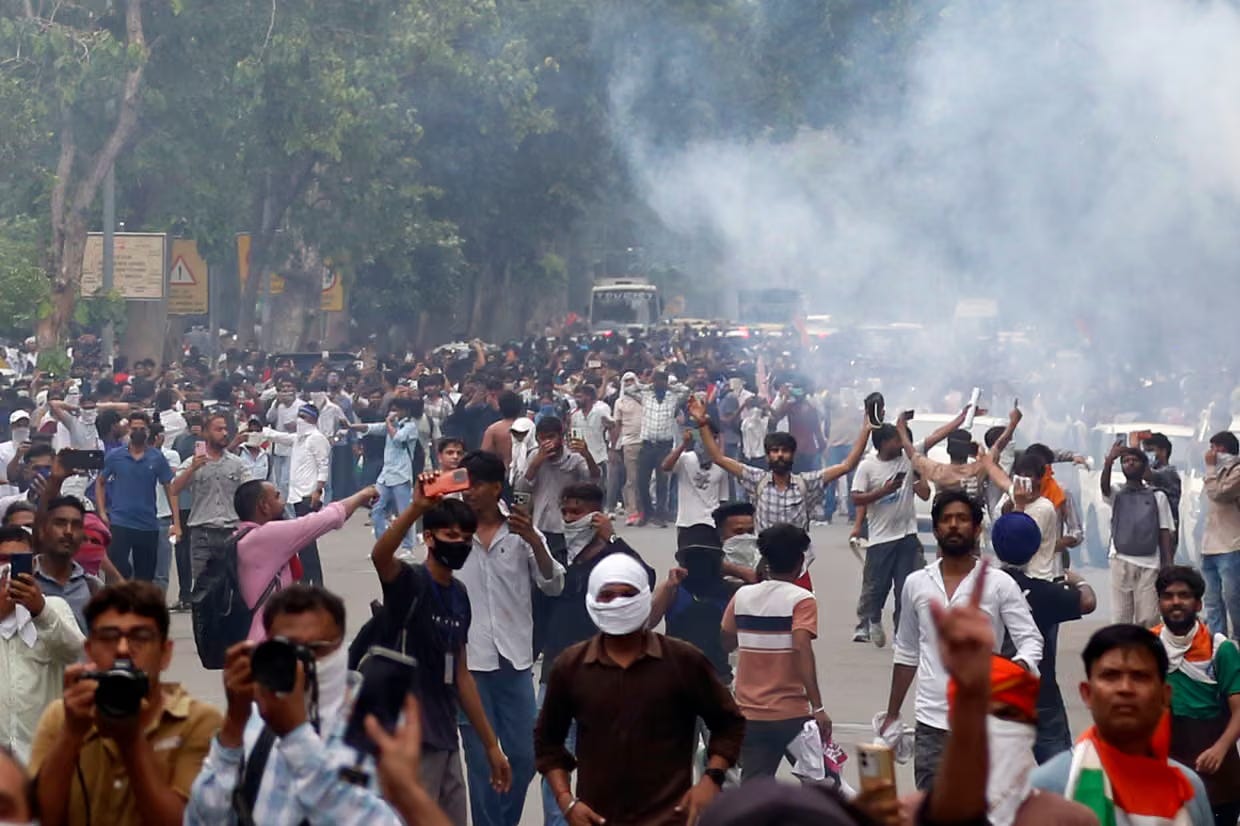
India’s “cockroach” movement, which forced the resignation of India’s education minister and is now demanding Modi’s own, is an arc often framed either as a spontaneous “Gen Z moment” or a simple morality tale of youth versus corruption. Mohite does neither. Instead, he argues that the movement’s real fuel is structural, and spends most of its length making that case.
He draws a direct connection between exam-leak outrage and the broader hollowing-out of Indian public education under the 2020 National Education Policy, which marked a shift toward standardized, commercialized, centrally-controlled schooling that the piece argues has deepened caste and class inequality by making quality education a function of what a family can pay.
The unemployment data does real work. Over 12 million applicants for under 9,000 railway jobs, PhD holders applying for peon positions…it frames the exam-leak grievance as one visible symptom of a much larger crisis of downward mobility.
The essay is also careful, and rightly so, not to romanticize the movement’s composition. Mohite explicitly notes that a significant share of protesters come from Hindu middle-class families who’ve backed Modi’s Hindutva politics, and treats that as a genuine complication. He holds the line and states that the Left’s task now is to push the movement’s anger past its single-issue origin toward “an anti-capitalist horizon,” rather than assume the horizon is already there.
Where the essay is thinner is in explaining the mechanics of that pivot. It reports, correctly, that Left student wings have been involved from the movement’s inception, and closes by insisting “only the Left can take the student movement further.” But it doesn’t show much of what that intervention actually looks like on the ground: what demands Left groups are raising inside the coalition, or where they’re meeting friction from the more moderate, single-issue-focused Cockroach Janta Party (CJP) leadership. That’s a real gap, especially given the essay’s own acknowledgment that a large bloc of protesters arrived via Bharatiya Janata Party (BJP)-aligned families rather than existing radical politics.
The comparison to the failed 2019–20 anti-CAA protests and the 2020 farmers’ movement is genuinely useful context, and correctly identifies what’s different this time: those movements, even at their largest, never fully generalized into opposition to the government itself, while this one has. This could be true, or it could be the kind of claim that looks more solid in the moment than it will in retrospect.
It’s worth watching how this article ages.
Why Trump is warming toward Zelenskyy — Shelby Talcott and Burgess Everett, Semafor
Since the war on Iran started and as Trump increasingly finds himself trapped with no way out, the relationship between US and Ukrainian presidents has witnessed a noticeable improvement, which the authors treat as a question of political calculation rather than a shift in ideological sympathy. The article notes Trump’s newfound support for Ukrainian Patriot missile production and his praise for Zelenskyy, reading this reversal, after years of tension and right-wing skepticism, as an opportunistic response to Russia’s current military struggles.
The most telling detail is the argument that Trump’s primary motivation is to secure a foreign policy victory before the midterms. If Russia is weakened, the calculation goes, pressing Putin with sanctions and a warmer stance toward Kyiv becomes the quickest route to forcing a negotiated settlement. In this framing, Ukraine is not an ally to be defended on principle, but a lever to be pulled in a broader effort to extract a “win” that can be touted domestically, especially as the US continues to incur strategic losses in the Middle East.
Talcott and Everett accurately highlight the fragility of this support. Trump’s complaints about the US weapons stockpile, and his insistence that Joe Biden “gave too much” to Ukraine, reveal that his transactional approach to foreign policy remains intact. Unlike his predecessor, the alliance is based less on the pretense of a commitment to Ukrainian sovereignty than a tactical maneuver by an administration seeking to manage its international liabilities and claim credit for ending a war.
What the piece captures, perhaps unintentionally, is the grim reality of client-state dependency. Whether the US administration is hostile or friendly, Ukraine’s ability to defend itself is entirely subordinated to the electoral needs and personal vanity of the American executive. The shift from “Russia sympathizer” to “Ukraine defender” among Trump’s allies is presented as a strategic adjustment, reminding us that for the US ruling class, “international solidarity” is no more than another bargaining chip.
The Region
Ten years since the failed coup in Turkey: The trauma on which Erdogan has built his hyper-presidentialism — Andrés Mourenza, El Pais
This article looks back at the July 2016 military uprising and its usefulness to the Turkish state apparatus. The piece argues that the failed coup provided exactly the shock necessary for Recep Tayyip Erdoğan to fundamentally reshape Turkish institutions, crushing democratic liberties and shifting the country from a parliamentary system to a highly centralized executive presidency.
What is most useful here is how Mourenza historicizes the ruling party’s reaction, framing the “Epic of July 15” not merely as a defense against military overreach, but as an active political technology. He highlights how the state of emergency was deployed far beyond the immediate plotters, the “Gülenist movement,” to purge tens of thousands of civil servants and imprison leftists, Kurdish politicians, and union organizers. The coup attempt was a crisis, certainly, but it was also an immense opportunity, functioning as a pretext for the mass removal of political opponents under the guise of national security.
The contradiction is clearest in how the state both celebrates and mystifies the event. Mourenza notes that despite the public mythology of citizens bravely defeating tanks, fundamental questions about what the intelligence services knew remain unanswered, reinforcing suspicions of a “controlled coup.”
By permanently maintaining emergency practices, such as replacing elected opposition mayors with state trustees, the government guarantees that the crisis is never truly resolved. The perpetual threat of treason becomes the engine of state power.
This dynamic is not unique to Turkey in any way, it is the familiar logic of the national security state. The article is a sharp reminder of how quickly ruling classes can seize upon a rupture to bypass institutional restraints and criminalize dissent. By turning the defeat of the coup into the founding myth of a new, more autocratic republic, the Turkish state demonstrated how effectively democratic language can be used to justify the dismantling of democracy itself.
Filmed in Western Sahara, The Odyssey Endorses Colonialism — Eoghin Gilmartin, Jacobin
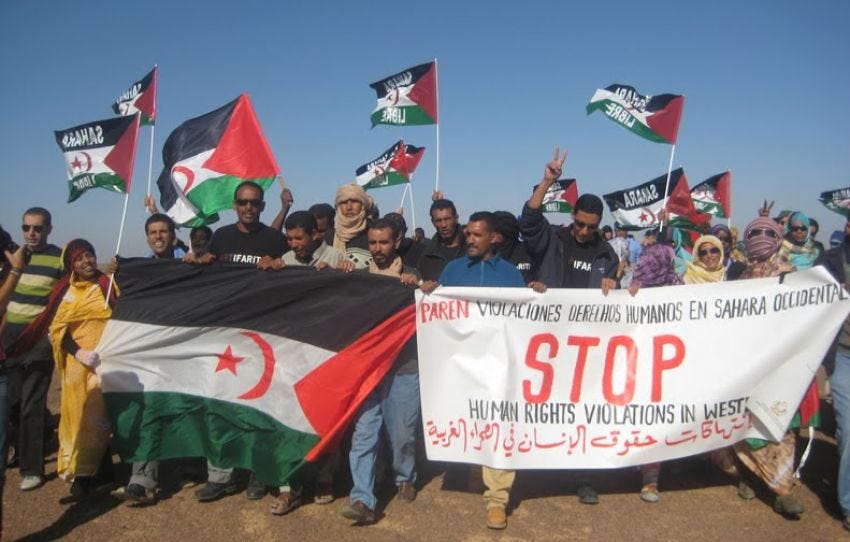
This piece does something a lot of “problematic production” pieces don’t bother with, it makes the case that the location choice isn’t incidental set dressing but load-bearing to an active state strategy.
First, Gilmartin traces how Dakhla’s transformation into a film location fits a documented Moroccan pattern of using investment (a €1.3 billion port facility), tourism (Ryanair routes, luxury resorts, Ivanka Trump’s photo op), and now cinema to make the occupation look like a settled economic fact rather than an active territorial dispute still on the United Nation’s decolonization list.
Essentially, Hollywood’s presence functions as exactly the kind of legitimizing signal Morocco has been engineering for years.
The piece is also careful to source its harshest claims rather than assert them. The comparison of Morocco’s practices to those of an occupying power is backed by the UN Working Group on Arbitrary Detention’s 2023 finding that the detentions of two dozen Sahrawi activists were illegal, and by documentation that torture was used to extract confessions from student activists in 2016.
Gilmartin cites Sahrawi filmmaker Brahim Chagaf’s account of being barred from his own homeland while Nolan filmed freely there, and rights defender Ghalia Djimi’s testimony of being disappeared for over three years.
To read more about Morocco’s occupation of the Western Sahara, click here and here.
Babies in Gaza Die Preventable Deaths Due to Medical Shortages Imposed by Israel — Shahad Ali & Sojoud Alkhour, Truthout
More than anything, this is a devastating documentation of the systematic collapse of maternal and neonatal care in Gaza amidst the ongoing Israeli genocide. Through the testimonies of mothers and physicians, the piece traces how basic survival has been engineered out of existence: women undergo unanesthetized cesarean sections, are discharged prematurely into unsanitary tents, and watch their newborns die for lack of functioning incubators and oxygen.
The most critical intervention here is the refusal to treat these deaths as a tragic but passive consequence of “conflict.” By highlighting Israel’s classification of essential supplies like anesthesia and sterile equipment as “dual-use” items, the authors set out to show that the medical collapse is not “incidental damage,” but the bureaucratic technology of genocide. The deaths of these infants are presented precisely for what they are: the foreseeable, managed outcome of a blockade designed to make reproduction and survival biologically impossible.
This focus on the logistical details of the blockade, who donates blood when the hospital has none, who changes a surgical dressing in an overcrowded ward, grounds the scale of the destruction in the physical reality of survival. The article shows that beneath the geopolitical rhetoric of “security,” the actual practices of state violence and genocidal intent are a daily assault on the bodies of mothers and children.
What emerges is a clear picture of how settler-colonial violence extends beyond the immediate moment of a bombing to control the very conditions of life and death. The testimonies do not ask for humanitarian sympathy; they demand a political understanding of a medical system deliberately starved of resources. By tying the personal grief of these mothers directly to the political mechanisms of the siege, the authors make it impossible to view the crisis as anything other than a man-made catastrophe.
A predatory state — Palestinian Feminist Collective

This report by the Palestinian Feminist Collective treats sexual violence not as an aberration of war or the failure of individual discipline, but as a structural instrument of statecraft and colonial management. The report maps a continuous history from 1948 to the current genocide in Gaza, proving that sexual humiliation, torture, and blackmail are systematic techniques used by a predatory state to break Palestinian social cohesion and enforce demographic control.
What is most effective here is the conceptual shift from viewing sexual violence as a purely individual trauma to analyzing it as a political tool. The report’s detailing of esqat—the use of sexualized blackmail, surveillance, and “honeytraps” to coerce Palestinians into collaboration—shows how intimacy and bodily autonomy are transformed into intelligence assets. By documenting how Israel weaponizes sexual shame and queer identities to extract information or compliance, the authors demonstrate that the occupation operates not just through sheer military force, but through the micro-management and violent exploitation of Palestinian social and familial life.
The report also makes a crucial intervention against liberal, Euro-Western feminist frameworks that often isolate sexual violence from its anti-colonial context. The authors argue that the discourse surrounding mass rape accusations against Palestinians on October 7 was mobilized precisely to justify reproductive genocide and the mass killing of civilians. In this analysis, the racialized construction of Palestinian men as inherent sexual threats serves a dual purpose: it manufactures the moral justification for the colonizer’s violence while obscuring the deeply institutionalized sexual violence perpetrated by Israeli soldiers and interrogators.
Ultimately, the document refuses to let sexual and gendered violence remain in the depoliticized realm of “human rights abuses.” By linking domicide (the systemic destruction of homes), forced displacement, and AI-assisted targeting, such as the automated “Where’s Daddy” software, to the disruption of the Palestinian family unit, the report insists that reproductive and gendered violence are central to the mechanics of ethnic cleansing.
The IMF’s suspicious silence: Where is the war? — Nabeel Abdou, Sifr
Within a day of Russia’s invasion of Ukraine, the IMF’s managing director was expressing grief and warning of serious economic fallout. For the US-Israeli war on Iran, the IMF waited four days to say anything, never named Tehran, opened with energy prices rather than casualties, and declared it “too early” to say much of anything, with a fuller answer deferred a month and a half, conveniently timed to its already-scheduled spring meetings.
The obvious cover story is sanctions. The IMF can’t lend to Iran, so why would it comment on Iran?
Abdo rightly names the smokescreen.
The IMF’s Article IV mandate isn’t a lending function; it’s supposed to be a surveillance function, an early-warning system for the world economy that doesn’t stop at the border of who’s creditworthy or politically permissible to fund. Sanctions explain why Tehran can’t get a support package. They explain nothing about why the institution that’s supposed to tell the world when the Strait of Hormuz closing might trigger an energy shock worse than 1973 and 1979 combined chose to say almost nothing about it for weeks.
The IMF was born at Bretton Woods to manage a specific world-system; dollar-centered, built to keep capital circulating across borders while labor and sovereignty stayed put, and every one of its “technical” functions has always operated in the service of that arrangement, not above it. This is the base-superstructure relation: an institution that presents itself as a neutral, rules-based referee is in fact a piece of superstructure whose neutrality is only ever available to those already inside the system it exists to reproduce. Its silence isn’t a lapse in that function at all, but a sign that it is working correctly.
And this is where the essay’s real ideological work shows up.
For decades, the IMF has told the Global South that austerity is a technical necessity, not a class choice. It has passed down its recipe; cut the subsidy and devalue the currency, this is simply what the numbers demand. Again, this is ideology presenting the interests of capital as universal, natural, and apolitical.
None of this should read as revelation. However, Abdo’s side-by-side timeline is a genuinely useful specimen of how the mechanism operates in real time, which matters for anyone who has to argue this case against people still inclined to take “technical assessment” at face value.
How did employers treat workers during the war in Lebanon? Four infographics explain it — Mohamed El-Khansa, Sifr
El-Khansa drops numbers. A third of surveyed workers were jobless when the ILO polled them in May 2026. Among those who kept their jobs but had hours cut, 78% called their pay cuts disproportionate to the hours lost, meaning “reduced hours” became cover for wage theft, not just cost-cutting.
Pay delays hit Syrian workers at nearly triple the rate of the overall sample. And 89% of workers got no support from employers at all, with what little existed skewed hardest toward Lebanese nationals and away from Syrians, Palestinians, and other migrants.
Egypt
Sedition à la carte| How one half-truth launched a movement — Saker El Nour, Al Manassa

Brilliant Egyptian rural sociologist, Saker El-Nour, does the patient work of dismantling Dr. Diaa El-Awadi’s Tayyibat diet. The first in a two-part series, El-Nour separates claims with a genuine kernel of truth from claims stretched past what evidence supports, from claims with no scientific basis at all and direct, measurable public-health cost.
The piece is also sharp on internal contradiction as a diagnostic tool. The diet bans eggs, legumes, and yogurt (documented protein and micronutrient sources) while leaving sugar, chocolate, and hard cheese essentially unrestricted, and even declining to flatly prohibit smoking. A system this internally inconsistent isn’t really operating on nutritional logic at all.
What El-Nour gestures at but doesn’t yet develop—he explicitly promises to return to this in part two—is the more interesting question: why does a diet this incoherent attract 11,600 posts, 3.1 billion views, and 51 million engagements in two months, in a country where, as the piece itself notes almost in passing, millions of people are struggling with the cost of medical treatment?
El-Awadi, a dismissed anesthesiologist with no training in nutrition or endocrinology, built an audience of millions promising recovery from chronic disease without medication; and the material condition making that promise land isn’t credulity in the abstract, it’s a healthcare system where actual medical care is often unaffordable, and where “free” advice promising to replace an insulin prescription with dietary discipline is not a fringe curiosity but a real economic alternative for people priced out of treatment.
Sedition à la carte | Why Do They Believe El-Awadi? — Saker El Nour, Al Manassa
Where part one dismantled El-Awadi’s claims fact by fact, part two asks why hundreds of thousands of people believed him anyway, and refuses both of the easy answers on offer; that his followers were credulous dupes, or that they were conspiracy theorists rejecting modern medicine wholesale.
What El-Nour finds instead, through actual interviews rather than survey aggregates alone, is a pattern of selective adherence. People who defended El-Awadi passionately, called him a martyr, cut out eggs and chicken, often quietly kept taking their diabetes medication, getting their blood work done, and negotiated a middle path summarized in one mother’s instruction to her son: “follow the Tayyibat, but take your medicine.” That’s a genuinely important corrective to how these stories usually get told, and it treats the followers as people making constrained, rational-under-pressure choices rather than as a mass of the deceived or the delusional.
The piece’s real center of gravity, though, is the material argument it builds toward and finally states directly: the gap opened by low government health spending wasn’t a passive backdrop to this phenomenon, it was its founding condition.
When a citizen bears more than half their treatment costs out of pocket, and when over half the population can’t afford an adequate diet in the first place, a free video promising recovery isn’t just ideologically appealing, it’s economically rational to try, before it’s persuasive on any other grounds.
That’s a more useful frame than “misinformation spreads because people are gullible,” because it locates the cause in austerity and the collapse of public healthcare access rather than in a failure of individual reasoning. The quoted testimony that opens the piece does more to explain the movement’s appeal than any amount of commentary on charisma or algorithm-chasing could.
The essay is also honest about where this analysis has limits, and to his credit, El-Nour doesn’t let sympathy for the underlying economic desperation soften the actual stakes. He names documented deaths, a child and a young diabetic man who stopped insulin on El-Awadi’s advice, as a hard boundary that resists reframing, no matter how well the social and psychological drivers are understood.
One of the essay’s most revealing observations is that official institutions’ counter-messaging was largely ineffective, while the real line of defense against the diet’s most dangerous elements came from family members pressuring patients directly.
El-Nour concludes that Egypt’s healthcare system “assassinates thousands through neglect, leaving them prey to the brutality of the market and the myths of social media.”
Studio Samara: When “Egypt” Visited Masr — Yara Shahin, Mada Masr

 Tiktok failed to load.
Enable 3rd party cookies or use another browser
Engaging with Shahin’s piece in English feels almost wrong, but needs must.
What she is describing, despite not reaching for the vocabulary, is use-value being evicted by exchange-value in real time, and watching it happen to your own childhood is a specific, disorienting kind of grief.
Downtown Cairo, in Shahin’s memory, was a space organized around use. Her mother’s actual workplace, ice cream as an actual reward, sidewalks she could loiter on for hours because loitering had a use to her, it was simply how you lived in a city.
The ironing man on the corner, the foul and ta’meya cart feeding an entire street its breakfast, these aren’t picturesque details, they’re labor meeting need directly, with no spectator required. That’s what a neighborhood is under a use-value logic: things exist because people need them, not because someone is watching.
What’s moved in—the ministries first, then the restaurants, then Studio Samara—is a different organizing principle entirely. Capital doesn’t want downtown Cairo’s use-value. It wants its exchange-value, and specifically its exchange-value as an experience that can be sold to people who no longer live inside the thing being sold.
Shahin catches the mechanism exactly when she describes a restaurant that includes “a corner where an ironing man practices his ordinary profession as though it were a performance, not a trade that exists on every street in the city.” That’s the whole transformation in one image: labor, stripped of its purpose, re-packaged as ambiance.
Studio Samara is the same operation, aimed at culture instead of trade labor. Folk performance, wedding processions, sha’abi songs, and the choreography and history behind decades of popular entertainment, gets stripped of the social relations that gave it meaning and resold as costume.
Shahin’s most devastating passage isn’t really about bad choreography. It’s the moment she imagines the venue’s own waitstaff watching their actual lives, the weddings they grew up attending in Matariya, Imbaba, and Shubra, get performed back at a paying audience as spectacle, gorilla costume included.
That’s alienation in something close to Marx’s original sense: workers watching their own social existence get converted into a product they don’t own, staged for consumers who mistake the performance for the thing itself.
The wedding that was once value produced for use, for a community’s own celebration and joy, becomes restaged, its value produced for exchange, extracted and sold back as “authenticity” to people who either no longer have access to the real version, or never actually did.
Shahin’s Beirut comparison sharpens the class dimension further, because Metro al-Madina apparently did the same extraction with actual labor and craft behind it; real musicological research, trained performers, and costuming that respected the material it was drawing from. Yes, commodification of cultural heritage isn’t avoidable once capital moves in, but the degree of care in the extraction is still a choice, and it’s a choice made by whoever owns the venue and sets the budget.
Studio Samara’s shoddiness—the cheap costumes, the untrained young performers, the incoherent set list—isn’t incidental. It’s what happens when a space is confident enough in its captive nostalgia-market that it doesn’t need to invest in the product it’s selling.
Her essay’s real ambivalence is not about taste, but the discomfort of recognizing that her own class position is the toll she’s already paid for access to both worlds, Masr and Egypt.
A beautifully articulated essay.
How Neoliberalism Hollowed Out Love & Compassion — Ahmed Etman
Ahmed Etman brilliantly traces the marketization of romance, arguing that the language of dating, opportunity cost, market value, knowing one’s worth, is not merely metaphorical but the literal colonization of intimacy by the logic of human capital. The piece insists that passion, traditionally understood as an uncalculated surrender, has become structurally impossible for a precariously employed working class deprived of both surplus time and the collective spaces that once sustained solidarity.
The most useful intervention here is the rejection of nostalgia. The author relies on Engels to remind us that bourgeois romantic love was itself a historical product, an idealized refuge built alongside the nuclear family’s role in the transmission of private property. Neoliberalism, in this reading, did not invent the commodification of love from nothing; it merely stripped away the illusion of autonomy that classical capitalism once afforded the private sphere.
The contradiction is clearest in the critique of dating apps, which the article presents as literal markets governed by an “economy of false abundance.” In a system where everyone is forced to manage themselves as an enterprise, commitment begins to look like an irrational investment risk. The problem, as the author sharply notes, is not technological but material: “time poverty” is a class condition, rendering the prolonged waiting and shared boredom required for deep connection a luxury available only to the economically secure.
Crucially, the essay dismisses individual solutions like “digital detoxes” as inadequate for a structural crisis. The final argument makes clear that reclaiming romance is impossible without reclaiming time and labor from the market. It is a sobering reminder that personal life cannot be ring-fenced from the relations of production: true passion, unmanaged by the logic of supply and demand, requires nothing less than the dismantling of the coercive economic necessity that turns both labor and love into commodities.
The “Husband Stitch”: The Postpartum Surgery Women Don’t Talk About — Asmaa Hassanein, Zawia3
Hassanein dives head-first into an investigation on something often dismissed as folk rumor and uncovers it’s a documented pattern with a cost, a mechanism, and a body count of ordinary suffering behind it.
She refuses to flatten “vaginal tightening surgery” into one thing. Instead, Hassanein carefully distinguishes procedures a woman requests for herself, as an informed adult exercising bodily autonomy, from the “husband’s stitch” proper, an unrequested, medically unnecessary addition made during routine post-birth suturing, without consent, specifically to enhance a husband’s sexual experience.
That distinction matters enormously, and Hassanein is disciplined about maintaining it even while making her larger argument, quoting a doctor who defines the ethical line precisely: if there’s no wound, there’s no medical justification for stitching at all, and the whole practice reduces to a violation dressed as a repair.
Where the investigation does its most valuable work is tracing how “choice” gets manufactured.
Mona Abdullah didn’t choose surgery because of pain, incontinence, or any diagnosed condition, she chose it after months of her husband comparing her body to what it was before pregnancy, after friends normalized the procedure as simply what postpartum women do now, after losing confidence in her own body under sustained pressure.
Her own words, “I wasn’t looking for cosmetic enhancement, I was looking for stability, and I felt my body had become responsible for keeping my marriage together,” describe something that technically clears the bar of “consent” while making clear how thin that consent actually is.
Hassanein cleverly holds both truths at once: some women, like Hasnaa Salem, genuinely want this procedure for themselves, and that’s a legitimate choice the piece explicitly protects; but a great many “choices” here are downstream of an ultimatum, explicit or implied, backed by the real economic and social cost of divorce.
The material dimension gets real space too. The 20,000-pound cost, sometimes borrowed from a sister, weighed against family income, is not a footnote, but the mechanism by which this becomes a class issue as much as a gendered one: women without that money face the ultimatum with fewer options, and the procedure’s price tag becomes one more lever in an already unequal negotiation.
What’s missing, and worth naming, is the state’s role in the vacuum the piece documents so well. It notes, almost in passing, that there’s no official data on how often this happens, no mandatory hospital reporting, no accountability mechanism, and then largely treats that absence as a research problem rather than a political one. But an unregulated, unmonitored cosmetic-gynecology industry growing at 16% annually, operating on the most sensitive part of a woman’s body with functionally no oversight, is not a data gap.
How can Egypt achieve “financial sustainability”? And who pays the price? — Hassan El-Barbary, Sifr
The World Bank’s June 2026 forecast, Egyptian growth rising from 2.4% to 4.6%, gets one paragraph before the essay moves to its actual subject: what “fiscal sustainability” is a euphemism for, and who’s paying its bill.
El-Barbary is careful to show how the term itself is doing a lot of ideological work, he notes that even mainstream monetary economics literature questions whether focusing on fiscal indicators comes at the expense of employment, wages, social spending, and public investment, meaning the critique isn’t radical framing imposed from outside, it’s a live methodological dispute the World Bank’s own definition glosses over.
El-Barbary, an accountant, sticks to his strongest suit: numbers. He breaks down how Egypt’s targeted primary surplus, 795 billion pounds, roughly 4% of GDP, the highest since the economic reform program began, is calculated before debt interest payments, which alone consume roughly 2.3 trillion pounds of a 4.6 trillion pound budget, near half of all government spending.
That means the surplus doesn’t represent debt relief at all, but the gap between what the state extracts from its population and what it spends on them, with that gap then funneled straight into interest payments. Stated that plainly, “fiscal sustainability” starts sounding like a description of who gets squeezed to keep creditors paid.
He is equally precise about where the revenue side of that surplus actually comes from. Tax revenue makes up 84% of projected government income, targeted to grow 38% year over year, and he flags clearly that this isn’t just a question of volume but of composition: VAT and consumption taxes, which fall on spending rather than income, are among the largest sources, meaning their weight lands hardest on those who spend the largest share of what they earn, which is by definition the poor.
Paired with the removal of fuel, electricity, water, and transport subsidies, and inflation that peaked at 38% in September 2023 before “slowing” to a still-brutal 12.3% by the end of 2025, El-Barbary highlights that a falling inflation rate doesn’t mean falling prices, just a slower climb from an already-elevated base. The picture that emerges is of a surplus manufactured almost entirely through the consumption of ordinary households, dressed in the neutral language of macroeconomic indicators.
An absolute must read, even if it does not go on to name who “exactly” benefits.
The Middle Generation Enters the Scene: Can Restructuring Save Egypt’s Civil Democratic Movement? — Shimaa Hamdy, Zawia3
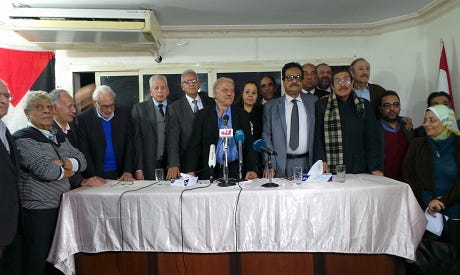
This is institutional reporting on a genuinely revealing crisis, and Hamdy’s real service is showing how a single bad statement functioned as a diagnostic test for everything already wrong underneath. The precipitating scandal is almost comic in its smallness. The Civil Democratic Movement, Egypt’s largest opposition coalition, issued a statement defending a Conservative Party leader’s Nile-front palace from demolition, equating a wealthy businessman’s illegal encroachment on the river’s protected zone with the actual displacement cases of families on Warraq and Qursaya islands and historic cemeteries.
The comparison was, rightly, met with wide criticism, and the coalition had to retract it and apologize within two days. That the coalition nearly split itself apart defending one man’s riverfront villa says more about who actually has influence inside it than any structural chart would.
Hamdy’s strongest choice is refusing to let the palace episode read as an isolated embarrassment. She traces it directly to the deeper, unresolved question every source in the piece keeps circling: who is actually a member of this coalition, and by what standard.
Ahmed El-Tantawy’s framing, that the movement needs to settle “who its members are and how its decisions get made” before anything else matters, is the piece’s real thesis, and Hamdy lets multiple sources independently confirm it from different angles, with Khaled Talima naming the Conservative Party specifically as a case study in a party benefiting from opposition-coalition legitimacy while never having earned it through actual opposition politics, and a source close to the party itself confirming it’s still privately weighing whether to leave rather than reform.
The piece is admirably specific about what “restructuring” actually means in practice rather than leaving it as vague institutional language; abolishing the board of trustees in favor of a general secretariat, ending a largely ceremonial board-chair position, rotating meetings between member parties instead of concentrating them at one headquarters, weighting votes by party size rather than treating a party’s vote as equal to an individual public figure’s. These are unglamorous, plumbing-level reforms, and Hamdy is right to give them real space, because they’re exactly the kind of decision-making mechanics that determined whether one party could effectively hijack the coalition’s voice for a personal grievance in the first place.
Where the piece does its most interesting political work is in the generational framing built into its own title. The push to bring in the “middle generation,” associated with the January 2011 revolution’s political cohort, reads as an attempt to solve a structural legitimacy problem with a demographic fix. Akram Ismail’s account is candid about the tension this creates. He describes two camps inside multiple-member parties simultaneously, one believing restructuring can revive the coalition, the other believing it already accomplished its purpose and should be allowed to end.
What the piece is honest about, and what elevates it past a straightforward organizational-politics writeup, is El-Tantawy’s blunter framing near the essay’s center. He explains that the coalition’s habit of governing by consensus makes decisive action nearly impossible, and that the real danger isn’t occasional error but drift into permanent paralysis. That’s a sharp, generalizable point about coalition politics under authoritarian constraint specifically, because when the state itself makes any independent political organizing costly, internal consensus-seeking becomes a mechanism for avoiding risk rather than building unity, and the cost of that caution compounds quietly until a moment like the palace statement exposes it all at once.
What’s missing is any voice outside the coalition’s own leadership, but this remains essential reading for anyone tracking Egypt’s civil opposition and how it actually functions internally.
Empire in the Mirror — Hossam el-Hamalawy
In this part of his ongoing series on the history of the Egyptian army in Sudan, Hossam el-Hamalawy reviews Eve M. Troutt Powell’s 2003 book A Different Shade of Colonialism and draws out its central, uncomfortable thesis that Egyptian nationalism did not simply emerge in opposition to British imperialism; it was co-produced by Egypt’s own colonial project in Sudan. El-Hamalawy uses Powell’s work to dismantle the comforting victim narrative that insists colonized people only ever experience empire from the bottom up.
The most striking intervention here is the focus on the Egyptian military as the primary vehicle of this contradiction. For the 19th-century Egyptian officer corps, Sudan was not merely a neighboring territory but an imperial frontier, a place for career advancement, punitive deployment, and the exercise of civilizing authority. When the Mahdist revolt in Sudan and the British occupation simultaneously collapsed this world in the 1880s, Egyptian officers experienced the loss not just as an anti-colonial defeat at home, but as the devastating loss of their own mastery over the south.
The contradiction is clearest in the figure of Ibrahim Fawzi, who fought the British while fiercely holding on to his sense of “civilizational superiority” over the Sudanese. El-Hamalawy notes how Fawzi embodies the “colonized colonizer,” holding an anti-colonial grievance against London while demanding proprietary rights over Khartoum. This is the heart of the critique: a reminder that the language of the household, where Sudanese domestic slaves were allegedly “uplifted,” scaled up seamlessly into the language of the state, justifying imperial expansion as paternal care.
While el-Hamalawy notes the book’s tilt toward elite intellectual history at the expense of operational details, the review’s broader stakes are clear. It refuses to let Egyptian nationalism remain innocent of its own racialized hierarchies and expansionist logic. By foregrounding the military’s role in this colonial imagination, the piece insists that understanding state power in Egypt requires looking south, recognizing that the very forces demanding sovereignty from Europe were actively practicing domination in Africa.
The Egyptian-Sudanese Battalion That Fought for the French in Mexico — Hossam el-Hamalawy
At this point in the review/engagement writing process of this reading list, the recurring theme seems to be journalists and writers refusing easy explanations or positions.
El-Hamalawy’s is no different. In this installment, part of his ongoing series on the history of the Egyptian army in Sudan, he refuses the two easy stories this material offers.
It would be simple to write these men as tragic victims; Sudanese boys seized by conquest, enslaved, manumitted into permanent conscription, and then shipped across an ocean to die of fever guarding a French railway in someone else’s civil war. It would be almost as simple to write them as forgotten heroes, a “black corps d’élite” deserving belated recognition.
El-Hamalawy does neither.
He explains clearly that these were coerced men who became instruments of coercion, colonial subjects turned imperial enforcers, and the essay refuses to let either half of that cancel the other out. To the Mexicans resisting French occupation, he notes, the Sudanese battalion “could appear as agents of violence and repression no different from the French themselves,” and he lets that stand without softening it, even while spending most of the essay establishing exactly how these men came to be in that position through no real choice of their own.
He explains that colonial armies functioned as reservoirs of labor, extractable and shippable across oceans regardless of where the men were actually needed. Sudan fed the Egyptian army, and, in turn, the Egyptian army fed the French project in Mexico.
That’s a genuinely useful way to think about imperial military structures generally, not as fixed national forces, as they are often portrayed, but as a kind of labor market in violence, where conscripted bodies circulate to wherever the imperial center’s fever belt, terrain, or racial theory of the moment requires them. The detail that the French specifically wanted troops they believed could survive yellow fever better than Europeans is the whole logic of the arrangement; these men’s value to empire was calculated, quite literally, in terms of expendability.
The essay’s most interesting turn, and the one that elevates it above a colorful historical anecdote, is the contrast between the battalion’s steadiness in Mexico and the mutiny that destroyed its planned reinforcement back home in Kasala.
El-Hamalawy uses this pairing to make the argument that military loyalty here wasn’t cultural or racial, as contemporary observers might believe, but contractual and material. In Mexico, brutal as the deployment was, the French command paid, fed, and looked after the men in practical terms, and the battalion held. In Sudan, when officers secretly received pay while their men went unpaid, the same military culture produced open mutiny and looting within weeks.
That’s a clean, well-evidenced demonstration that consent to serve an oppressive institution is always conditional on the institution honoring its side of an exploitative bargain, and it collapses immediately once that bargain is visibly broken. It’s a genuinely materialist reading of loyalty, and it’s earned by the specific archival detail.
The real teeth-kicker, however, is the realization that colonial service abroad functioned as a channel of internal mobility within an otherwise rigid racial hierarchy. Essentially, empire offered its most brutalized conscripts one route to relative status, and that route ran through helping crush another people’s resistance to a different empire.
El-Hamalawy calls it “doubleness”, casually, and does not expand. But the conclusion is right there for us to draw: colonial hierarchies frequently manufacture consent precisely by offering the most subordinated a narrow, blood-priced path upward, which does more to stabilize the hierarchy than any amount of coercion alone could.
As El-Hamalawy concluded, “Their odyssey is a glimpse into how empire really worked.”
Egyptian popular consciousness and the 30 June Revolution: A historical reading — Mohamed El-Saoudi, Ahram Online
A useful reading, not of Egyptian popular consciousness, but of the official mythology built to replace it.
El-Saoudi, who works for the security apparatus-linked Egyptian Centre for Strategic Studies, heading its “National Identity, Values, and Beliefs Studies Unit,” begins from a premise so totalizing it makes argument unnecessary: Egyptians, formed by the Nile and several millennia of centralized rule, possess a "collective instinct to venerate the state as the guarantor of life, property, justice, and survival.
And of course, once the state ceases to be a set of institutions with particular class interests, coercive powers, and political histories, and becomes a civilizational organism, every criticism of those institutions can be recast as a threat to Egypt itself.
The contradiction is clearest in his definition of June 30. The “revolution,” he says, was not made to dismantle existing structures but to “preserve the state,” restore its authority, and shield the armed forces, police, judiciary, Al-Azhar, Church, and bureaucracy from “Brotherhoodization.”
But a mass mobilization whose political content is the rescue of the coercive apparatus and administrative order is not revolutionary in any meaningful social sense. By sheer definition, it is a restoration project, a disguised counterrevolution in waiting, with mass participation supplying the popular mandate.
The article turns this contradiction into a virtue. Egypt is said to have escaped the fate of neighboring states because its people understood the difference between opposing a government and dismantling “national institutions.”
What disappears in this oh-so soothing tale is the more awkward distinction between a state and the people living under it: between institutions that provide public goods and those that suppress independent organisation, between national development and spectacular state expenditure, between stability and political closure.
El-Saoudi’s “popular consciousness” is therefore wonderfully convenient. It is not public opinion, susceptible to propaganda or material interests, but a hidden and timeless national conscience, one that happens to ratify the current regime’s security doctrine, infrastructure agenda, and demand for ideological discipline. Roads, the New Suez Canal, and other “presidential initiatives” appear as self-evident expressions of a people-state compact, rather than policies whose implementation and distributional effects, costs, beneficiaries, and displaced populations require scrutiny.
The conclusion, however, gives the game away: intellectuals, schools, media, and cultural institutions must educate young Egyptians in “national security,” combat supposedly “extremist ideas,” resist rumours, and prevent the loss of confidence in national institutions. This is less a historical reading than the state’s ideological programme that is currently taking place: criticism becomes rumor, political alternatives become ideological capture, and confidence in the state becomes a civic duty.
For what it’s worth, this is a (not so) polished articulation of the New Republic’s preferred origin story, one in which millions acted, but only to hand history back to the institutions, ruled by one man, that would rule over them.
If you have not read it yet, check out this week’s labor dispatch from The Cairo Report:
Egypt, The New Republic: Work made cheap, speech made conditional & rights made temporary

This issue of The Cairo Report covers a strike in a paper company and another in a ceramic manufacturer, three “bread martyrs” in Menoufiya, the reignition of the Al-Wafd journalists’ battle against the newspaper administration, and a profession-wide initiative by the Pharmacists Club to battle the seven-year judicial guardianship imposed on the Pharmac…
*What We’re Reading is a fortnightly list of the stories behind the headlines, read through the lens of class and power. In your inbox every other Wednesday.