



In this issue of What We’re Reading, we examine how private capital and state power sanitize elite privilege and normalize ties with Israel through Egypt’s art scene; the lethal accountability gaps hidden behind Western “precision” warfare in Iraq; and the unraveling illusion of Saudi Arabia’s security umbrella.
We also break down what an Egyptian paycheck actually amounts to after the bare costs of labor, the exploitation underpinning Morocco’s wiring factories, the security apparatus that shaped Hamas’s leadership, and why right wing politics mirrors the defense of Manchester City’s billionaire owners.
World
The Man City theory of politics — Janan Ganesh, Financial Times
Manchester City supporters are currently defending their owners through a financial scandal, sometimes alternating between denying wrongdoing and celebrating it. Janan Ganesh sees a resemblance to Trump and Nigel Farage supporters, whose allegiance survives the failure of policies that supposedly attracted them in the first place.
Eventually, he argues, the original grievance becomes irrelevant, because people have chosen their team.
While the resemblance is spot on, his explanation is much less convincing.
Ganesh correctly recognizes that political commitment involves more than assessing whether a government delivered its promises, as people invest themselves in causes, acquire friendships and interpret disappointments through explanations they already trust. But describing how loyalties become durable leaves us with the question of how particular leaders and interests acquire the benefit of them.
In our previous reading list, Jonathan Liew approached City through the power of its owners. Their wealth supplies influence far beyond football. Ganesh encounters supporters defending those proprietors, then largely abandons the ownership question. Yet the connection between the two is precisely what makes his comparison with right-wing politics interesting.
Supporters care about an institution that belongs to their lives. The owner controls its resources and can finance the success they want. Over time, defending the club can come to mean defending the owner’s authority over it. People with little influence over the business find themselves protecting the proprietor’s freedom to run it. Their attachment is substantial; the identification of their interests with his requires explaining.
A similar operation takes place on the right when loyalty to a country becomes loyalty to a particular organization of property and power. Workers and business owners can be recruited into the same national cause while possessing sharply conflicting interests over wages, taxation and public provision. The movement gives them a common adversary and presents the advancement of its leaders as a victory they share. A billionaire can become “our” billionaire, whose wealth establishes his strength against the establishment rather than his place within it.
This does not mean everyone in the coalition is being deceived. Some supporters gain directly from its policies. Others accept losses because they expect future gains, value advantages over an excluded group, or understand an attack on the leader as an attack on themselves. The coalition holds together through these differences. Explaining it means examining how those commitments are sustained and whose interests prevail when they collide.
Ganesh passes over that political work. He places a banking crash and a “migrant surge” beside one another as possible initial causes of right-wing support, before declaring such origins increasingly beside the point. But migration’s political meaning is already being fought over. Housing shortages and insecure employment require explanations involving landlords, employers and government decisions. Making migrants the common explanation directs anger away from those relationships and toward people with less power within them. That interpretation has to be promoted, defended and renewed.
Right-wing loyalty therefore has a history that continues after the first vote. Parties supply accounts of each new disappointment; leaders identify enemies; institutions distribute rewards and impose costs. The resulting identity can become difficult to challenge. Calling it hard-wired turns the outcome of this continuing activity into something we are invited to accept as human nature.
Nor should we expect exposing a contradiction to dissolve it. A worker can resent an employer’s power while supporting a politician who strengthens employers. Changing that understanding requires more than presenting the correct figures. Collective struggles can give people another experience of where their interests lie and what they can accomplish together.
Liew’s proposal to transfer City to its supporters offers a concrete version of this possibility. Attachment to the club could become a reason to challenge its purchaser’s control. The wider political question is whether people can organize around interests that the existing allegiance subordinates. Ganesh recognizes how effectively loyalty can protect powerful people. He gives up too quickly on those whose loyalty makes that protection possible.
Region
The Many Casualties of Precision Warfare — Jaclynn Ashly, Jacobin
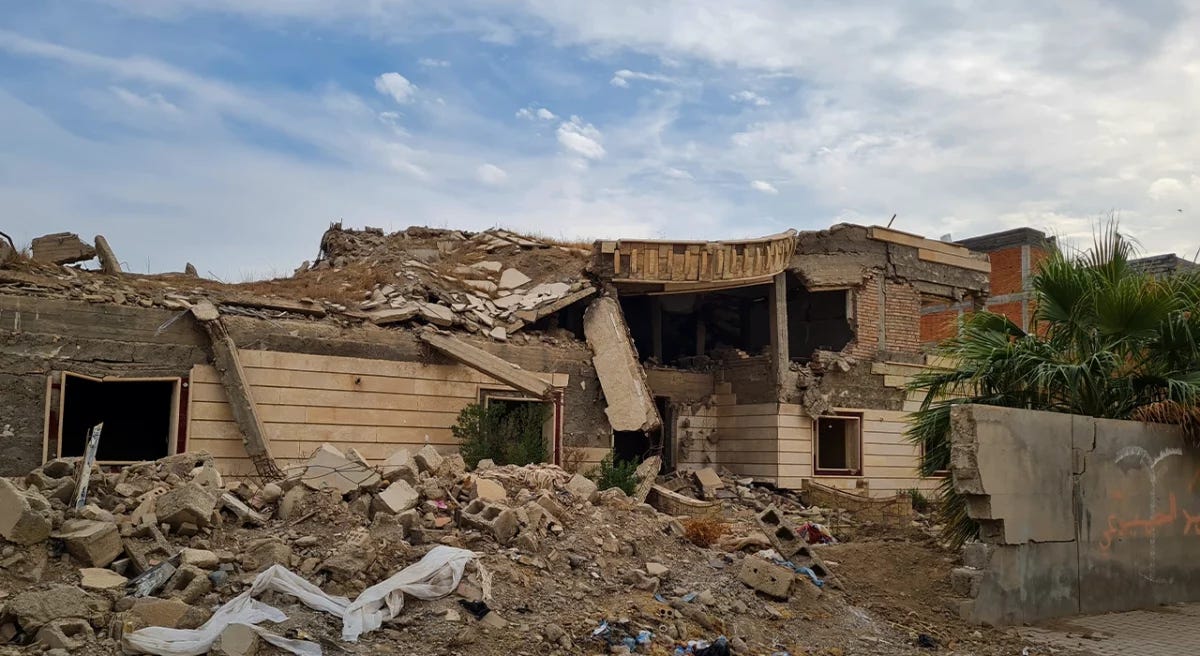
Before bombing an ISIS weapons factory in Hawija, Iraq, the US and their allies’ planners did not know how much explosive material was stored inside. Their civilian harm estimate excluded the secondary explosion. The strike went ahead, and years later, Dutch officials cited “uncertainty” about identifying victims as an obstacle to compensating them individually.
Jaclynn Ashly follows both decisions through the institutions that made them possible. Dutch aircraft carried out the 2015 attack using American intelligence, killing at least 85 civilians and devastating surrounding neighborhoods and businesses in the process. Planners had selected “smaller bombs” (which are still huge bombs) to reduce the projected harm, while leaving the consequences of detonating the factory’s contents outside that calculation.
Her account of the “industrial zone” is particularly instructive. People lived above workshops and beside small factories; displaced families had moved into the area. These arrangements connected housing to the means of earning a living, so destroying a workshop could remove a household’s income just as injuries created new expenses.
The coalition’s division of authority compounds this separation. The United States controlled the targeting information and approvals, then investigated civilian casualties and restricted what its Dutch ally could see of the findings. The Netherlands supplied the aircraft and retained the power to refuse the mission. Its dependence on American intelligence did not remove that choice. Afterward, however, that dependence became part of its defense.
Ashly reports that Washington’s limited civilian payment mechanism was inaccessible to Hawija’s survivors because Dutch aircraft had dropped the bombs. The American role in identifying, approving, and investigating the target did not give those survivors an equivalent route to claim against the United States. The operational chain that assembled the capacity to attack became a series of separate jurisdictions when people sought redress.
This is where the political efficiency of remote warfare comes into view. Protecting Western military personnel reduces one source of pressure on governments conducting wars abroad. Restricting information about civilian deaths reduces another. A weapon can become more accurate while its deployment becomes easier to authorize and sustain. Judging the technology solely by where the bomb lands misses the additional freedom it gives the government deciding to use it.
The costs persist elsewhere, as Ashly documents families selling assets to pay for treatment, destroyed livelihoods, and injuries that prevent people from working.
The Dutch response included reconstruction through international organizations: electricity infrastructure, municipality-owned shops and other projects, all of which could provide useful services without compensating the people harmed by the bombing. A Dutch peace organization found that victims were not made a specific priority in selecting beneficiaries. Many had already left Hawija, partly because the destruction had made staying untenable.
Their displacement then helped exclude them from the response to the damage that displaced them.
Voluntary assistance also leaves the Dutch government determining the scope of its response. Survivors are demanding recognition of a claim against it. That difference remains even after an apology: in 2025, the cabinet acknowledged civilian suffering while maintaining that the attack had been “lawful”.
Ashly follows survivors bringing their case into Dutch courts, alongside the work of Iraqi organizations and researchers establishing the damage. PAX, the Dutch peace organization, says a database containing records on more than 300 victims was repeatedly offered to the Netherlands and went unused. Death certificates, medical records and property documents were available; officials did not really seem to care.
That makes this an account of people contesting the terms on which their suffering becomes politically consequential. They are assembling evidence, pursuing claims and insisting on obligations that the government would prefer to manage through discretionary assistance. The uncertainty invoked against them is itself being challenged by their work.
Ashly shows how much organized effort survivors must expend simply to make the aftermath part of the war’s official reckoning.
The Saudi Phase of the Iran War Signals More Chaos to Come — David Faris, The Nation
The Saudi monarchy wanted a weaker Iran without putting the kingdom’s commercial future at risk. David Faris looks at the unraveling of that calculation through attacks on Saudi airports, oil facilities, and a major pipeline. Riyadh, which he notes encouraged the American war, now confronts the limits of the protection it expected Washington to provide.
His account makes clear why declarations of American victory mean so little: Iran and Yemen’s Ansar Allah retain the capacity to impose costs that Saudi rulers cannot simply spend their way out of.
For the monarchy, economic diversification and American military support have belonged to the same development strategy. Oil revenues help finance new industries; foreign investment is meant to expand them; security arrangements are supposed to protect the conditions under which that money earns a return. Tourism, aviation, and data centers add sources of income, but they also require reliable access, functioning infrastructure, and confidence that operations can continue.
Diversification changes the kingdom’s exposure to disruption. It does not abolish it.
Ansar Allah can exploit that exposure without matching Saudi Arabia’s military resources, and their task is narrower than conquering the kingdom or destroying its armed forces. Interrupting transport or threatening an export route can impose losses across businesses far from the point of attack. Defenders have to keep an interconnected economy functioning; attackers can choose where to interrupt it. The concentration of valuable infrastructure gives Saudi Arabia economic weight while providing its adversaries with leverage.
Faris describes the humiliation of a wealthy state by a force based in an impoverished country, and the distribution of wealth itself helps explain how that pressure works.
This also complicates his account of a previously stable order giving way to chaos. Faris condemns the Saudi regime and acknowledges its role in encouraging war. Yet the kingdom’s earlier appearance of security needs to be read alongside its attacks on Yemen. Saudi-led airstrikes killed civilians and restrictions on supplies deepened deprivation long before the latest attacks on Riyadh. Prosperity inside the kingdom coexisted with a war its government helped wage across the border. Earlier retaliatory strikes had already shown how fragile that separation was. Its further breakdown endangers civilians who bear no responsibility for the monarchy’s decisions; it also exposes how selectively the old regional “stability” was experienced.
We would be slower to infer Iranian hegemony from the failure of American protection, because the ability to make an existing arrangement intolerably costly does not establish the capacity to organize a durable replacement. Faris rightly treats Iran’s allies in Yemen as actors with interests of their own. That autonomy is very important—cooperation against a common enemy cannot guarantee agreement over a settlement, much less control over what happens afterward. Iran can gain bargaining power without acquiring command of the region.
Nor can Saudi rulers exchange security systems as readily as they might change suppliers. American weapons bring continuing requirements for spare parts and logistical support. A December 2025 US notification for a proposed Saudi helicopter support package explicitly linked maintenance to integration with American-led coalitions. Such arrangements help reproduce the dependence that battlefield failures call into question. A threatened monarchy may seek still more support from the power whose guarantees have disappointed it, and military failure can weaken Washington’s authority while generating fresh demands for its equipment.
That is the bind running through Faris’s piece. Saudi rulers have pursued commercial expansion alongside a regional hierarchy backed by American force. The war meant to weaken a rival is now damaging the conditions needed for that expansion. More weapons might protect particular sites, but they cannot settle the political conflicts that make the network vulnerable.
The monarchy’s harder problem is how to keep promising investors uninterrupted business while participating in, and pushing for wars whose consequences it can no longer confine elsewhere.
Car wiring harnesses cross borders, made by precarious Moroccan workers — Said Oulfakir, Assafir Al-Arabi
The promise of export-led industrialization is that cheap labor is a stage you pass through. Investment arrives, production becomes more sophisticated, and better jobs are supposed to follow. Said Oulfakir’s account of Morocco’s automotive wiring industry explains why industrial expansion can instead entrench the conditions workers are expected to outgrow.
The industry is growing, evidenced by the fact that automotive wiring exports reached 57.8 billion Moroccan dirhams in 2025. Bundles of cables and connectors carry electricity and signals through a vehicle; their assembly remains difficult to automate, so manufacturers depend heavily on human dexterity, and they organize that dependence through narrowly divided, repetitive tasks, performed under pressure to keep the line moving.
Oulfakir is good on what this arrangement does to workers. The product can become more complex while the individual job offers little opportunity to acquire broader skills. Years of experience need not bring greater control over production or a better position within it. The factory develops its collective capacity by combining workers whose individual roles remain restricted. An expanding industry and a workforce with limited prospects are perfectly compatible outcomes of that organization.
And yes, these jobs can improve on the alternatives available and that is part of what makes the arrangement durable. People need the wage, and employers draw power from the difficulty of finding a better one. Employment brings workers into industrial production without necessarily giving them the means to demand a larger share of its gains.
At the level of industrial policy, these employment relations become a competitive advantage. Morocco offers access to European markets, infrastructure, and a workforce available at lower cost. Maintaining the country’s position within the production network consequently gives the state a stake in employers’ demands for competitiveness. A wage increase that workers need can appear, from within that strategy, as a cost threatening investment.
Oulfakir wants Morocco to retain more technical knowledge and manufacture more valuable components, alongside better wages and opportunities for workers. Sensible enough. But the connection between those outcomes has to be fought over. A larger domestic share of production can strengthen local suppliers without strengthening their employees.
Research cited in the article describes carmakers pushing suppliers to automate and bring production closer to European assembly plants. Thus, workers are required to remain inexpensive to attract production, then possibly face displacement when machinery changes the calculation. Their livelihoods depend on continuing to sell labor that employers are simultaneously trying to economize on.
Yet the production process Oulfakir describes also creates a basis for challenging that dependence. Making one assembler replaceable does not make the coordinated workforce dispensable. Exact delivery schedules require people to complete connected tasks on time. Acting together, those workers could turn the manufacturer’s dependence on their cooperation into bargaining power.
This is why the restrictions on union activity reported in the piece are important to its economic argument. They help management retain command over a collective productive capacity that workers themselves supply, and Oulfakir gives us the material for understanding how industrial growth generates both exploitation and the means to contest it.
Hamas’s al-Majd: A Comprehensive History — Mujamma Haraket
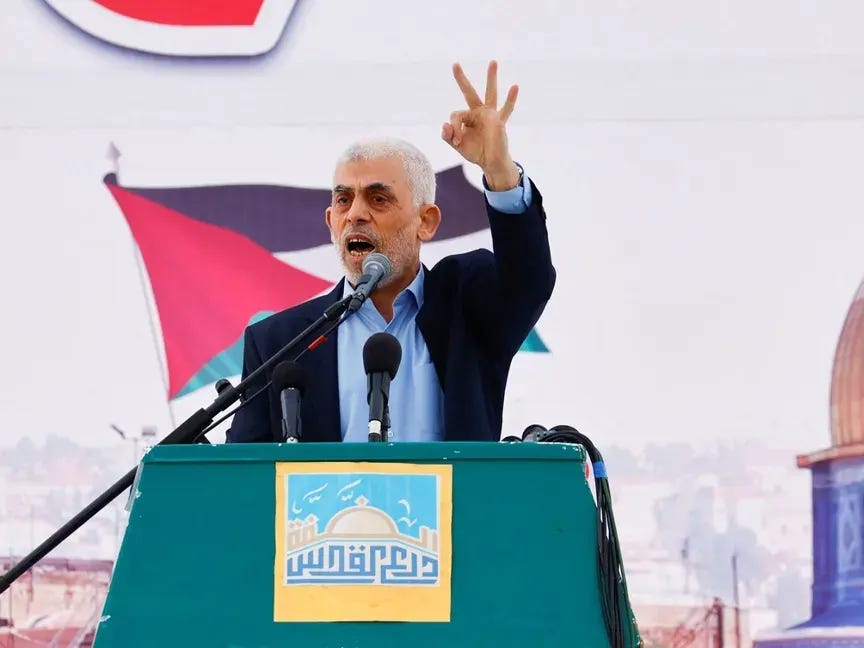
Mujamma Haraket is, hands down, the best security analyst on Gaza. It helps that his writing is closer to the style of a storyteller than that of a cut-and-dry, heavy-subject expert.
In this essay, he provides a detailed history of al-Majd (Munaẓẓamat al-Jihād wa-l-Daʿwa), the security and counterintelligence body of the Gaza branch of the Muslim Brotherhood associated with Sheikh Ahmad Yassin. It was assembled from an earlier security apparatus and a separate military apparatus, and it became the training ground for several future Hamas leaders, most notably Yahya al-Sinwar. Its best-documented activity is identifying, interrogating, and executing Palestinians suspected of collaborating with Israeli intelligence.
Al-Majd was, eventually, made a component of the Izz al-Din al-Qassam Brigades.
“In his [Sinwar’s] unpublished study, Ḥamās: al-Tajriba wa-l-Khaṭaʾ [Hamas: Trial and Error], he recalls assuming responsibility for field security monitoring at the university, with the task of protecting Salah Shehadeh and limiting students’ contact with him.” (Reading about the duties of a young Siwar is…indescribable).
While a very long read, it is absolutely worth it.
Egypt
How much of their salaries do Egyptians spend just to be able to work? — Ibrahim El-Hady Eissa, Zawia3
Eissa is one of Zawia’s best investigative journalists. Here, he offers a compelling and practical examination of what a salary really means in the Egyptian context. He makes the invisible visible and shows us, through multiple cases, how a worker’s salary is not the same as the money they actually have available to live on. Transportation, meals, drinks, mobile data, and the additional costs of extended working hours all eat into earnings before rent, bills, or family expenses are even considered.
Eissa develops the argument through a combination of personal experience, legal analysis, illustrative cost scenarios, and international comparisons. Its examination of Labor Law 14/2025 provides a useful framework for understanding working hours, rest periods, overtime, and the absence of a general legal requirement for meal or transportation allowances.
The discussion of in-kind benefits adds an important dimension, showing how workers with identical salaries may enjoy very different levels of financial security depending on their employers.
Overall, Eissa succeeds in turning an everyday workplace reality into a broader question of labor rights, employer responsibility, and the true cost of employment. Therefore, a salary’s real value cannot be measured by its face value alone, but by what remains after the costs of earning it have been deducted. Its main contribution is to make these often invisible expenses visible and to invite a more serious discussion about who should bear them.
It seems like a rudimentary argument, but, unfortunately, it is not so in Egypt’s case.
Finishing Egypt’s Antiquities and Laundering Its Art — Ahmed Naji, Al Manassa
Naji writes a scathing indictment of the growing entanglement of private capital, state power, and the Egyptian cultural scene. Through the case of Art D’Égypte and its Forever Is Now exhibition at the Pyramids of Giza, he exposes a fundamental contradiction: institutions that claim to promote Egyptian art and bring culture to the world have instead become vehicles for private accumulation, elite privilege, and the normalization of political relations with Israel.
Art doesn’t exist outside society or above class struggle; after all, artists need time, resources, spaces, and freedom to create. Yet under capitalism, these necessities are increasingly controlled by those who possess wealth and connections. Cultural institutions are dependent on corporate sponsors, wealthy collectors, and state patronage, while artistic success is measured by market value, international visibility and access to elite networks.
Naji’s account of Art D’Égypte illustrates this process. A private commercial enterprise has secured extraordinary access to Egypt’s most important historical sites, while independent cultural initiatives and public institutions have been consistently marginalized. The result is a redistribution of cultural power towards a small circle of businesses, investors, and state-connected elites.
The Pyramids are a particularly striking example. They are part of a historical inheritance that belongs to society as a whole, yet they’re being monopolized annually by a privileged company to serve as a decorative backdrop.
Naji argues that the retreat of public cultural provision does not necessarily mean that the state has withdrawn. Rather, the state remains highly active in deciding which private actors receive access, prestige, and institutional support. Public resources are mobilized, but the benefits are concentrated in private hands.
The controversy surrounding French artist Bernard Venet adds a further political dimension. Naji documents Venet’s connections to Israeli cultural institutions and the large-scale boycott campaign by Egyptian artists that ultimately forced Art D’Égypte to withdraw his invitation.
The organizers’ retreat was done under immense pressure and without a clear public statement naming Palestine or taking an explicit position on the Gaza genocide.
The episode demonstrates the power of collective action. Artists, galleries, and professional organizations withdrew immediately, and that pressure forced a commercial institution to reverse a decision it might otherwise have defended. Even in a scattered cultural environment dominated by powerful institutions, organized resistance can win concessions.
For us though, the lesson cannot stop at the importance of individual conscience or professional solidarity. The central question is how such resistance can become sustained and collective. Artists and cultural workers are not simply independent individuals competing for recognition, but workers (any wage earner is a worker) whose livelihoods depend on access to studios, exhibition spaces, public funding, and institutions. They share material interests that can provide the basis for organization, just as workers in other industries do.
That means defending independent cultural institutions, expanding public access to artistic spaces, resisting the privatization of heritage, and building democratic organizations capable of challenging decisions made by commercial sponsors and state authorities. It also means linking the struggle for cultural freedom with the struggles of workers and ordinary people for decent living conditions, political freedoms, and an end to imperialist domination. A cultural movement that remains confined to the professional elite will struggle to challenge the social relations that reproduce its dependence.
There is, nevertheless, a tension in Naji’s argument. His defence of an earlier, more vibrant Egyptian cultural scene rightly recalls the value of independent initiatives, public institutions, and artistic experimentation. But the answer cannot simply be a return to a supposedly better past.
Nor should the critique of commercial cultural power become a defence of cultural nationalism. Egypt’s historical heritage should not be reduced to a possession that belongs exclusively to the Egyptian state or national elite. Its preservation and accessibility are matters of public interest, while artistic solidarity across borders is essential to resisting the international networks of capital and imperialism.
Culture should not be the privilege of those who can buy access to it. It should be a living part of society, shaped by the people who create it and open to the people whose labor sustains it.