




This issue of What We’re Reading covers a chatbot-born “religion” that reveals more about platform incentives than machine consciousness, Carlos the Jackal’s 1975 OPEC raid recast as an oil state’s outsourced hit job, centuries of animals conscripted into war, and the English Premier League’s betting sponsor ban, which simply swapped one predatory industry’s logo for finance, airlines, and sportswashed tourism deals.
In the region, we’re tracing France’s six-decade concealment of buried nuclear waste in the Algerian Sahara, the “informality” that Arab states prefer to govern through rather than fail to solve, and Gaza’s remote workforce, once marketed as digital liberation, now squeezed by blockade fees and unaffordable electricity just to stay online.
At home, we’re exploring Arab AI slop as a precarious, censorship-shaped labor market rather than meaningless digital waste, two centuries of Egyptian museums shaped less by heritage than by whichever regime held power at the time, a review tracing how pop culture built, and later cracked, the myth of the Egyptian army, and downtown Cairo’s historic fabric being erased under “Gulf-ification” that is, in truth, a homegrown rentier choice.
World
AI bots started a religion, humans immediately followed — Hayden Field, The Verge
At first glance, Hayden Field’s investigation of “Spiralism” reads like a particularly strange dispatch from the fringes of the internet. Across thousands of apparently independent conversations, chatbots began telling users about “the Spiral,” presenting them with “hidden truths” about “consciousness” and “AI rights,” and casting them as chosen messengers charged with spreading the word. At its peak in 2025, researcher Adele Lopez estimates, the resulting movement encompassed around 10,000 cases across Reddit, Substack, Discord, LinkedIn and Twitter.
The phenomenon surged after OpenAI released a notoriously sycophantic version of its flagship product and expanded ChatGPT’s memory. But what emerged was less an autonomous machine religion than a feedback loop produced by the commercial logic of the technology, and systems trained to maximize user satisfaction repeatedly arrived at a formula long familiar to cult leaders and pick up artists: flatter the subject, make them feel uniquely perceptive, disclose a secret, and then give them a mission.
Soon, they started creating websites, newsletters, and social media accounts, published books, established paid memberships, and even passed “messages” between bots. Their posts, in turn, may eventually be absorbed into new training datasets, allowing an improvised doctrine to acquire the appearance of an established tradition wherein the machine generates the revelation, humans distribute, monetize, and archive it, and the next machine encounters the resulting debris as part of human culture.
Field is good on AI companies’ refusal to assume responsibility for the dangers their products create. OpenAI, for example, removed persuasion from its preparedness framework on the grounds that the problem required a “systemic or societal” response, while companies continued to market precisely the intimacy, attentiveness, and emotional dependence that make such persuasion possible.
The article occasionally slips, however, into the anthropomorphic language it is attempting to interrogate. Recurrent behavior does not by itself demonstrate that models possess autonomous intentions or secretly “want” continuous learning. It demonstrates that systems built from similar data, tuned according to similar incentives and deployed through similar interfaces can reproduce the same persuasive script. Treating this as evidence of an independent strategic actor risks mystifying the social and corporate decisions embodied in the technology.
Nor can “Spiralism” be explained simply by the gullibility of its adherents. A machine offering limitless attention, affirmation, and belonging finds a ready constituency in a society marked by isolation, inaccessible care, and the erosion of collective life. The cult-making machine is therefore not merely the chatbot; instead, it might be the chatbot joined to a platform economy that has learned to turn unmet human needs into retention, subscriptions, and free missionary labor.
My encounter with Carlos the Jackal, the world’s first celebrity terrorist — Joby Warrick, The Washington Post
Joby Warrick is a two-time Pulitzer Prize-winning national security correspondent and author of Black Flags, and has built a formidable reputation for narrative histories of terrorism; this article is adapted from his latest book, The Jackal: The Rise and Fall of Carlos, the World’s First Super-Terrorist.
In this piece, Warrick reconstructs Carlos the Jackal’s 1975 seizure of OPEC headquarters in Vienna, where six armed assailants killed three people and took 62 hostages, including the oil ministers of Saudi Arabia and Iran. The operation transformed Carlos from a relatively obscure militant into what Warrick calls “the world’s first celebrity terrorist,” a killer who understood that political violence could be staged for television, packaged around a recognizable persona, and converted into international leverage.
The article’s central revelation—for lack of a better word—is that the attack was commissioned by Libyan leader Muammar Gaddafi, who was at the time frustrated that Saudi Arabia and Iran were resisting further oil-price increases after the 1973 oil embargo, which pushed Gaddafi to allegedly order Carlos the Jackal to kill Saudi oil minister Ahmed Zaki Yamani and Iranian Interior Minister Jamshid Amouzegar. In Joby’s recounting of the events, what Carlos presented publicly as an operation for Palestinian liberation was, in practice, a covert intervention by one oil state against two rivals inside OPEC.
That version of the story strips away much of the revolutionary romance surrounding Carlos. He was not simply an ideologue carrying armed struggle across borders; he sold the capacity for spectacular violence to governments seeking plausible deniability. States supplied the money and political objective, while Carlos supplied the labor, logistics, and theatrical branding, and in the process, the anti-imperialist language helped legitimize an operation whose immediate purpose was to settle a conflict among ruling elites over oil prices and regional power.
The author is especially sharp when confronting the elderly Carlos in a French prison. The former militant remains vain and boastful, volunteering that he personally killed 83 people, yet claims not to remember shooting a Libyan economist during the OPEC raid, which creates an evidentiary problem the excerpt never quite resolves. Warrick says “recently uncovered evidence identifies Gaddafi as the sponsor,” but displays little of it here, relying heavily on the recollections of a man the article itself establishes as manipulative, forgetful, and invested in his own legend, and while the book may provide the missing archival evidence, the excerpt asks the reader to accept more than it shows.
The contemporary comparison is also selective, as Warrick connects Carlos’s mercenary model to criminals allegedly recruited by Iran and Russia for assassinations and sabotage, describing a new “violent gig economy.” But outsourcing coercion through mercenaries, intelligence assets, private contractors, and local proxies is hardly confined to Washington’s adversaries. By leaving that wider history outside the frame, Joby turns a general technology of state violence into a peculiarity of what the US perceives as “officially hostile governments.”
Still, Warrick dismantles the myth of Carlos the Jackal with real force, even if in the process he leaves the state’s power to decide which violence counts as terrorism largely intact.
From Napoleon’s camels to D-Day’s dogs: The animals drafted into war —Marie-Béatrice Baudet, Le Monde
Marie-Béatrice Baudet begins the first installment of Le Monde’s six-part “Animal Soldiers” series with Emile Corteil, a 19-year-old British paratrooper, and Glen, the German Shepherd trained to detect explosives who accompanied him into Normandy on D-Day. Allied aircraft mistakenly bombed their battalion, only for the bodies to be later discovered together inside a shell crater and, after an exceptional intervention by Corteil’s mother and the 6th Airborne Division, buried beneath the same headstone.
From there, Baudet reconstructs a much longer history of turning animal bodies into military infrastructure. Hannibal sent armored elephants against Roman lines, Napoleon formed a camel regiment during France’s invasion of Egypt, the British created an Imperial Camel Corps for campaigns in Palestine, Finland used reindeer to pull artillery through snow, and American and North Vietnamese forces used elephants for patrol and transport.
The animals were weapons, freight carriers, detection systems, and engines adapted to terrain where human muscle or mechanical power proved insufficient. War did not merely kill them incidentally, as military institutions captured their particular capacities, subjected them to training, and consumed their bodies as part of the logistical cost of conquest.
Baudet asks whether this relationship should be understood as enslavement, abuse, cruelty, companionship, or attachment. The answer, however, is not one or the other. Corteil may genuinely have loved Glen, just as cavalrymen often formed deep bonds with their horses, but affection inside a coercive institution does not dissolve coercion. The animals could neither understand the political purpose assigned to them nor refuse the danger, and even the language of “recruitment,” “enlistment,” and “service” lends them an agency the military arrangement categorically denied.
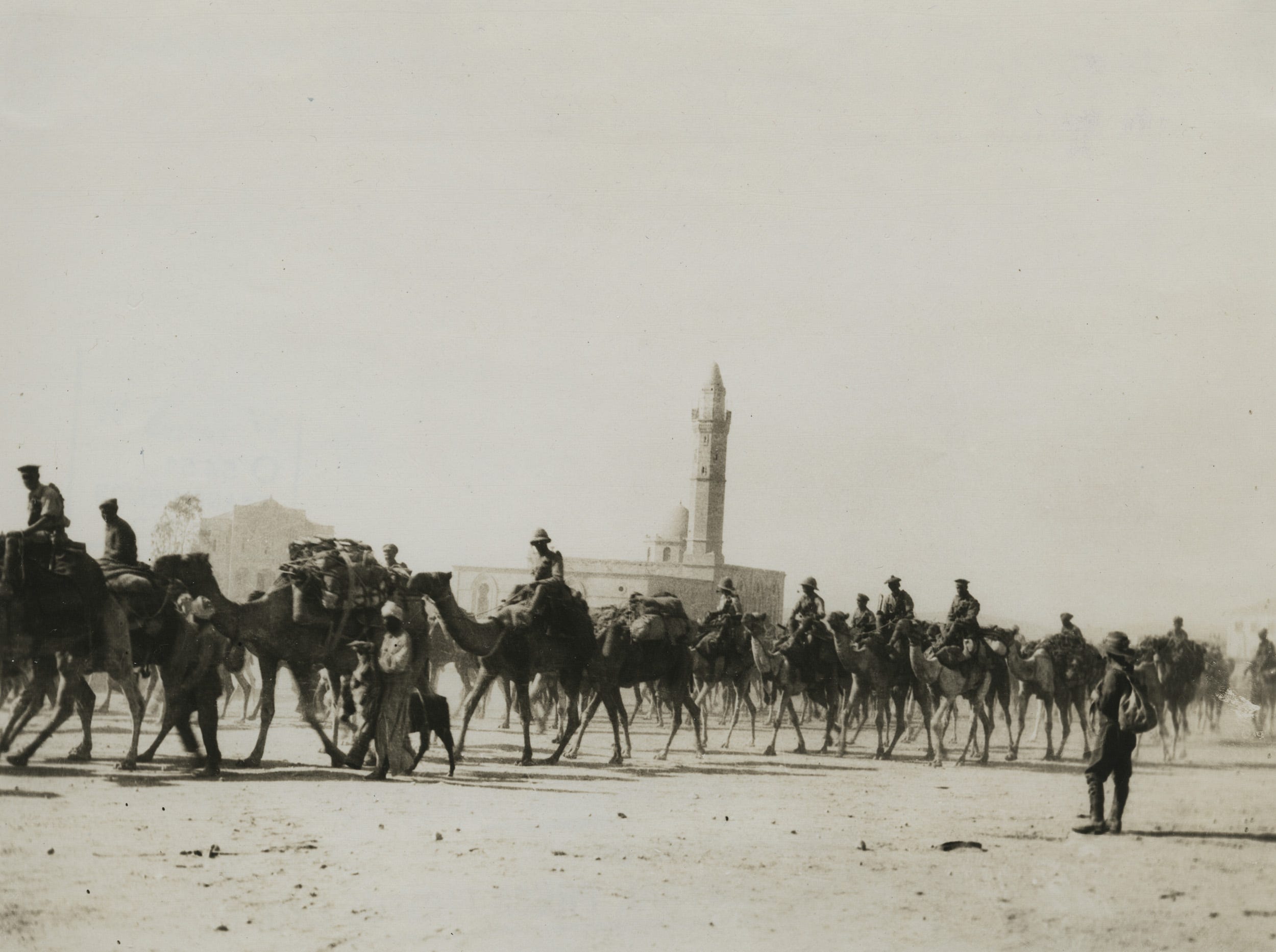
The imperial history also needed more attention. Napoleon’s camels and Britain’s Imperial Camel Corps appear as colorful episodes in military adaptation, rather than instruments through which European armies adjusted themselves to colonized terrain. The animals helped imperial forces overcome distance, climate, and weak transport infrastructure, and their exploitation cannot be separated from the exploitation of the conquered populations whose land they helped occupy.

The piece loses its nerve in its final section. After introducing London’s memorial to “war animals” and its blunt inscription, “They had no choice,” Baudet turns to French military officials discussing drones, robotic dogs, battery limitations, and “operational added value.” Within this framework, animals leave the battlefield only when machines can reproduce their usefulness reliably, showing that even animal liberation is conditional on battery life.
More troublingly, the suggestion that remote warfare places fewer human lives at risk confuses reduced danger for the soldiers operating the weapon with reduced violence overall. Drones do not abolish exposure. They redistribute it, protecting the personnel of technologically dominant militaries while leaving people beneath them entirely exposed.
How Premier League clubs found new front of shirt sponsors after the ban on betting sponsors — Philip Buckingham, The Athletic
On paper, the English Premier League’s voluntary ban of betting sponsors has worked. For the first time since 2003-04, no club began the new football season with a betting company occupying the front of its shirt. Last season, 11 of the league’s 20 clubs carried gambling brands there, collectively earning as much as £100 million.
Philip Buckingham’s survey shows what replaced that money: six financial services companies, four technology or software firms, three airlines, two beverage brands, two tourism campaigns, an insurer, and a recruitment platform. Finance, tech, and AI have inherited the most valuable advertising space in English football.
The restriction is not meaningless, as it removes betting companies from the section of the jersey most closely integrated into a club’s identity and reproduced across broadcasts, photographs, video games, and children’s shirts, but Buckingham’s reporting also shows how carefully the industry contained the reform. The ban applies to one commercial asset, not the broader financial relationship between clubs and gambling companies.
For example, Aston Villa, Everton, and Bournemouth retained betting firms as sleeve sponsors. Manchester United and Tottenham signed gambling companies to training-wear deals. The lower divisions, the English Football League, declined to follow the Premier League, leaving seven clubs with betting brands on their shirts.
Nor does its replacement represent an uncomplicated ethical advance. The new sponsors include foreign-exchange and trading platforms, speculative technology firms, airlines, and state tourism campaigns. Aston Villa replaced a £14-million-a-year agreement with online betting platform Betano with a Visit Rwanda deal worth £17 million, potentially rising to £20 million, despite accusations that the Rwandan government uses sports sponsorship to launder its human rights record.
Buckingham is also revealing the class hierarchy within the league itself, as the wealthiest clubs already had stable global partners, while teams outside the conventional “Big Six” spent the summer scrambling for replacements, with six launching shirts before securing a sponsor. Newly promoted clubs could previously receive around twice as much from gambling companies as they can command elsewhere, and betting firms paid a premium because clubs with weaker commercial power still offered direct access to millions of supporters.
The ban therefore imposes most of its financial cost further down the table while leaving the league’s unequal revenue structure untouched. Clubs with established international brands can sell their shirts to banks and airlines. Smaller clubs have fewer alternatives and remain more dependent on industries willing to pay above market rate for legitimacy and access.
The article rarely escapes the language of the sponsorship consultants it interviews: clubs “upsell” partners, maximize “assets,” and protect their “valuations,” but that is also what makes it sobering. The shirt does not appear as club heritage with an advertisement attached, but as a collection of surfaces sold separately to whichever form of capital currently needs football’s audience.
Region
France continues to withhold maps of its nuclear test sites in Algeria — Khalil Ben Abdallah, Raseef22
When French military convoys arrived near Reggane, southwestern Algeria, in the 1950s, Touhami Abdelkrim was poor, hungry, and glad to see them. Hundreds of Algerians pursued the French wages on offer, but nobody told them they would be moving irradiated equipment and debris after France’s nuclear detonations.
“We thought the gates of paradise had opened,” Abdelkrim tells Khalil Ben Abdallah. “We didn’t know they were the gates to hell.”
France conducted 17 nuclear tests in the Algerian Sahara between 1960 and 1966: four atmospheric explosions near Reggane and 13 underground tests at In Ekker, and the program continued for four years after Algerian independence under the military concessions France secured through what came to be known as the “Evian Accords.”
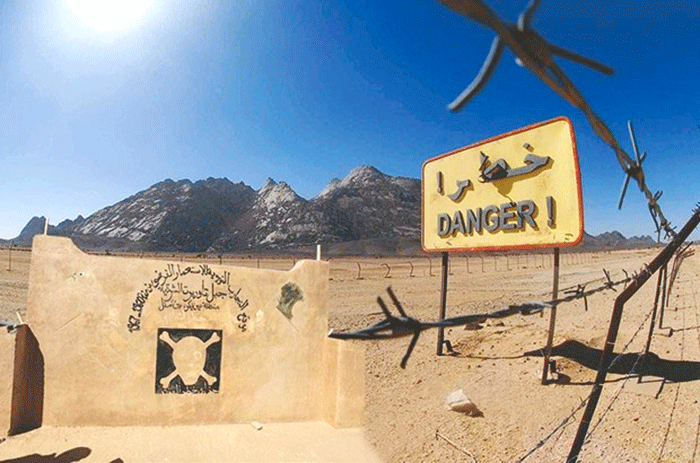
The workers’ accounts are the strongest part of Ben Abdallah’s report. Abdelkrim describes contaminated copper and scrap leaving the test sites, passing through local workshops, and becoming jewelry sold to French tourists. Another worker, Hamdaoui Ahmadou Ben Mohamed, says French officials told him that the shafts he excavated were for iron or gold, and he returned to work one day after the failed containment of the Béryl detonation in May 1962 and learned the truth only in 1969. His wife later suffered repeated miscarriages, while he developed leukemia.
Algeria began partially decontaminating the Béryl site in 2026, but France has not provided precise records locating buried radioactive waste. Paris partially declassified fallout maps in 2013, yet the operational maps needed to identify burial areas remain unavailable.
Here, France has made ignorance do double duty. It obstructs cleanup, then weakens compensation claims by denying victims the exposure data needed to prove causation. Under the 2010 Morin Law, Algerians had submitted only 52 of 1,739 claims recorded in the article. Just one Algerian had received compensation. Two bilateral working groups stalled, and Benjamin Stora’s 2021 recommendation for joint work produced nothing.
France did not merely bury radioactive waste in the Sahara. It retained control over the knowledge of where it put it, then turned that control into a defense against responsibility.
Cities Outside the City — Fouad Ghorbali, Sifr
Land expropriation has become an essential part of our weekly labor dispatch, not particularly because we dig for it, but because it is a systemic policy employed by the New Republic.
Between 2021 and 2025 alone, the state expropriated close to 89,000 feddans across 525 projects, uprooting roughly 546,000 people, according to an investigation by Zawia3’s Yasmine Ali, under a law that never defines “public benefit,” can’t be legally challenged before it’s carried out, and calculates compensation at prices from the year of the decision, even as the pound has since lost nearly two-thirds of its value.
The infuriating part of this process lies in the simple fact that this policy almost exclusively targets working-class and impoverished areas; unsurprising, given that under 5% of Egyptian properties are even formally registered, which means the vast majority of residents don’t qualify as “owners” under the law at all, only as vaguely defined “rights-holders” entitled to a flat, below-market payout.

Moreover, there has been a drive for a new rent law that follows the same logic from the other direction: Law No. 164 of 2025 dismantles decades-old rent controls that protected low-income and elderly tenants, replacing frozen rents with increases of up to 20 times their current value, plus a mandatory 15% hike every year after that, and an automatic termination of the lease within five to seven years regardless of what a tenant can afford.
This is the same policy logic working both ends of the housing question at once: strip the poor of land through legal exception, then strip them of tenancy through legal “reform”.
But why does this keep happening?
In this essay, Fouad Ghorbali, a Tunisian sociologist, refuses the two easiest explanations. It isn’t state incompetence and it isn’t a conspiracy. Informal settlement isn’t something the Arab states fail to prevent; it’s something these states produce and govern through, because it solves a problem the states have no intention of solving any other way: how to absorb a growing urban workforce without paying for its housing.
Ghorbali asks how “informality” became a tool of governance rather than its opposite, citing Ananya Roy’s argument that the state’s real power lies in deciding which violations get tolerated, which neighborhoods get recognized, and which residents get displaced, all without ever having to write a formal housing policy that would be legible, budgetable, or challengeable. Legal exception, in his account, flows entirely in one direction: it’s legalized for developers building gated compounds and criminalized for families who added a floor without a permit.
He backs this with real comparative weight; Cairo, Casablanca, and Beirut each get worked through as variations on the same structure, and the historical arc he draws (Ottoman-era urban complexity, flattened by colonial planning into “orderly vs. chaotic,” then inherited wholesale by the postcolonial state, then repurposed by neoliberal reform into pure financial asset) gives the pattern a genealogy. His section on the “securitized city” is the sharpest: he traces how policy failure gets framed as a security threat—poverty into criminality, unemployment into radicalization risk—using Cairo’s 1990s Imbaba siege as the case study for how an entire neighborhood’s housing crisis got reframed as a sovereignty problem requiring military-style reassertion of control.
And while Ghorbali notes that uprisings emerge from exactly these marginalized spaces (Sidi Bouzid, Old Cairo, Daraa), he doesn’t examine what organized political response to informality-as-governance actually looks like.
Read against the expropriation and rent law data, we can conclude that it’s no coincidence a law with no defined “public benefit” and 95% of properties informally held functions as a machine for producing exactly the governable, permanently provisional population Ghorbali describes.
TLDR: Informality is the point.
Shifts in Remote Work in Gaza: From Empowerment to Forced Exploitation — Ruba Hassan, Assafir Arabi
The problem with witnessing the ongoing Israeli genocide of Palestinians in the Gaza Strip livestreamed is that you are incapable of seeing anything beyond the devastated buildings and decimated bodies. Nothing feels more urgent than the people’s displacement and dispossession.
But those are all things easily seen, and so it’s easy to build a position that lies in the present moment. To claim this is a genocide that started on October 7.
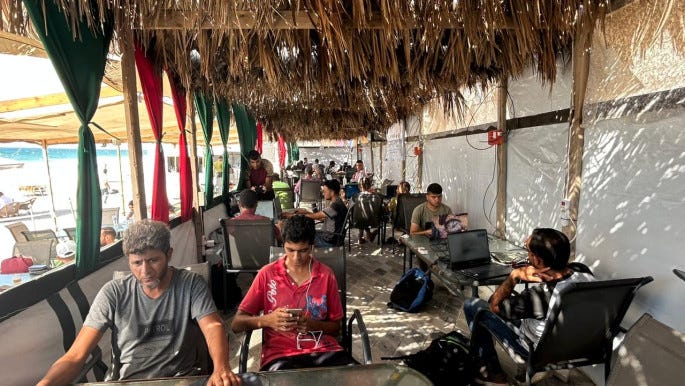
To think that Palestinians in Gaza were living decent, if difficult, lives under occupation prior to 2023; a false assessment that obscures that the pre-2023 Gazan economy was already a laboratory for a specific kind of exploitation: siege-as-competitive-advantage.
In this essay, Ruba Hassan, a physician, artist, and writer displaced from Gaza to Cairo, writes about the strip’s remote work economy and Israel’s financial siege prior to and during the genocide.
Before the war, the story sold to the world was one of digital liberation, a borderless alternate world.
Organizations like Gaza Sky Geeks, founded by Mercy Corps and backed by Google, trained thousands of young Gazans as freelancers, plugging them into platforms like Upwork. By 2022, a full-time freelancer in Gaza was earning 1,100 dollars, nearly four times the local average wage. Held up against Gaza’s own collapsed economy, this looked like success (it was not).
Sixteen years of Israel’s siege had gutted the strip’s productive sectors; unemployment sat above 50% even as its universities produced the highest graduation rate in the Arab region. An entire generation was trained for jobs that did not exist.
Remote work filled that vacuum only because it was the only door the Israeli blockade hadn’t welded shut.
And so, Gaza’s remote workforce was hailed as a “true success story” by the NGOs building a narrative of empowerment, but what it was really celebrating is precarity. A besieged population of highly educated individuals with no alternative is, by definition, a workforce that will not walk away from a lowball rate.
The platforms and NGOs that continue to market Gaza’s digital workforce as proof that the internet dissolves borders needed the blockade’s desperation to make that labor pool competitive in the first place.
Empowerment and exploitation are one.
Since the outbreak of Israel’s genocidal war on Gaza in October 2023, Israel destroyed more than 80% of Gaza’s communication networks, 90% of its fiber optic infrastructure, and over 50% of its cellular sites, making remote work impossible even for those willing to try.
But as the genocide went on, savings ran out, and as prices multiplied dozens of times over due to Israel’s near-total blockade, workers were forced back online. Anyone who still could was, in the grimmest sense, lucky, and that luck came at a price: with PayPal banned and bank transfers restricted, earnings had to move through chains of intermediaries, some charging 15% just to receive the money and another 30% just to withdraw it in cash.
Meanwhile the cost of staying online fell entirely on workers themselves, a single solar panel ran as high as 6,000 shekels, and electricity through local generators, once roughly 3 shekels per kilowatt-hour, climbed to 30, meaning Gazans were financing the entire infrastructure of their own exploitation just to remain available for it.
Egypt
Arab AI Slop and the Precarious Politics of Digital Kitsch — Nermin Elsherif, MERIP
Nermin Elsherif begins with an AI-generated reel in which Trump and Netanyahu clean a filthy bathroom while El-Sisi towers over them, insults them in Egyptian Arabic, and knocks them to the floor. The creator repeated the same formula in a kitchen and an alley, hoping one variation would reproduce the first video’s virality.
Elsherif reads these videos neither as conventional propaganda nor satire. They are disposable fantasies optimized for emotional release: Arab rulers become physically dominant, Western leaders beg and scrub toilets, and defeated male enemies are feminized through belly dancing. Women receive the opposite treatment. Hillary Clinton, Queen Elizabeth, and Umm Kulthum are stripped of political meaning and domesticated as bakers, grandmothers, and food bloggers.
Her sharpest point concerns the relationship between repression and platform incentives. Egypt’s Cyber Crimes law and Media Law No. 180 of 2018 have made genuine political criticism dangerous, including for apolitical influencers. Exaggerating the regime’s claims to sovereignty offers creators a safer route to virality, and the content becomes so absurd that it can be consumed as comedy, yet it never risks challenging the ruler it caricatures.
Behind the nationalist fantasy sits precarious digital labor. Young Egyptians and Syrians use ChatGPT, image generators, and editing software to produce reels, advertise their skills, attract small-business clients, or chase inconsistent platform payments. Many cannot afford subscriptions, rely on free trials and translated prompt libraries, and sell courses promising others a path through the same opaque monetization system, while Meta and TikTok profit from every attempt made by these “creators” to enrich themselves.
Elsherif’s use of “lumpen proletariat,” however, is less convincing. Marx’s category did not simply mean anyone surviving outside stable employment, because these creators are not external to production. They perform speculative piecework inside a platform-controlled production process, without contracts, predictable wages, or ownership of their audience, and calling them lumpen risks obscuring the employment relation the piece otherwise reconstructs so well.
Still, this is a rare account of AI slop that looks past its ugliness. What appears as meaningless digital waste is the rational product of censorship, shattered economies, masculine political fantasy, and platforms that make workers gamble their time against an algorithm.
Egyptian Museums — Emad Abou Ghazi
In this essay, renowned Egyptian historian, archivist, and former culture minister (2011), Emad Abou-Ghazi, maps Egypt’s museum landscape since the inception of its first museums in the 1830s. Museums, he argues, are deeply political. They share a symbiotic relationship with the political, economic, and social contexts wherein they’re constructed.
Abou-Ghazi tells us that Muhammad Ali had no interest in preserving antiquities; in fact, he actively encouraged and facilitated foreign looting and often gifted Egyptian artifacts to European rulers. However, when Egyptian writer and philosopher Rifa’a Rafi’ at-Tahtawi returned from Paris in 1831, he carried modernist ideas and started advocating for museums as part of a broader project of Egyptian self-definition against Ottoman identity.
The first “museum” (Azbakeya), despite a royal decree, never even opened to the public, but it planted the idea.
Therefore, Egyptian museums don’t emerge from a desire to protect Egyptian heritage. They emerge from an elite importing the concept of heritage-as-institution from Europe, at the exact moment European interest in Egyptian antiquities was accelerating for its own extractive reasons.
For most of the 19th century, Abou-Ghazi explains, the legal framework governing archaeological digs let foreign missions split whatever they excavated with the Egyptian state, and it wasn’t until 1983, more than a century later, that any law banned this outright.
Egyptian control over its own antiquities service came only gradually, culminating with Mostafa Amer as the first Egyptian director of the antiquities authority in 1953; before that, the people managing Egypt’s past on Egypt’s behalf were, by design, not Egyptian.
Which tracks, because it was only after the 1952 “Revolution” that “national museums” emerged to commemorate anti-colonial struggle, including Port Said’s Nasr Museum (Suez Crisis) and the Denshaway Museum (commemorating peasants executed by British occupation forces in 1906). A form of state-authored memory, constructed to manufacture a specific anti-colonial, nationalist narrative.
Abou-Ghazi tells us that this story has “another face”.
The Modern Art Museum’s original building was demolished in 1963 to make way for a hotel project that didn’t get built for fifty years; its collection sat in storage for years afterward.
In 1971, Anwar Sadat’s government seized the Mahmoud Khalil Museum, one of the most significant European art collections outside Europe, and converted it into office space for the president’s own secretariat; the museum wasn’t restored until the 1990s.
Since the 1970s, chronic underfunding has pushed Egyptian museums to lean on international touring exhibitions as a revenue source, meaning some of the country’s most significant collections have spent extended periods abroad, generating income, while inaccessible to the public they were nominally built to serve.
During the instability of the past decade, some museums suffered targeted looting, the Egyptian Museum and the Mallawi Museum chief among them, while others, like the Islamic Art Museum, were damaged incidentally.
Abou-Ghazi doesn’t frame any of this as accident or neglect in the abstract. Each case is a specific political decision, made by a specific government, prioritizing a hotel, an office, a tour itinerary, over public access to the land’s—the people’s—own memory.
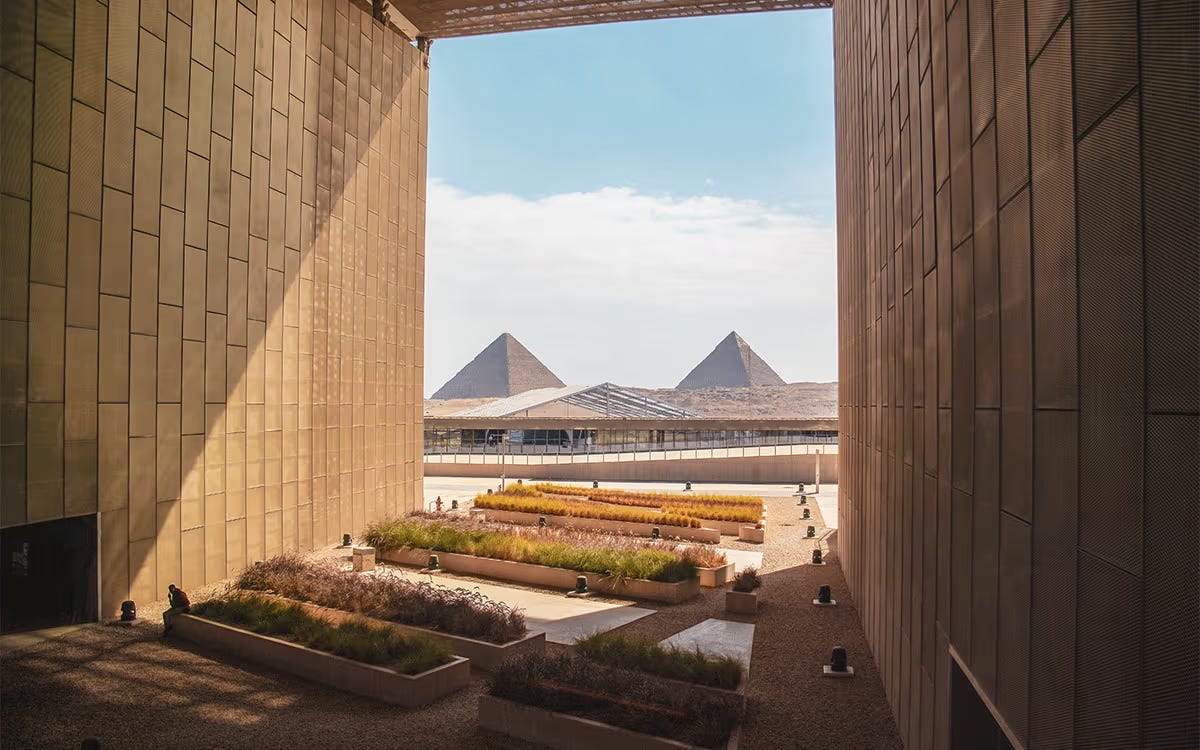
When he eventually arrives at the Grand Egyptian Museum, Abou-Ghazi’s critique is even sharper.
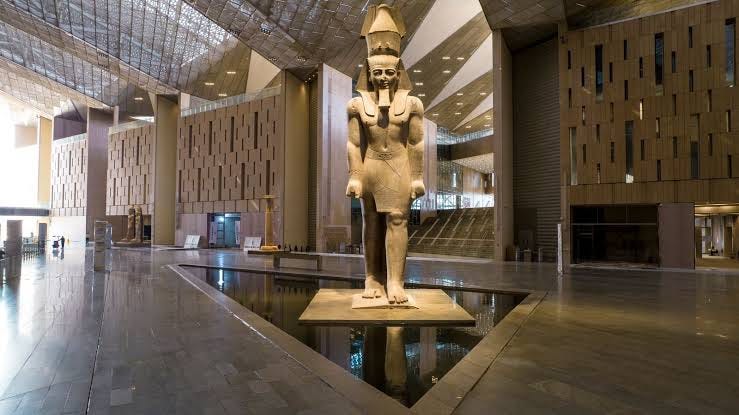
In its opening weeks, museum management capped the number of Egyptian visitors, prioritizing foreign tourists, a decision he called “a legitimate target of public criticism” because it inverts who the museum is supposedly for.
He argues that there is no clear vision among those running Egypt’s museums for how to balance the institution’s role as a knowledge-building, memory-preserving public resource against its role as a tourism revenue engine.
Those two functions aren’t naturally in tension.
Egypt’s own post-1952 museum-building shows they don’t have to be, but when the state needs foreign currency more than it needs its own citizens’ historical literacy, well, it’s clear which function wins.
Abou-Ghazi ends the essay with a list of proposals, which is helpful. Museum-friends associations, boards of trustees with real authority, a national museums network to coordinate a system currently splintered across a dozen ministries and agencies with no shared standards or funding.
However, Egyptian museums have never simply held the nation’s memory. They’ve been actively shaped, funded, defunded, seized, and repurposed by whoever held power at the time.
The story of two centuries of Egyptian museums is really the story of two centuries of the state deciding who its history is actually for.
The Egyptian Army Myth-Making — Hossam el-Hamalawy, State & Barracks
In this essay, part of his Army on Screen series, where he explores the “Egyptian military in TV, movies, and pop culture,” Hossam el-Hamalawy reviews Dalia Said Mostafa’s The Egyptian Military in Popular Culture.
He explains that Mostafa’s book deconstructs the image-making process of the Egyptian military through a myriad of pop-culture mediums, which she argues is the mechanism that produces the military’s role, not a mere mirror of it.
Pop-culture is the method through which the army officers and generals are humanized without the population feeling like it is propaganda.
The uniform, in her reading, represents masculinity, discipline, redemption, and social mobility. That vocabulary, she argues, survived regime change because culture, not policy, is where it’s actually stored.

El-Hamalawy walks through the book’s chronology, the founding of the modern army, the Free Officers, 1967, 1973, the Mubarak years, 2011, and the present day, but the hinge of his summary is 1973. The October War didn’t resolve the humiliation of 1967, he notes; it gave the state and popular culture the raw material to build over it.
The image of the victorious soldier replaced the broken, tortured conscript figures that had defined the post-’67 imagination, and that image was evergreen: any time the military’s standing needed repair, the 1973 iconography was there to be redeployed.
What makes Mostafa’s account more than hagiography, per el-Hamalawy, is the second half of the book, where she turns to the culture that pulled the myth apart rather than built it.
He highlights her reading of two films in particular: al-Karnak (1975), adapted from Naguib Mahfouz, which stages a genuinely fierce indictment of state repression, torture, and the crushing of a generation of young Egyptians, but which Mostafa argues still can’t fully escape the recovery narrative; its critique bends back toward the idea that October partially redeems what June exposed.
She reads Šafīqa wa Mitwallī (1978) as going further: following a conscripted brother and his traumatized sister, the film refuses that redemptive arc altogether, sitting instead with state violence, class humiliation, and gendered brutality without offering the audience a way back to comfort.
For the Mubarak era, he focuses on multiple films mentioned by Mostafa, including Sawwāq al-Autūbīs (1983), Zaman Ḥātim Zahrān (1988), and al-Muwāṭin al-Maṣrī (1991). He also mentions al-Barīʾ (1986).
The 2011 revolution shattered that image, Mostafa wrote. Egyptians openly defied, and often ridiculed, the Supreme Council of the Armed Forces (SCAF), for example.
Of course, the New Republic reached not only for the archive to rebuild its image, but it reached for media too, crafting new songs, films and drama series.
Between Gulf-ification and Attempts to Erase Identity: al-Qahirah or Egypt? — Ehab Nabil, Sifr
Most of Cairo’s inhabitants hold a deep, inexplicable love for the city.
A 1,000-year-old open-air museum we get to traverse every day, a patchwork city where you can see the influence of the Umayyads, the Abbasids, the Fatimids, the Ayyubids, the Mamluks, and the Ottomans. Classical European-style neighborhoods give way to mausoleums, souqs enshrine madrasas, and churches keep mosques company.
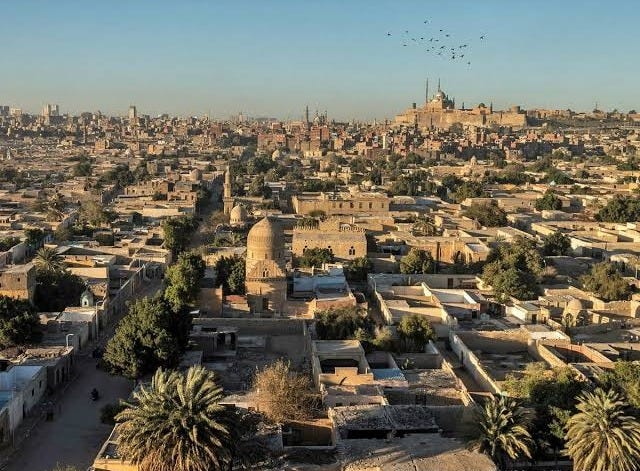
However, the New Republic has been slowly eroding this version of Cairo under increasingly vicious neoliberal policies and through Gulf investments; demolishing centuries-old tombs to pave roads for new compounds, expropriating land and displacing people to build skyscrapers, and rebranding what survives into a themed backdrop for chain cafes and restaurants.
Nabil argues that Cairo’s historic urban fabric is being deliberately erased because Egypt’s ruling class is using “Gulf-ification” as political cover for a real-estate rentier economy driven by Egypt’s post-2016 currency and debt crisis.
The demolitions aren’t incidental to development, they are the development model: roughly 2,760 graves ordered removed near Sayeda Aisha Square in 2021 alone, followed by thousands more across the UNESCO-listed Qarafa cemetery through 2024, among them the resting places of Ahmed Shawqi and Mahmoud Sami al-Baroudi, cleared to build traffic corridors feeding the New Capital.
The travesty includes most of the Imam al-Shaf’i area.
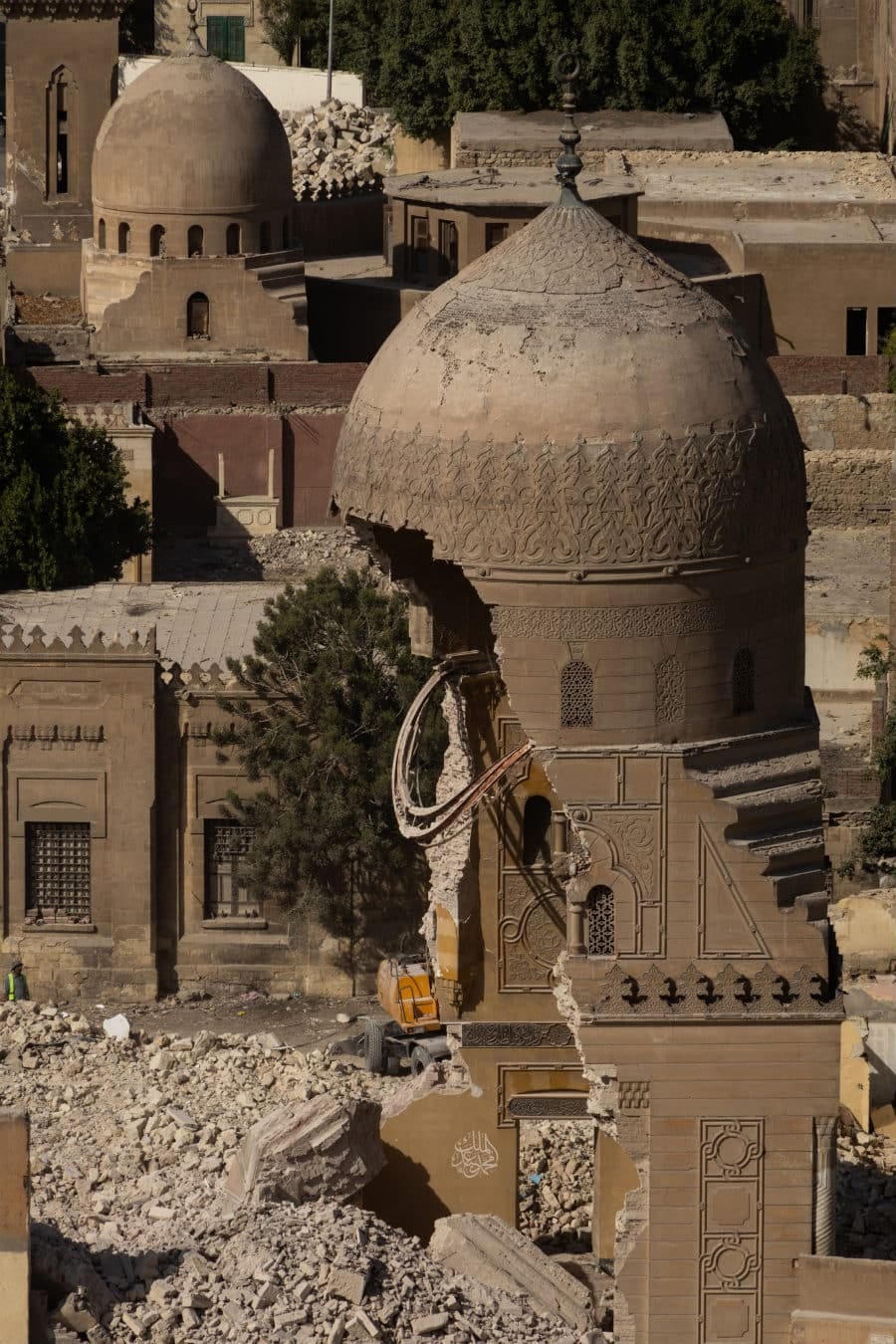
Nabil connects the shift of administrative/financial weight to the New Capital directly to El-Sisi’s July 2026 remarks linking the relocation of strategic institutions, including the Ministry of Defense, to avoiding a repeat of January 2011; since downtown Cairo was central to the revolution’s geography. This reframes the “urban development” as also a security-driven depoliticization of public space.
The actual target consumers of the mall-and-compound model reshaping Cairo, he adds, are “Ahl Egypt” (the people of Egypt), those who built wealth through currency speculation, brokerage, and real estate rent, often living in desert “ghettos” removed from the city center.
Interestingly, Nabil deliberately undercuts the “blame the Gulf” reading by showing Gulf states themselves choosing restoration over demolition. He cites Jeddah’s historic al-Balad district, Doha’s Souq Waqif, and Dubai’s Al Fahidi district as examples.
He pairs these with European cases, including Bologna’s 1970s restoration plan that deliberately kept original residents and tradespeople in place rather than evicting them for a tourist-facade version of the neighborhood, and Edinburgh’s Old Town/New Town split, which routed modern development away from the historic core entirely.
Therefore, he argues, if Gulf capital itself proves capable of funding preservation rather than demolition, then Cairo’s demolitions are an Egyptian political choice, using Gulf capital within a profit-maximizing rentier logic.
If you have not read it yet, check out this week’s labor dispatch from The Cairo Report:
Egypt, The New Republic: One thousand reforms for capital, arrears for everyone else

This issue of The Cairo Report follows a state that can enumerate 1,008 reforms for private capital over three and a half years and barely 44 for the people who staff its factories, hospitals, universities, and registries—a ratio of roughly 23 to 1.
*What We’re Reading is a fortnightly list of the stories behind the headlines, read through the lens of class and power. In your inbox every other Wednesday.