


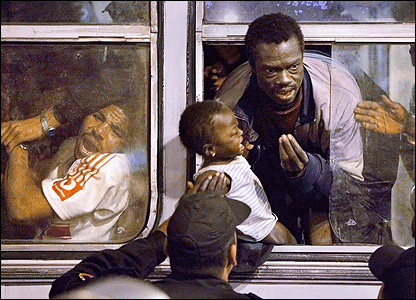
In the earliest, darkest hours of December 30, 2005, a force of nearly 6,000 Egyptian Central Security Forces (CSF) surrounded a sit-in by Sudanese refugees in Mostafa Mahmoud Square—no one in, no one out.
First, they drenched them and their makeshift homes—made of patchwork cloth and plastic—soaking children, women, and men to the bone.
The refugees screamed chants in protest, planting themselves like trees.
The streetlights went dark.
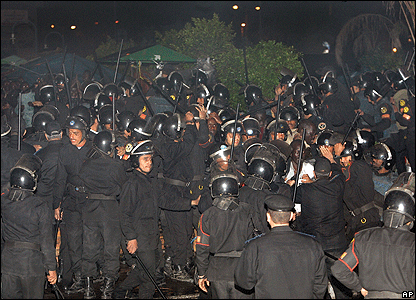
Then, the CSF closed in with batons. Legs clambered, bodies fell, screams of panic and cries of anguish echoed to jeers by some Egyptian civilians and police forces, carmine welled on scalps and knuckles, rivulets and spatters sluggishly spreading on charcoal asphalt.
At least twenty refugees were announced killed by Egyptian bloggers and activists who witnessed the violent dispersal, but in the following days, they would record up to 156 deaths.
Before that night, the term “massacre” did not really exist in Egypt’s domestic political lexicon. The CSF had a pattern of killing several civilians during protests, sit-ins, and riots, but it had never before killed dozens in the span of 30 minutes with little more than fists, batons, and shields—sadism justified by racial discrimination.
A deep hatred of this “other”; a refugee that day, and a fellow Egyptian in a few years.
To understand why thousands of riot police were mobilized against a crowd of refugees armed with nothing but tents and placards, it’s necessary to rewind to the mid-1950s.
The origins
By 2005, Sudanese people had migrated to Egypt in three major waves since the Free Officers’ July 1952 coup. Each was driven by a different war.
The first was propelled by the country’s first civil war, which ran from 1955 to 1972.
The second, larger wave came during the country’s second civil war, a conflict that broke out in 1983 and ground on for twenty-two years, killing around half a million people and displacing hundreds of thousands from their homes, before finally ending with the Comprehensive Peace Agreement (CPA) between the Sudan People’s Liberation Movement (SPLM), the political wing of the Sudanese People’s Liberation Army (SPLA), and the Sudanese government on January 9, 2005.
The third wave came from Darfur, where conflict had erupted in 2003 and was still actively producing displacement two years later.
For decades, Egypt had adopted what was essentially an open-door policy toward Sudanese nationals: no visas, no residency requirements, and little need for the United Nations High Commissioner for Refugees (UNHCR) to determine refugee status on a case-by-case basis, since Sudanese arrivals were more or less absorbed into Egyptian life by default.
That changed after the June 1995 assassination attempt on Egypt’s toppled President Hosni Mubarak in Addis Ababa, which was widely attributed to actors linked to the Sudanese government.
In its aftermath, Egypt revoked the privileges Sudanese nationals had enjoyed, including free education and healthcare, and imposed visa and residency requirements on new arrivals.
The more immediate rupture came in June 2004, when the UNHCR’s Cairo office stopped conducting individual Refugee Status Determination (RSD) interviews for Sudanese asylum seekers, freezing both new and pending claims.
In their place, the UNHCR introduced a blanket “temporary protection” status, the so-called “yellow card,” reversing nine years of case-by-case practice in a single policy shift. The justification was the CPA, which the UNHCR judged sufficient to make return to southern Sudan viable.
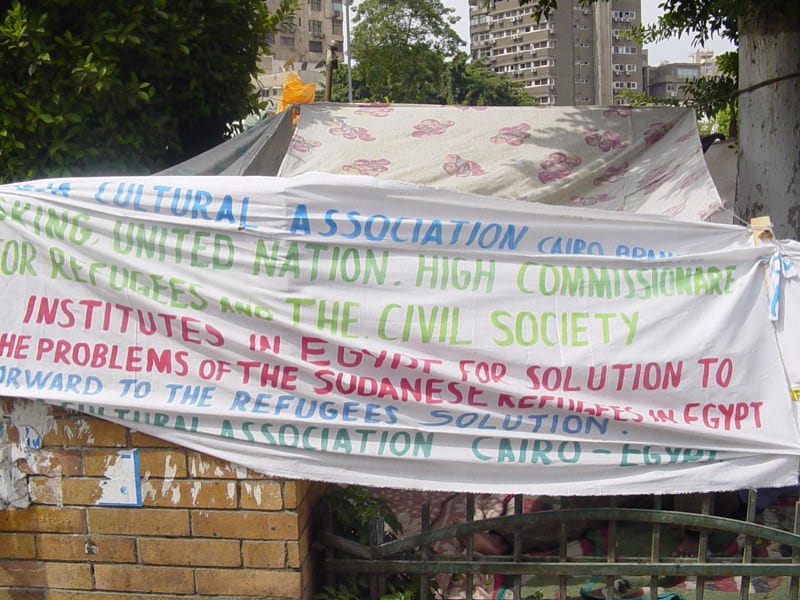
The yellow cards were only ever meant to be a stopgap, valid through the end of 2004 pending a fuller policy review. Except the review was repeatedly postponed, leaving tens of thousands of Sudanese refugees in indefinite limbo.
That same month, Egypt and Sudan signed the Four Freedoms Agreement, granting each country’s nationals freedom of movement, residence, property ownership, and work in the other’s territory. Egyptian officials pointed to the agreement as proof that Sudanese nationals no longer needed refugee protections at all. But for many Sudanese refugees, accepting that framework would mean accepting the authority of the very government they had fled.
An October 2005 report by African open-access newsletter Pambazuka, an anonymous contributor documents a precursor protest against the yellow-card freeze in August 2004, organized by the Egyptian non-governmental organization South Center.
Per the report, Egyptian police responded with tear gas and detained twenty Sudanese demonstrators.
Nine months into this bureaucratic war of attrition, in March 2005, three Sudanese refugees attended a Human Rights and Refugee Law seminar in Cairo and, in its wake, formed a group calling itself Sout al-Laji’een (Refugee Voices), compiling grievances from across the wider Sudanese community in the city.
By the time the sit-in launched weeks later outside the UNHCR’s Cairo office, the scale of who it claimed to represent was already contested. The UNHCR’s own Deputy Protection Officer, Ahmed Mohsen, was quoted by organizers in the demonstration’s first days admitting the agency simply could not keep up, telling them there were 58,000 Sudanese refugees in Cairo and no way the UNHCR could possibly be there for all of them.
However, the Forced Migration Review contested this number, citing only 30,000 Sudanese refugees registered, emphasizing that this number is only a fraction of the far larger, mostly undocumented Sudanese population in Cairo, which was commonly estimated, loosely, at around 3 million people once long-settled economic migrants were counted alongside refugees.
That gap between state convenience and agency bureaucracy on one side, and human reality on the other, is what emptied into Mostafa Mahmoud Square.
The sit-in
On September 29, 2005, 42 Sudanese refugees gathered in the garden facing the Mostafa Mahmoud mosque in Mohandiseen, in front of the UNHCR office, to begin a sit-in protesting the agency’s continued postponements, according to a copy of the memorial booklet, “We Will Not Forget,” issued by the El-Nadeem Center for Rehabilitation of Victims of Violence in February 2006, obtained by The Cairo Report.
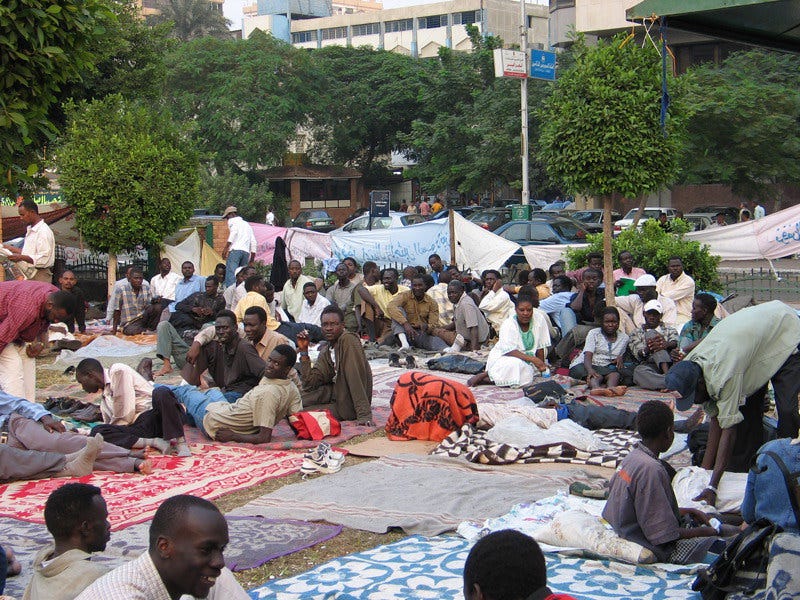
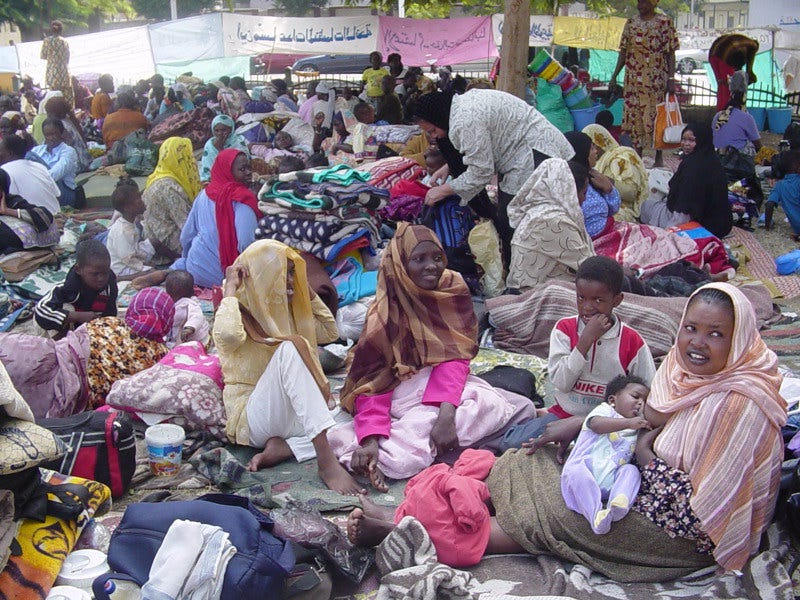
Most of the initial group at the sit-in were youths already active in Sudanese mutual-aid networks in Cairo, and they named their site of protest, the garden, “al-Nagila,” Arabic for “the grass”. Over the following weeks, more and more Sudanese sought refuge in al-Nagila, and the sit-in grew with them, reaching an estimated 1,800 to 2,500 participants, per the UN.
The numbers, naturally, fluctuated day to day. Some residents left the encampment for day labor and returned while some families camped continuously. They pitched rudimentary tents, kept their clothing in plastic bags, and organized demos within the boundaries of al-Nagila on occasion.
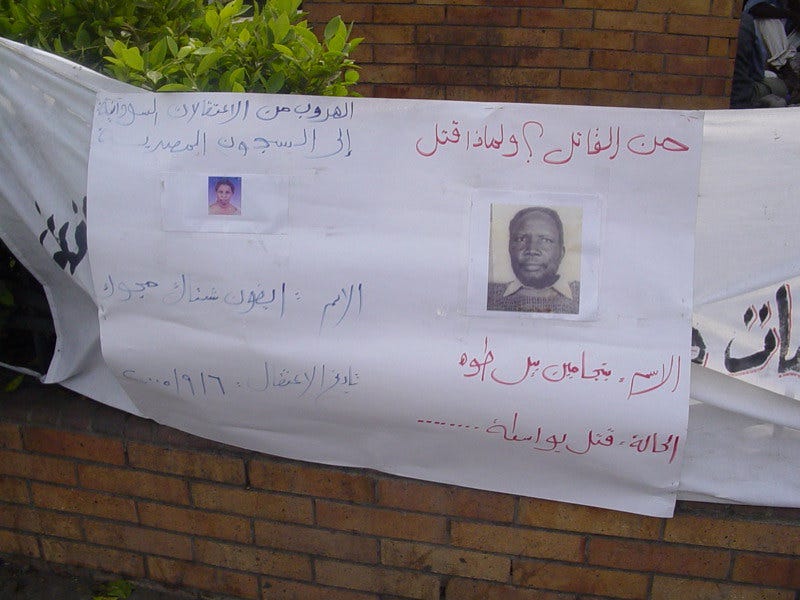
The refugees formed committees inside the encampment to manage food distribution, informal rules of conduct, and even something resembling an internal curfew, according to El-Nadeem’s report.
Their demands were simple: either third-country resettlement, credible guarantees for voluntary return, or a path to local integration in Egypt with basic rights. Their most repeated chants were “al-Nagila, al-Nagila…We will die on al-Nagila” and “No state for us but al-Nagila, except Sudan.”
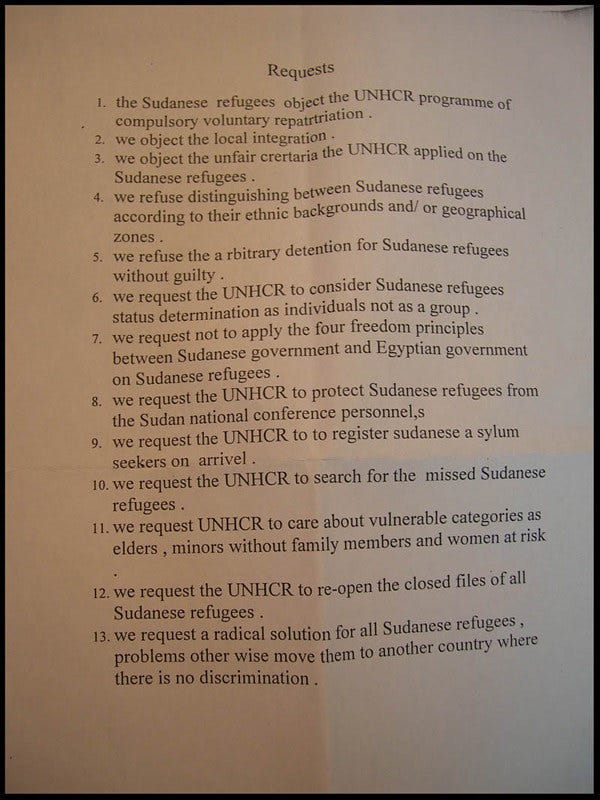
The sit-in witnessed multiple rounds of negotiations, starting with one in the very first week.
“We approached the UNHCR office, but they did not care for us. They treated us very rudely, responding sarcastically to us. They always treat us rudely,” one of the Sudanese participants told El-Nadeem Center.
On November 17, the UNHCR and the Egyptian foreign and interior ministries offered emergency assistance and housing to those who have lost their homes during the sit-in, as well as aid to those willing to return to southern Sudan, in exchange for ending the sit-in by noon that Sunday. Protesters didn’t accept it, and numbers instead grew to 3,000, The New Humanitarian reported.
In fact, on November 21, dozens of the camping Sudanese refugees also declared a hunger strike.
“Until our demands are met, we will not relent. We would rather die here than face the conditions the UNHCR is imposing by closing its doors to us,” Sudanese asylum seeker Amir Khaled told The New Humanitarian. “If the UNHCR fails to respond, we will steadily increase our number of hunger strikers.”
Between months of an Egyptian security crackdown and the UNHCR’s blatant, if not criminal, disregard, the refugees held very little trust in any promises made by either party.
Another factor that sowed mistrust was Egyptian civilians. Multiple accounts by Egyptian bloggers and civil society organizers explain that Mohandiseen residents regularly incited violence against them. They threw racist slurs as they passed al-Nagila by, tossed trash at the sit-in, loudly complained about how “dirty” the refugees were, jeered at them, and regularly lodged complaints with law enforcement. This state was only exacerbated by state media, which stoked the flames into an inferno.
Negotiations reached a crisis when five negotiators representing the Voice of the Refugees signed an agreement with UNHCR to end the sit-in by December 22 in exchange for the agency resuming individual case interviews. The broader refugee body rejected the deal, insisting on enforceable resettlement guarantees rather than vague assurances, and the sit-in continued.
However, things were coming to a head.
On the same day, then-foreign minister Ahmed Aboul Gheit called for intensified endeavors and greater effort to bring the sit-in to an end as soon as possible.
The massacre
In the aftermath, many people would say the dispersal came as a surprise.
But Alaa Abdel-Fattah and Manal Bahey El-Din Hassan would later notice a comment left on their famous blog, ManalAlaa, that warned of the dispersal’s imminence mere hours before it took place. The comment, posted anonymously, went so far as to predict that it would be a massacre.

Multiple activists who witnessed the massacre confirmed to The Cairo Report that, at the time, they did not believe the dispersal would be as violent as it was.
But the comment wasn’t the only warning.
Per journalist Nora Younis’s account, she received word just before ten o’clock on the night of Thursday, December 29, that Mohandiseen was being transformed into “a military encampment”.
Small groups of activists and journalists, Younis among them, made for the scene.
By 11 pm, state security trucks and plainclothes police were sealing off Batal Ahmed Abdel Aziz, Ahmed Orabi, and Gamaat al-Duwal streets. Public buses were being staged around the area, some already carrying security personnel inside. Younis recorded several of their plate numbers as they passed—4129, 3696, 4107, 4136, 4335, 3416, 3534—a small, almost bureaucratic act of documentation that would later help corroborate the scale of what was being assembled.
Within minutes, every road leading to the square had been sealed and bystanders forced to disperse.
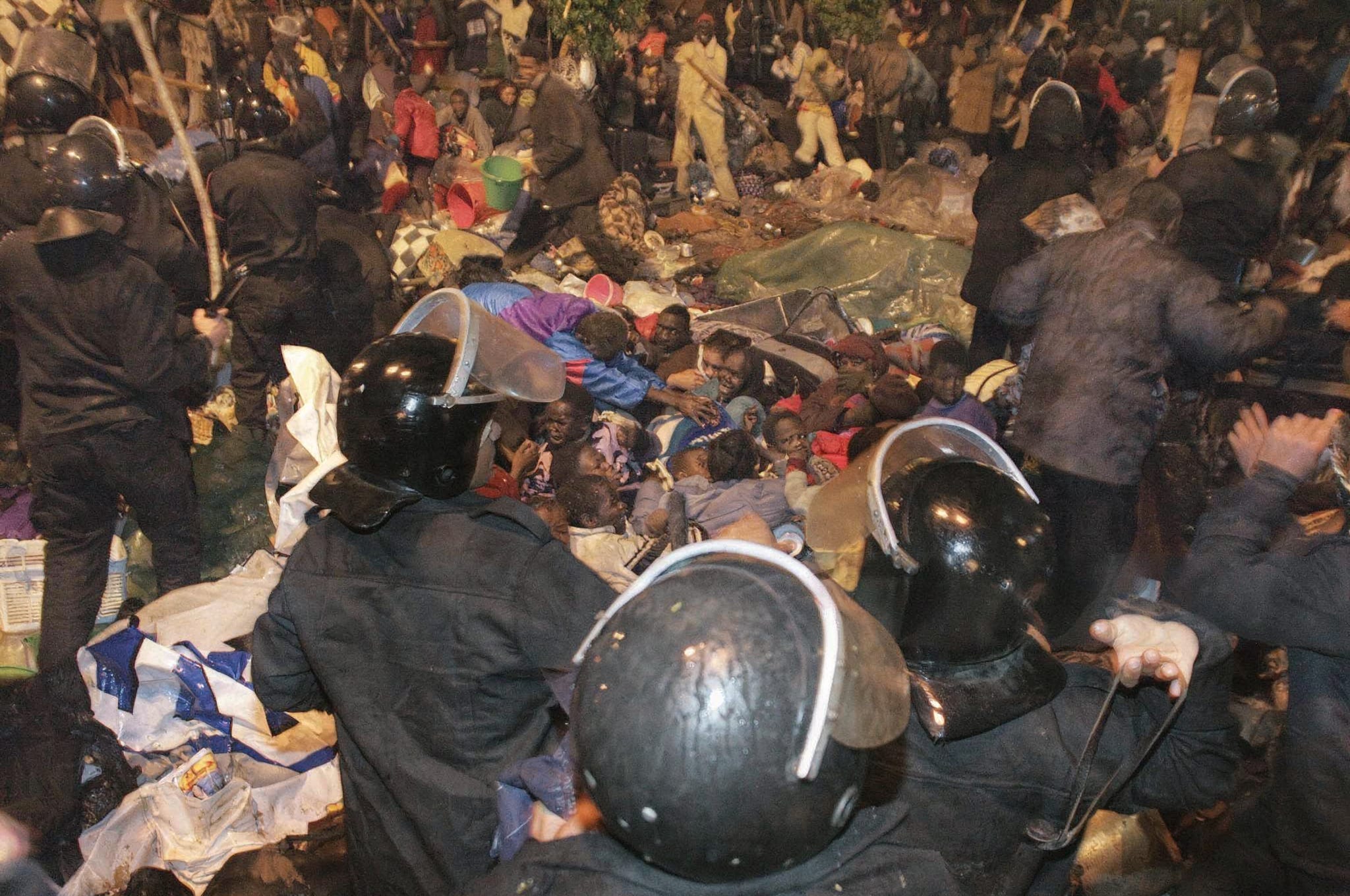
Younis wrote that the CSF ringed the camp in five or six parallel lines, counting 60 Central Security vehicles, four fire engines, ten armored vehicles, and a fleet of requisitioned public buses waiting to carry people away.
By one o’clock in the morning on Friday, December 30, the operation began in earnest.
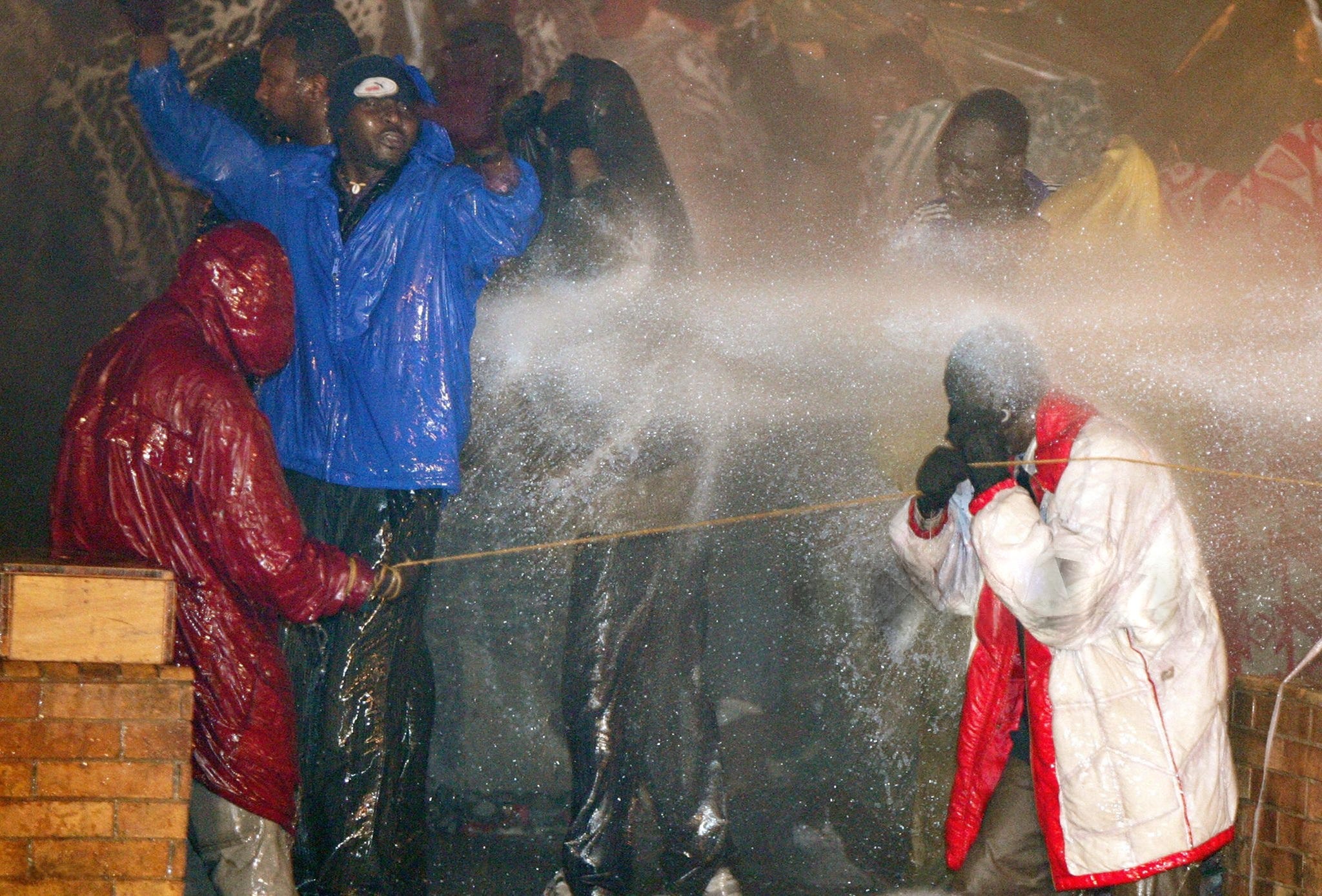
Security forces opened fire with water cannons on the refugees in freezing winter temperatures, a first burst lasting roughly six minutes, followed about an hour later by a second, more forceful blast aimed directly at people rather than over them, Younis reported. Some officers taunted refugees as they were soaked, telling them they needed “a shower” after three months of living in the square without one.
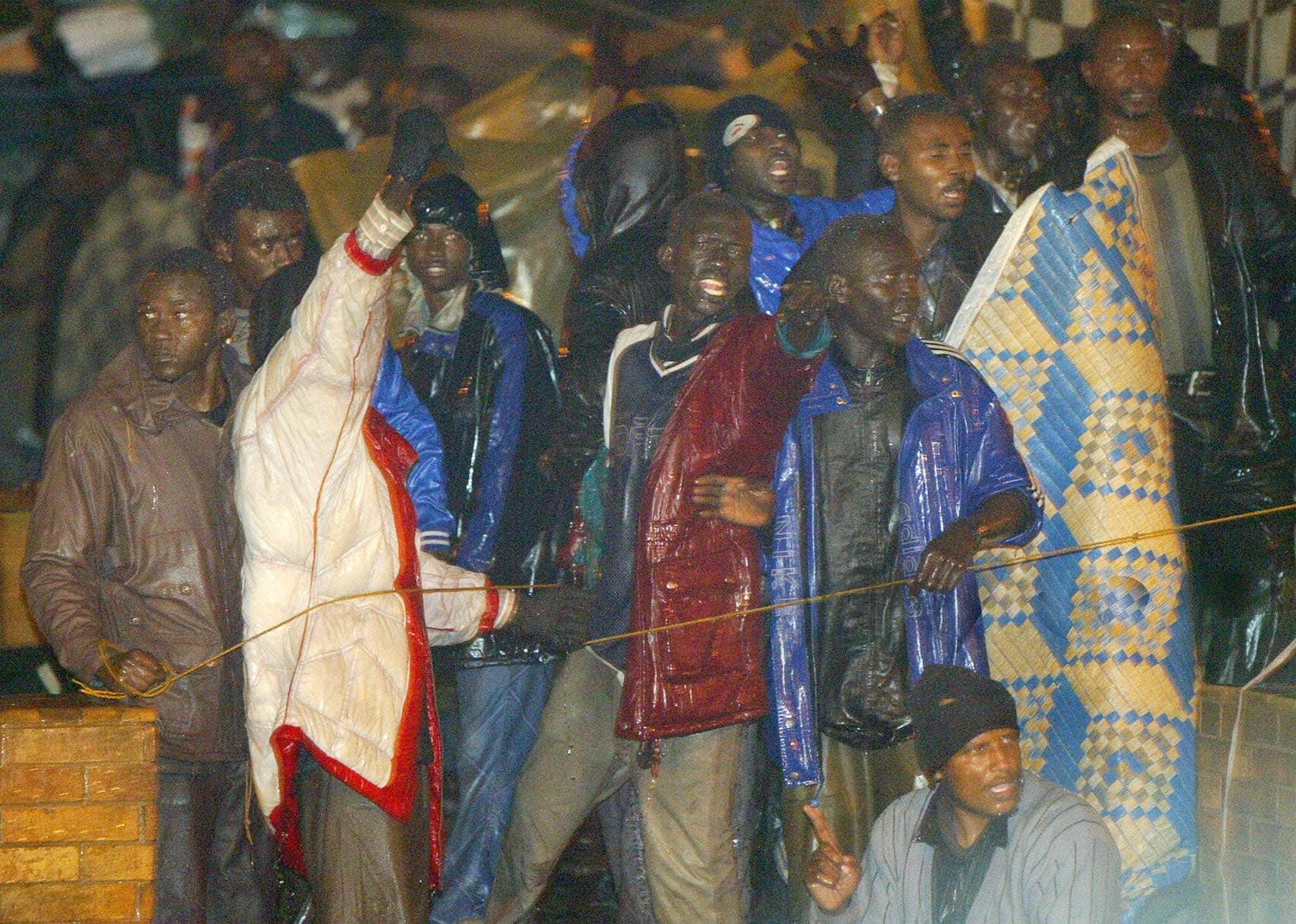
Then, for a few hours, an uneasy lull.
It broke just before five a.m.
Security lines began closing in on the camp from all sides. Inside, refugees, Muslim and Christian alike, responded with chants and prayer, the square filling with chants of “Allahu Akbar” and “Hallelujah” rising together against the advancing lines.
Water cannons fired a third time, with some refugees describing an additional tear gas attack.
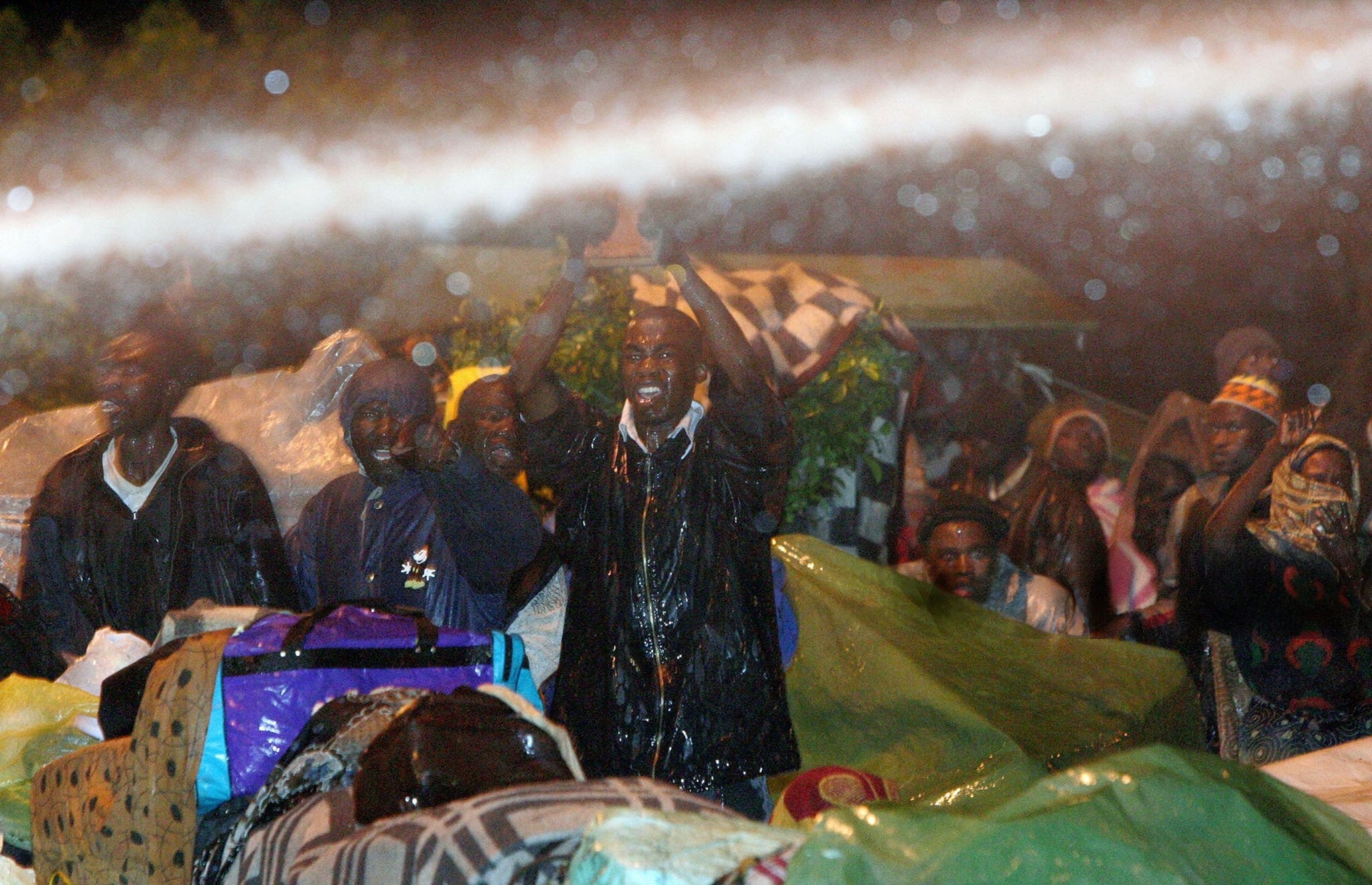
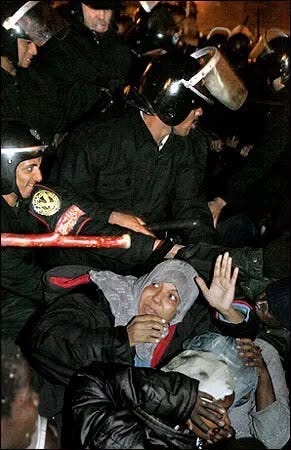
Then baton-wielding officers charged.
“We were trapped. Three thousand of us in a small square, and we were being brutally beaten from all directions. We were piled on top of each other. Out of nowhere, a man would fall and not speak at all,” a refugee told El-Nadeem. “We would hear these muffled sounds, then suddenly find another man falling. I don’t know what they were hitting with, but it paralyzed us. One hit and you could not move your jaw to speak, let alone your body.”
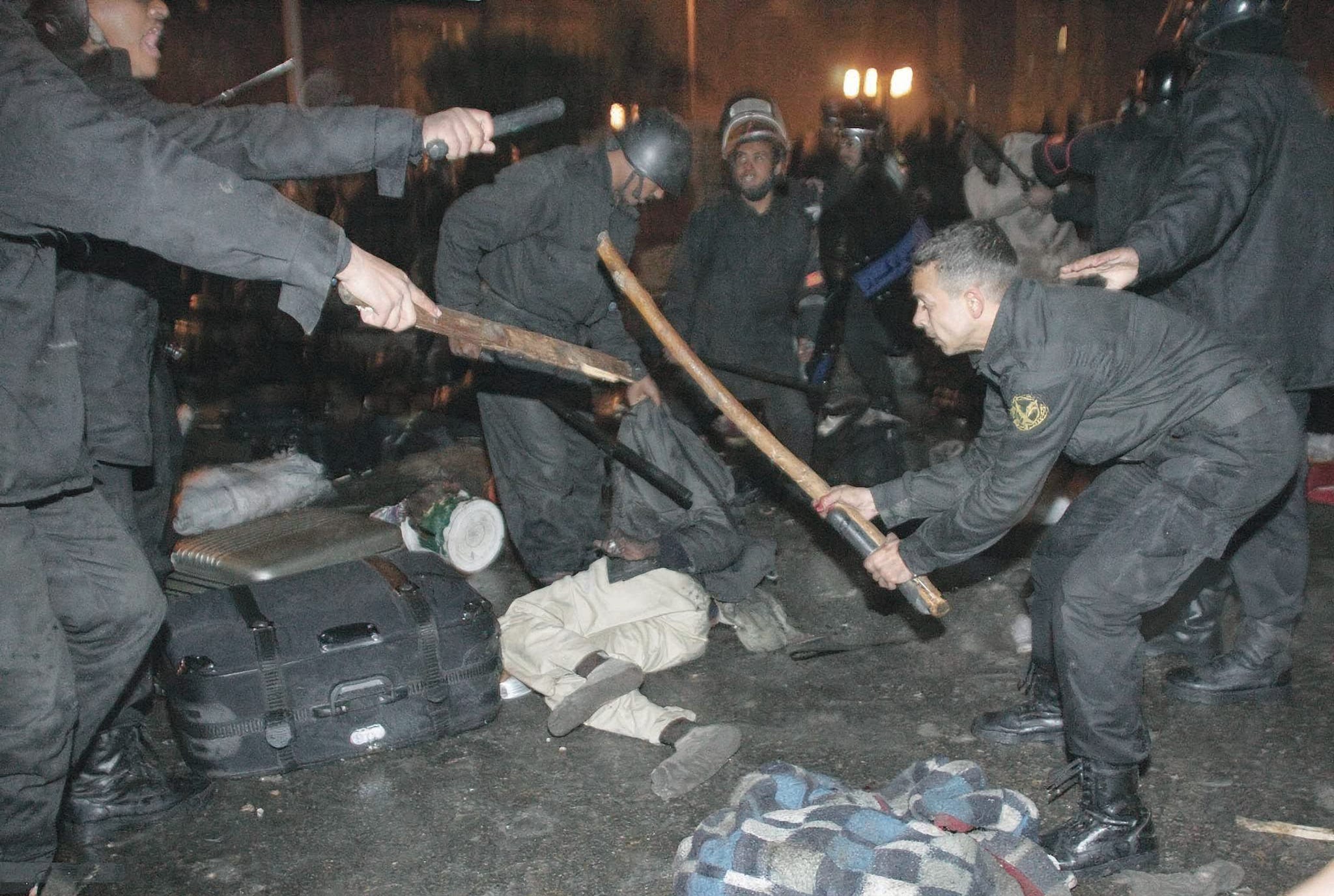
The CSF did not discriminate; men, women, and children were all beaten, refugees dragged in twos and threes toward the waiting buses, and—in some of the most disturbing testimonies—beatings that continued on victims after they had already stopped moving.
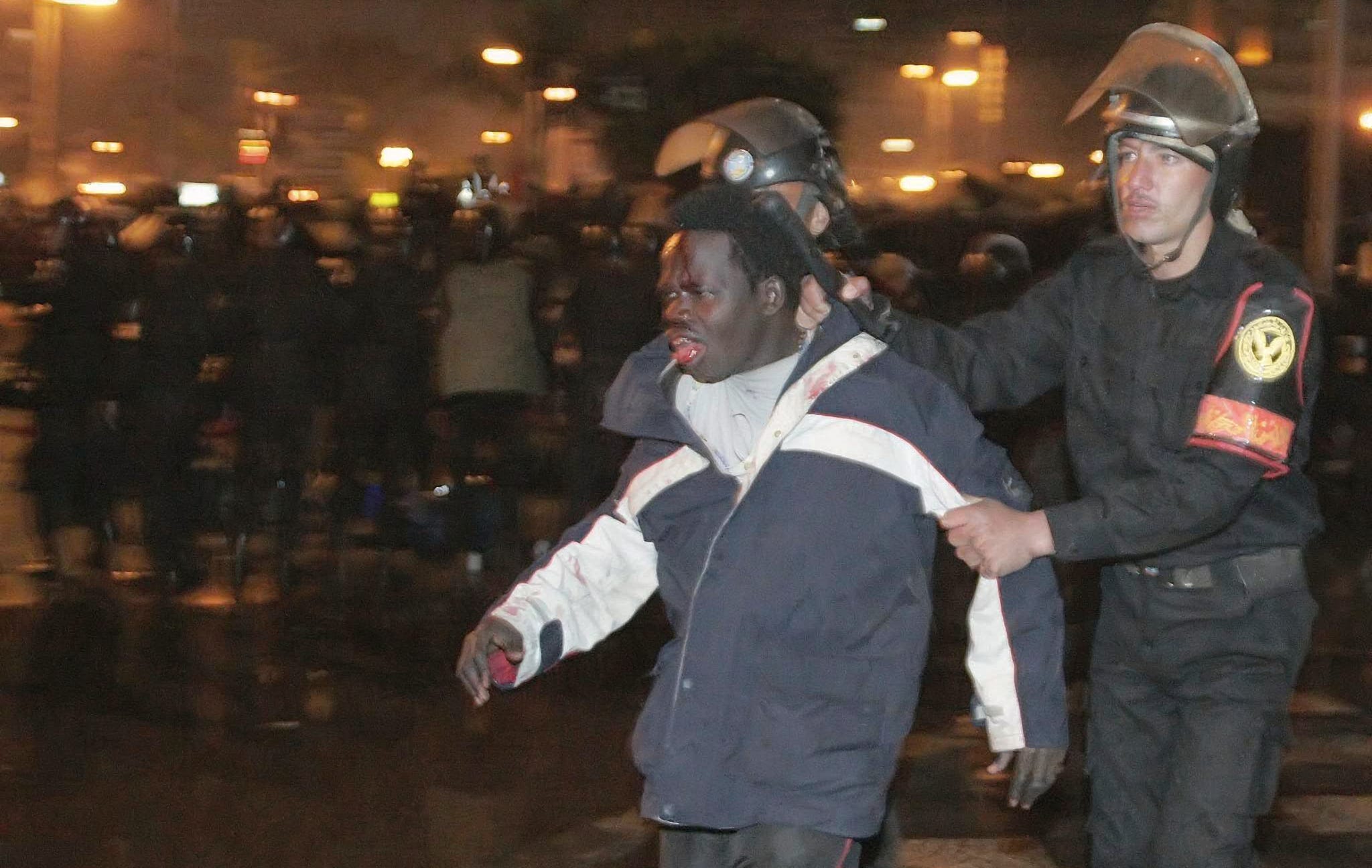
“They [CSF] were pounding any moving body on the ground, including women and children; they did not care. There was no chance to negotiate a final time,” a third refugee told El-Nadeem. “Children were on the ground; we tried to carry them, but they would hit us and the children we carried. Those of us who died stayed dead. But those injured and exhausted? They were physically dragged to the public buses, beaten on the way to the bus, on the bus, and until the bus reached its destination.”
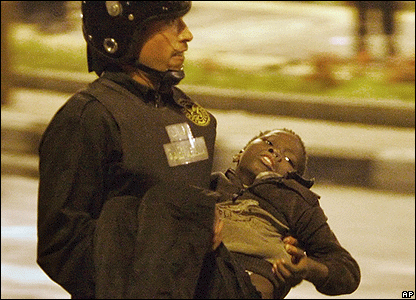
“They punched my eye; blood oozed from my nose,” she added. “Every time I tried to hold onto a child, they hit them, so much so that my own fingers were broken.”
Officers destroyed what little the refugees had left, tearing apart tents and throwing bags and documents aside even as the assault continued around them.
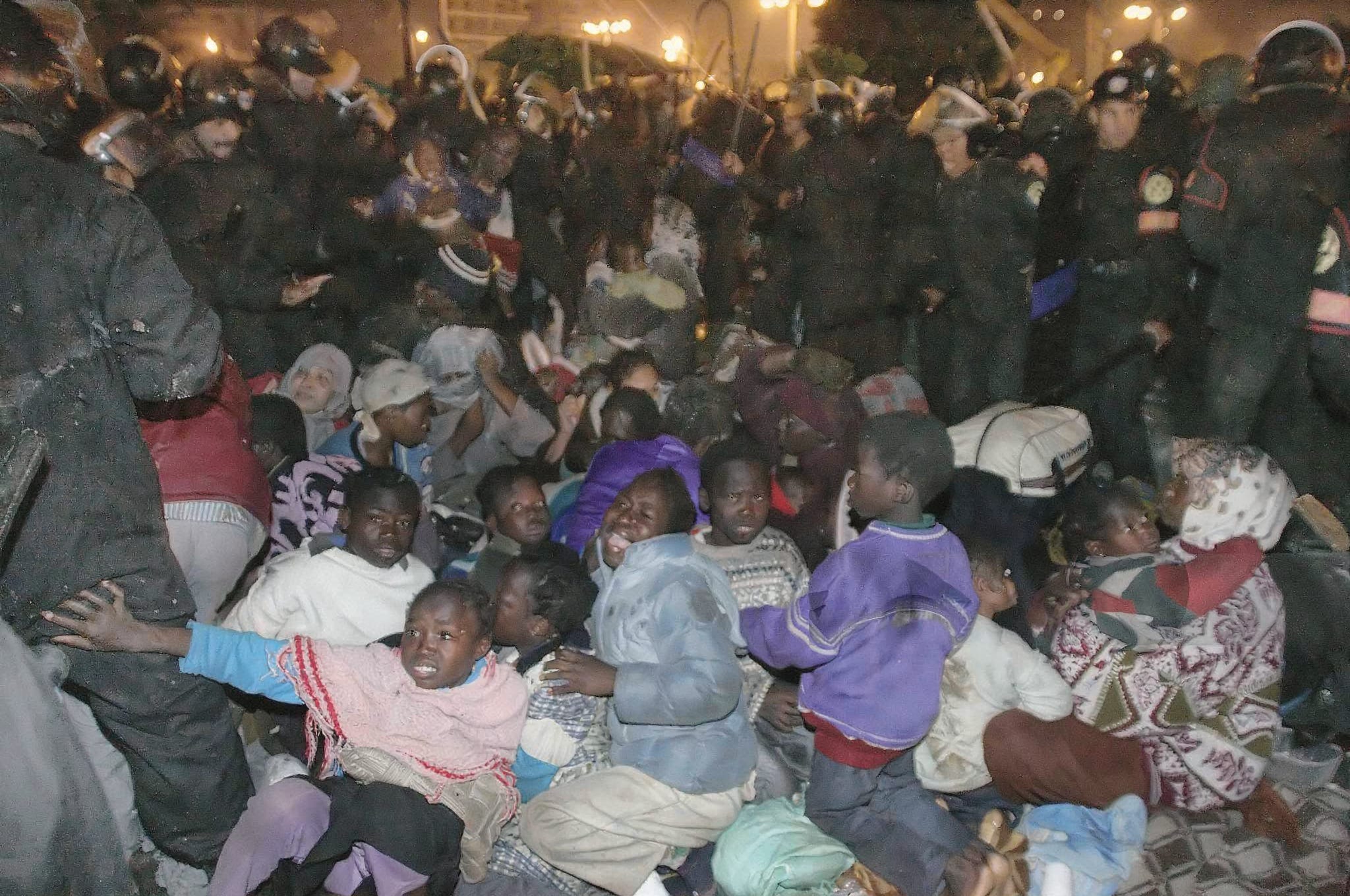
“The Egyptian Central Security Forces did not come to disperse the sit-in; they came to kill,” another refugee told El-Nadeem. “They came to kill as many people as possible”.
For Socialist Papers, journalist Gehan Shaaban reported that an activist with the American African Foundation Against Torture, Zein, who was a member of the delegation negotiating with security forces, smelled betrayal.
Zein told Shaaban that he asked for a one-hour reprieve to persuade the refugees to peacefully disperse. The security representatives agreed. Within minutes of Zein returning to camp, a State Security officer summoned him and told him, “Get in your car and leave.”
When Zein tried to ask for an explanation, the officer stated that he had authorization from “Mr. President” to break up the sit-in “at any cost,” adding, “These people are going to get beaten.”
Zein replied, “Then we’ll get beaten right along with them,” and returned to the camp.
By roughly five-thirty, it was over.
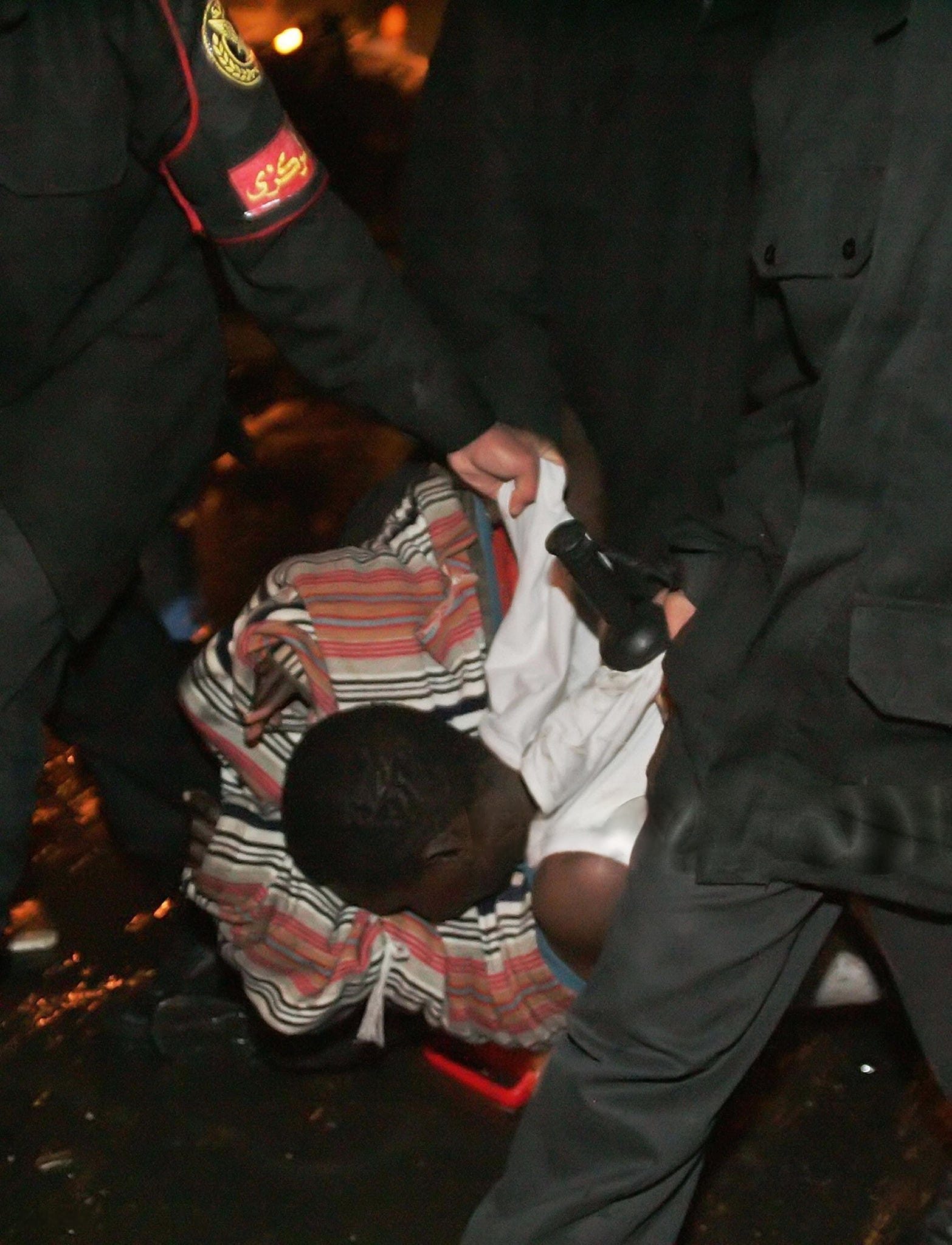
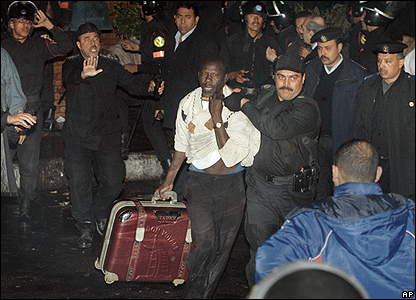
Hundreds of refugees had been shoved into buses that carried them to Central Security camps scattered across Cairo’s outskirts, including Dahshur, 6th of October City, Tora, and Mansheyet Nasser, while smaller numbers were taken to State Security offices at Gaber Ibn Hayyan or to prisons further afield, in Shibin al-Kom in Menoufiya and in Qanater.
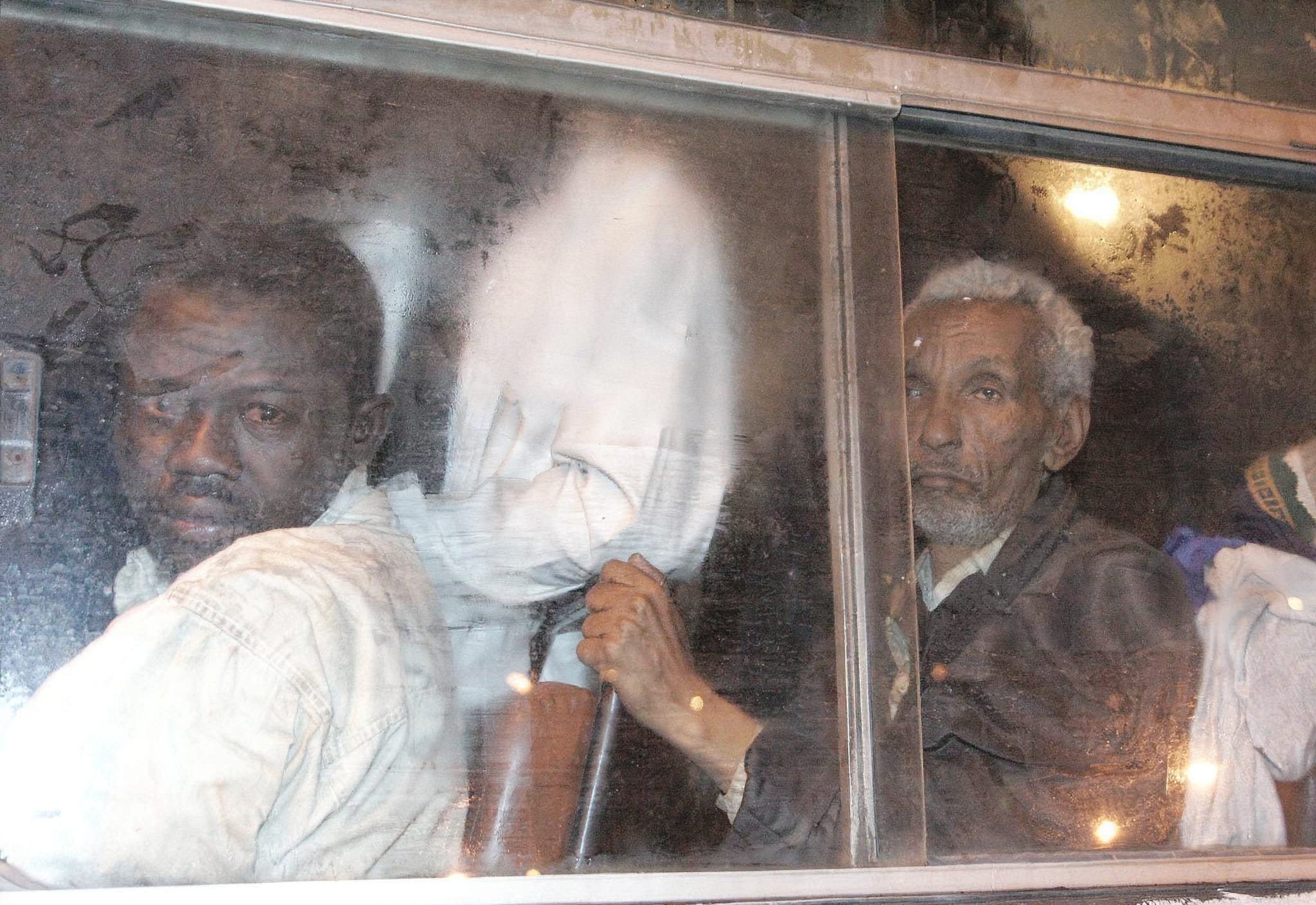
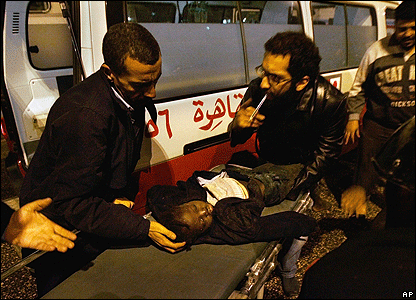
Some testimonies published in the El-Nadeem report described bodies, or people no longer conscious, being tossed out of moving buses at intervals and left at the roadside.
That same day, the operation’s commander, Major General Tarek Abdel Razek, filed police report No. 9975 at Dokki police station accusing refugees of assaulting security forces and injuring 75 officers.
It was, from the outset, an official record built to invert the violence rather than account for it.
“When I fell, I was holding a child; I was nearly dead. They dragged me like a dog. When I came to, my hands were tied. They hit me with an electric baton,” a refugee told El-Nadeem. “When I woke up again, I found myself in a morgue surrounded by the dead. I couldn’t raise my head. There were two doctors saying, ‘These are dead people, but what do we do if one isn’t?’ The response was ‘kill him’.”
“I was surrounded by dead men, women, and children. Some children, as young as a year and a half, were between life and death,” he added.
The death toll as of January 2, 2006, documented by Shaaban, stood at 156, distributed as follows: Al-Sanabil Hospital (28 bodies), Zeinhom Morgue (74 bodies), the Ambulance Authority (40 bodies), Imbaba Hospital (one body), and 6th of October Hospital (13 bodies. Additionally, approximately 400 Sudanese refugees were missing.
“One hundred and fifty-six human lives were snuffed out in half an hour, in cold blood,” Shaaban wrote.
That number constitutes confirmed deaths, not all of them. Exactly how many refugees were killed that night and in its aftermath, we still don’t know.
The aftermath
Within hours of the massacre, Egyptian rights groups had issued condemnation statements, among them El-Nadeem Center, the Cairo Institute for Human Rights Studies (CIHRS), and the Egyptian Initiative for Personal Rights (EIPR). Political factions, including Kefaya and the Revolutionary Socialists, did so as well.
Twelve Egyptian rights groups, including the Hisham Mubarak Law Center, sent a letter to the United Nations High Commissioner for Human Rights Louise Arbour demanding an independent international investigation, the dismissal of Interior Minister Habib al-Adly, and the release of detained refugees.
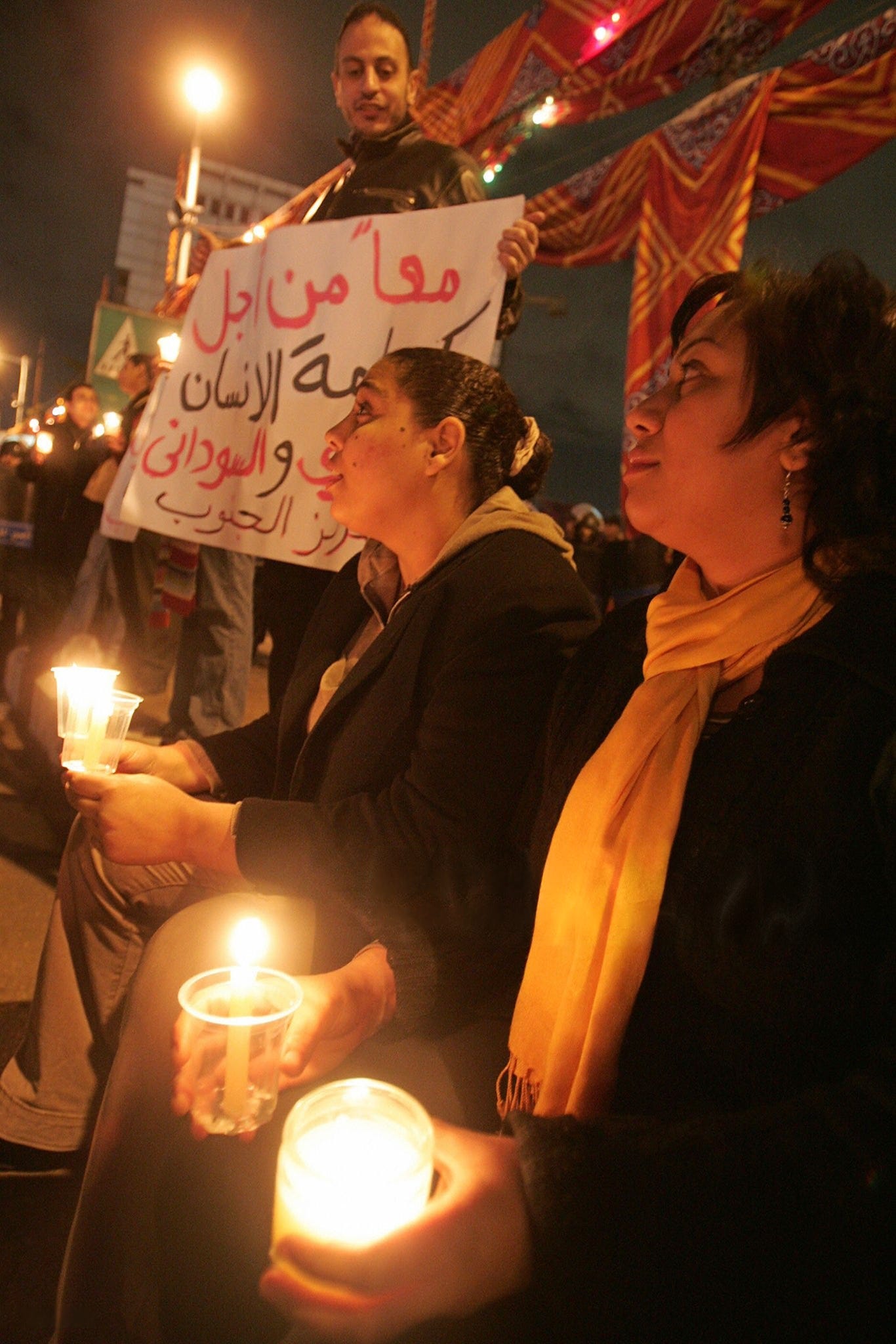
“There is the issue of indiscriminate mass killing. Collective punishment—that is, punishment not directed at a specific individual for a specific crime proven to have been committed following a fair trial that afforded all guarantees of the right to defense—is precisely what Israel is inflicting upon our Palestinian brethren,” Tamer Wageeh wrote for The Socialist. “Are we, then, to grant the ruling regime in Egypt a license for mass killing? Do we want it to employ against us—or against anyone else—Israel’s despicable policy of mass killing?”
It would not be until the outbreak of the January 25 revolution, but especially the Maspero massacre in October 2011, that this question would be answered.
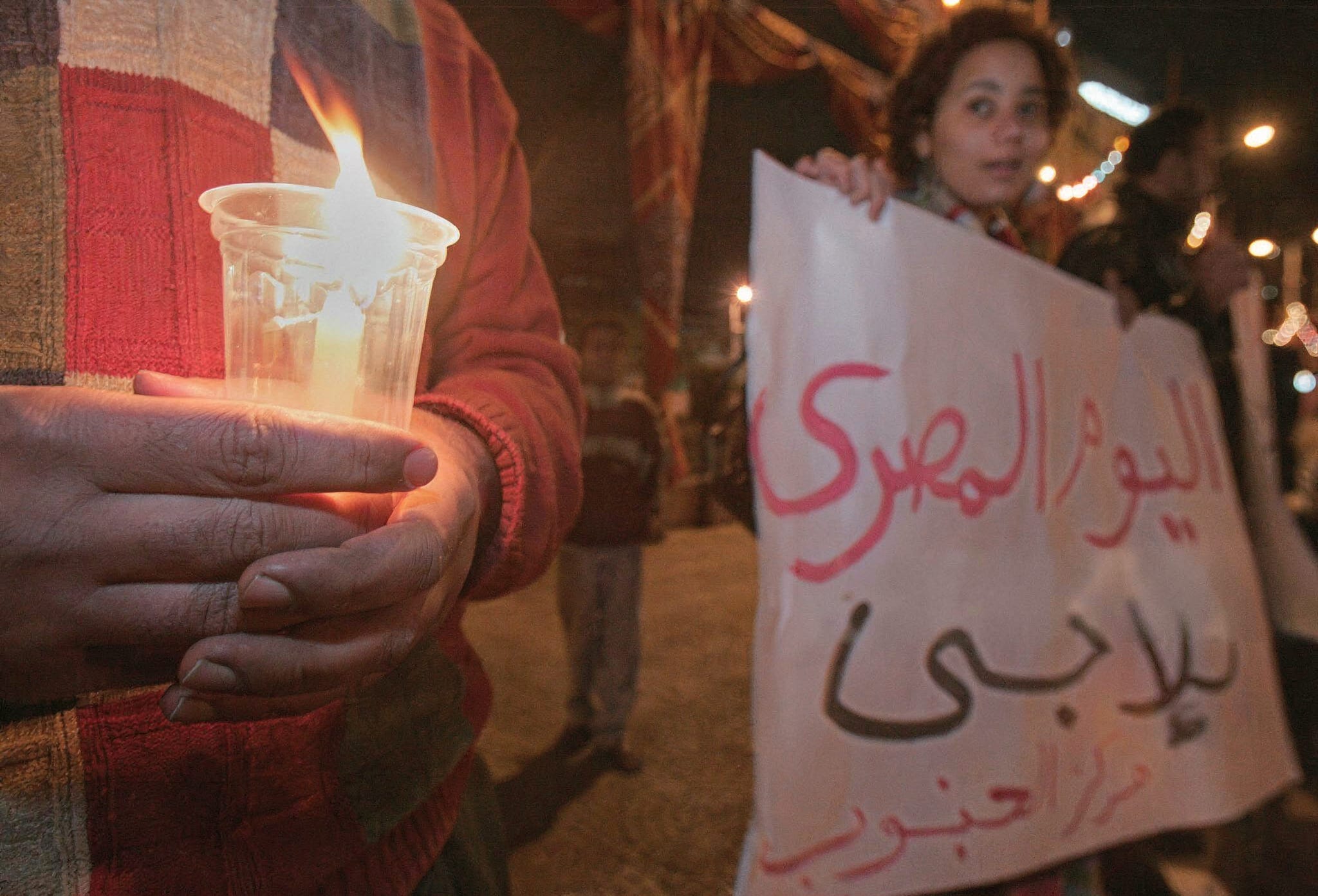
Some rights groups, political factions, and blogger-activists followed up the statements with a call to protest against the massacre, a notification for which went out via ManalAlaa, alerting people to the date, time, and location: Saturday, December 31, 12 pm, at the Mostafa Mahmoud Square (al-Nagila). There was also a call for a candlelight vigil mourning the refugee martyrs, who were named al-Nagila martyrs, and protesting the repressive practices of Egyptian security forces.
Days later, activists called for organizing an ongoing exhibition and a weekly open discussion on the streets of Cairo to raise public awareness about the massacre, recall past violations by security forces, and draw connections between those violations and the massacre itself.
The first event was scheduled for Thursday, January 5, at 5:00 pm, at al-Nagila.
The organizers’ relentless choosing of al-Nagila as the site for protest was strategic. It allowed them to protest the UNHCR directly; it kept the massacre’s memory vivid in the moment, and it gave cover for Sudanese refugees who lost their family members to join them in protest, “protected” by Egyptian activists.
Others showcased their solidarity with art.
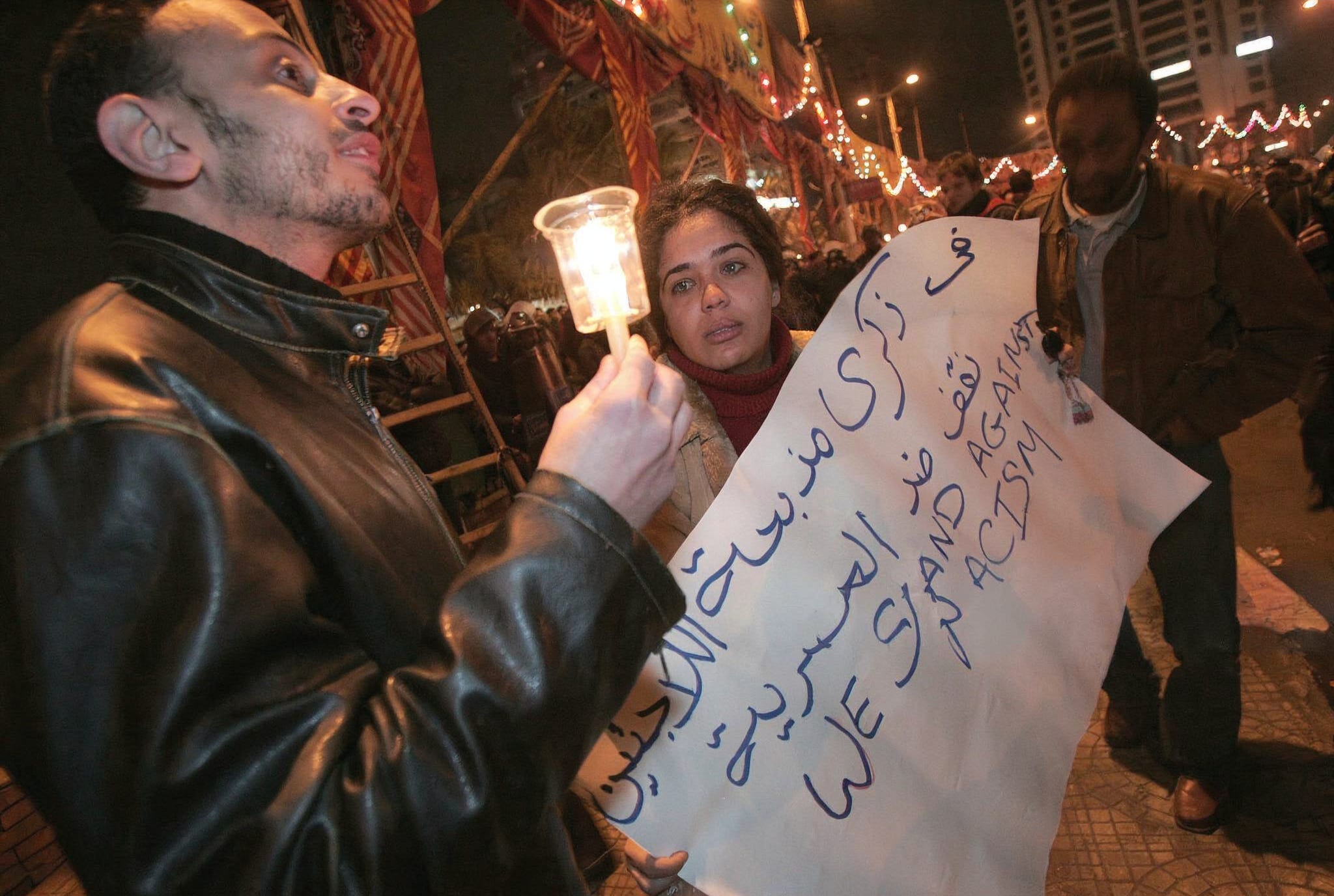
That being said, several Egyptian politicians, including those belonging to so-called “opposition” factions, refused to participate in any of these actions, according to Wageeh’s account.
In parallel, between January 2nd and 30th, 2006, 40 Sudanese survivors sought treatment at the El-Nadeem Center, including 30 men (ages 23–48) and 10 women (ages 19–41). Of these, 10 were university students and 9 university graduates, per the El-Nadeem booklet.
Beyond the center’s logging of physical injuries, it also logged psychological ones.
The clinicians documented acute anxiety and severe depressive symptoms in nearly all patients seen, and specifically flagged post-traumatic stress symptoms such as intrusive flashbacks (particularly of children being beaten or trampled), sleep disturbances, and re-traumatization among the subset of survivors who had prior torture or detention histories in Sudan.
Refugees who lost identification papers in the raid (many papers were left floating in the trampled garden or swept into garbage trucks) were sorted into a separate “illegal migrant” administrative category; roughly 275 people were recorded as lacking documents entirely (75 lacking only passports, 200 lacking any documentation) and were transferred to a State Security facility at Lazoghli before being moved to a holding facility at El-Qanater.
Multiple individual testimonies gathered by El-Nadeem describe detention at Shibin al-Kom prison, Qanater prison, and Tora, some for a week or more, before conditional release; several describe Sudanese embassy officials being granted access to detainees inside Egyptian custody to pressure individuals toward “voluntary” repatriation, and at least one testimony states that 100 detainees were deported with Sudan’s foreign minister personally present to receive them.
Many of the Sudanese who escaped the massacre or were released from detention or hospitals sought refuge in churches in the immediate aftermath. But on January 3, Egyptian security forcibly evacuated Sudanese refugees who had taken shelter at a church in Sakakini, and subsequently deported 654 refugees who had lost their identity papers to Wadi Halfa, Sudan, Shaaban reported.
The state took five months to answer the Egyptian rights groups.
In May 2006, the Dokki public prosecution office closed its investigation with a single finding: the deaths were the result of “stampede and overcrowding.” No one was named, no one was held accountable.
A month later, the Forced Migration and Refugee Studies program at the American University in Cairo offered its own accounting, a 68-page report titled “A Tragedy of Failures and False Expectations,” which spread the blame three ways—onto the UNHCR’s mismanagement, onto Egyptian security forces, and onto the refugees’ own protest leaders.
It took two more years for the international pressure to sharpen. On the second anniversary, in December 2007, five organizations—Amnesty International, Human Rights Watch, EIPR, the Hisham Mubarak Law Center, and El-Nadeem—jointly petitioned Mubarak to authorize a judicial inquiry independent of the one that had already closed.
They pointed out, bluntly, that the original investigation had never interviewed a single eyewitness.
Months earlier, in the spring of 2007, a UN committee on migrant workers’ rights had made a similar demand; Egypt’s Foreign Ministry rejected it within days, arguing the committee had no standing to ask. Rights groups called the rejection out publicly, but nothing moved.
By then, one survivor had stopped waiting for the state to change its mind. George Kajokabi, who had lost his wife and child in the massacre, filed a case against the Egyptian government before the African Commission on Human and Peoples’ Rights in 2007, after exhausting every domestic option; case No. 344/2007, argued by the lawyer Ashraf Milad, Al Manassa’s Safaa Sorour wrote in 2016.
It took the Commission six years to formally accept it for review, which it finally did in 2013, on the grounds that Egypt had never offered an effective remedy at home. By the massacre’s eleventh anniversary, in December 2016, the case was still pending; 37 Sudanese who had been in the square that night were still officially unaccounted for, and Kajokabi’s lawyer told Sorour he doubted Egypt would ever honor a ruling against it, that the state would simply invoke sovereignty and wait the case out, the same way it had waited out everything else.
Why now?
As anti-refugee sentiments grow sharper and more dangerous by the day, fuelled by a steady stream of vitriol from state media, the massacre can be, at this moment, a clear lens.
The massacre’s mechanism depended on a population made illegible, in the very literal sense. They were uncounted, undocumented, unbanked, and unhoused. That illegibility made this population disposable to both state violence and market exploitation.
Borders and precarity are not humanitarian questions; they have always been class ones.
Both refugees and precarious workers are being disciplined by the same logic of enforced illegibility.
Solidarity cannot stop at a border that the state itself treats as porous whenever it’s convenient and rigid whenever it isn’t.
Cairo’s refugees are subjected to the same city, the same economy, the same repressive apparatus as the rest of us, except they are, factually, the most precarious group. A Sudanese refugee cannot disappear into Cairo the way a debtor or a tenant behind on rent can. In this country, blackness is treated as evidence of criminality and dirtiness. There is no blending into a crowd for a population the street has already decided to watch.
Historically, this also acted as a rehearsal, though no one alive that night was rehearsing anything.
The techniques tested, refined, and redeployed that night became the opening move in a more organized repertoire of state violence.
Al-Nagila proved to the state that it could kill dozens of people in half an hour, blame a stampede, and pay no cost. It realized that it could weaponize the media and bourgeois sentiment to gain public approval for its violence—that it could manufacture consent in weeks.
Six years later, those lessons were used on Egyptians in Tahrir Square and beyond.
“Dirty refugees” became “immoral youth,” then “Christian scum,” then “idiot Muslims.”
Other, manufacture consent, water the asphalt with blood, repeat.
Yet, it was also a rehearsal for organizers and activists.
They learned to campaign against this violence, realized the limitations of some of their tactics, understood just how important their live documentation was, and built the habits—the vigils, the weekly gatherings, the insistence on naming the dead—that would resurface, sharpened, during the revolution.
When, in 2023, the war broke out between the Sudanese Armed Forces (SAF) and the UAE-backed paramilitary Rapid Support Forces (RSF), a fourth wave of Sudanese refugees arrived in Egypt. Not only have they been subjected to extreme racism, but also to multiple crackdowns.
In its biannual report on refugee deaths, the Refugee Platform in Egypt (RPE) documented the deaths of 24 forcibly displaced people, all of whom died inside detention facilities or during arrest, transfer, and pre-deportation detention procedures between December 2025 and July 2026. Of those killed, 18 were registered with the UNHCR.