


In October 1927, the American Soccer League solved a scheduling problem by persuading a football club to forfeit its participation. Philadelphia had already dropped out, and Hartford, Connecticut’s new entrant, agreed to follow, reducing an inconvenient 11 teams to a tidy 10.
Attendance had disappointed, but league president Bill Cunningham insisted that Hartford was “sound financially,” and with 11 teams, somebody would have to sit out each game week.
By making these adjustments, the league had simplified the schedule by removing what was essentially an employer, leaving its employees—the players—to make their own arrangements.
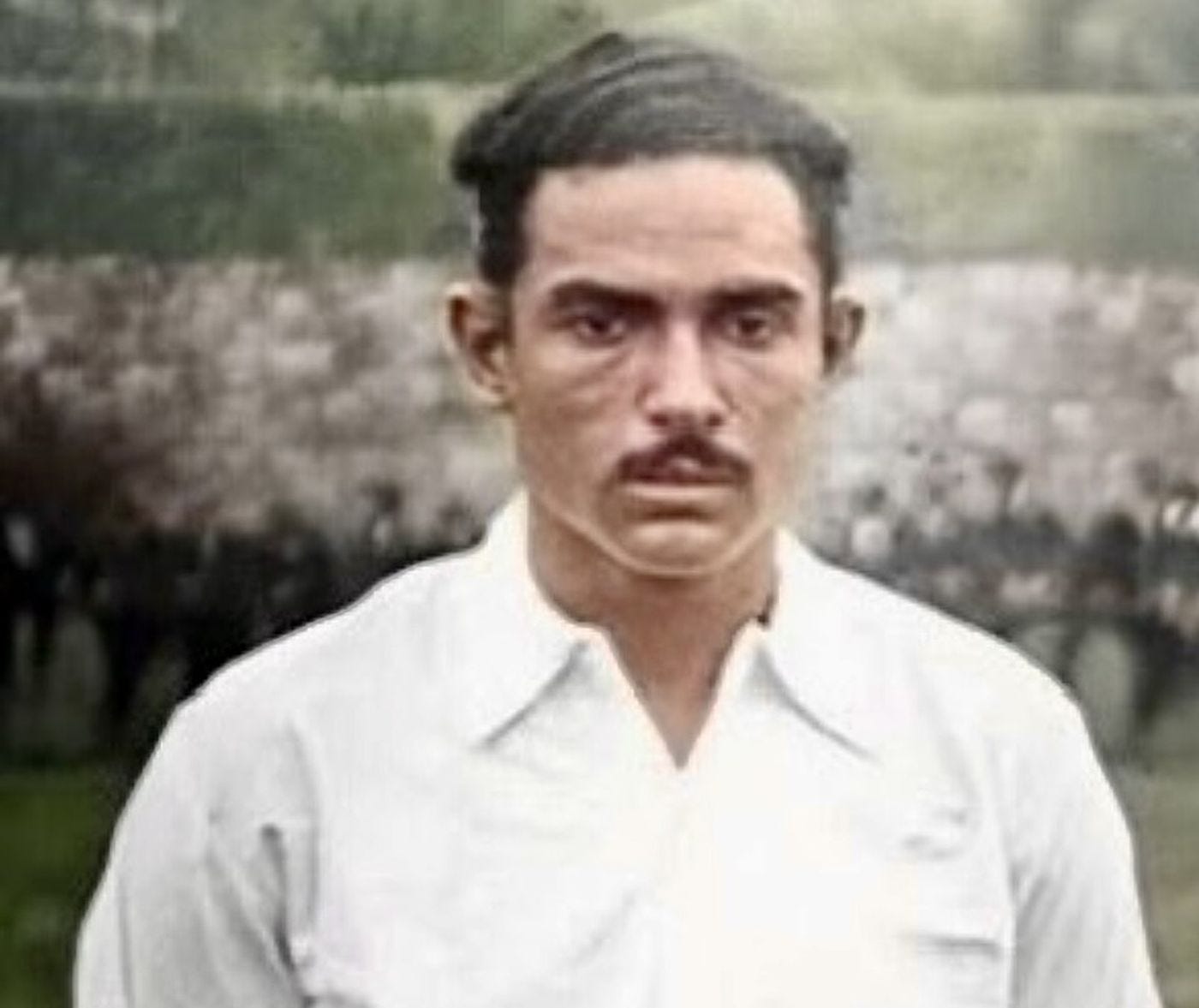
Among these players was Tawfik Abdullah, the Egyptian forward who had first left his homeland for England seven years earlier. Hartford had bought him from Massachusetts-based Fall River just three months before deciding to withdraw from the league, meaning Tawfik’s new employer barely had time to become his former employer.
Seen from a century away, Tawfik Abdullah’s travels make an impressive and fairly interesting itinerary: England, Scotland, Wales, the United States, Canada, before returning to Egypt. But following the contracts reveals a more demanding journey. Clubs wanted his skills, bought and sold his services, and sometimes ceased to want a team at all. He had to keep finding a place in this business while sports pages praised his football and made a spectacle of his complexion.
Yet much of his later fame rests on his becoming the first Egyptian to play in England’s first division, while the rest of his career increasingly resembles the travels of a pioneer, and the football he played after returning to Egypt recedes further still.
Some admirers have tried to repair his neglect by awarding him several distinctions he never held. Making a living from football across several countries and continents was apparently not enough; he also had to come first in everything, even in suffering.
Empire, engineering & Osmaston Road
Seven years before Hartford disappeared from the American Soccer League, Tawfik had arrived in Derby, England, to sign for Derby County. But Abdullah already had an international career underway, as he had just represented Egypt at the 1920 Antwerp Olympics.
Domestically, the football scene that developed him included matches against British military sides, since Egypt was under British occupation at the time.
Those encounters also put Egyptian players in front of soldiers with connections to clubs in the United Kingdom, creating opportunities for recruitment along a route opened by imperial power.
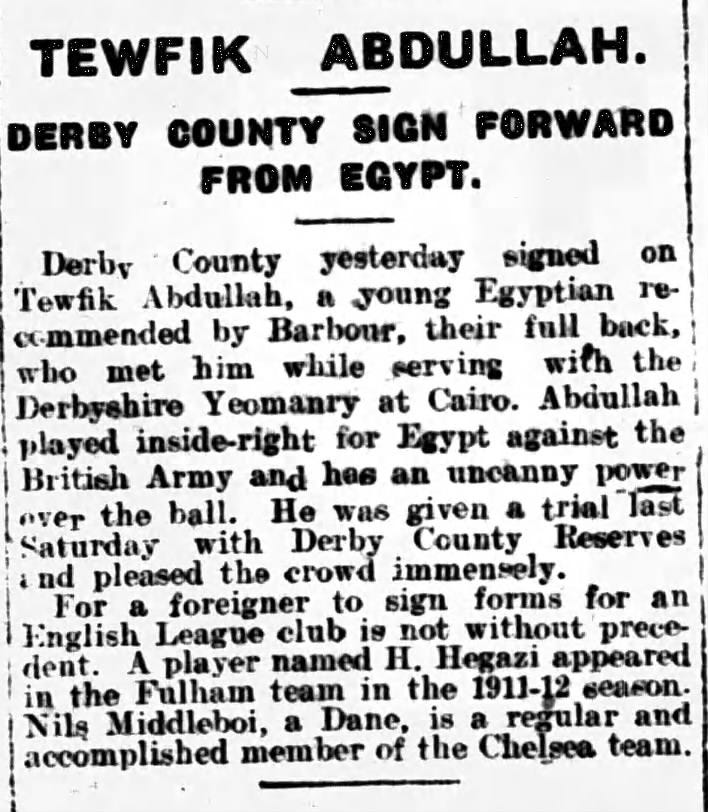
One of those soldiers was Tommy Barbour, a Scottish footballer with a Derby County connection, serving with the Derbyshire Yeomanry—a regiment of the British Army reserve. Barbour is said to have seen Abdullah play and recommended him to Derby. Announcements of the signing in September 1920 recalled Tawfik’s performances at inside right against army teams.
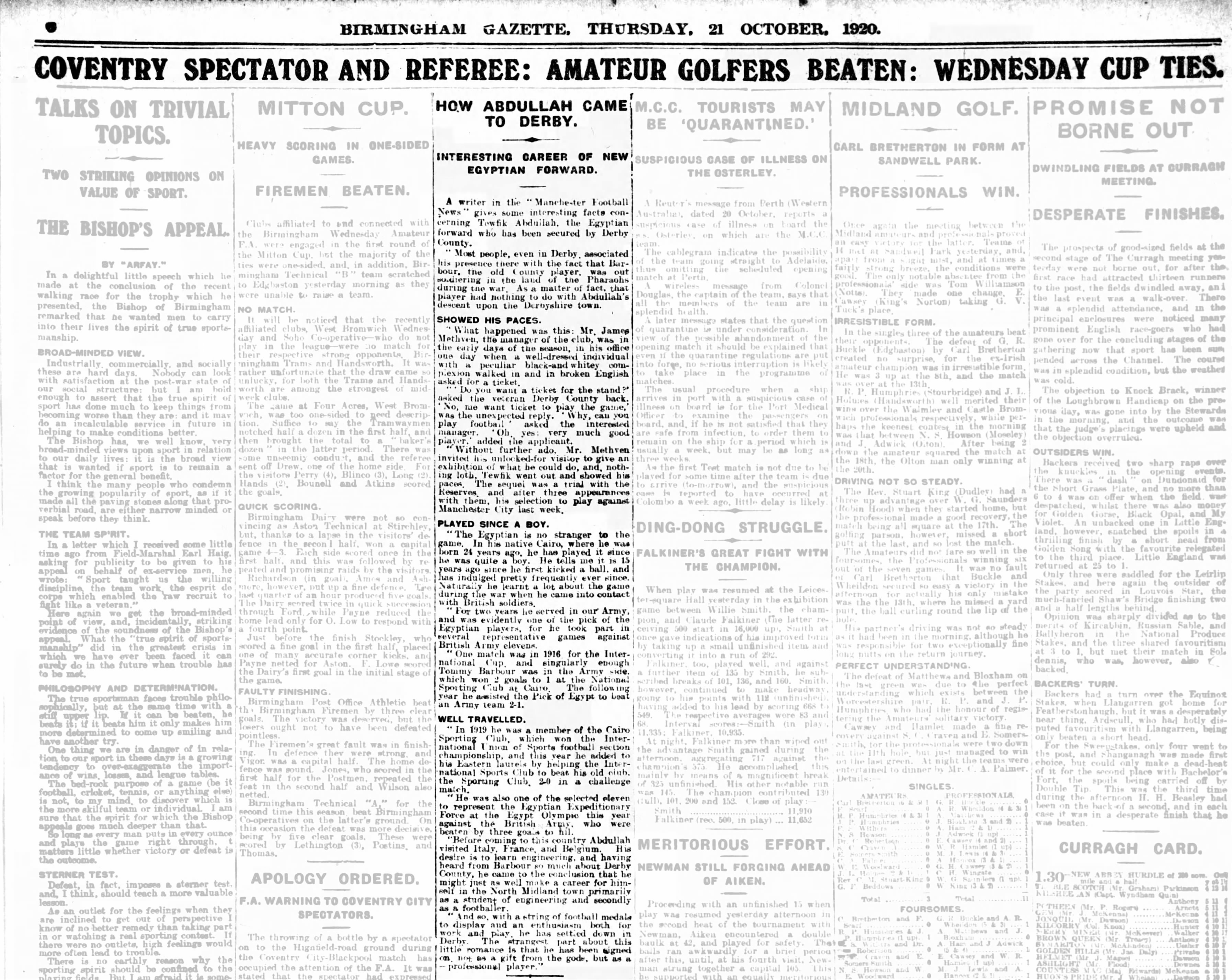
Barbour had made Derby attractive by describing opportunities to pursue engineering, according to the Birmingham Gazette. For a young footballer at the time, learning a trade could be part of planning a working life longer than a playing career, and a move might offer a place in a team and a way to prepare for the years when teams stopped calling.
Still, Tawfik arrived in Derby as a footballer and was recorded in the 1921 UK census as such. The census also offers glimpses into his life at the time. For example, we know through the census record that he lived at 122 Osmaston Road as a boarder—a person who lived in someone else’s household and paid the head of the household for both a room and meals.
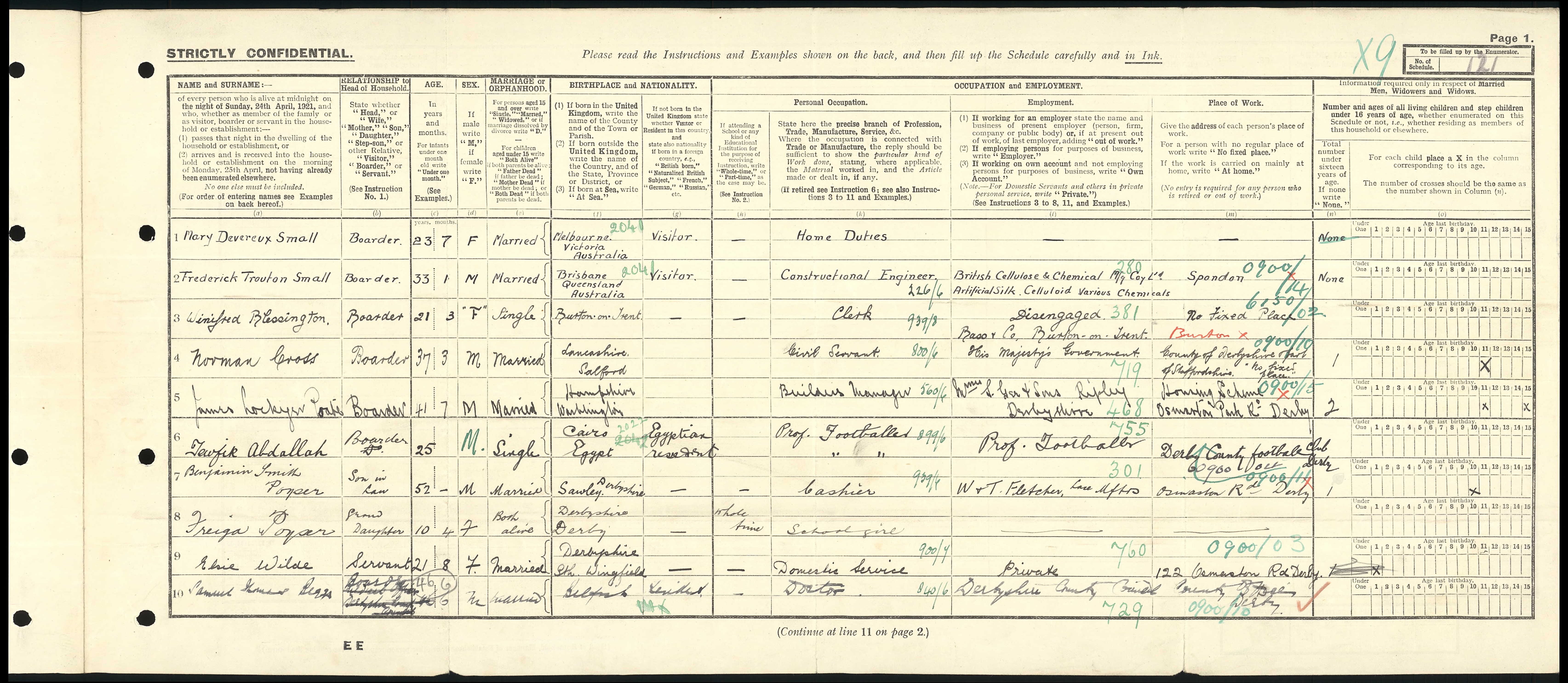
Alongside the international appearances, the newspaper headlines, and the magazine covers, there was a club job and a room in somebody else’s house.
On the pitch, Abdullah had made an excellent first impression less than a month after joining his new team, scoring the opening goal in a 3–0 win over Manchester City in Derby’s first victory of the season. The Birmingham Gazette put the crowd at 20,000, and a team that had been struggling to win finally had an afternoon to enjoy.
The match reports give a useful introduction to his game. The Egyptian forward could control the ball and beat a man; the Gazette and the Daily Sketch both questioned his speed. He played in the now-extinct position of inside right, between the right winger and center forward in the five-man attack then common in football. That position required someone who could find a teammate as well as a shot.
Quick decisions and close control gave him something to offer even when a defender could outrun him.


His debut made him the first Egyptian in England’s First Division, football’s top tier at the time.
And while most newspapers wrote bland columns of his arrival, the British weekly Topical Times supplied a more elaborate welcome. Its November 1920 cover surrounded a smiling Abdullah with a pyramid, the Sphinx and palms beneath the caption “Derby’s Dusky Dribbler.”
An Egyptian had joined an English football club, and the illustrator had apparently been asked to bring the whole country.
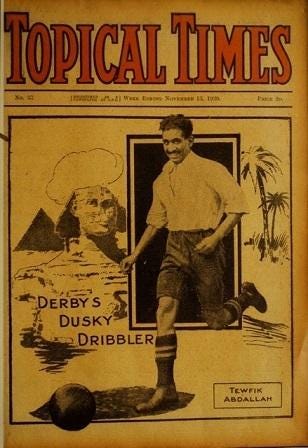
There is admiration here, but it comes with instructions about how to admire him. Derby provides the modern professional setting. Egypt contributes antiquities and a “dusky” complexion, and in this setting, the UK appeared to be admitting a visitor from another age into the sporting present.
This is how a flattering portrait could reproduce the imperial order, and while the political relationship does not explain every editorial decision, it helps explain the ease with which an Egyptian footballer could be made intelligible and presented as an exotic addition to an English institution.
The following year, however, Derby County was relegated, and Abdullah’s 12 First Division appearances were followed by just three in the Second Division.
But by 1922, another personal connection offered a fresh opportunity: Derby teammate Willie Paterson recommended his friend to his father Sandy, who ran Cowdenbeath in Scotland, for the 1922–23 season.
Cowdenbeath played in the Scottish Second Division at the time.
Writing in 1930, Sandy Paterson described Tawfik’s recruitment, and the broken arm that interrupted his spell. He remembered one of the cleverest footballers he had known.
“I consider him to be one of the smartest footballers I ever saw, but he did not have a great chance here,” Sandy wrote, adding that “he could hit the ball harder with his bare feet than most players could with football boots,” which earned him the nickname “Barefoot Tawfik.”
He was also dubbed “Toothpick” and “Happy.”
Sandy ended his recollection by saying, “When he left us, he went to America, where, incidentally, he resumed his friendship with Willie.”
The profession's pay and rules at the time help explain why the United States’ offer was lucrative. In the English Football League, the maximum wage was nine British pounds a week in 1920, falling to eight pounds by 1924. Successful professionals could live reasonably well, but even strong demand for their services did not free them from the wage ceiling, and popularity with the crowd and bargaining power with the employer were—and still are—different things.
The clubs also controlled registration, the permission a player needed to appear for them. Under the retain-and-transfer system, an English League club could keep players’ registration after their contract expired and demand a fee before allowing them to join another club.
Selling labor across the Atlantic
The Hull Daily Mail on May 26, 1923, reported that Cowdenbeath wanted him for another season, but a “very lucrative offer from the States” had tempted him away. He was weighing an opportunity to improve his terms.
The Egyptian pioneer had the entirely reasonable ambition of getting a better job.
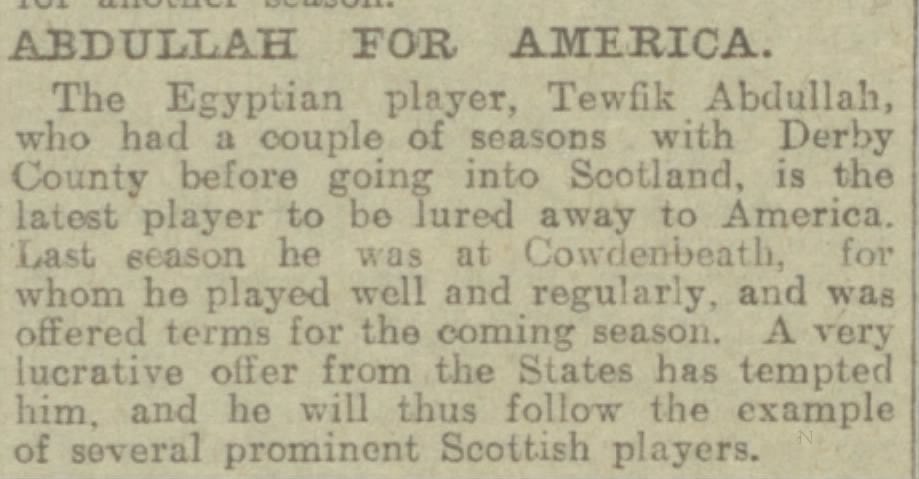
Nonetheless, the journey took longer than the headline suggested. He spent the following season with Bridgend Town in the Welsh section of the Southern League before joining Hartlepool United in England’s Third Division North.
In March 1924, the South Wales Argus called his departure a loss to Bridgend.
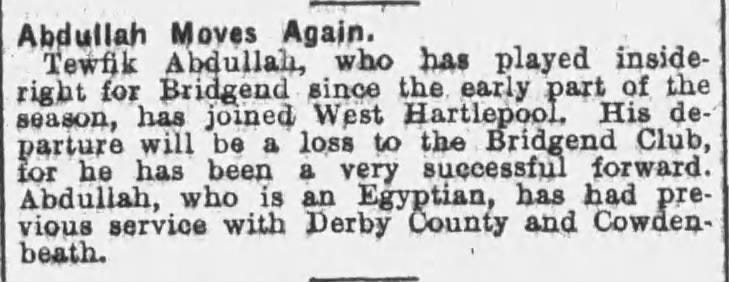
He made 11 appearances and scored once at Hartlepool. Four clubs and three countries now lay between the young international arriving in Britain from Cairo and the professional preparing to leave it.
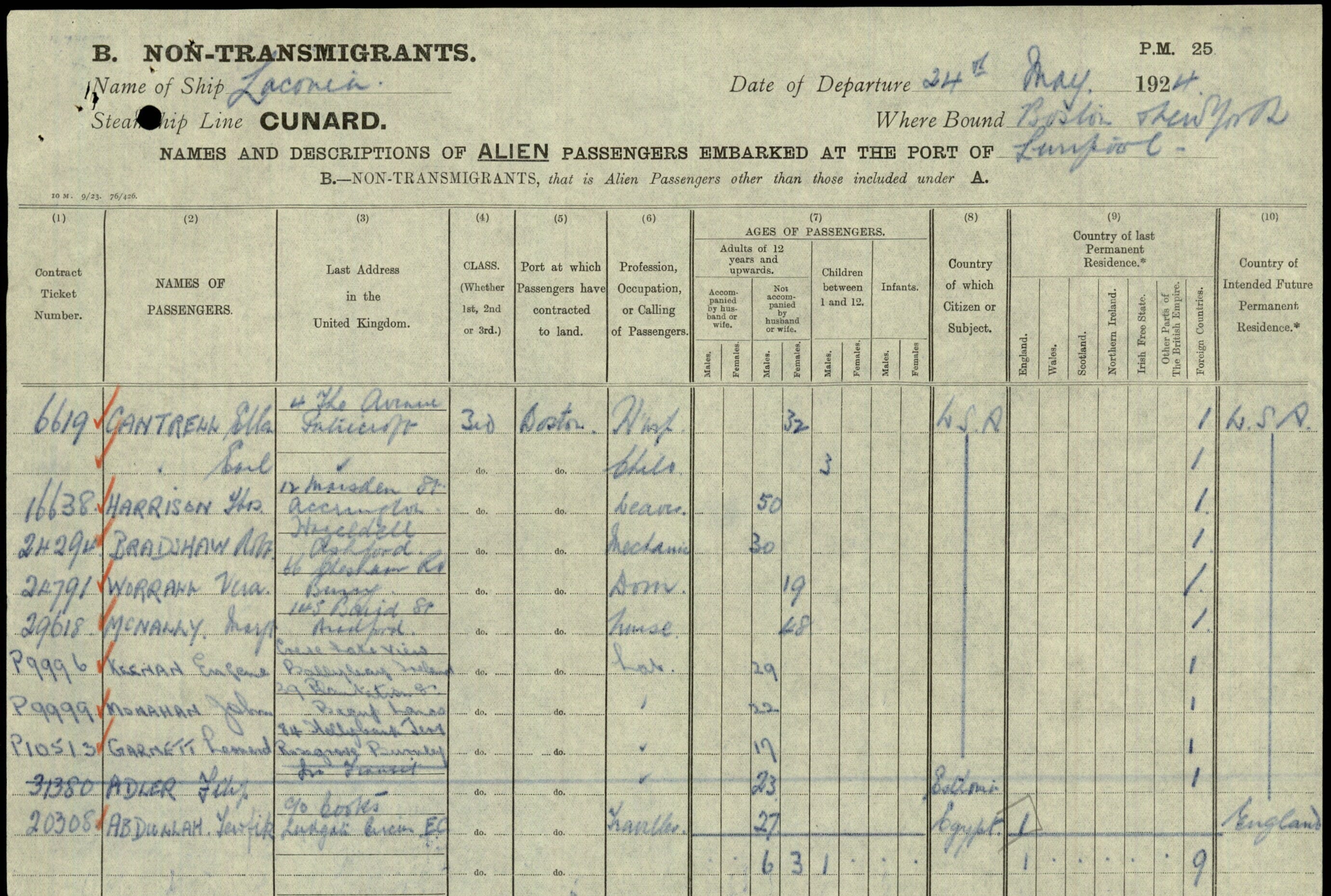
On 24 May 1924, the Laconia’s passenger list recorded him leaving Liverpool, traveling third class to Boston, but this time, the occupation column recorded him simply as a “Traveller.”
His address was care of Cook’s, the travel firm, at Ludgate Circus in London, which meant he entered England as his intended future permanent residence.
The American Soccer League had been founded in 1921 by bringing together clubs from leagues in the northeastern United States. Football already had teams and spectators across New England, New York, New Jersey, and Pennsylvania.
Industry appeared directly in the names of clubs such as Bethlehem Steel and Todd Shipyards. Businesses helped fund the teams, while owners could look abroad for players to fill their squads. Abdullah was entering a professional competition with money to spend on recruitment.
Then, in 1924, the league expanded from eight teams to 12. Providence, in Rhode Island, was one of the newcomers, alongside Boston and New Bedford. Expansion created places to fill, and American recruitment reached players European clubs still claimed under contract, threatening their control over who could employ those men.
In Scotland, the departures acquired the title “American Menace.”
For Alex McNab, a Scottish international recruited by Boston, the menace arrived as a cable at his engineering yard job. His UK club had offered him 4 pounds a week and demanded more than 1,500 pounds when he sought a transfer. The American offer was about 12 pounds a week “to work and play football.”
McNab, like many professional footballers at the time, already combined playing with another occupation, which the offer also covered. He was therefore weighing the income from the arrangement as a whole. From the engineering yard, the American Menace looked like an improvement.
Abdullah joined Providence, and in 1925, The Bethlehem Globe heaped praise on the forward, describing him as “an opportunist who seldom misses with his accurate and speedy shooting when within vicinity of goal,” even if his running had failed to impress reporters in Derby.
However, in his second season at Providence, he broke a leg against Fall River, and months out of the game brought predictions that he was finished.
An injury threatened a career built on abilities that a club needed him to demonstrate each week. In a Boston Globe profile published on January 15, 1927, George M. Collins recalled Abdullah’s response: “Once my leg mends you watch me hop in there and hold my own.”
By 1927, Fall River had acquired him from Providence. He joined the club he had been playing against when he broke his leg, now the winner of three successive league championships.
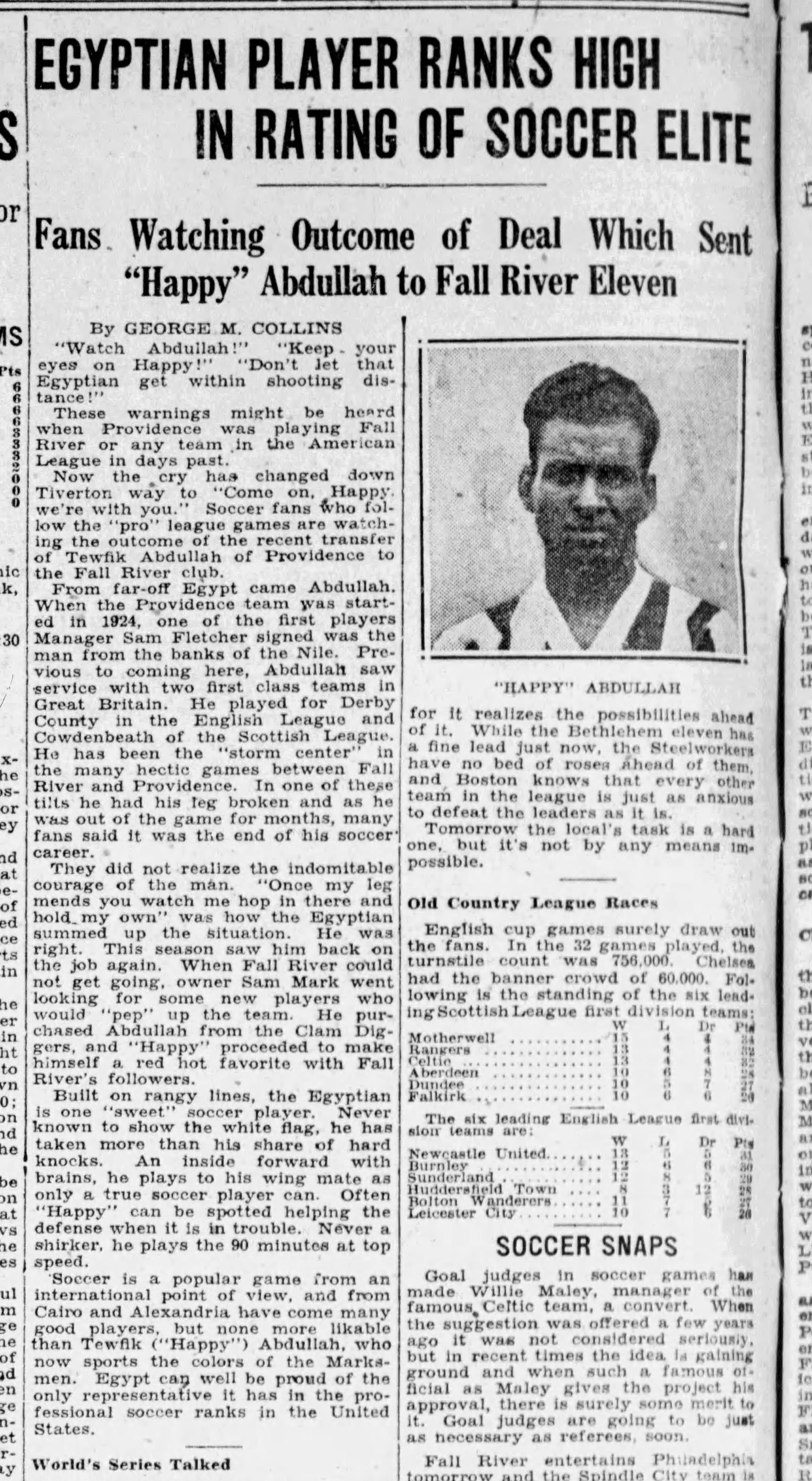
Collins described Abdullah keeping his promise: supplying passes to his winger, going back to help the defense, and having the stamina to keep doing both. Fall River supporters had taken to “Happy” and were now free to admire the skill that had previously been directed at their own goalkeeper.
Against nearby New Bedford, the same month he joined Fall River, he headed a cross into the net 20 minutes in. Roughly 7,000 spectators watched Tawfik lead his new team to a win that day, and a match report in The Standard Times complained about dangerous fouls and poor refereeing; its writer thought New Bedford’s Tommy Maxwell bore a “particular grudge” against Abdullah.
Spring brought a chance of more distinguished company. Nacional of Montevideo toured the United States, bringing several players who had helped Uruguay win the 1924 Olympics three years earlier, which was a considerable attraction for an American audience.
A selection of the American Soccer League’s best players was assembled to face it, and Tawfik Abdullah’s employer permitted him to join them.
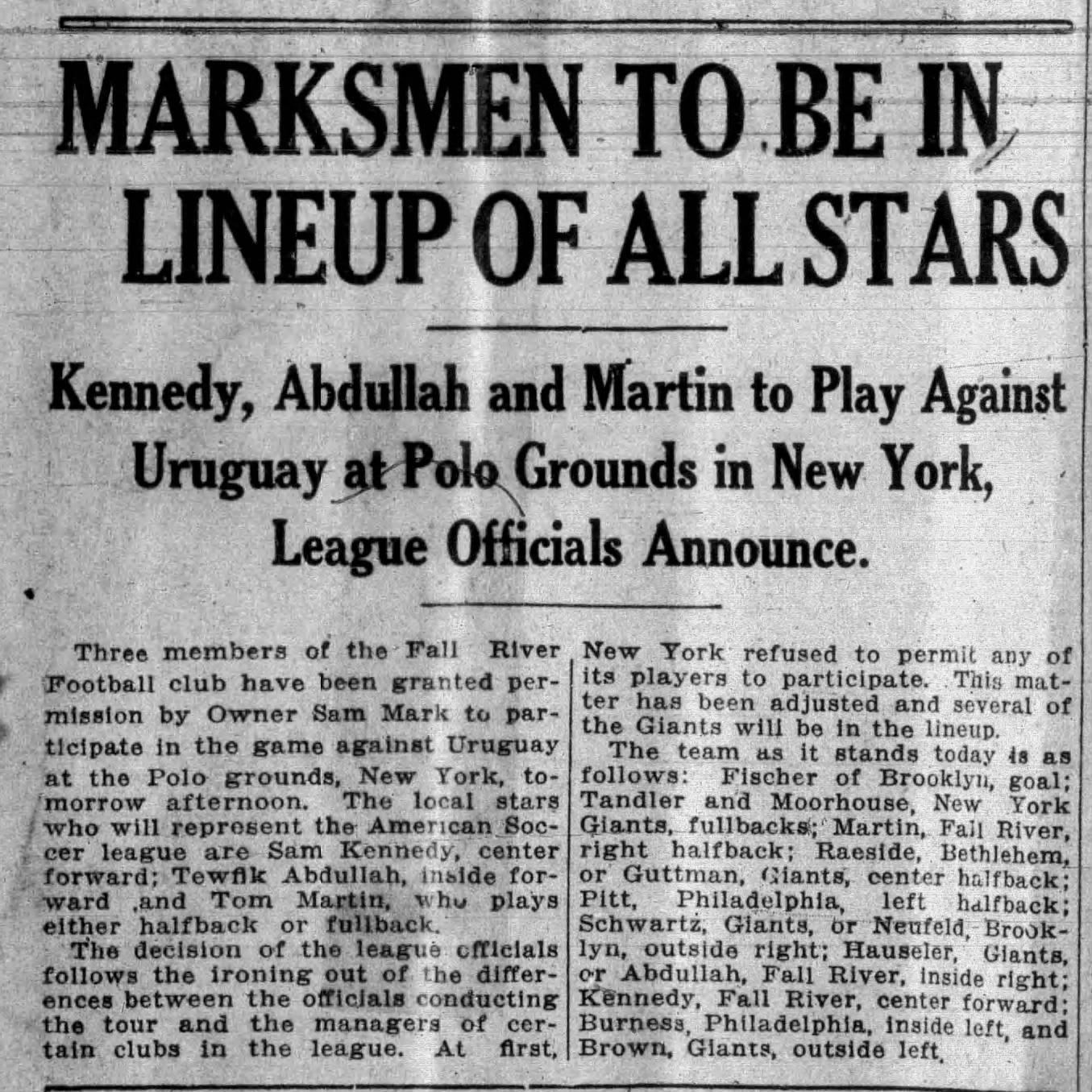
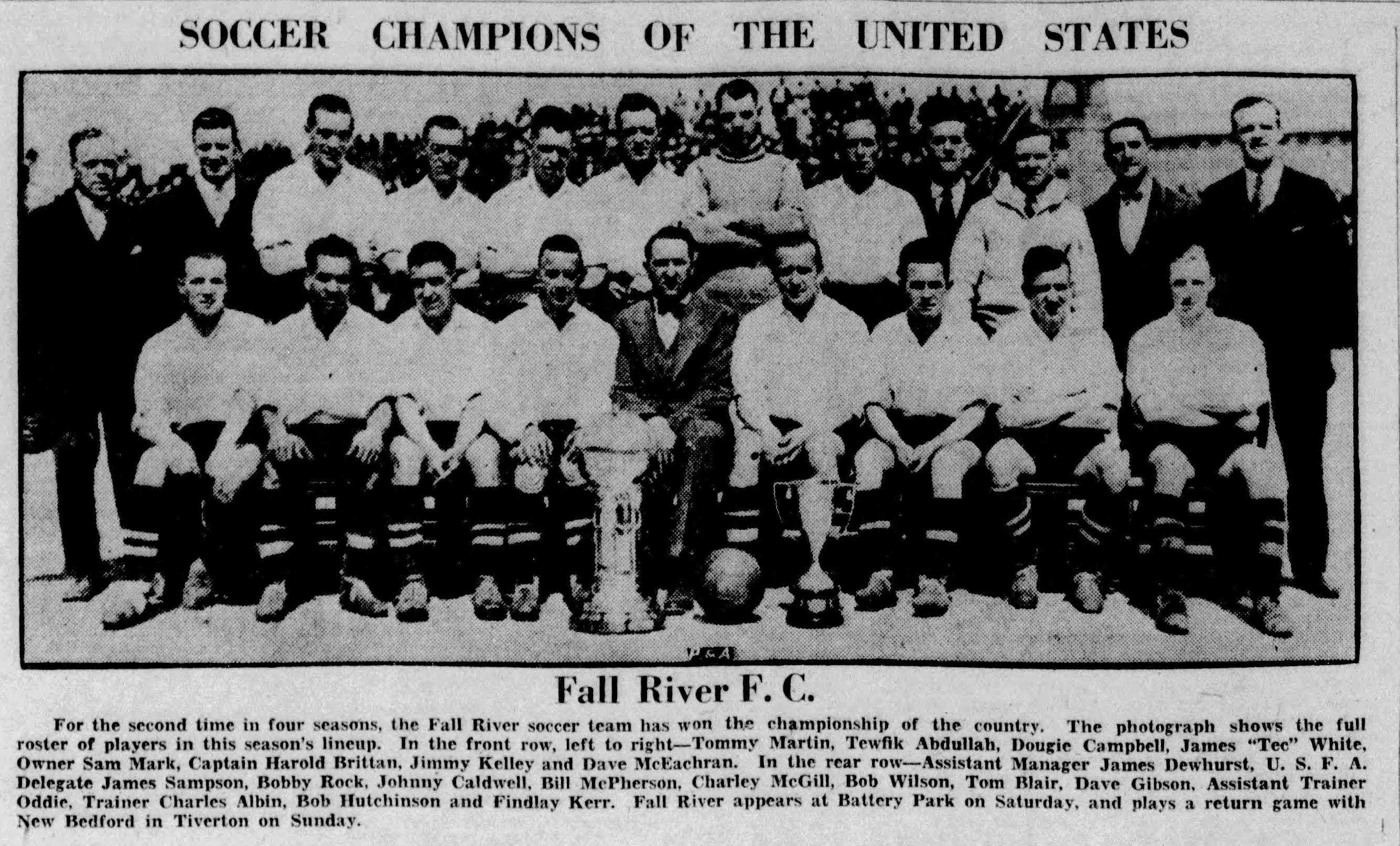
In May, Abdullah was pictured in Fall River’s championship photograph after the club won the 1927 National Challenge Cup, now the US Open Cup—the Egyptian’s first major trophy.
The next month, Montreal Carsteel recruited across the border. The Hamilton Spectator announced Tawfik Abdullah’s signing.
The pioneer was on the move yet again, heading to his fifth country in less than seven years.
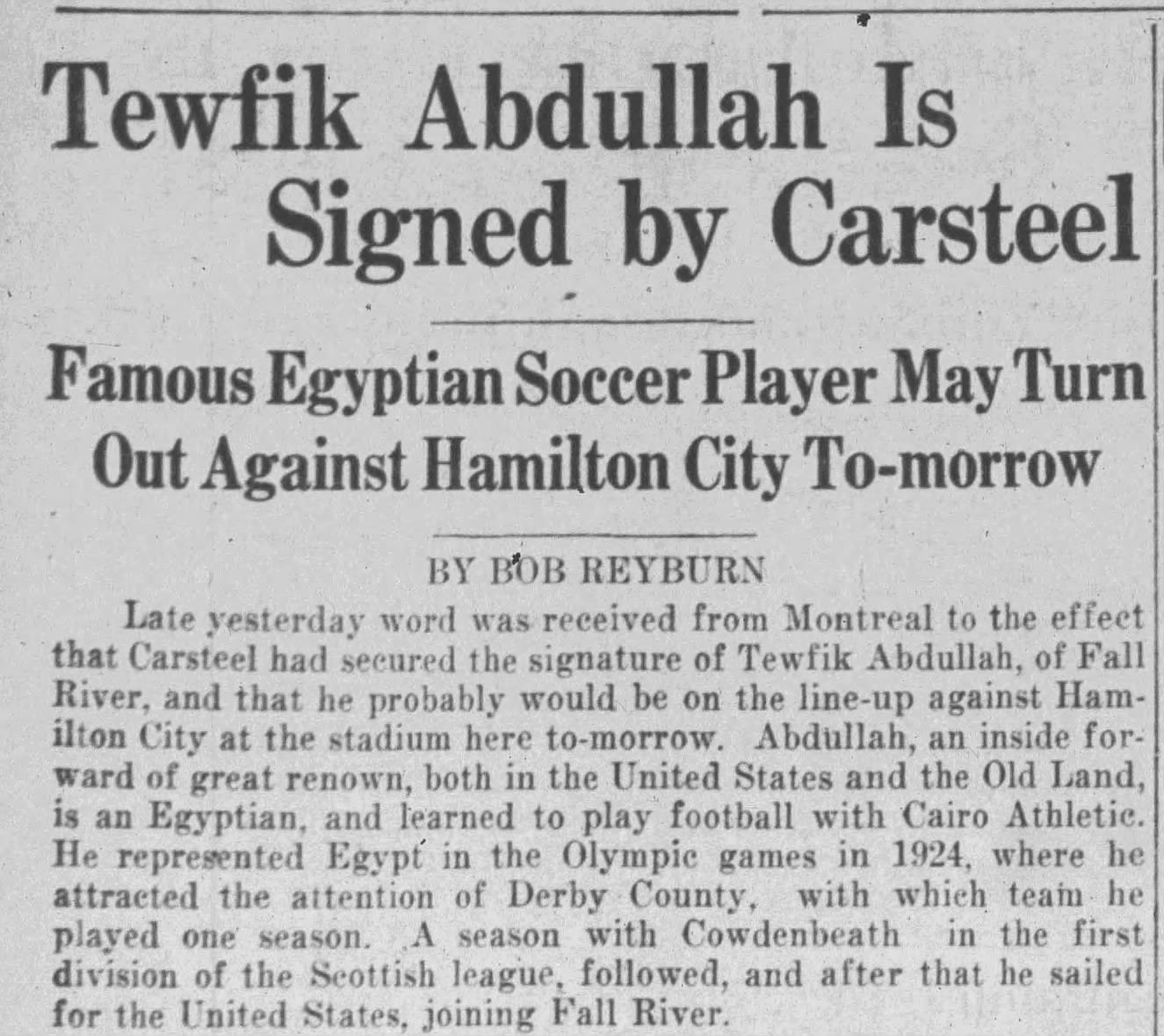
Then, a week after he signed, the Montreal Star promoted him for the match against Hamilton Thistles. Its headline promised a “Genuine Egyptian,” advertising his nationality with the confidence of a label on imported goods.
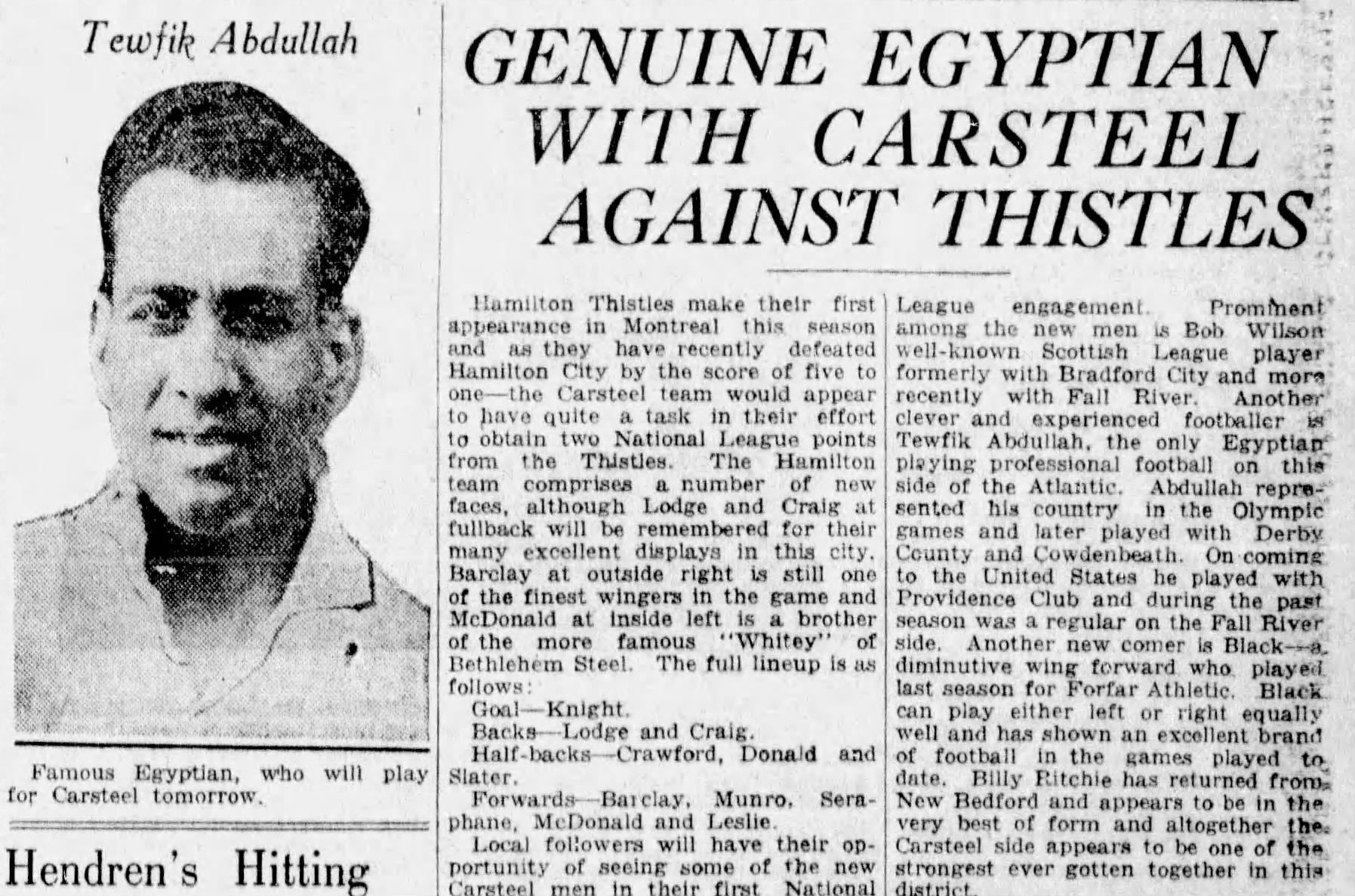
Carsteel’s name advertised an industrial connection too. Leonard Peto, a senior executive of Canadian Car and Foundry, had founded the club. Montreal football also included teams attached to railways, a hospital, and an explosives factory. For a recruit, that connection could offer a route to employment outside football.
For example, Carsteel’s later coach, former England international Sam Chedgzoy, spent 25 years in the company’s payroll audit department. That second occupation lasted far beyond a normal playing career, at a time when company football could make an introduction through sporting ability and keep a man employed for work that had little to do with scoring—or stopping—goals.
It was one answer to the problem of making a living after the crowd stopped paying to watch.
Tawfik’s stint in Canada appears to have been brief. Later that summer, the Herald News reported Fall River’s transfer of Abdullah to Hartford, leaving unclear the terms of his move to Carsteel—and why Fall River was subsequently listed as the transferring club.
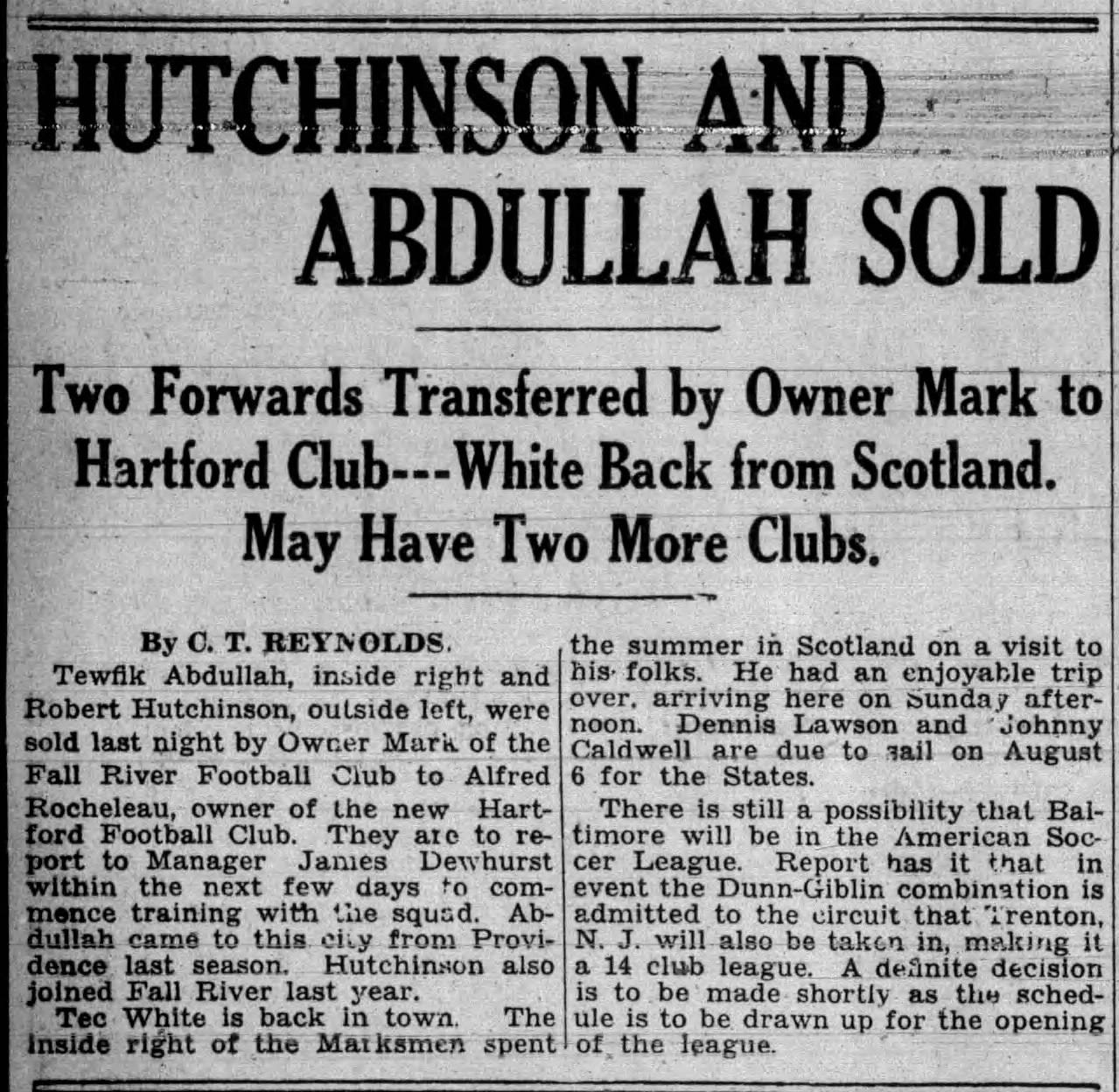
Regardless, Hartford, nicknamed by the press as the league’s “baby member,” was still assembling a team for its first American Soccer League season, while a regular audience proved harder to attract. The club soon began changing home grounds in search of a consistent fan base, before Bill Cunningham persuaded its management to withdraw.
Abdullah found a place with the New York Nationals and by 1928 had returned to Fall River, scoring against Bethlehem Steel in a 2–1 win.
At that point, keeping a career going seems to have required considerably more movement than running between the winger and center-forward.
Useful enough to sign, unequal by design
Tawfik Abdullah’s career also unfolded in a racist sporting culture capable of publishing explicit eugenicist doctrine.
In September 1927, Soccer Pictorial Weekly carried Ernest J. Viberg’s column titled “Racial Influence on Soccer,” which sorted footballing ability by race. Egyptians and Turks went into a vaguely imagined Far East, their football dismissed as “child’s play.”
In Viberg’s conception, dark skin supposedly made for poor teamwork, while Nordic organization received the favorable comparison.
Perhaps the irony is that the theory struggled to place Egypt on a map, yet somehow felt equipped to assess its passing.
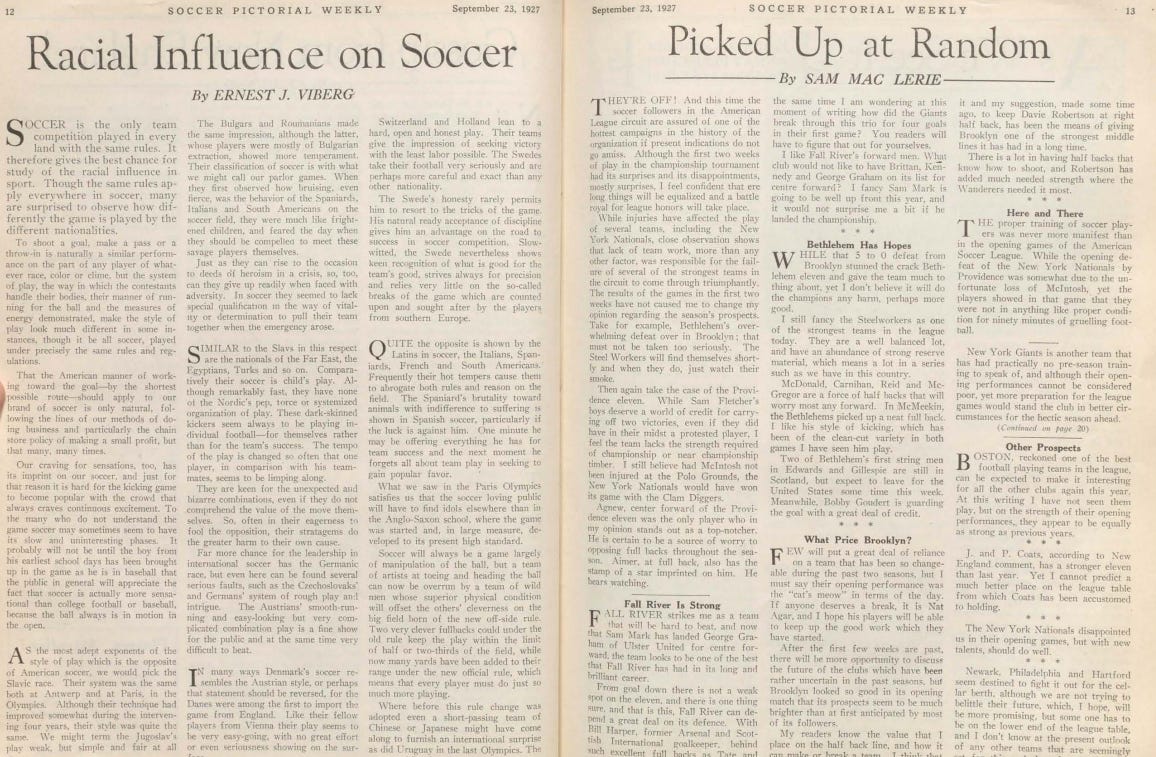
Viberg was the business manager of the New York Nationals, one of Abdullah’s clubs. These ideas came from inside an employer’s office, showing how football could welcome a useful Egyptian forward while one of its officials published theories denying the Egyptians’ abilities in general.
Treating the successful player as an exception allowed the theory to survive contact with the team sheet, and while his contract demonstrated that someone wanted his work, it did not mean the racists running the game regarded him as an equal.
Even praise could preserve a hierarchy of teachers and pupils. Newspapers regularly credited England and Scotland with developing Abdullah, and while British football had certainly added to his experience, he had made Egypt’s Olympic team before Derby signed him.
Such accounts handed Britain credit for an education it joined partway through, and Egyptian clubs and players who came before it slipped out of view.
Going back home
Abdullah returned to Cairo in the summer of 1928 as nobility to a football community that had known him before the foreign headlines.
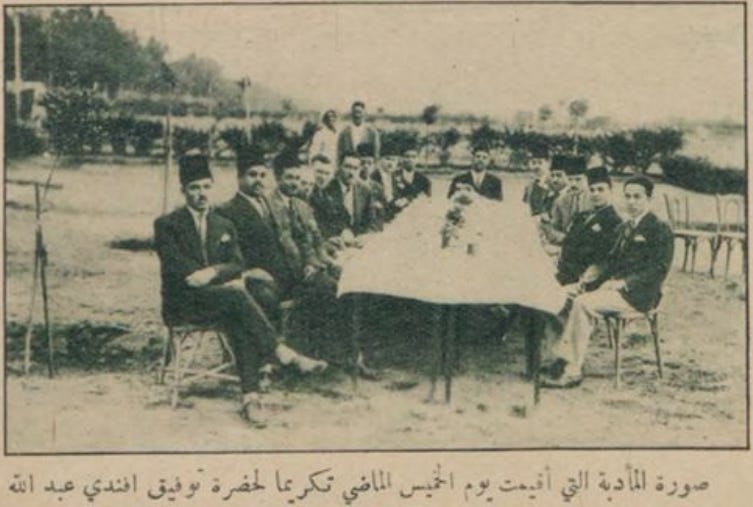
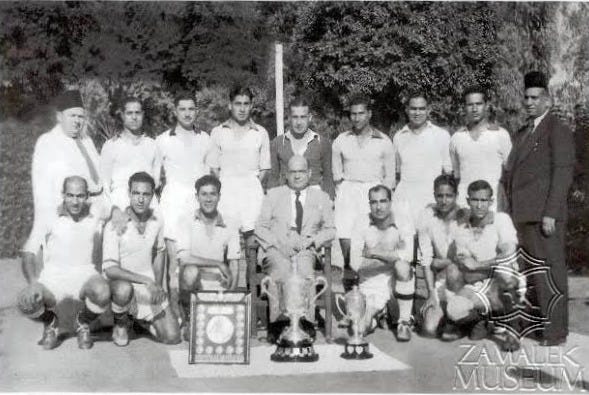
In May, Mokhtalat, the club now called Zamalek, held a tea party in his honor, organized at chairman Mohamed Haidar’s initiative.
The Egyptian magazine Al-Musawwar pictured the guests alongside Tawfik “Effendi” Abdullah along an outdoor table.
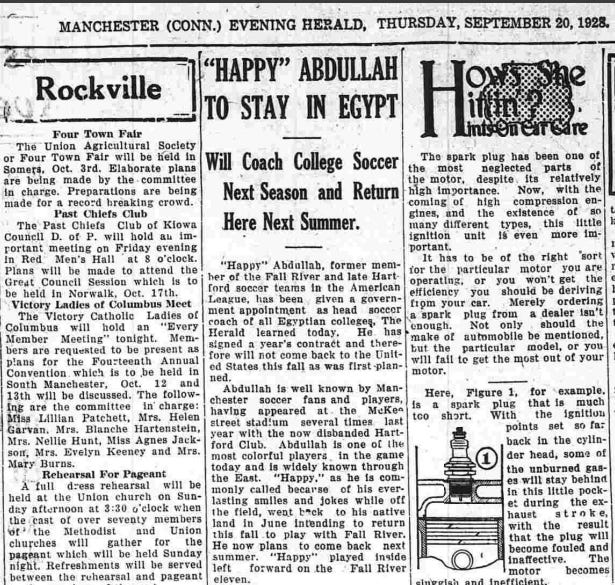
There was work for him too. That September, Connecticut’s Manchester Evening Herald reported that a one-year government appointment coaching Egyptian college football was delaying his intended return to the US.
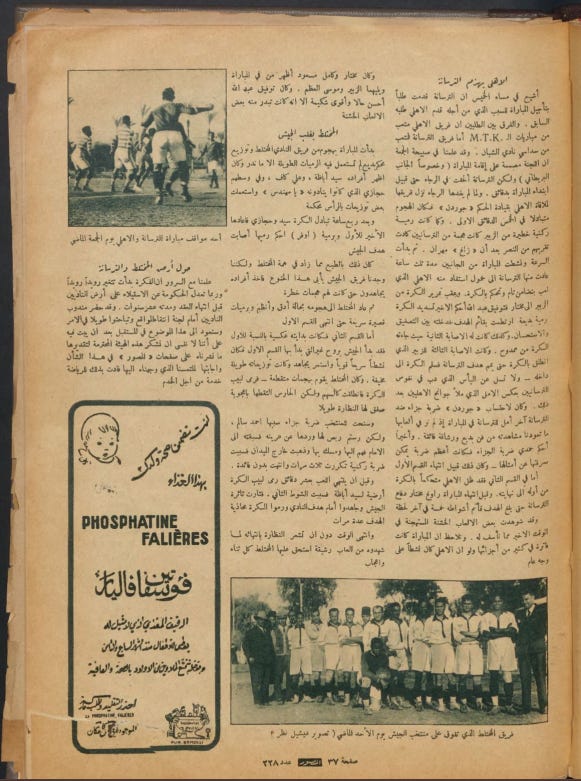
He was soon playing for Al Ahly, Mokhtalat’s Cairo rival. Egyptian club football then ran through regional leagues and cup competitions; the nationwide league familiar today would begin in 1948. The Cairo League supplied regular local opponents, while the cups brought a different field of clubs into contention for trophies. Abdullah was returning to a full calendar of competitive football.
In February 1929, Al-Musawwar reported Al Ahly’s 5–0 win over Tersana, praising Abdullah’s improved form and determination while objecting to some of his rough play.
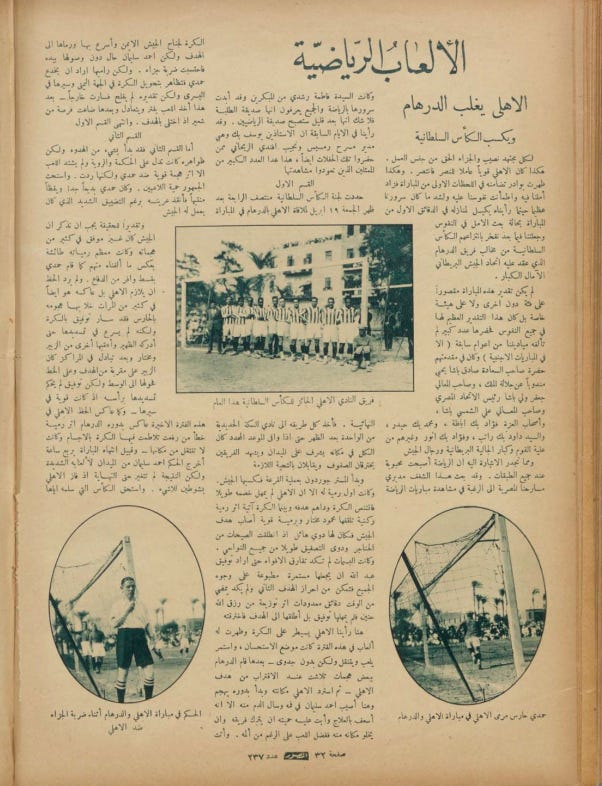
Two months later, Al Ahly reached the Sultan Hussein Cup final, which had brought Egyptian clubs and British military teams into the same tournament since 1917. Army sides won its first four editions.
On April 19, 1929, Al Ahly faced the Durhams, another British military side.
Al-Musawwar’s account gives the afternoon plenty of life. Another Egyptian pioneer, actress Fatma Rushdi, arrived early; members of the nobility attended; a British penalty went astray; and Al Ahly’s Ahmed Soliman played on with a bleeding nose.
Mahmoud Mokhtar scored first, and Tawfik Abdullah added the second in a 2–0 win.
The troops had stayed in Egypt after the UK wanted to convey the appearance of granting one of its colonies “formal independence” in 1922. Still, Britain had reserved authority over defense and imperial communications, among other matters.
Expectedly, independence came with an empire’s list of exceptions, and the military teams represented a power still limiting Egyptian self-determination.
That gave a cup final against the Durhams a political setting its scoreline alone cannot convey. Abdullah, recruited to an English team after games against the British Army, was now back home, helping an Egyptian club beat the occupiers. And, on the pitch, the soldiers had no option but to accept the result.
Al Ahly’s European tour later that year would take Abdullah across the Mediterranean again, but this time in an Egyptian club’s shirt, playing alongside teammates from Cairo against European opposition.
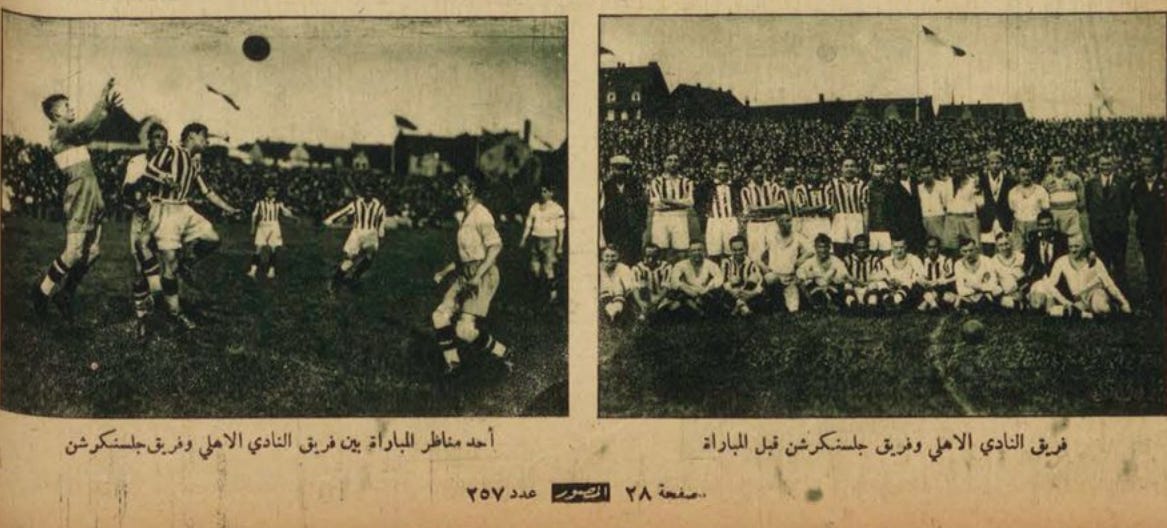
In Gelsenkirchen, Germany, he scored twice against Schalke 04, including a late equalizer headed from Gamil El-Zobeir’s cross. Al-Musawwar describes his goals; the German-language Sozialdemokrat records the 3–3 draw.
The tour also brought a 5–2 defeat by Tennis Borussia in Berlin, injuries, tired players and, according to the Egyptian report, a financial loss.


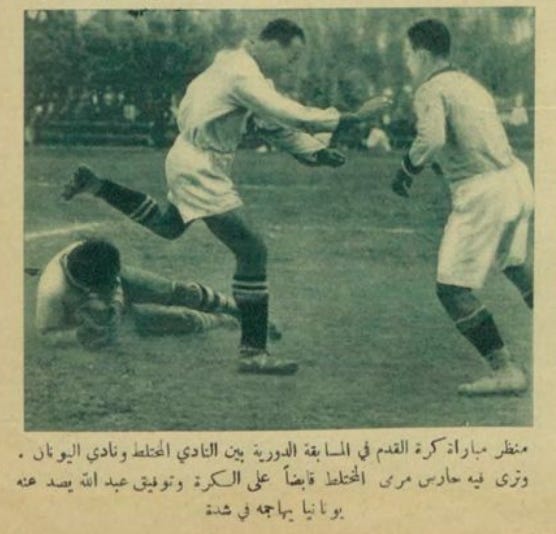
By January 1931, Abdullah was playing for Mokhtalat. Al-Musawwar photographed him helping protect its goalkeeper against a local Greek club in the Cairo League. The city’s competitions brought Egyptian teams into contact with clubs from foreign communities and the British military.
This was the football world in which Abdullah continued to play, crossing its different settings and the rivalry between Cairo’s two leading clubs.
He would later coach Egypt’s national team from 1940 to 1944 and briefly manage Zamalek during the Second World War.
The nationalist invention of records
The surviving record gives Abdullah a memorable and recognizable professional life. There is skill, bad luck, recovery, and the repeated business of finding somewhere to work. A pioneer is allowed to have all of those things.
The trouble begins when his biography must also prove his country’s standing, and every foreign appearance is expected to yield a national distinction.
In a 2018 tribute prompted by racist abuse of the young English forward Rhian Brewster, Egyptian sports columnist Yasser Ayoub argued that Egypt had neglected a football pioneer.
It is unclear, at least to me, how recovering an Egyptian predecessor was a reasonable response from the columnist to another player’s mistreatment. But all else aside, Ayoub included Abdullah’s Egyptian career, but also called him the first Egyptian, Arab and African in England’s First Division, an American league scoring champion, and football’s first victim of racial discrimination.
The tribute had given itself rather a lot to prove.
The claim to be the First Division’s first African removes the experience of Arthur Wharton, born in Accra, Ghana, who played in that division for Sheffield United in 1895, 25 years before Abdullah.
Celebrating an African pioneer by making an earlier African pioneer disappear is an odd way to repair neglect.
The scoring title fares no better. In his best goal-scoring season abroad, Abdullah tallied 15 goals, behind Providence teammate Jerry Best’s 24 and league leader Archie Stark’s 62. Not once during his tenure in the US was Tawfik Abdullah the country’s top goal scorer, as Ayoub has claimed.
Still, 15 goals were a contribution a footballer might reasonably expect to count in his favor without an invented award.
The claim to be football’s first victim of racism likewise leaves out Tottenham’s Walter Tull, whose racist abuse was documented in 1909.
Such claims, stemming from sloppy journalism at best, and nationalist fervor at worst, change the kind of history being recovered. Wharton and Tull should enlarge the account of what players faced.
Instead, they become inconvenient competitors for a distinction assigned to Abdullah, and a shared history of discrimination and exclusion turns into a contest between national biographies.
Even humiliation must apparently produce an Egyptian world record.
Another column by Ayoub in June 2026 omits the claim that Abdullah had been a top goal scorer in the American championship. It awards him another distinction: being the first to draw attention to racial discrimination and inspiring the first demands to end racial discrimination in American football.
In reality, Tawfik played in the US during the Jim Crow era, a racial caste system that preceded Abdullah’s birth by decades and lasted long after he had left the field.
Unlike other sports at the time, football had no formal, codified color line or league-wide segregation policy.
But the sport existed within the broader legal and social landscape of American segregation, meaning players could encounter discrimination off the field even when leagues did not officially exclude them.
Because of the lack of such policy, and because non-white football players were a sporadic occurrence, football in the US never had a single campaign calling for the end of discrimination in the sport.
The sources of Ayoub’s claims remain a mystery, and more than a century after his playing days abroad, Abdullah is still being put to work as the first man to do something.
Ayoub ostensibly writes against racism, and Topical Times made entertainment out of racial difference.
Their purposes are plainly different. Yet the nationalist tribute and the imperial illustration reach an awkward accommodation over what makes Abdullah important.
The magazine celebrates his admission to English football, and the tribute enlarges the honor attached to that admission. England retains the authority to decide when an Egyptian footballer’s life becomes significant, even in a history intended to reclaim him.
The scout in the stands
In 1957, Tawfik Abdullah watched a young Mahmoud Abu Regila playing for Zamalek’s youth team. The future Zamalek player and coach, who described growing up poor, remembered Abdullah offering him a place in a company side with a salaried job attached.
By then, Abdullah worked at the Greater Transport Company, a Cairo bus operator whose owner also chaired Zamalek. The business fielded a team in a competition for company sides, separate from the club competitions. Abu Regila could therefore play for the company while continuing with Zamalek’s youth side; as he later explained in an interview, the offer of a salary made him accept.
This was the same connection between work and football seen earlier in McNab’s American offer and Chedgzoy’s long company employment. A sporting recommendation could help obtain a job, and the wages could make it possible to keep playing.
Abdullah was now the older colleague able to make the introduction.
Years later, however, Abu Regila complained that modern players “reserved their loyalty for whoever paid most.” His own account places a salary near the beginning of the supposedly purer age. Yet he himself accepted the company offer because it included pay. Money had apparently become vulgar sometime after it helped him keep playing.
Abdullah’s goal against Manchester City was 37 years behind him when he made that offer. He had spent much of his own career finding a place where football could provide a living.
Now he could help a younger player do the same.