


Russian wheat became cheaper at the port this month, but the quoted cost of carrying it to Egypt more than tripled, pushing the grain’s delivered price roughly 16–17% higher in nine days.
On August 11, Russian wheat cost $224 a tonne before freight, while carriage from the Black Sea to Egypt was quoted at $22, producing a combined price of about $244–246. By August 20, the wheat itself had fallen $9, or 4%, to $215, but freight had risen to $70—a jump of $50, or 250%—and the combined cost reached about $285, an increase of $39–41 a tonne.
The contradiction moves beyond last week’s coverage by The Cairo Report, and beyond the threat of a wheat shortage. Russia has wheat, and its port price is falling because exporters cannot move enough of it, but Egypt must, nevertheless, pay more because access to the crop is now controlled by a shrinking pool of shipowners prepared to enter the Black Sea, alongside insurers charging for the possibility that the vessel may be struck.

“Owners are asking $70/mt freight to Egypt from deep-sea ports, which limits the business. I would rather not trade,” a Russian seller told S&P Global.
That is also why rerouting Russian wheat through the Baltic does not solve the price problem. Wheat traded at Vysotsk for $255 a tonne on August 19, with another $48 for freight to Egypt, producing a delivered price near $303. That is $18, or 6.3%, above the already inflated $285 Black Sea quote and $57–59, or 23–24%, above the August 11 cost.
“I can sell from the deep sea, but the vessel will not come,” another seller said.
At the same time, Russia’s government is responding to an obstruction of circulation. President Vladimir Putin estimated that the country would have about 60 million tonnes of grain available for export this season, while the Kremlin said that it was preparing measures intended to ensure the crop was shipped “on time and in full,” without identifying the routes, restored capacity or timetable.
The Russian Agriculture Ministry is separately considering state purchases of between one million and three million tonnes, subsidized loan extensions, and payments to producers struggling to sell their crops, according to reports, all in an effort to prevent the logistical breakdown from pushing farmers’ prices still lower.
Bulk transport operator Rusagrotrans cut its Russian wheat-export estimate for August to 1.8 million tonnes, 2.7 million tonnes, or 60%, below the 4.5 million exported in August last year, which would be the lowest August volume since the 2010 drought and export ban, while agriculture research firm SovEcon has a higher estimate of 2.2 million tonnes—12.8% above July’s 1.95 million—but it also assumes that some shipments resume. The two forecasts differ over the extent of the outage, not over whether exports remain severely depressed.
On Ukraine’s side, President Volodymyr Zelenskyy denied that the country’s Black Sea corridors were blocked, adding that “three or four ships were still entering and leaving” the Greater Odesa ports each day, although the volume was three to four times higher before the latest attacks.
Shipping through the remaining routes has not restored anything close to normal export capacity. Ukraine exported 522,000 tonnes of grain between August 1 and 18, only 20% of the volume that could have moved with unrestricted logistics. Alternative routes through the Danube River, railways and roads added approximately $50 to the transport cost of each tonne, making grain exports from much of the country unprofitable, Ukrainian Agriculture Minister Taras Vysotskyi said.
The danger reached a voyage assigned to Egypt before the price mechanism became visible.
The Xin Hai Tong 66 was empty and approaching Novorossiysk to load grain for Egypt when it was attacked, three people familiar with the voyage told Reuters. No crew members were injured, and no Egyptian cargo was destroyed. But the strike interrupted a specific procurement movement, not merely an export route that Egypt might use later.
The ship already had an Egyptian connection, as tracking records placed the vessel, IMO 9449247, off Ain Sokhna with the Egyptian port listed as its destination in April.
Five other grain carriers were attacked around Novorossiysk and Tuapse on August 17 and 18: the Anna S, Elina B, Fehu, Victoria V, and Necibe. The Anna S was empty and heading to load grain when repeated strikes caused a major fire. The Elina B rescued its crew, then was itself struck after loading about 56,300 tonnes of wheat. The Fehu was carrying 54,000 tonnes, while the smaller Victoria V and Necibe were preparing to load.
Several of the same ships circulate through Egyptian waters and ports. The Anna S made two recent Suez Canal passages, in June and July, and had previously broadcast Port Said as its destination. The Elina B was routed toward Suez in late July. While the Fehu departed Damietta on June 11.
Victoria V was already a repeat caller at Egyptian ports. Public tracking records list five El Dekheila calls and one Alexandria call over the preceding year, including a departure from El Dekheila on March 28, and two of its Egypt-bound voyages carried wheat loaded in occupied Mariupol and Berdyansk; Ukraine sanctioned the vessel in November 2025.
Each strike removes a vessel temporarily or permanently, deters another owner and raises the price demanded for the next Egyptian voyage.
The disruption is beginning to appear at the Egyptian end of the route, although port balances must not be confused with the country’s strategic reserve.
Damietta held 46,064 tonnes of wheat on August 24—21,366 tonnes in the public sector silo and 24,698 tonnes in private warehouses. Four days earlier, the combined balance was 68,220 tonnes, falling by 22,156 tonnes, or 32.5%, between August 20 and 24.
Compared with July 31, when the port held 138,033 tonnes, the balance was down by 91,969 tonnes, or 66.6%. The decrease partly reflects normal distribution, but the port’s daily bulletin listed no new wheat among the arriving cargo, only 18,821 tonnes of corn, which points to the fact that stocks are being drawn inland faster than they are being replenished.
The freight increase arrives as the government prepares to replace guaranteed quantities of subsidized food with money whose value will depend on the market.
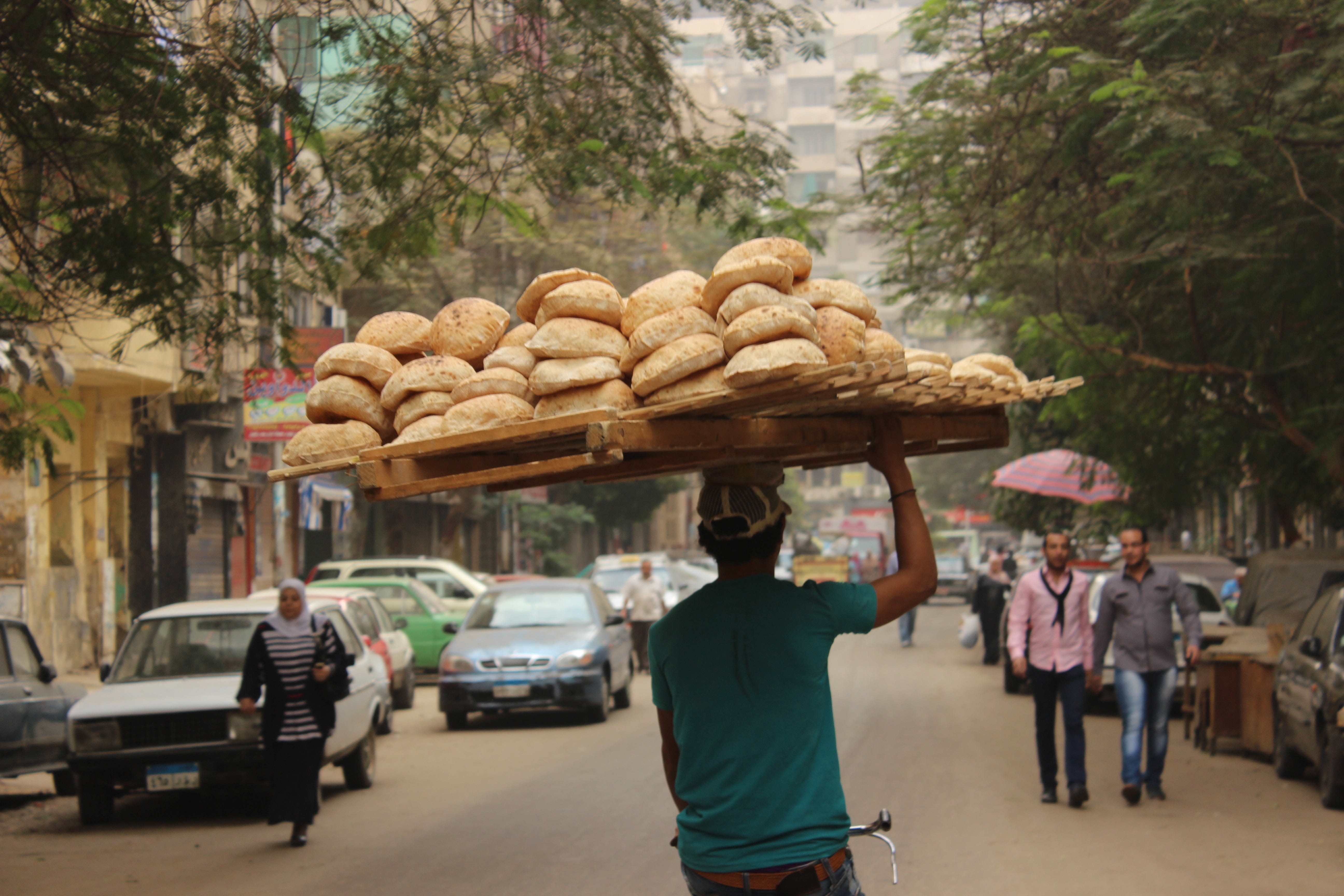
Under the present subsidy system, each eligible person can buy five loaves of bread a day at 20 piasters each. A full monthly allocation of 150 loaves therefore costs 30 Egyptian pounds (about $0.60), and the state absorbs changes in the cost of wheat, freight, milling, and bakery production while the household’s price remains fixed.
However, one cash subsidy scenario discussed by Supply Minister Sherif Farouk would price the loaf at 1.5 pounds, up from 20 piasters, representing a 650% increase in price, and the same 150 monthly loaves would cost 225 pounds, also 650% above their current 30-pound cost.
The government has considered a total monthly cash allowance of 200–350 pounds per person, compared with the current 50-pound commodity allowance, a nominal increase of 300–600%. But if bread is folded into that sum at 1.5 pounds a loaf, bread alone would consume 112.5% of a 200-pound payment, 75% of a 300-pound payment, or 64.3% of a 350-pound payment.
More importantly, none of the government’s plans outlined so far contain a formula requiring the payment to rise with wheat, freight, or food prices, and without that protection, giving consumers “choice,” as the government puts it, means deciding which necessity to abandon when the fixed sum no longer buys them all.
The difference between the two systems is therefore not merely how the subsidy reaches the ration card. An in-kind bread subsidy makes the state carry the market risk, and when freight rises from $20 to $70 a tonne, the additional cost appears in the public procurement and subsidy budget. In contrast, a fixed cash payment passes that risk to households, and the state’s liability ends at the stated number of pounds.
That shift is already being tested farther up the bread chain. The Supply Ministry introduced direct debit in August, requiring mills and bakeries to finance flour purchases before being reimbursed for bread sold. The previous system allowed accounts to be settled later, leaving the state to carry more of the working-capital burden, resulting in the stoppage of 1,500 subsidized bakeries during the rollout, according to Al Manassa’s Enas Hussein.
Following a meeting with bakery representatives on August 23, the Supply Ministry formed another committee to “review unresolved demands,” and the following day, Farouk discussed building new market-monitoring and price data systems with the World Food Programme (WFP).
On the other side of the sea, however, there is little reason to expect the transport premium to disappear quickly.
Zelenskyy said Ukraine had offered a reciprocal halt to attacks on vessels carrying agricultural products. Russia rejected a deal limited to shipping and sought protection for its oil refineries and pipelines in return. Kyiv says any energy ceasefire must also protect Ukraine’s electricity and energy infrastructure.
Egypt’s stronger domestic harvest and local procurement provide time, but not independence from the route. Russia and Ukraine supplied more than 82% of Egypt’s wheat imports in the first half of 2026, and the government may have purchased nearly five million tonnes from Egyptian farmers, but national import needs still exceed that amount.
The Black Sea war has made Russian wheat cheap for those unable to move it and expensive for those who need to eat it, and guaranteed bread forces the state to confront that contradiction in its budget, while a fixed cash subsidy would resolve it differently—by reducing what millions of households can buy.