



Egypt’s constitution enshrines healthcare as a right, mandating comprehensive care and allocating “no less than 3% of GDP” for healthcare. In reality, however, the FY2025/26 budget for health was roughly 1.21% of GDP, below half the constitutional minimum. This funding gap has tangible consequences; as public spending has been squeezed, ordinary Egyptians are forced to pay the difference—out-of-pocket (OOP) health spending at catastrophic levels, comprising over 60% of all health expenditure. In practice, the system has shifted toward cost recovery and patient payment, undermining affordability, equality, and public trust.
Policy levers & systemic strain
Egypt’s healthcare shift currently rests on three policy levers. First, fiscal austerity under tight deficit targets has repeatedly kept health underfunded. Second, a centralized, militarized procurement apparatus–the Unified Procurement Authority (UPA)–has controlled most medicine and equipment purchases, initially established as a corporate entity by the Egyptian president in 2019 and placed under the control of a former army general, reporting directly to the prime minister’s office. Third, a wave of privatization and cost‑sharing has been enabled by recent laws, opening public hospitals to private management and raising user fees.
Today, these dynamics have proved increasingly unsustainable. By mid-2025, the UPA’s unpaid bills to suppliers had ballooned to EGP 43 billion, triggering widespread shortages as foreign currency scarcity choked imports. On September 10, 2025, President Sisi had reportedly “overhauled”–or rather reversed–the procurement process. Hospitals are once again allowed to contract directly with suppliers, but with the UPA now acting as monitor in three‑party deals.
Meanwhile, the state sharply hiked fees in specialized care. In July 2025, Ministerial Decree 220/2025 raised psychiatric and addiction treatment charges by up to 511%. Other alarming issues emerged; vital cancer and other medications vanished from shelves, operating rooms are short on supplies, and an increasing number of doctors reported departing the country.
Staffing crisis: Egypt’s vanishing doctors
Recent independent reporting has highlighted a growing crisis in the Egyptian public healthcare sector, marked by a significant shortage of physicians. Over the past seven years, approximately 21,000 doctors have resigned, which is a staggering number. The Egyptian Medical Syndicate has estimated that only 82,000 out of the 212,835 licensed physicians in the country are still practicing domestically. By January 2025, the rate of resignations had accelerated to around twelve per day, averaging a departing doctor every two hours. As a result, the national doctor-to-population ratio has fallen to 6.7 doctors per 10,000 people, well below the World Health Organization’s global average of 17.2 per 10,000.
Economic and workplace pressures driving the exodus
Surveys conducted among expatriate physicians link emigration to a troubling trend fueled by a combination of harsh factors. The primary reasons cited are economic strain (76%) and low pay (60%), with many doctors reporting that they’ve had to personally purchase medical supplies out of pocket for their patients. Furthermore, the head of the physicians’ syndicate has publicly condemned the poor working conditions, emphasizing that low domestic salaries push young doctors to seek better-paying jobs abroad to pay their student debts at home.
Additionally, when examining pre-tax wages, the mass emigration of physicians becomes more understandable. Interns currently make a monthly salary of 2,800 EGP, while entry-level government residents earn about 7,000 EGP. In contrast, today’s average living wage needed to get by is approximately 13,942 EGP.
*Author’s calculation for basic living wage: Anker Research Institute’s 2024 urban-Egypt living-wage reference of EGP 12,448 / month is adjusted for the most recent year-on-year urban CPI published by CBE, 12 % in Aug 2025.; Using the formula 12,448 × 1.12 ≈ EGP 13,942
The work environment is another significant factor. Over 70 percent of Egyptian doctors report facing workplace violence, and in 2022, the Medical Syndicate recorded 149 deaths among physicians due to severe cases of exhaustion from working long hours.
Austerity & constitutional healthcare rights
Article 18 of the Egyptian Constitution is unequivocal in its language, stipulating that every citizen has the right to “comprehensive healthcare” and mandating a minimum state spending target of at least 3% of GDP, which is to “gradually increase to meet international standards.” This constitutional guarantee, much like that of education, was intended to serve as the bedrock of Egypt’s social contract, promising a healthcare system based on need, not wealth. Yet, this promise seems to have been systematically undermined, or, more accurately, never fulfilled.
Despite state officials’ claims of fulfilling constitutional obligations, Egypt’s FY2025/26 state budget allocates a mere 1.2% of GDP to healthcare. Independent analyses note that the government’s assertion of compliance relies on a questionable accounting approach that inflates spending figures by including military and police hospital expenditures and healthcare-related debt repayment, without improving resources available to the civilian healthcare sector.
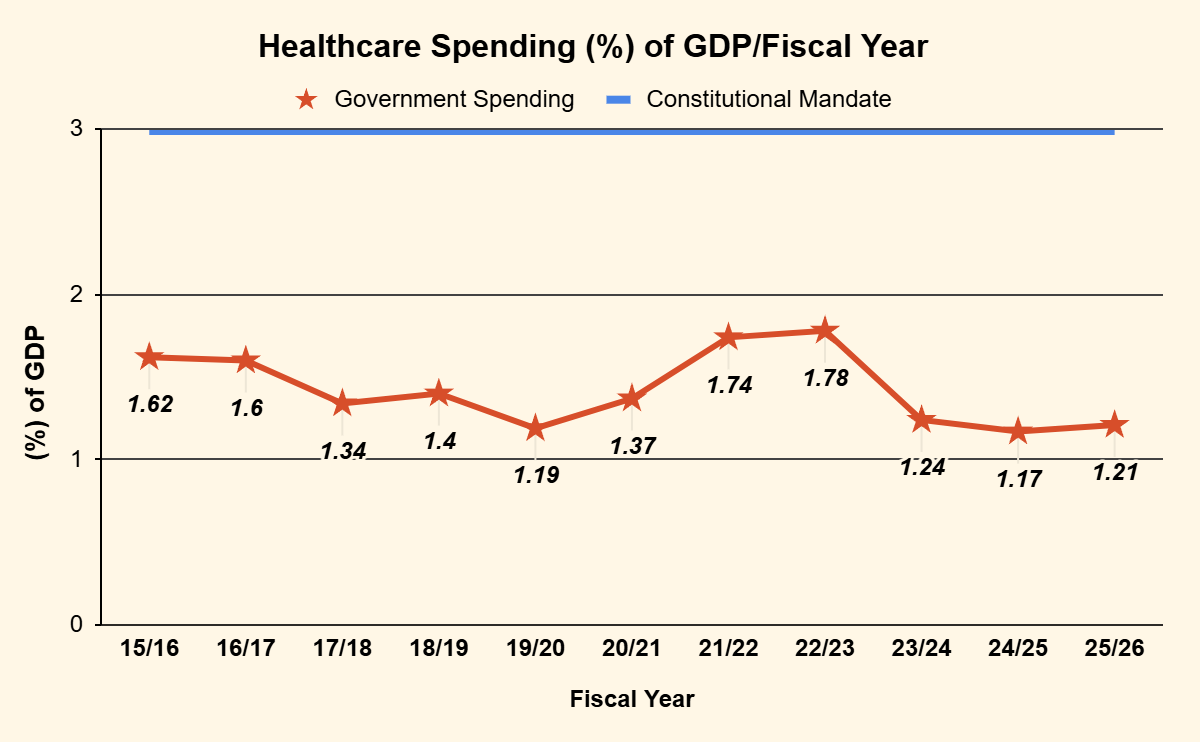
Consequently, this deficit has shifted the financial burden onto citizens, with out-of-pocket (OOP) expenses covering over 60% of total health expenditure. As World Bank data reveals, approximately 30% of households face catastrophic health spending, defined as over 10% of income, pushing 7% into poverty due to these costs.
Severe austerity measures, driven primarily by debt and international conditionality, have prioritized budget discipline over the constitutional guarantee of every citizen’s right to “comprehensive healthcare with quality criteria,” creating a direct contradiction between the promise of universal care and inadequate state spending on actual needs.
International conditionality & domestic priorities
The persistent underfunding of Egypt’s public healthcare sector is deeply intertwined with the state’s commitments to international financial institutions. The architecture of the current IMF program, which provides an $8 billion loan, is built around strict fiscal consolidation measures that crucially constrain the state’s ability to fulfill its constitutional obligations. A key pillar of this program is achieving a primary budget surplus.
The Fund has also been consistent in calling for the state to pursue “a new economic model” that seeks to reduce the state’s footprint and “enable the private sector to become the primary engine of [economic] growth.” This strategy has essentially translated to cutting subsidies and implementing means testing in healthcare policies, which has proven to be somewhat mediocre in its effectiveness.
Alongside these measures, there is a notable focus on attracting private sector participation in the public healthcare system, specifically through manage-and-operate concessions. This approach suggests that private funding can provide equitable care. Crucially, it overlooks the risks associated with rising costs and the gradual decline of accessible healthcare. Additionally, this strategy serves to maintain the regime’s legitimacy in the eyes of lenders.
The fork in the road: The UPA model
Established in 2019 and reporting directly to the Prime Minister, the Unified Procurement Authority (UPA) was given an exclusive mandate to centralize the purchase of medicines, medical supplies, equipment, and health technologies for all government and public entities under the pretense of leveraging economies of scale, applying uniform quality standards, and stabilizing drug supply. However, the UPA was a technocratic attempt at treating what was fundamentally a political problem of corruption and a policy of chronic underfunding; challenges that procurement centralization alone would not fix.
Previously headed by Major General Bahaa El-Din Zeidan, the UPA quickly transformed from a cost-saving mechanism into a monolithic chokepoint, accumulating a staggering debt of over 40 billion EGP by mid-2025 to pharmaceutical companies and medical suppliers. The payment crunch was compounded by Egypt’s foreign currency shortages and liquidity crises, which choked imports of active pharmaceutical ingredients and finished drugs. The result was a cascade of stockouts; dozens of essential medicines vanished overnight.
The state’s response was essentially to break its own monopoly and bail out the UPA. The Ministry of Finance agreed to pay 60% of the UPA’s debt, and President Sisi reportedly issued a directive letting hospitals sign contracts with suppliers directly, with the UPA’s role reduced to monitoring and oversight. While this move would again aim to solve a policy problem, it does not represent a genuine devolution of power. Instead, it similarly orders risk downward, leaving hospitals and suppliers to once again navigate the complexities of a broken system while the fundamental issues of underfunding remain deliberately unaddressed by a regime that has consistently undermined public healthcare needs.
Patients, providers, & the broken care contract
This flight of talent exposes how prioritizing austere policies bleeds into human capital. Just as centralized procurement collapsed under the weight of debt and foreign-currency scarcity, the public-sector wage bill and degraded hospital conditions have made professional life unsustainable for doctors. The consequences are medical stockouts, rising fees, the steady erosion of Egypt’s capacity to train, retain, and protect its healthcare workforce. In effect, the state has shifted risk not only onto patients but also onto doctors themselves, an abandonment of both ends of the healthcare contract.
A broken system abandons the vulnerable
The state recently decided to raise fees of psychiatric and drug addiction treatment at public hospitals by up to 511%. Critics and rights groups rightfully blasted the move as a disaster for vulnerable people and launched multiple campaigns, aiming to reverse the decision. Advocates have also warned that many will simply forego needed care rather than pay, which would lead to worsening conditions for those with psychiatric issues. This episode starkly demonstrates how the state’s push for “service improvement” ends up pushing costs onto the sick, a pattern well-documented in Egypt and as well as other countries where market logic intrudes into health policy.
So, what?!
Egypt’s constitution promises care as a right; by September 2025, the system prices it as a product. The 2025/26 state budget allocation for healthcare sits near 1.21% of GDP against a 3% constitutional minimum, and the shortfall shows up as higher out-of-pocket bills and delayed treatment. Centralized purchasing via the UPA produced debts, stockouts, and government bailouts, leading to a policy rollback that lets hospitals buy directly as a stopgap, not a cure. User fees climbed, including steep addiction treatment and psychiatric-care increases, while fiscal targets and “private-led growth” keep the state’s spending ceiling low. Unless funding, staffing, and procurement are re-anchored to meet the constitution’s pledge, the social contract will keep eroding, and both patients and providers will keep paying the price, and the result will remain a downward transfer of risk.
It sounds like our system. Healthcare Should be a right of every person
My daughter recently had a holiday in Egypt with the family. She became ill with a stomach virus, dehydrating rapidly. She was rushed to a beautiful hospital receiving very high quality fully comprehensive care. She is a nurse so knows it when she sees it. This was only available to her because of her travel insurance. You do have fantastic health care but only for the wealthy. If its there it should be available for all not just for this who have the money to pay for it. So sad.