




This week’s issue of The Cairo Report covers the arrest of Matsada2sh’s entire newsroom, reports from detainees’ families of beatings and tear gas at 10th of Ramadan Prison after the new Criminal Procedure Law was abruptly delayed by a year, and the launch of a collective by women from detainees’ families demanding a political end to freedom-of-expression cases.
On the labor front, garment workers at Samanoud are still owed wages after ending their strike, more than 800 Misr El Amria workers have been locked out since August 8, and 39 Al-Ahram Printing workers recovered unpaid wages after a complaint, even as the company’s debt crisis lingers. Agricultural engineers went to court to force a syndicate election.
We also look at the military’s push into gold mining, an agricultural export boom resting on 97% informal farm labor, one in five Egyptians over 60 still working, and a bank fund limiting its retirement floor to earlier members.
Journalists organize sit-in amidst an unprecedented press crackdown
Dozens of journalists trickled into the Journalists Syndicate building on Abdel Khalek Tharwat Street in Downtown Cairo on the afternoon of October 3. They varied in age, political camps, and their status as syndicate members. They gathered in the syndicate’s lobby for a symbolic sit-in at 3 p.m. to protest the arrest of the entire newsroom of Matsada2sh, one of Egypt’s few independent media platforms.
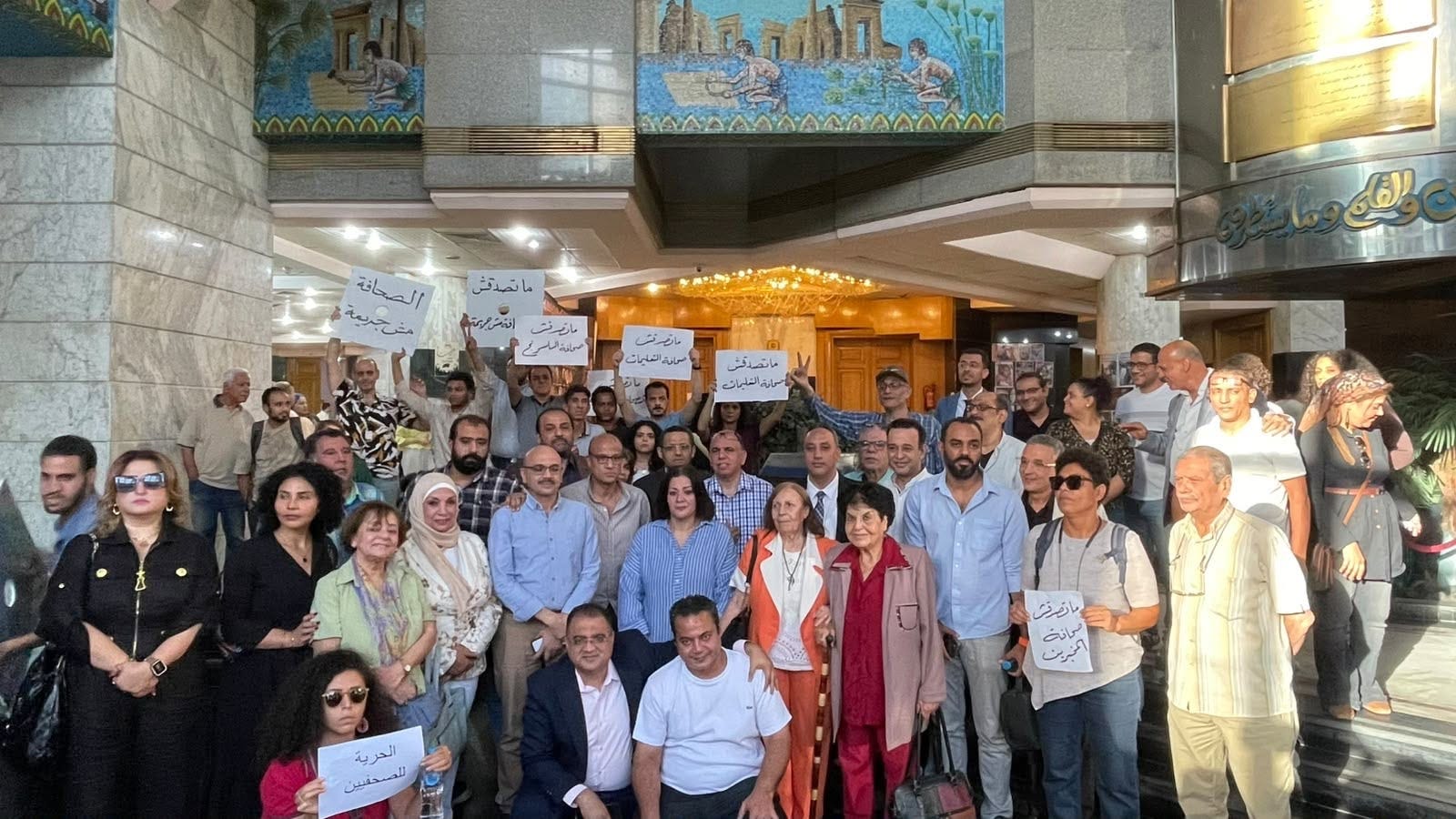
An entire newsroom was abducted by state security in a press crackdown the likes of which Egypt has never seen before. Today, October 4, marks six days since their enforced disappearance.
Hours after the sit-in, the Supreme State Security Prosecution ordered one of the six, Mohamed Ashraf Abu Emaira, detained for 15 days pending investigations, EIPR lawyer Islama Salama stated on October 4. He was charged with joining a terrorist group, publishing and broadcasting false news and statements, and using a social media site, in State Security Case No. 8083 of 2026.
Salama said she attended Abu Emaira’s interrogation, which began at 10 p.m. on October 3 and ended this morning. Only he has been questioned so far.
The lawyers are following up on when the other five will be interrogated so they can attend.

Members of the syndicate’s general assembly said they would keep the sit-in open until the journalists are released, and the syndicate board will hold an emergency meeting Monday with a single item on its agenda: how to respond to the arrests.
The campaign began Monday night, September 28, with raids on the journalists’ homes, according to Matsada2sh and its defense team, the Egyptian Initiative for Personal Rights (EIPR). The six are Mohamed Ashraf Abu Emaira, Abdallah Qadry, Islam Barakat, Mohamed Adel, Mohamed Mahmoud and Omar Helal. Mahmoud and Adel, the last two still free, were abducted from Cairo’s streets on the morning of September 30.
EIPR said the security personnel who raided some of the homes showed no arrest or search warrants and did not say why the journalists were being held or where they would be taken. They also seized devices belonging to the journalists and their relatives.
On October 1, the Ministry of Interior (MOI) acknowledged the arrests and said the six were “suspected of preparing fabricated news” for the platform, alleging links to the Muslim Brotherhood (MB). It did not name specific charges or say where they were held. The ministry also accused them of operating an unlicensed platform run from abroad.
The ministry accused a fact-checking platform that regularly debunked claims made by MB-affiliated media of being operated by the MB, which is exactly the argument Matsada2sh made in response to the MOI statement.
Syndicate head Khaled Elbalshy told those gathered at the sit-in that the Supreme State Security Prosecution informed the syndicate’s lawyer that the six have not yet been investigated.
EIPR head Hossam Bahgat confirmed on the morning of October 3 that the prosecution chief told the lawyers the journalists had neither been tried nor ordered held for 15 days in pre-trial detention.
That contradicted a story released late on October 2 by Al-Masry Al-Youm, back-dated to October 1, claiming the prosecution had ordered the journalists detained for 15 days pending investigations. The now-state-aligned platform did not provide any sources for its claims.
Activists and journalists commented on how Al-Masry Al-Youm could get away with spreading false news, a charge that follows every independent journalist and dissenter, and which the MOI has leveled at the six. And while the selective application of this charge is well-known, never has it been more obvious.
More than 80 organizations, including Human Rights Watch, Reporters Without Borders, and the Committee to Protect Journalists, have condemned the arrests and called for the journalists’ immediate release. The syndicate has asked the MOI and Public Prosecutor to release them and disclose the grounds for arrest and their place of detention, stressing their right to a lawyer and to be brought before an investigating authority within 24 hours.
Matsada2sh co-founder Abdelrahman Mansour, who is based abroad, told the Associated Press that the families still do not know where the six are held.
The US State Department said on Thursday, October 1, that it had waived human rights conditions on more than $300 million in military aid to Egypt, citing Cairo’s “helpful role” since the launch of the US-Israeli war on Iran on February 28. That was the same day the MOI acknowledged it was holding the Matsada2sh newsroom.
The waiver letter to congressional committees is dated September 21, and the Rubio memo justifying it is dated September 4, so the decision predates the raids. However, that is the point. Washington had already settled, a week before the first door was kicked in, that nothing the Egyptian security state did at home would cost it.
A state that rents out its geopolitical position to whichever war is running does not need to answer to its own population for how the bill is paid. That bill is collected from the working class: higher fuel prices, frozen raises, delayed wages. An independent fact-checker that picks apart official claims, whether from the government or its opponents, is one of the few tools people have to see where the costs land.
The timing seems suspicious, too. The government is preparing a conference for the second half of October to show citizens its achievements, with ministers meeting to draft its themes, Al-Ahram reported. The government says the aim is to assure citizens that it listened to them, yet the dialogue leading up to it will not be fully open but “limited,” according to the cabinet spokesperson, leaving unclear how citizens’ concerns will reach the table or what happens after.
A state that curates the conversation about its own record in advance, and decides who gets a say, has just put the country’s best-known independent fact-checking newsroom in the hands of State Security prosecutors.
A government cannot claim to have listened while arresting the people who check what it says.
Whatever this conference is, it is not a space where official claims will be tested, and the six are, undoubtedly, a message about who is allowed to test them.
Court-forced elections reopen control of agricultural engineers’ pension fund
Egypt’s Agricultural Professions Syndicate has begun preparations for its first elections since its current council’s mandate expired in February, after members went to court to force the process forward. The council decided on 28 September to open nominations nationwide in November, explicitly citing compliance with judicial rulings, seven months after the Administrative Court ordered it to begin the legally required election procedures.
The plaintiffs—Sayed Abdel Latif, Mohamady Fathy El-Badry and Ibrahim Abdel Aziz Ebeida—had challenged the council’s failure to call elections after its four-year term ended, and have since emerged as figures in the opposition current contesting control of the syndicate.
The election process is opening just as the incumbent leadership says it has nearly eliminated a decades-old pension backlog. Syndicate head Sayed Khalifa announced that 90 million Egyptian pounds was transferred on September 16 to cover pension entitlements from January through September 2026 for roughly 250,000 beneficiaries, after the council had previously said it inherited more than 500 million pounds in arrears in 2022.
Yet the occupational pension itself remains just 100 pounds a month, with Khalifa saying any increase to 120–125 pounds would “require an actuarial study by the next council.”
The coming vote is also a struggle over the collective resources behind that pension. Khalifa has said the fund depends on member contributions, statutory revenues, and returns from syndicate property, with parts of the syndicate’s clubs, hospitals and other assets placed under investment contracts whose proceeds are split between the facility and the pension fund.
That makes representation inseparable from distribution: whoever controls the council also administers members’ dues, property and the surplus used to reproduce members after retirement.
The contradiction, however, is clearest in the franchise itself. Khalifa said in July that more than half of registered members were behind on subscriptions and that unpaid dues restricted voting and candidacy rights under the syndicate’s rules; by September 28, he said every member in the database would be able to participate without personally clearing those arrears.
No published instrument we have seen explains that change in stance. What is already clear, however, is that members had to use the courts to reopen nominal democratic control over an institution that manages their collective wealth, which will effectively determine who controls the social resources accumulated in members’ name and how much of those resources return to them.
Military continues to bank on gold mining
Egypt has begun awarding exploration blocks under its new mining system as Shalateen and Saudi Gold Refinery prepare further expansion in the Eastern Desert, where informal miners face a military crackdown.
The government announced its first awards under the new open-sector mining system at last week’s Egypt Mining Forum, with the state’s Shalateen Mineral Resources Company planning to offer five additional gold exploration zones before year-end, separately from the government’s rolling concession system. Separately, Saudi Gold Refinery has submitted bids for seven blocks near Al Baramiya, allocating 10 million US dollars for exploration and envisaging investment exceeding 200 million dollars if projects advance.
The prospective beneficiaries include private mining investors and the military’s commercial apparatus. Shalateen’s ownership structure assigns 34% to the armed forces’ National Service Projects Organization (NSPO), alongside 35% for the mineral resources authority, 24% for the National Investment Bank and 7% for the authority’s Egyptian Company for Mineral Resources.
Shalateen’s private partner Afaq Mining is chaired by Mostafa El Bahr, a former head of the mineral resources authority, illustrating movement between regulation and private business. Saudi Gold Refinery, owned by businessman Suliman Al Othaim, returned after earlier negotiations with Shalateen failed over production-sharing terms. The new royalty-and-tax framework offers its preferred arrangement. It plans to export semi-refined gold to Saudi facilities, unless Egypt requires domestic refining, placing that stage of processing and employment abroad.
Commercial opening has proceeded alongside military control over licensing and access. Prime Ministerial Decision 1440/2026, issued in May, requires Defense Ministry approval and coordination with the Armed Forces Operations Authority before mining licenses can be issued, including on land administered by other state bodies. On June 22, the military spokesperson announced a joint armed forces–Interior Ministry campaign in the Southern Military Region against “unauthorized mining and criminal networks,” reporting 223 arrests and equipment seizures. In August, reporting by Mada Masr, a Shalateen source said the army had taken over police checkpoints along the Edfu–Marsa Alam road, and miners described restrictions on supplies and lost livelihoods.
For workers, the question is how formalization redistributes access, income, and risk. A 2023 investigation described informal miners receiving daily pay or a share of extracted gold, dangerous shafts, and improvised explosives, while an employer reported migrant workers dying from suffocation. A mill owner also said Border Guards officers and Shalateen officials obstructed an attempt by around 50 miners to establish a union-like organization.
Working past 60 & the unequal right to retirement
One in five Egyptians aged 60 or above was employed in 2025, according to figures released by the Central Agency for Public Mobilization and Statistics (CAPMAS) on October 1.
The agency counted approximately 1.9 million older workers, with agriculture and fishing accounting for 49.5% of their employment, and wholesale and retail trade another 19%. These sectors together accounted for more than two-thirds of older employment, putting the ability to stop working at the center of the retirement question.
Egypt’s 2019 social insurance law sets pension age generally at 60 for employees and 65 for self-employed people and workers in its irregular employment category. In 2025, the minimum actual contribution period for an ordinary old age pension increased from 10 to 15 years, which is an important difference for people whose working lives include jobs that generate no recorded insurance contributions, as years of labor do not necessarily translate into years of pension entitlement.
An EIPR study published in May 2024 traced the replacement of earlier subsidized arrangements for vulnerable workers. It found that contribution costs under the unified system could obstruct access for low-income irregular workers. The inequalities accumulated during working life therefore follow workers into old age.
Receiving a pension also leaves the question of what it can buy. The National Organization for Social Insurance (NOSI) raised the minimum pension for newly retiring workers to 1,755 pounds from January 2026, while existing pensions increased by 15% in July. The law caps ordinary annual increases at 15%, leaving pension income exposed when inflation exceeds that ceiling.
Care adds another claim on household income and labor. The Social Solidarity Ministry’s September 2026 statement counted 201 licensed care homes accommodating approximately 4,468 people. Beyond residential institutions, the OECD’s May 2026 assessment found that families, especially women, provide most elderly care, while poorer households have fewer paid alternatives.
The promised expansion of rights also faces an implementation gap. A May 2026 campaign statement published by EIPR still demanded executive regulations for the 2024 elderly rights law. A practical right to retirement requires accessible insurance, adequate income and affordable care, and without those conditions, households absorb the costs through continued employment, reduced consumption and unpaid caregiving.
Agricultural export boom leaves workers and small farmers exposed
Egypt’s agricultural export boom is generating foreign currency alongside insecure work and losses at the farm gate. Fresh and processed agricultural exports earned 11.5 billion dollars in 2025, but industry insiders who spoke to Enterprise last week described refrigeration gaps, shipping delays, and pesticide violations that erode returns.
The social conditions of production remain much less secure: the OECD’s 2026 assessment reports agricultural employment as 97% informal. Export totals consequently reveal little about how earnings reach hired workers, tenant farmers, or smallholders.
On the side of capital, large agribusinesses are securing finance to reorganize production and supply. International Finance Corporation (IFC) records show a financing package of up to 40 million dollars for Nile Agriculture, approved in April and recorded as invested in June, to develop 13,711 feddans in Minya. Its guarantor, Nile Sugar, is 99.6% owned directly and indirectly by Naguib Sawiris and his mother Yousriya Loza.
IFC anticipates providing seeds, credit, and transport through an outgrower scheme reaching 25,000 farmers, ostensibly easing constraints on cultivation while tying growers more closely to the processor.
Worker representation deserves equal attention: IFC’s labor appraisal says a previous workers’ syndicate was replaced by an HR committee. Its action plan requires stronger “supplier farm inspections” covering wages, minimum age, and occupational safety by November 30, 2026.
Pesticide compliance connects export losses to hazards borne first by agricultural workers. In a May 2025 investigation by Barbara Yusuf, Zawia3 traced 103 rejected Egyptian containers between February 2022 and March 2025 to chlorpyrifos residues, and documented continued pesticide circulation, mixing crops from registered and unregistered farms, and a 15-year-old preparing and spraying chemicals.
Egypt’s pesticides committee had supposedly ordered food crop use to cease in June 2022, with remaining restricted uses ending in December 2023. A separate European Union (EU) regulation adding chlorpyrifos to persistent pollutant restrictions took effect on September 30, 2026. Border inspection requirements remain commodity-specific: 10% for Egyptian oranges and 20% for strawberries. Effective enforcement therefore involves pesticide suppliers, farm practices, and workers’ protection throughout production.
Earlier reporting by Zawia3 shows how these weaknesses distribute costs down the production chain. Tomato growers interviewed in August 2025 described crops spoiling while trucks queued outside processing factories, with farmers continuing to pay transport and harvesting costs. Its August 2026 investigation documented inadequate fertilizer access and weakened extension and cooperatives, limiting small growers’ ability to manage production and negotiate sales. Hired workers face another layer of deductions: in a March 2025 investigation, a girl reported receiving 50 pounds daily, reduced to 40 pounds by a labor broker, alongside accounts of injuries and unsafe transport.
These experiences give substance to the distributional question behind export growth: whether investment makes testing, refrigeration, and technical support accessible to smaller producers, and whether workers secure adequate pay, safe conditions and independent collective representation.
Al-Ahram Printing’s debt crisis reaches the shop floor
Thirty-nine workers at the state-owned Al-Ahram Printing and Packaging in Borg El-Arab have recovered their unpaid August wages and returned to work after filing a complaint with the Labor Ministry, according to a provincial labor directorate roundup.
The settlement is a concrete gain for workers who had both gone unpaid and been prevented from entering the workplace. But the dispute did not arise in isolation, as in late August, police and Central Security entered the company’s plants to execute an auction linked to debt owed to Qatar National Bank (QNB), after which the auction purchaser and court-appointed custodian prevented employees from entering and machinery representing roughly half the plant’s equipment was dismantled and removed, according to the company’s Egyptian stock exchange (EGX) disclosures.
The company regained possession on September 9 after reaching an installment arrangement on the remaining debt and paying the first installment, but the underlying production crisis remains unresolved. By September 23, the company said an inventory had found machinery and other equipment missing or damaged, while it was challenging the August auction in court, and the EGX kept the company’s shares suspended pending a detailed recovery plan addressing the effects of asset seizures on production, financing needs and a timetable for restoring operations.
Regulators had earlier cited roughly 107 million pounds in negative working capital, 83.2 million pounds in negative shareholders’ equity and 156.9 million pounds in accumulated losses.
The sequence is yet another display of how a balance sheet dispute between creditor and company—owned by the state in this case—is converted into a labor crisis at the point of production. Workers had no say in contracting the bank debt, choosing which machinery would secure it, or deciding how the company would be financed; nevertheless, once creditors moved against the fixed capital on which production depends, workers lost access to the factory and one month of wages.
The Labor Office has now restored that immediate relation—the workers are back inside and August pay has been recovered—without resolving the conditions that broke it. Their employment still depends on machinery, solvency, and production decisions being fought over by banks, courts, shareholders, and regulators outside their control.
That also places the ministry’s intervention within a broader pattern of reactive enforcement under the new labor law. In the same roundup, inspectors found establishments in Luxor and Beheira with missing contracts and minimum wage problems but issued warnings and time to regularize rather than reporting immediate restitution or penalties.
Bank fund reserves retirement floor for earlier members
Egypt’s Financial Regulatory Authority (FRA) has approved rules that exclude newer entrants to the Arab Land Bank workers’ private insurance fund from its minimum retirement payout.
Decision 2745/2026, dated August 31 but published on September 30, reserves the guarantee of 37 months’ subscription wage for members who joined through December 31, 2016. Members joining from 2017 receive a benefit calculated from membership duration without that retirement floor, although death and permanent total disability retain the minimum for everyone.
The amendments apply retrospectively from January 1, 2026, dividing retirement protection within the same workplace by fund entry date.
The difference is substantial for members retiring after shorter periods in the fund. Under the formula of 1.6 months’ subscription wage for each membership year, a non-founding member with 10 years receives 16 months’ subscription wage—56.8% below the protected cohort’s minimum, by The Cairo Report’s calculation.
At an illustrative subscription wage of 10,000 pounds, that means 160,000 pounds against 370,000 pounds with the guarantee. The weaker protection therefore falls on later entrants whose membership ends before they accumulate enough years.
The wage used in these calculations is itself regulated and can differ from actual earnings. An earlier amendment, issued in June 2024, tied subscription wages to January 2024 basic pay, with annual increases of 5% from January 2025. Including additional pay required an actuarial study and regulatory approval. The retirement benefit consequently depends on two institutional decisions: which earnings count toward it and whether a minimum protects members whose accumulated entitlement remains small. Excluding later entrants from that minimum reduces the fund’s obligation precisely where the membership-based formula produces its lowest payouts.
Workers face third month of lockout as company management skips labor bureau hearing
More than 800 workers at Misr El-Amria Spinning and Weaving Company have been left without clear answers about their jobs. They have spent two days at labor authorities, where management either did not show up or told them reopening is “under study,” the Egyptian Commission for Rights and Freedoms (ECRF) stated on September 30.
While the company has been shut since August 8, workers have been receiving reduced wages amid growing talk that management intends to liquidate the company, according to the ECRF.
Workers went to the Hanoville labor directorate on September 29, but company management did not attend, per the ECRF. At the Labor Directorate in Smouha on September 30, management reportedly denied the workers’ financial claims and reiterated that reopening was “under study,” without providing a timeframe or criteria for the study.
According to workers who attended the directorate on Wednesday, a meeting is scheduled for Sunday, October 4, between the company’s managing director and the Labor Ministry’s undersecretary in Alexandria.
The ECRF said the meeting cannot produce a fair outcome unless workers’ freely chosen representatives take part. It said the meeting should be judged by whether it ends in a public decision to reopen the company, pay full wages, and implement the earlier agreement with workers, not by whether it takes place.
Management has given a different account. In a written response to the workers’ collective complaint, which The Cairo Report reported on August 29, the Alexandria Labor Directorate accepted the company’s version. It said management paid the statutory 3% periodic allowance on insured wages in January, then introduced an additional 12% allowance on basic wages in July, folding 7% into basic pay.
Workers said the directorate reproduced company memoranda without independently addressing their argument that the calculation violated Law No. 75 of 2026, according to Al Manassa’s Ahmed Khalifa.
The directorate also said workers retained their full legal wage rights during the suspension. It relied on an internal letter dated August 10 that the complainants were not allowed to inspect. It neither formally classified the shutdown nor issued a binding payment order covering its duration.
It also found the workforce ineligible for a 750-pound monthly cost-of-living allowance, though workers said they had received comparable payments before and that other textile companies still pay them.
Management closed the factory on August 8 rather than return to negotiations, with security forces surrounding the premises, the ECRF said. It condemned the move at the time as a tool to intimidate workers and break the strike. Management then paid reduced wages for the period workers were barred from entering.
Workers filed individual complaints with the Amria labor relations office, saying they were denied entry without justification and that parts of their pay were withheld. They cited pay for the eighth working hour, an increase in the meal allowance, and the unapplied raise.
The rights group warned that if the liquidation rumors are true, the prolonged closure and reduced pay could be a way to wear workers down until they resign or accept unfair settlements, clearing the way to end hundreds of employment relationships. Any decision affecting the company’s future or its workforce, it said, cannot be taken without workers and their representatives.
The ECRF is calling for an immediate, public decision to reopen the company, with workers returning without signing any waivers; full pay for the closure period, with all deductions refunded; full implementation of the 12% raise, with back pay; workers’ chosen representatives at Sunday’s meeting and any later talks, with results announced transparently; and an official disclosure from management of the company’s status and plans, and a pledge not to liquidate or cut jobs without genuine negotiation.
It also demanded binding action from the Alexandria Labor Directorate and the Labor Ministry, including a public timeline for the “study” and legal steps over management’s failure to attend the labor office, as well as guarantees against retaliatory, disciplinary, or security measures against workers for striking, filing complaints, or demanding their rights.
Samanoud garment workers still owed wages
Update: Around 300 women workers in the garment section of the Samanoud Textile and Weaving Company are still owed 900 pounds each in August wages, and their health insurance remains suspended, the ECRF stated on September 27. Workers in all other sections have been paid in full, the group said.
The women had joined a strike that began September 17 and ended September 24. The ECRF said they had treated it as their last resort to claim pay for a month they worked in full.
The garment section makes up about 300 of the company’s roughly 500 workers, around 60% of the workforce, per the ECRF, many of whom are sole breadwinners supporting their families and children.
The total still owed is about 270,000 pounds, less than 0.5% of the more than 74 million pounds in financing the National Investment Bank (NIB) has announced it is injecting into the company, the ECRF said. The group said this raises serious questions about why the wages are still being withheld.
The state-owned NIB owns 52% of the company. A bank delegation visited the factory on September 24 and promised to resolve the crisis, according to the ECRF, but the promises have not yet turned into action. The group said verbal pledges are not enough and called for written, public commitments with a clear timeline, especially given the bank’s position as majority shareholder.
As The Cairo Report reported last week, workers ended their weeklong strike on September 24 after the company paid an additional 1,200 pounds of delayed August wages and pledged to pay the remaining 1,000 pounds on September 28, Al Manassa’s Ahmed Khalifa reported.
Management also promised to pay wages in the first week of each month going forward.
Workers responded with an ultimatum: pay September wages in full by October 10 or they will resume a factory-wide strike.
Prison Watch: Prisoners and their families fight back
Families of detainees issued an urgent statement, open for signing, on October 2 expressing grave concern over reports of beatings, tear gas use, and injuries inside 10th of Ramadan Prison Complex, as well as the forced transfer of a group of detainees to other facilities without their families or lawyers being told.
The families said they have no independent way to confirm what happened to their relatives, citing restrictions on direct contact between detainees, families and lawyers.
Rights lawyer Mahienour El-Masry confirmed on Facebook that a series of taghreeb, the practice of punitively transferring prisoners to distant facilities, has been taking place, with one of the transferred being researcher Ismail El-Eskandarani.
The statement said the events cannot be treated as an isolated incident. Prisons across Egypt have seen protests and strikes over detention conditions and continued imprisonment, according to the families, who said they have received allegations from other prisons of hunger strikes, bans or limits on visits, and several suicide attempts or self-harm.
They link the unrest to the sudden postponement of the new Criminal Procedure Law just hours before it was due to take effect, and hold the legislative and executive authorities responsible for the anger caused by the loss of that hope. Shorter pretrial detention periods were among the law’s most prominent features, the families said.
“A detainee does not postpone his life by a year,” the statement said, describing relatives who have lost breadwinners, children raised without their parents, and women deprived of family life. They said what they want is neither a new promise nor a new date, but urgent action to verify the situation and protect detainees.
The families, joined by citizens and public figures in solidarity, demanded no punitive or disciplinary measures against detainees for protesting; an independent investigation by the Public Prosecutor into the information received and distress calls made; a field verification by the National Council for Human Rights (NCHR) and independent rights groups; access for independent medical authorities to examine anyone suspected of injury, with families notified of their condition and lawyers able to monitor their legal and health situations; and an urgent review of prisoners’ status and the release of anyone with no legal justification for continued detention, whether in pretrial detention, on trial or serving a sentence.
In tandem, Egyptian women from the families of people held over cases tied to freedom of opinion and expression announced on October 3 the founding of “Kefaya Sugoon – Women for Justice” (Enough Prisons). The collective called for a clear route to end cases connected to the exercise of freedom of opinion and expression, covering people in pretrial detention, those referred to trial and those already sentenced. It said the people held are citizens whose lives, and those of their relatives, are being used up, not “numbers in files.”
It addressed the president and state institutions directly, as well as the House of Representatives, the government, the national councils, political parties and forces, rights groups and public figures. Ending the file needs a decision, will and a clear path, the statement said, and the burden should no longer rest on the families alone.
The statement also presented the issue partly as an economic one. When one family member is detained, it said, income stops, responsibilities multiply, and a mother or wife is left to carry the home, work, and spending alone, on top of the financial and emotional cost of prison visits. In a period of economic pressure on everyone, many families cannot keep bearing years of detention.
Days earlier, Parliament gave final approval on September 30, in an emergency session, to postpone the new Criminal Procedure Law for a year, less than 24 hours before it was due to take effect on October 1. The government cited the need for further organizational, technological and staffing preparations, including a digital system for judicial notifications and remote court proceedings, which sparked outrage in prisons.
Security sector update

So, what?!
As usual, this week’s dispatch reads as a ledger of how the system works.
The state hands gold blocks to its own companies and Saudi investors while the military cracks down on the informal miners who dug the Eastern Desert first. Farms earn record dollars on a workforce that is 97% informal.
Factory gates are locked on workers who struck over a raise they say was agreed, and women who sewed are still owed their August pay. People past 60 keep working because retirement is a floor guaranteed to some and withheld from the rest.
Meanwhile, foreign money keeps the machine running and asks nothing.
Washington waived its human rights conditions on $320 million in arms aid in the same days Matsada2sh’s entire newsroom was seized, because a fact-checker is an audit The New Republic will not tolerate.
It delays the law that promised shorter pretrial detention and answers prisoners’ protest, reportedly, with tear gas and transfers, and tells their families to wait another year.
Courts, strikes and complaints are winning what the state’s promises never will.
The bill for the extraction always lands on workers, prisoners, and the reporters who counted it, and next week we keep counting.