




This issue of The Cairo Report covers the liquidation of intelligence-owned El-Fagr, whose journalists are demanding the syndicate step in to protect their unpaid wages and employment rights; arbitrarily dismissed EgyptKE journalists suing their outlet; the General Federation of Pensioners’ Unions’ renewed campaign for a minimum pension of 6,400 Egyptian pounds a month; and the Engineers’ Syndicate head’s challenge to the Prime Minister’s account of engineers’ earnings.
We also explore the third worker death on duty at the state-owned Egyptalum in two months, Wadi al-Qamar residents’ 10-year battle against a multinational corporation polluting their neighborhood finally nearing its verdict in December, and Egyptian lawyers’ challenge to remote litigation fees as unconstitutional.
Elsewhere, veteran labor organizer and founding president of the now-defunct Egyptian Democratic Labor Congress (EDLC) Yousry Maarouf was summoned for an internal investigation at the Alexandria Container and Cargo Handling Company after workers secured an agreement to restore eight-hour shifts.
On the land expropriation and resistance front, Warraq Islanders have extracted a series of commitments on compensation and basic services from state and security representatives, as Tora El-Balad residents have staged three-day protests against threats of expropriation.
Intelligence-owned paper liquidated
Update: El Fagr journalists are demanding intervention by the Journalists Syndicate to protect unpaid wages and employment rights after the intelligence-owned newspaper’s board decided to pursue liquidation. Journalists’ Syndicate head Khaled ElBalshy said on September 6 that management had confirmed an internal decision but told him formal procedures had not begun.
According to a statement from the Egyptian Observatory for Journalism and Media (EOJM), ElBalshy said the media regulator had received no official notification. The website remains operational, while the print edition remains suspended.
According to one of the paper’s journalists, who spoke to The Cairo Report on condition of anonymity, said staff learned of the decision “by chance”, accusing management of failing to notify either journalists or their syndicate, adding that a general assembly had approved liquidation and that employees are now demanding council action to protect workers’ entitlements and hold those responsible accountable.
ElBalshy’s subsequent account, however, distinguishes the owners’ decision from its formal implementation, while leaving the complaint about staff exclusion unanswered. He pledged to “pursue the available syndicate and legal channels to protect journalists and other workers.”
A previous issue of The Cairo Report traced the wage crisis to the expiry of an advertising agreement with POD, a United Media Services (UMS) affiliate, and documented stalled efforts to sell the institution.
At the time, journalists formed a committee to facilitate negotiations with management and the syndicate, supporting a proposed sale that promised restructuring and payment of arrears.

But conflicting accounts of share percentages and complications involving deceased shareholders’ heirs obstructed the process. Staff were still awaiting a general assembly to address disputed shares; they now face an internal decision toward liquidation without an announced settlement of their claims.
The workforce had already absorbed substantial costs to preserve the institution. EOJM previously documented journalists making concessions and continuing to produce the website without pay, including colleagues who had worked for years without formal appointment. In June, the organization announced preparations to represent dozens of journalists seeking their entitlements.
Under Egypt’s labor law, liquidation does not extinguish employment obligations, and workers’ claims receive preferential status against the debtor’s assets. EOJM’s legal unit likewise stresses that an internal liquidation decision does not itself terminate employment or cancel accrued rights.

Pensioners’ union
Update: Egypt’s General Federation of Pensioners’ Unions is renewing its campaign for a minimum pension of 6,400 pounds a month, seeking to tie retirement income to the wage floor as pensioners struggle to secure both adequate benefits and timely payment.
Federation president Ahmed El-Araby said in a letter carried in an Al-Ahram column by Sakina Fouad on September 6 that the organization was preparing parliamentary and public support for legislation setting the minimum at 80% of the 8,000 pounds minimum wage.
The campaign follows previous demands the federation said it submitted to the president’s office in February, and addresses the widening wage–pension gap documented in last week’s Cairo Report dispatch. The 1,755 pounds minimum for pensions beginning in 2026 equals just 21.9% of the state wage benchmark, and while approximately 11.5 million pensioners and beneficiaries received a separate 15% increase in Jul, the federation’s proposal would establish a stronger relationship between income during employment and the minimum available after retirement.
El-Araby also argues that the higher floor is already required by law, but the existing formula does not establish that entitlement. Social Insurance and Pensions Law No. 148 of 2019 sets the relevant minimum at 65% of the minimum insured wage, while using 80% as a ceiling in pension calculation. The minimum insured wage—the earnings threshold used to calculate contributions—is currently 2,700 pounds. Employers nevertheless must insure workers at their actual wages. The campaign therefore would involve both changing an inadequate statutory floor and enforcing contribution rules that determine workers’ future income.
Engineers challenge official claims on pay and job security
Egypt’s Engineers’ Syndicate head Mohamed Abdel Ghani demanded better pay and secure employment on September 10, challenging Prime Minister Mostafa Madbouly’s account of engineers’ earnings. Abdel Ghani said tens of thousands of engineers in government and public business enterprises earned 4,000–9,000 pounds, while private sector salaries ranged from 6,000–11,000, many of which are well below the 8,000-pound minimum wage. He described the much higher salaries cited by Madbouly as “exceptional.”
During a September 6 visit to industrial projects in Ain Sokhna, Madbouly said that “newly graduated engineers earned 25,000–30,000 pounds monthly,” using those examples to defend major projects and continued infrastructure investment as sources of employment, alongside his assertion that “national unemployment had reached record lows.”
His salary examples concerned particular workplaces in the Suez Canal Economic Zone, not earnings across the profession, leaving unanswered how widely workers share in the gains from investment.
Notably, Abdel Ghani speaks with an independent electoral mandate. In this year’s Engineers Syndicate elections, he was the independent candidate who defeated former transport minister Hani Dahi, backed by Nation’s Future, which itself is a state security-backed party.
Abdel Ghani had received 10,505 votes against Dahi’s 6,389. He was also a co-founder of Engineers Against Sequestration, which campaigned to restore members’ control of their syndicate. His victory nevertheless left institutional constraints: the state-aligned Unified List won all 11 complementary council seats contested in the election.
The pay demands predate both his election and Madbouly’s remarks. In March 2024, then-syndicate head Tarek El-Nabarawy approached the prime minister and health minister seeking inclusion of health sector engineers in the medical professions incentive framework, and before leaving office, he renewed demands for a higher professional allowance in January 2026, linking inadequate compensation to experienced engineers leaving state institutions.
If anything, these interventions show that the government’s investment narrative has developed alongside repeated demands to improve conditions for the professionals carrying out its work.
Abdel Ghani’s latest demands extend to permanent appointments for engineers working on daily rates in ministries, a dedicated pay and employment framework, and revised professional and risk allowances. The dispute therefore concerns the terms on which engineers supply their labor as well as their salaries, and while unlikely, its practical test is whether ministries provide secure jobs and whether public and private employers deliver pay improvements beyond the better-paid projects highlighted by the prime minister.
Former EDLC head summoned
Alexandria Container and Cargo Handling Company has summoned labor organizer Yousry Maarouf for an internal investigation after workers secured an agreement to restore eight-hour shifts, the Center for Trade Union and Workers Services (CTUWS) said. In its statement, CTUWS said the summons followed his presentation of workers’ demands during talks involving the Ministry of Transportation and holding company officials. It called for an end to what it described as retaliation, saying complaints from the company’s security official and executive managing director prompted the investigation.
According to the workers’ complaint, more than 1,000 of approximately 3,000 workers left through early retirement, including many union committee members. Management had introduced 12-hour shifts in September 2025 and restructured wages in August 2026, reducing most workers’ earnings. Workers subsequently stopped work, securing the shorter shift agreement and promises to reconsider wages. However, Maarouf was later arbitrarily transferred to a lower-income department.
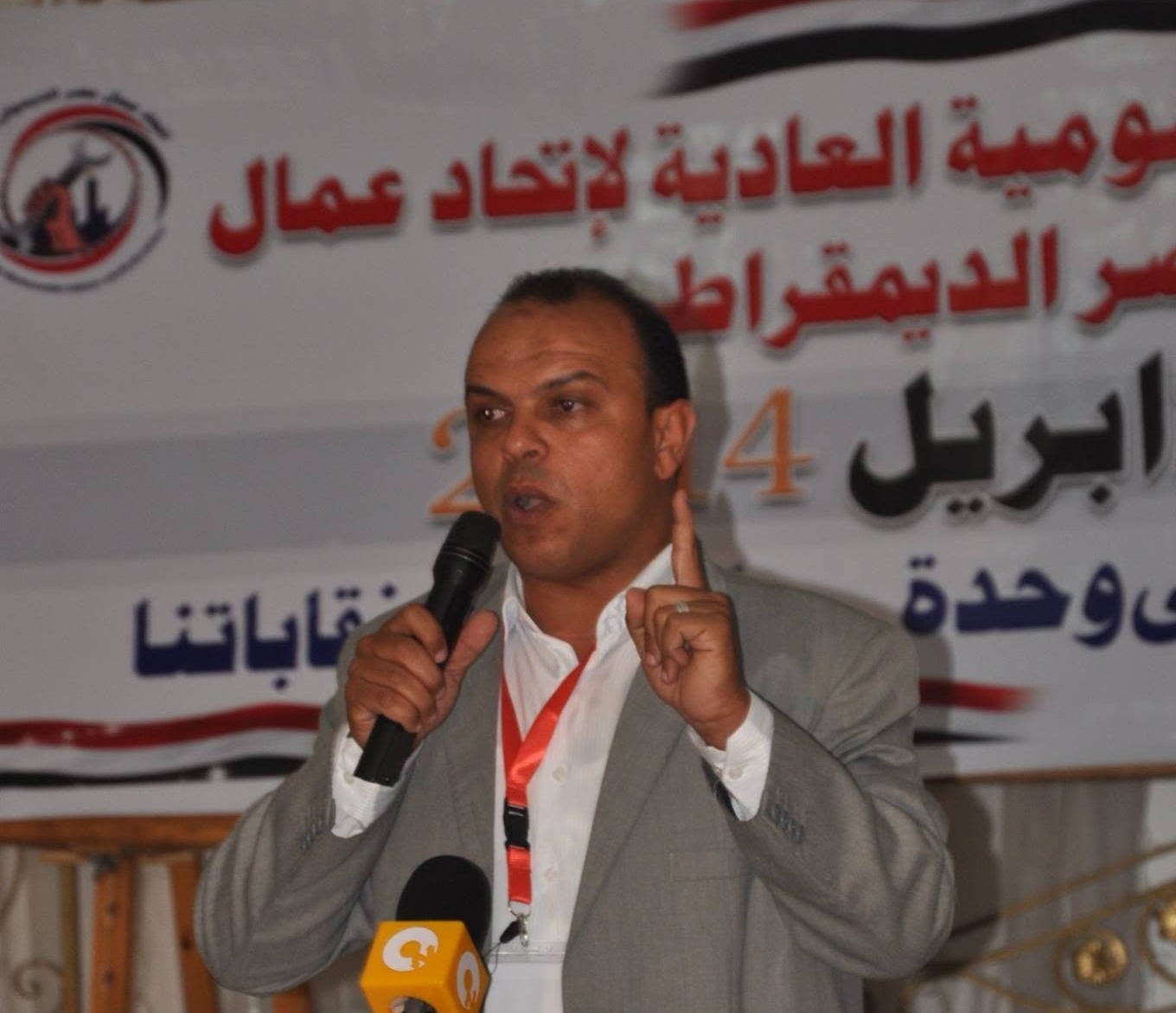
Maarouf was elected founding president of the now-defunct Egyptian Democratic Labor Congress (EDLC) in April 2013, as independent unions expanded after the 2011 uprising. Two months later, an Alexandria court acquitted him and four colleagues of inciting a strike, overturning three-year sentences issued in absentia. Workers had challenged a container berth concession and demanded repairs to company equipment.
Later disputes with the company included five-day wage deductions against him over pay-related Facebook posts in 2017 and December 2023.
His organizing has also challenged the company’s union committee in 2024. Represented by the Egyptian Initiative for Personal Rights (EIPR), Maarouf sought its dissolution over failures to convene annual general assemblies since 2022, which has prevented the general assembly members from scrutinizing accounts, budgets and audit reports. A court rejected his appeal in November 2025, upholding an earlier dismissal.
Lifeguards’ safety depends on cost-cutting
In a new report by Al-Masry Al-Youm’s Reham El-Eraky, lifeguards working on Egypt’s North Coast have described exhausting shifts, inadequate rescue equipment and an employer’s refusal to cover an injury sustained during a rescue. In one of the testimonies, a 22-year-old student working as a lifeguard during the summer said his foot caught in wood while he ran to help someone drowning, and that the company he worked for declined to pay for treatment.
Other workers described conditions that make sustained vigilance harder. Another lifeguard reported 12 continuous hours under direct sunlight without rest, alongside sunburn and inadequate accommodation, while a third said employment lasted only three months annually and called for practical training between seasons. Their accounts connect visitors’ safety to workers’ physical endurance and seasonal insecurity, as employers obtain rescue coverage during the busy months, while workers must find ways to support themselves between precarious contracts.
The complaints concern protections already recognized in the Egyptian Diving and Lifesaving Federation’s safety code, which calls for formal contracts and insurance documentation, and specifies a one-hour break after four continuous work hours, with another lifeguard covering the post.
Separately, the labor law requires employers to provide appropriate occupational protection without charging workers.
Earlier reporting identifies how spending decisions can undermine those protections. In a September 2025 investigation by Salah Laban for Independent Arabia, a rescue company owner acknowledged reducing staffing and employing cheaper students to accommodate low contract prices, while an instructor said trained lifeguards encountered workplaces without suitable equipment and employers assigning them unrelated service duties, shedding a light on the pressure exerted through contracting: operators’ spending limits become contractors’ staffing and wage decisions, with workers expected to deliver rescue services under the resulting conditions.
Workers have also sought a collective means of challenging that arrangement. In another investigation by Youm7’s Ahmed Gamal El-Din earlier this summer, one lifeguard called for a legal body to defend workers facing unclear contracts and disputes over pay and accommodation, as others demanded better wages and an end to cleaning and beach service duties that diverted attention from rescue work. The same report described official instructions against such distractions, which completely disregard the fact that enforcing those protections requires staffing, equipment, and expenditure decisions that workers currently struggle to influence, despite carrying the immediate risks when provision falls short.
Third worker killed at Egyptalum in two months
The Egyptian Commission for Rights and Freedoms (ECRF) called for an urgent, independent investigation into the death of a temporary worker who was pulled into machinery at the state-owned Egypt Aluminium Company (Egyptalum) in Naga Hammadi, on August 4.
Abdel Rahman Omar Gahlan, 30, died after being caught in a conveyor belt while cleaning it, the latest in a string of fatalities at the plant that the ECRF said exposed a “pattern of unsafe, precarious labor conditions.”
The rights group added that the belt lacked basic safety mechanisms, including a safe power cut-off and protection against sudden movement, and that Gahlan suffered severe injuries to his arm and neck that proved fatal.
“A worker who loses his life at a job site is not a number in an accident log, he is a human being who was doing his job in an environment that was supposed to be secured,” the commission stated.
Two other workers reportedly died at the same plant within the past two months alone, according to worker testimonies gathered by the ECRF, one inside the cell-room section and the other from electrocution. The commission said one of those deaths was officially attributed to a “heart attack,” a “falsification with serious legal consequences.”
Reclassifying a workplace fatality as a natural death strips the case of its legal status as a “work injury,” the ECRF said, shielding the company from criminal and civil liability, denying the worker’s family legally mandated compensation, and removing the incident from official statistics.
The case breaches constitutional guarantees under Articles 13, 18, and 59, which require the state to protect workers’ security and health, per the ECRF. It also violates Labor Law No. 14 of 2025, in force since September 2025, which mandates accident prevention across all workplaces regardless of a worker’s contractual chain, “negating any defense based on a worker’s employment through a subcontractor,” as well as Social Insurance and Pensions Law No. 148 of 2019.
The commission argued that “contractual precarity” is the direct root of these deaths rather than an incidental factor. Gahlan and his colleagues worked as temporary labor hired through a contracting company, without a written contract with the actual employer and without insurance coverage. Workers under this system, it said, lose all protections and cannot refuse hazardous tasks for fear of dismissal.
The group also pointed to a recurring practice among contracting firms of avoiding insurance coverage altogether, or resorting to “token and selective” insurance for a small number of workers presented only during inspections.
This arrangement is not at all new for Egyptalum, and the pattern was previously covered by The Cairo Report.
The company stopped directly hiring graduates of its own training institute in 2011, shifting instead to employing them through privately-owned labor-supply intermediaries under agreements the workers themselves are not party to and have never seen.
Workers trained specifically for aluminium production have gone on to spend years inside the plant earning a fraction of the legal minimum wage, without social insurance, health coverage or injury protection.
On February 28, roughly 3,000 “temporary” workers at the plant launched an open-ended strike and sit-in that cut output by an estimated 70 percent, demanding direct employment contracts before any discussion of pay; management’s offer to raise wages was rejected on those grounds.
On the strike’s third day, Central Security Forces (CSF) entered the premises and dispersed the sit-in, and more than 500 workers were later turned away at the gate and told their contracts had ended. It was the company’s third such labor action in under eighteen months.
Wadi al-Qamar residents’ 10-year battle against multinational nears verdict
An Egyptian administrative court has reserved judgment in a decade-long legal battle brought by residents of Alexandria’s Wadi al-Qamar neighborhood against the Alexandria Portland Cement Company (APCC), the majority shares of which are owned by Belgium’s Titan Group, setting a ruling date of December 26 after more than ten years of litigation over the company’s use of coal, the Egyptian Initiative for Personal Rights (EIPR) stated on September 9.
The current case traces back to 2015, when Prime Ministerial Decree No. 964 of 2015 amended the executive regulations of Egypt’s environment law to permit existing industrial facilities to use coal or petroleum coke as a substitute for natural gas, citing “necessity and the public interest.” The amendment effectively legalized coal use at plants like Titan’s while disregarding the serious environmental and health harm to nearby residential communities.
EIPR filed suit on behalf of Wadi al-Qamar residents before the Alexandria Administrative Court, registered as Case No. 8815 of judicial year 70, seeking to halt the company’s use of coal and to annul the specific clause of the cabinet decision that permitted it.
Repeated complications and procedural delays have marked the case. A committee of environmental experts from Alexandria University was formed to assess the company; after it emerged that no environmental experts affiliated with the Ministry of Justice were available, it later came to light that the committee’s chair had previously worked with the defendant company. TITAN separately brought natural gas supply companies into the case as additional parties, further complicating proceedings, according to EIPR.
By 2022, the Alexandria Administrative Court referred the case to the Cairo Administrative Court, where it was re-registered under its current case number, a transfer that produced further delay as the parties continued procedural manoeuvring.
During hearings, the EIPR lawyer representing Wadi al-Qamar residents submitted documentation establishing that the residential community predated the factory’s establishment. She also presented final, binding criminal rulings showing the company had failed to comply with environmental standards; the EIPR said it had secured four compensation rulings against Titan on residents’ behalf in recent years.
Those four compensation rulings have themselves become a drawn-out fight. In one, an appeals court awarded resident Hanaa Abdel-Latif 750,000 Egyptian pounds in November 2023; in another, resident Said Dawiya was awarded 120,000 pounds in January 2024. Titan contested both, filing procedural challenges to halt enforcement, then appeals against those challenges, then further cassation appeals; in Dawiya’s case even reportedly enlisted an acquaintance to file a separate suit seeking to reclaim seized assets, which was rejected in late December 2024. Egypt’s Court of Cassation finally rejected Titan’s appeal in Dawiya’s case on January 1, 2025, making the compensation ruling final, though the company continued to delay payment.
A further ruling, issued in April 2024, ordered Titan to pay one million pounds to resident Hani Abdel Fattah Abu Aqeel and his son over health and environmental damage from the plant’s emissions. That ruling became final roughly a year and a half later, and—after further delay tactics from the company—the EIPR announced the payment was finally collected at the end of December 2025, more than a decade after Wadi al-Qamar residents first turned to the courts.
Separately from the domestic litigation, residents filed a complaint in 2015 with the Compliance Advisor Ombudsman, the independent accountability office of the International Finance Corporation (IFC), a World Bank Group institution that has financed the Titan plant since 2010.
After roughly six years, the investigation concluded that the IFC itself had erred from the outset by failing to properly assess environmental and social impacts given the project’s scale and proximity to housing, and confirmed that dust emissions from the plant exceeded internationally accepted levels by a wide margin, alongside elevated noise and vibration and cracking in nearby homes.
The EIPR has said that without a commitment from the IFC to act on the ombudsman’s findings and compensate those harmed, the standards remain “ink on paper.”
It is worth noting that the factory was established in 1948 and was nationalized in 1961, before ownership passed back to the private sector through privatisation in the 1990s. Successive expansions eventually blocked residents’ view of the sea entirely, but it was the 2002 construction of a fifth production kiln approved under what was meant to be a six-month temporary permit, at the same time as the Titan acquisition of a majority stake, that triggered organized protest, as residents began noticing a rise in illness in the area.
The APCC also cut its workforce from roughly 2,503 employees to just 320, most of whom had been Wadi al-Qamar residents.
A ruling is expected at the December 26 session.
Warraq islanders reorganize against expropriation
Update: A delegation representing Warraq Island residents met with officials overseeing the island’s redevelopment file this month, extracting a series of commitments on compensation and basic services, but residents closed the meeting by warning that no demolition or rezoning should proceed inside their community until their central demand is formally answered, according to a September 12 statement by the “We Are Staying on Warraq Island” movement.
The meeting, convened by a fifteen-member residents’ committee formed at a previous session, took place at the New Warraq City Development Authority on September 10 after being postponed.
At the centre of the meeting was a specific request from residents: that the authority approve planning a designated plot within Warraq Island itself so that new development would allow private homes to be built for residents who wish to remain on the island.
Under the proposal, each homeowner would be compensated with a suitable replacement home and would not be required to vacate their existing house until the new one was completed and they held formal ownership documents for the land beneath it, following models used by Egypt’s New Urban Communities Authority (NUCA), under official contracts and fair construction terms.
Officials responded that the request represented a legitimate right that could form part of the development plan, and said they would forward it to the relevant authorities for study, promising a faster process than in the past, when similar discussions dragged on for a full year.
Officials laid out, in more detail, how compensation would work for two categories of residents.
For those whose homes fall within the demolished zone and who wish to move into apartments being prepared for the initial phase, a first batch of 1,000 units, which the contracted company has committed to complete between September 30 and October 15, compensation would be allocated on a like-for-like basis: apartment for apartment, square meter for square meter.
A resident who owned a building with three apartments would receive three apartments in return; anyone requesting more space than they previously had could obtain it at a price set by compensation committees, while anyone receiving less space than before would be paid the difference at the same rate, reflecting their share in the land, all under official contracts.
Officials were explicit that these replacement apartments would go only to original residents and property owners, not to anyone who built or altered structures on the island after the fact, with compensation for such cases to be handled separately, outside the island.
For residents willing to relocate into the planned new development block rather than rebuild on the island, officials said compensation for the structure itself would follow the rates already set, while the resident would receive a plot of land within the block equal in area to what they gave up, on which a specialized company would provide construction materials at official prices under formal contracts. Under this option, residents would not be required to leave their current homes until the block was fully developed and serviced.
Residents used the meeting to press a set of more immediate, practical grievances, receiving the following commitments from officials:
A hospital, youth centre, post office and other services are currently being planned and will be presented to residents soon, with implementation folded into the urgent phase of the project.
A park and gardens are being planned near the “Tahya Misr” corniche adjoining the island, with officials currently working to identify the most suitable sites.
Street-sweeping carts will be deployed from Saturday, along with a dedicated phone line residents can call to request them.
The authority will contract, through a tendering process, with companies to clear demolition rubble from within the island, with that work due to begin shortly.
A vaccination specialist will soon be made available to serve island residents.
On residents’ request for a dedicated staff member to issue death certificates after hours, officials said death registration is now automated, and that after 6 p.m. no facility across the wider district, not just the island, can issue such certificates except in two other areas; they added that the director of Warraq Island’s hospital had pledged to ease the process for residents, and said the matter would be reviewed further.
Concluding the meeting, residents’ representatives stressed that no measures should be taken inside any residential cluster on the island, including clearing land or determining street layouts, before officials formally respond to their central demand for in-place, land-based compensation.
In a statement following the meeting, the residents’ committee told the community that the outcome now rests with the authority’s follow-through, urging residents to hold their ground on the island, avoid unilateral dealings with the authority outside the committee, and stay coordinated with one another as the process moves forward.
EgyptKE sacks journalists for refusing sub-minimum-wage pay cut
Update: EgyptKE arbitrarily dismissed 11 journalists after they refused management’s attempt to cut their salaries below the legal minimum wage, according to a September 6 statement by the Egyptian Center for Economic and Social Rights (ECESR), which is now legally representing the journalists.
The center said it would pursue the necessary judicial and administrative procedures to protect the journalists’ financial and employment rights against the outlet’s management.
The move follows a meeting between ECESR lawyers and a group of the affected journalists to discuss legal defense options, after the journalists had already filed a collective official complaint with the labor office in Cairo’s Agouza district.
The complaint documented “administrative intransigence, being barred from work, and the arbitrary dismissals and withheld salaries that followed,” in clear violation of the labor law and constitutional guarantees, the rights group emphasized.
The crisis dates back to July 28, when EgyptKE management began arbitrarily dismissing the journalists after they rejected a decision to cut their salaries below the legal minimum wage of 8,000 pounds.
Egyptian appeals court upholds quarter-million-pound payout to fired tobacco worker
An Egyptian labor appeals court has upheld a ruling ordering Elhennawy Tobacco Company to pay more than 270,000 pounds to a worker dismissed after more than three decades of service, in the latest of a string of court victories for employees of the company, the ECESR stated on September 8.
Circuit 9 of the Damanhour Labor Court of Appeal affirmed the earlier ruling from the Damanhour Labor Court ordering the company to pay worker Zeinab S.A. 180,000 pounds in compensation for unfair dismissal, 7,943 pounds for failure to provide statutory notice, and 82,392 pounds for unused leave balance, a total of 270,335 pounds covering more than 33 years of service, plus four percent interest from the date of the ruling until payment, in Case No. 1809 of 2025.
The Damanhour Labor Court had previously ordered compensation of close to one million pounds, plus statutory interest, for five Elhennawy Company workers, including Zeinab, in separate unfair-dismissal suits brought by ECESR lawyer Mohamed Mamdouh El-Damiati. The latest ruling brings the number of judgments issued in favour of Elhennawy Company workers to 17, out of 29 unfair-dismissal cases still before the courts.
The conflict between Elhennawy Company and its female workers stretches back more than 21 years, to 2003, when workers first demanded special allowances and pushed back against extended working hours, workforce reductions, and the denial of child-care leave, per the ECESR.
After workers rejected a collective agreement signed between the union committee and the company that they considered damaging to their rights, management responded with dismissals and transfers to remote locations intended to pressure them into resigning. That pattern has recurred repeatedly over the years, workers say, following each court ruling ordering their reinstatement.
This included a company decision to relocate workers from Damanhour to Borg El Arab. Workers had previously secured a court ruling that the relocation order was unenforceable, but the company subsequently refused to allow the objecting workers back into the workplace, prompting them to file unfair-dismissal suits seeking compensation and their legal entitlements, chief among them, application of the legal minimum wage and special allowances.
During the proceedings, the court referred the cases to a panel of experts in Damanhour to calculate the workers’ entitlements. The company, for its part, relied on minimum-wage exemption requests it had submitted to the Federation of Egyptian Industries (FEI), along with leave records and rulings issued in other cases, in an attempt to reduce its liability.
The workers’ defense argued these documents should not be considered, on the grounds that they did not apply to the dispute or lacked sufficient legal basis, citing Court of Cassation rulings that resorting to litigation interrupts the statute of limitations under Article 383 of the Civil Code.
The rulings form part of a series of successive legal wins secured by the ECESR on behalf of Elhennawy Company’s women workers, which the center says has established the principle that compensation and entitlements in unfair-dismissal cases must be calculated on the basis of the legally mandated minimum wage, the floor of protection guaranteed under labor legislation, rather than the below-minimum wages some companies impose in violation of the law.
Egyptian lawyers challenge remote litigation fees as unconstitutional
A legal team from the Khaled Ali Law Firm, working alongside attorneys Khaled El-Gamal and Hamdy Abu El-Ela, has filed a lawsuit before Egypt’s State Council challenging newly announced fees for remote court appearances, arguing they violate the constitution and encroach on parliament’s exclusive authority over taxation, Ali stated on September 10.
The suit, filed against the Minister of Justice, targets a fee schedule published on a platform the Ministry of Justice created for remote hearings.
Under the new system, lawyers must pay 500 pounds to attend a felony hearing, 300 for a misdemeanor or misdemeanor-appeal hearing, and 100 for a pre-trial detention renewal hearing. It remains unclear whether these fees cover all hearings in a given case or are charged per session, meaning costs could multiply with each additional hearing.
Lawyers are also charged 10 pounds per page for document copies, and the platform requires users to pre-load credit to pay for attendance, renewal requests, or copying services, as well as purchase a messaging package to receive service notifications.
The legal team argues these amount to new, obligatory fees imposed on anyone practicing law through the remote litigation system, which will become mandatory under Egypt’s new Criminal Procedure Code set to take effect on October 1. Crucially, lawyers say, the platform is the only means available to represent clients during remote investigations, detention-renewal hearings, or trials. This effectively forces lawyers to pay government-set fees that were never approved by legislation.
The petition warns that because no law caps or regulates these fees, the authority that imposed them could raise them at any time without limit, with no legal safeguards protecting defendants’ rights or the right to a defense.
The lawsuit rests its constitutional argument on several provisions. Article 97 of the constitution guarantees litigation as a protected right for all citizens and bars any administrative decision from being shielded from judicial review. Article 98 guarantees the right to a defense, personally or through legal representation, and states that the independence of the legal profession is a guarantee of that right.
The petition also cites past rulings from Egypt’s Supreme Constitutional Court holding that the right to litigate presumes accessible access to courts unburdened by financial costs or procedural obstacles, and that the rights to litigation and defense are inseparable; neither has practical value without the other.
On the question of legislative authority, the lawsuit invokes Article 38 of the 2014 amended constitution, which states that public taxes and fees may only be created, amended, or abolished by law, and that no one may be compelled to pay taxes or fees beyond what the law specifies. It also cites Article 96, which enshrines the presumption of innocence and guarantees defendants a fair trial with defense safeguards.
The petition further argues that the Justice Ministry’s decision to set these fees by administrative decree, rather than through legislation, amounts to an overreach into parliament’s exclusive lawmaking authority.
Ahmed Fouad Abu Hanish, Secretary-General of the Helwan Lawyers’ Syndicate, announced the syndicate’s solidarity with Ali and El-Gamal.
“The union stresses that imposing new fees related to exercising the right to defense or initiating litigation procedures must be within the limits of the law, and in a way that does not impose burdens or restrictions that affect the citizen’s right to access justice,” he stated.
ECRF calls for full labor inspection into real estate developer over year-long wage violations
The ECRF has called on Egypt’s Ministry of Labor to conduct a comprehensive inspection of Orientals For Urban Development (OUD), an Egyptian joint-stock company, saying wage violations at the company have hardened into a pattern.
The commission said it has continued to receive complaints and distress calls through its hotline from workers at the company, having already issued two statements in April documenting the firm’s refusal to pay wages at multiple sites and its failure to provide workers with insurance coverage. The ECRF had also previously filed complaint No. 46169 of 2026 with the Public Prosecutor’s Office over an assault and intimidation incident against one employee.
According to the commission, the pattern now repeats roughly every four months: wages stop, workers who object are arbitrarily dismissed or forced to resign, partial payments are then issued alongside pressure on workers to withdraw their complaints from labor offices, and the cycle begins again.
The commission said it recently received a new complaint from the company’s Heliopolis site, which employs around 28 workers, including some who resigned without receiving full dues. This is the same site where 26 workers filed a similar complaint with company management and then a labor office in April, which the ECRF documented at the time—confirming, it said, that the same cycle recurs at the same site through the same mechanism, and that partial payments made in earlier waves never addressed the root crisis.
It added that any waiver signed by a worker under the pressure of withheld wages cannot be considered a free expression of will, and that the persistence of this mechanism reflects an absence of inspection and oversight by the Labor Ministry, as well as a failure to examine complaints submitted through official channels, including the unified government complaints system.
The commission linked the worsening conditions to a change in company leadership following the death of the founder and chairman of Oriental Weavers, the parent company, with management passing to an heir. It noted the company has also faced escalating complaints since 2020 from customers who purchased real estate units, as well as problems affecting workers in its carpet manufacturing division.
Beyond a comprehensive labor inspection of all Al-Sharqiyeen for Urban Development sites, the commission called on the Ministry of Labor and relevant oversight bodies to take several further steps.
It urged that the company be compelled to pay all overdue wages to affected workers immediately and retroactively, and that authorities investigate the pressure placed on workers to withdraw their complaints from labor offices, treating any waiver made under such pressure as void due to economic coercion while ensuring that withdrawn complaints continue to be reviewed.
The commission also called for full payment of dues owed to workers who resigned, including overdue wages, leave compensation, and end-of-service benefits, and said resignation must not be used as a pretext to void rights that had already accrued. It further urged that the company be compelled to immediately settle its outstanding debt to the National Organization for Social Insurance (NOSI) and to retroactively restore workers’ insurance coverage, and called for the investigation into the complaint filed with the Public Prosecutor’s Office over assault and defamation against employees to be expedited, along with the provision of necessary protection for affected workers and their families against pressure to withdraw their claims.
Finally, the commission called for the company to be placed under publicly announced, periodic monitoring by the Ministry of Labor until wage and insurance payments normalize, in order to prevent the cycle from recurring after each crisis.
Prison Watch: Renewals, postponements, and refusing a woman’s right to husband’s sample for ICSI
The Supreme State Security Prosecution renewed the detention of union leader and teacher Mohamed Zahran for 15 days on September 7, pending investigation in case No. 5773 of 2026, according to the Center for Trade Unions and Workers Services (CTUWS).
On the same day, the EIPR called on Public Prosecutor Mohamed Shawqi to use his authority to immediately investigate the fate of Abdallah Ramadan, who remains held without legal basis despite a final judicial decision ordering his release on August 9 in connection with Case No. 12225 of 2024 (Zagazig Misdemeanors).
According to the rights group, Ramadan was held in Port Said for ten days before being transferred to Zagazig Police Station, his local jurisdiction, to process his release, but was then moved to an undisclosed location on August 26.
The following day, the EIPR filed an appeal before the Court of Cassation seeking to halt enforcement of and overturn the ruling that upheld a one-year prison sentence and 200-pound fine against political activist and poet Ahmed Douma, the rights group stated on September 8.
The New Cairo Misdemeanor Appeals Court had upheld the first-instance ruling in July, sentencing Douma to a year in prison with hard labor over allegations that he deliberately broadcast false news domestically and abroad concerning his earlier detention at Badr 1 prison. That case followed his arrest in April, months after he had been released under a presidential pardon that ended a previous decade-long prison term.
On September 9, the EIPR published its monthly capital-punishment tally, which found that Egyptian courts issued death sentences to 39 defendants in 30 cases during the month of August, among them 2 issued final verdicts that could not be appealed.
Meanwhile, the Supreme State Security Prosecution renewed the detention of detainees held in what has become known in the media as the “Shia case,” case No. 5635 of 2026, per the ECRF. The prosecution renewed the detention of 13 defendants in the case, who face charges of joining a terrorist group and financing that group; the prosecution later renewed the detention of another 19 defendants in the case, including al-Dostor journalist Haider Kandil.
Additionally, Egyptian terrorism circuits at the Badr court complex issued a string of postponements.
A Cairo court panel postponed three terrorism cases involving 130 defendants to different sessions to complete trial proceedings, including postponing the trial of 117 defendants in the case known in the media as the “media cell” case to a November 22 session to hear witnesses, the ECRF stated on September 7.
In parallel, Egypt’s Administrative Court has rescheduled a lawsuit filed by the ECESR on behalf of a woman seeking to overturn the Interior Ministry’s refusal to let her obtain samples from her imprisoned husband to undergo ICSI (intracytoplasmic sperm injection) at her own expense. The court’s First Circuit ordered the case returned for pleadings at a session on December 5. The suit names the Interior Minister, the minister’s assistant for human rights affairs, the director of the Minya governorate’s social protection sector, and the Public Prosecutor.
The case follows a landmark and unprecedented report issued by the State Commissioners Authority at the Administrative Court, which recommended in April 2025 that the woman be recognized as entitled to obtain samples from her husband, who is serving a 15-year prison sentence, to complete the procedure at her own expense.
According to the underlying lawsuit, the plaintiff married her husband in 2014. The couple struggled to conceive, and she eventually underwent a successful ICSI procedure that resulted in a triplet pregnancy, but her husband’s arrest in January 2015 and subsequent detention, followed by his 2022 sentencing to 15 years, caused her, under severe psychological strain, to miscarry. The suit states she is now 36, that her health does not permit natural conception, and that she will not be reunited with her husband before his sentence concludes in 2037, making ICSI her only remaining option.
It says she petitioned the Interior Minister and his aides for permission, offering to bear all costs, but received no response, which led her to bring the case through ECESR.
The center stated that Egypt has no explicit legislation permitting conjugal visits for prisoners either, and that a 2017 Al-Azhar fatwa found no religious objection to ICSI procedures.
More land expropriation & more resistance
Residents of Tora El-Balad neighborhood, on the Nile Corniche south of Cairo, staged three days of street protests this month over a newly launched survey of properties and land in the area, which they fear is a precursor to demolitions tied to a broader plan to redevelop the Nile waterfront in Greater Cairo, according to reporting by Saheeh Masr.
Protests over the past three days brought chants of defiance to several of Tora’s main streets, including Ibrahimiya, Makhzan al-Anabib, and Tob al-Faraouny streets, in objection to the start of a property and business survey in the area. The demonstrations followed a negotiating meeting between Cairo Governor Ibrahim Saber and a number of residents’ representatives, attended by MP Wael Saada, who represents the district and belongs to the Nation’s Future party.
The Cairo governorate had formed a committee in August, under Decision No. 16043, to survey the area’s assets and properties. The committee includes district heads and officials alongside representatives from the governorate’s expropriation, informal-settlement development and housing research departments, as well as police officers from the Tora station; its stated task is to catalog properties and land and gather the data needed to calculate compensation if expropriation decisions are later issued.
A resident who attended the meeting with the governor told Saheeh Masr that officials told attendees the survey committee would formally begin work on September 15 and continue for about a month, aiming to identify properties and land that might fall within the scope of works serving “the public interest.”
He said residents asked the governor whether the anticipated demolitions were linked to the Corniche development project, and were given no clear answer. He said officials indicated that compensation values would not be set until the survey was complete and the specific properties, sizes, and locations subject to removal had been determined, with a committee then pricing per-square-meter values.
Residents raised the possibility of alternative housing or compensation reflecting current market prices; apartments in the area currently sell for roughly 3.5 to 4 million pounds, per Saheeh Masr, but officials deferred discussion of that proposal until after the survey concludes.
Residents’ concerns date back to September 2025, when Egypt’s official gazette published a redevelopment plan for the Nile waterfront covering southern Greater Cairo, stretching from the Athar al-Nabi area in Old Cairo through Dar al-Salam and Maadi to Tora, though the published decision did not specify final details of the development’s shape or which areas would be demolished, referring only to plans for tourism and recreational zones, hotel and residential towers, and cultural centers.
Based on satellite mapping, the area where the property survey committees are set to begin work, according to locally circulated boundaries, spans roughly 21 feddans, stretching from just past the Tora bridge to the Shorouk police officers’ club on the Nile, in the direction of Helwan. That area borders the site of the former Tora prison along the Corniche, which also falls within the new waterfront development plan.
A source in the Cairo governorate’s southern district, speaking on condition of anonymity, told Saheeh Masr that the start of the survey does not mean the entire area faces demolition, saying no such decision is currently under discussion since the development plan has not reached its final form at the governorate level, but that authorities are preparing all scenarios by cataloging the number of properties and plots involved.
As for the former Tora prison land along the Corniche, the source confirmed it was vacated more than three years ago and is now held by the NUCA in preparation for new projects, even as the fate of the surrounding properties in Tora El-Balad remains undecided.
Tensions escalated further after residents intervened to stop National Security personnel from arresting a resident who had posted a video online declaring she would not leave her home.
In footage of the incident that circulated on social media, one resident is heard asking whether she would be jailed simply for saying she would not leave, and whether everyone who said the same about their ancestral land would likewise face arrest.
In the footsteps of Warraq islanders, the residents chanted “We will not leave our homes, not even in death”.
Security sector update

The Cairo Report’s latest feature

So, what?!
The question is not simply whether the country’s laws recognize a wage, a pension, a safe workplace, a home, or a defense. It is who can turn those formal rights into something usable before a worker is dismissed, a pensioner falls deeper into poverty, a resident is displaced, or a case is delayed into irrelevance.
Across this week’s dispatch, collective organization is the only force capable of making institutions respond: journalists going to their syndicate, pensioners organizing around a floor, workers acting together over shifts and wages, lawyers challenging new barriers to defense, and residents negotiating through representatives they chose themselves.
But each advance remains provisional when the other side retains control over a workplace, a file, a timetable, and ultimately the terms of implementation.
The New Republic’s promise of development therefore rests not only on low labor costs or private investment, but on a deeper transfer of responsibility—people harmed by public and corporate decisions are expected to organize, litigate, and wait for the protections that should have been guaranteed from the start.