




This issue of The Cairo Report examines how Egypt’s industrial policy continues to subsidize and de-risk private investment while workers carry the costs of low wages, insecure contracts, unsafe workplaces and an eroding pension system. T&C Garments, one of the country’s largest apparel exporters, is lobbying for lower social-insurance contributions and labor costs even as its workforce has repeatedly reported below-minimum pay, retaliation, and dismissals after collective action
We also cover seasonal contracts paying older per-class teachers 40% below the public sector minimum wage, a Labor Ministry inspection regime that grants unsafe workplaces more correction time than penalties, and an ammonia leak that hospitalized 15 women workers, including five children, at an Ismailia export factory.
Elsewhere, a new study shows the minimum pension has fallen to roughly one-quarter of official wage benchmarks, while steel tariffs concentrate production among integrated firms and leave rolling mill workers exposed to stoppages and wage insecurity.
The dispatch also follows Warraq Island residents as they enter talks over a proposed redevelopment scheme, documents the repeated dismissal of a blind Jumia employee amid quota evasion allegations, and records the continuing toll of workplace and commuting deaths.
T&C seeks lower social costs alongside state industrial finance
The chair of one of Egypt’s largest garment exporters, Magdy Tolba, said on August 30 that “wage increases were welcome but must be accompanied by a reassessment of social-insurance contributions, taxes and other labor costs,” particularly for labor-intensive industries.
He argued that many manufacturers “lack sufficient profit margins” to expand, and that the new state-backed industrial investment fund would fail unless the government also reduced production costs and ensured investors a reasonable return.
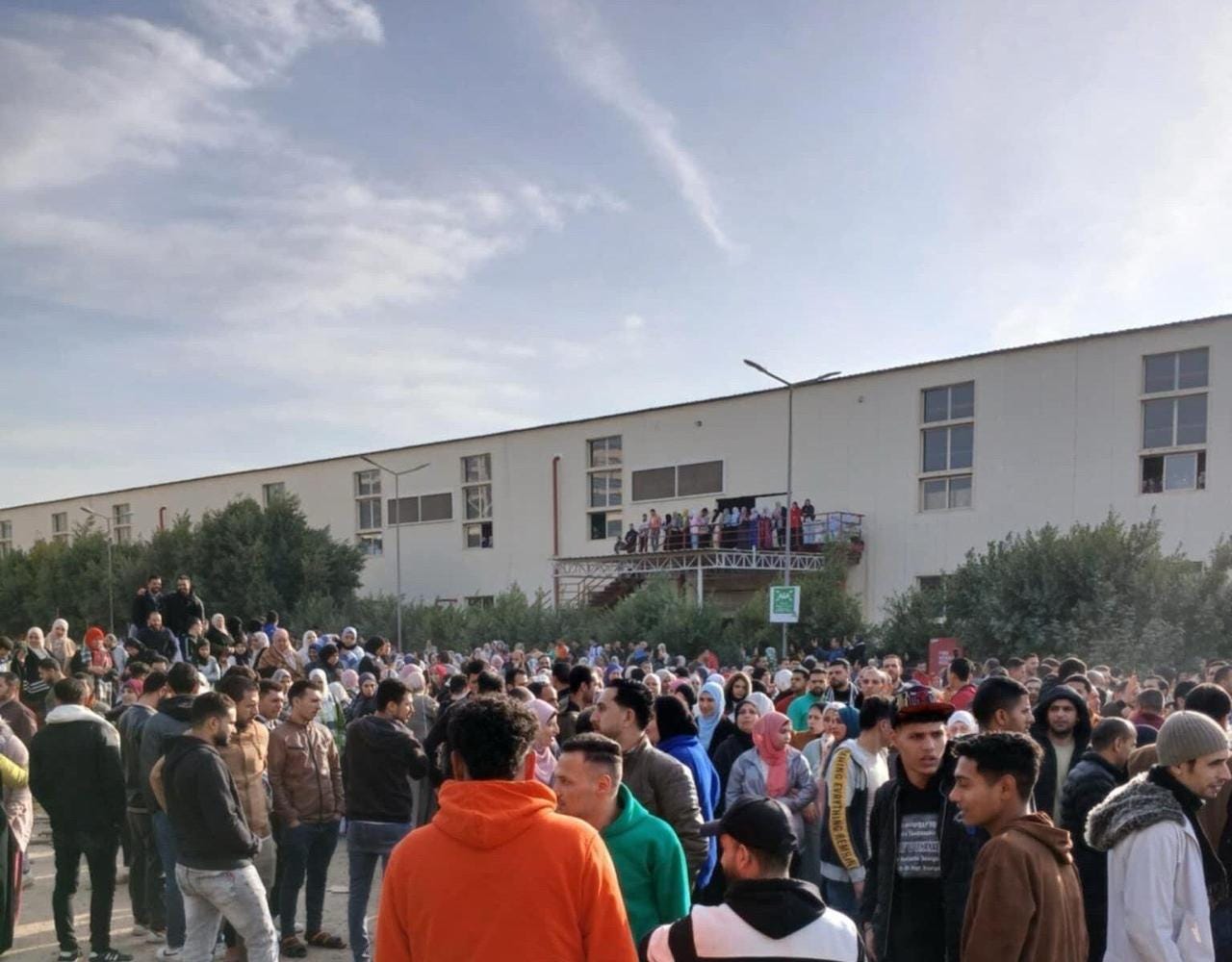
The Sovereign Fund of Egypt-led vehicle is expected to invest directly in industrial companies and support privately managed funds. In his statements, Tolba asked whether it would finance new or existing companies, provide direct funding or acquire equity, and what advantages investors would receive.
These suggestions come from the head of a company whose competitive strategy explicitly rests on low labor costs. On their website, T&C describes Egypt’s population as a source of “productive and inexpensive labor” and identifies duty-free access to the United States and European Union as another advantage. The company was established in 2010 as a joint venture between the Egyptian Tolba Group and Turkey’s Tay Group.
T&C exports all its production, with approximately 70% going to the United States and 30% to Europe. Its Obour facility operates under the Qualified Industrial Zones (QIZ) system, which gives eligible Egyptian goods containing the required Israeli input duty-free access to the US.
The United States government figures say textiles and garments have benefited most from the QIZ arrangement. T&C also received a 20 million US Dollar loan from French public development financier Proparco in 2020 to double production capacity, with the lender projecting that the expansion would create 1,700 jobs and preserve another 4,000.
The company’s expansion has been accompanied by repeated labor conflict. Workers reportedly struck in 2015 over unpaid entitlements and again in 2020 after management proposed dismissing 40% of the workforce during the pandemic, according to Fakar Tany.
A January 2024 stoppage followed worker reports of wages between 2,500 and 4,000 Egyptian pounds, delayed annual increases, extensive deductions, and renewable one-year contracts. Workers sought a 50% increase and later obtained raises of approximately 30–35%.
In January 2025, approximately 6,000–7,000 workers mounted a 12-day strike demanding the legal minimum wage, higher meal and transport allowances, annual increases, profit sharing and changes to the disciplinary system. One worker alleged that T&C included transport in its headline wage and made workers bear the entire social insurance cost.
Security forces arrested workers after the company filed a complaint. Nine were detained for four days on allegations including obstructing production and inciting a strike before a court released them on 2,000 pounds bail. T&C suspended them and then dismissed all nine after they returned to work.
Sameh Tawfik Ali, an organizer whose contract was not renewed after 14 years, still had a dismissal case before the courts in January 2026.
The conflict continued this year when workers staged a five-hour partial stoppage in January after receiving annual increases of 400–700 pounds, saying many still earned less than 7,000 pounds despite more than 15 years of service.
In February and March, workers accused management of forcing resignations and threatening referrals to National Security against workers who attempted to renew collective action. No substantive public company response to those allegations was located.
Tolba’s current demand also continues a policy campaign stretching back at least 13 years. In 2013, he sought installment plans for manufacturers’ social-insurance arrears, removal of insurance-payment requirements from industrial licensing, and lower contribution rates. In 2017, he again called for reductions in insurance and taxes, arguing that high payments encouraged employer evasion. In the same interview, he said that “workers who obstruct production should face criminal accountability” and urged the government to treat investors as partners whose problems should be resolved to increase exports.
In July, Tolba described labor shortages as a greater industrial constraint than interest or exchange rates, arguing that young people preferred informal work such as driving tuk-tuks to supposedly stable factory employment. He said Egypt could multiply exports by raising productivity inside existing factories without major new capital investment.
At T&C, however, workers have repeatedly described annual contracts, below-minimum wages and retaliation for organizing.
The government has already reduced some employer liabilities in last year’s labor law when it replaced the training fund payment of 1% of net profit with a contribution capped at 30 pounds per worker, while last week, the National Organization for Social Insurance (NOSI) lowered the upfront payment required to reschedule employer arrears from 15% to 5%, while the government prepares another vehicle to place investment capital in industry.
Tolba is asking it to go further: support industrial expansion while reducing the share of labor costs paid by employers in an approach that treats wages as acceptable only when capital receives compensation elsewhere.
Older piece-meal teachers given contracts below minimum wage floor
Egypt’s Education Ministry has ordered governorates to place per-class teachers older than 45 on seasonal contracts that impose an eight-hour working day while paying 4,800 pounds monthly, running from September 1 to June 30, 2027, and expiring automatically unless both parties agree to extend them.
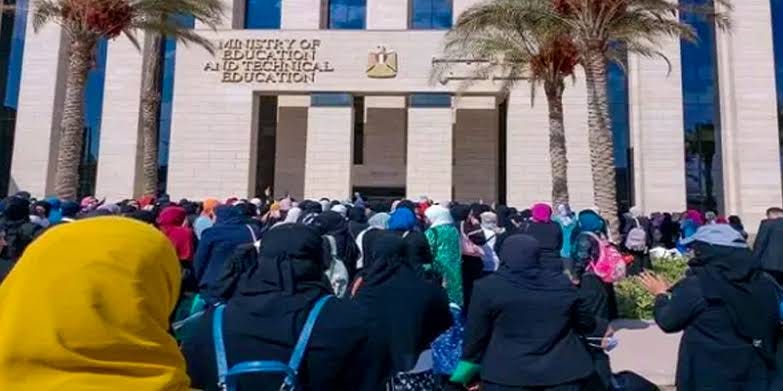
The pay is 3,200 pounds, or 40% below the 8,000 pounds minimum for state workers. Finance Ministry rules extend the minimum wage supplement to Treasury-funded workers contracted for monthly remuneration, while the ministry recently said the minimum covered its different employee categories, and unless the teachers receive the 3,200 pounds difference separately, the contract underpays them in breach of the government’s own wage floor.
The model calculates 4,800 pounds from 24 weekly classes at 50 pounds each, before deductions, but requires full-day attendance and allows deployment after official hours or to other schools. It also bars outside employment. Teachers receive 15 ordinary, 15 sick, and seven casual leave days, but a governorate may terminate the contract without compensation whenever it declares that their services are no longer required.
A “weak performance rating” also ends the contract, while penalties can deduct 10 days’ pay per incident and 30 days overall. Teachers must acknowledge that repeated service creates no claim to appointment, giving the state the control and disciplinary authority of a permanent employer while denying the teacher an equivalent wage, grade or continuity guarantee.
Many affected teachers reached the age ceiling while covering vacancies through successive temporary schemes. Some worked under the 36,000 short-term contracts scheme that ended after just two months in 2019, before returning through per-class work that initially paid 20 pounds.
The ministry later raised the maximum age for appointment to 45 but excluded teachers already above it despite years of school service. This is not, in any sense, a marginal workforce, as in December 2025, the education minister said that the country relied on approximately 160,000 per-class teachers after claiming to have covered its shortage through hourly labor, permanent recruitment, and heavier or reorganized workloads. The new contracts convert that continuing public need into annually revocable individual employment, allowing the government to retain experienced labor while using administrative classifications to avoid the cost and security attached to a regular public position.
250 Matrouh teachers threaten mass resignation over blocked transfers, what's the story?

On August 8, 250 public-school teachers employed by Matrouh’s Education Directorate and currently seconded to their home governorates submitted a letter titled “Collective Resignation” to Education Minister …
Unsafe workplaces given more time than sanctions
The Ministry of Labor granted 897 establishments more time to correct occupational safety deficiencies during 1,414 inspections and reinspections conducted from 23 to 27 August, compared with 296 violation reports, 41 referrals for legal action, and 27 closure recommendations. Inspectors recorded just 183 compliant establishments, making up a mere 12.9% of the total inspected workplaces.

Across all the inspections, allowing time for correction remained the ministry’s dominant response, while referrals and proposed closures covered only a small share of cases requiring intervention.
The campaign comprised 770 initial visits and 644 follow-ups at establishments previously given legal deadlines. Since the ministry reported 897 compliance periods, more than the number of initial inspections, some establishments may have received further time after reinspection, although the statement provided no case-level breakdown.
This was not, by any means, an isolated result. The ministry had reported 1,026 compliance periods against 569 violations and 47 closure recommendations during January, 745 compliance periods against 203 violations and 45 closure recommendations in March, and 1,000 compliance periods against 355 violations and 42 closure recommendations in April.
Granting time to remedy workplace defects is not inherently inconsistent with the labor law. Where inspectors identify an imminent danger, however, the law requires the responsible authority to close the workplace or, at the very least, stop the dangerous equipment until the risk disappears, while preserving workers’ wages. The latest release recorded recommendations rather than completed closures and did not identify the establishments, hazards, deadlines, repeat offenders, or resulting penalties.
The cost of that discretion was explicitly visible during the same month. In August, workplaces produced at least 23 workplace deaths: four in falls from high places, four in excavation or structural collapses, six in sewer chambers or drains, two beneath workplace machinery or vehicles, one drowning at a fish farm, one killed by a rock fall inside Sukari mine, two who died after a chemical tank explosion at a Fayoum salt factory, and three killed by oxygen depletion and hydrogen-sulfide exposure while cleaning a pickle-factory pit, while inspectors continued to give employers more time.
Ammonia leak hospitalizes 15 women workers, five of them children
Speaking of unsafe workplaces, 15 women suffered breathing difficulties after ammonia leaked from the refrigeration system of a vegetable freezing and export factory in Ismailia’s industrial zone on September 2. All were taken to Suez Canal University Hospital, where their conditions were said to be “stable.”
Casualty lists show that one worker was 16 and four were 17, making five of those injured legally children.
Unnamed sources told Veto’s Ayat Sameer that a production line technician forced the workers to continue after the leak was detected and that management did not immediately halt production, increasing the total number of workers exposed to inhaling ammonia, which would directly conflict with the labor law, which allows workers to leave without permission when an imminent danger threatens their health and requires employers to keep them out until the danger is removed.
Ammonia exposure can damage the eyes, throat, and lungs and can be fatal at very high concentrations.
Employing workers aged 16 and 17 is not automatically unlawful, but Egyptian law prohibits assigning anyone under 18 work that endangers their health or safety because of either its nature or the conditions in which it is performed. Ministerial Decision No. 50 of 2026 also limits children to six hours of daily work, and requires employers to register their ages, tasks, medical examinations, and supervisors with the Labor Directorate they report to.
The accident follows another mass gas exposure in the same industrial zone in December 2025, when a chlorine leak at a garment factory injured 18 workers, including workers aged 15 and 17.
Pension floor’s fall to one-quarter of wage benchmarks
Update: A new Egyptian Center for Economic and Social Rights (ECESR) study says the government has allowed the minimum pension to fall to about one-quarter of official wage benchmarks, leaving retired workers to absorb much of the inflation imposed after decades of contributions. The 1,755-pound minimum for a worker retiring in 2026 equals 21.9% of the 8,000-pound statutory minimum wage. ECESR’s longer series shows the pension floor briefly reaching 46% of its selected wage benchmark in 2020 before falling to 21–22% during 2024–26.
The comparison, however, requires two qualifications, as the 1,755 pounds are the minimum for pensions beginning during 2026, not the amount received by every low-income pensioner, while about 11.5 million existing beneficiaries received a separate 15% increase in July, and the report’s finding that 51% received less than 3,000 pounds, 85% less than 5,000 pounds, and 95% less than 7,000 pounds comes from FY2022/23 data covering former government workers and their heirs, rather than all current recipients.
Even so, the statutory 15% ceiling on annual increases prevented pensions from matching price growth when urban inflation reached 38% in September 2023, leaving subsequent increases to operate from an already diminished real income base.
ECESR estimates that the uninsured share of workers rose from 54.8% in 2019 to 60.8% in 2024, reaching 90.5% among private sector workers, which makes the wage–pension divide a product of the labor system before retirement as well as pension policy afterward: informal employment, missing contributions, and understated insured wages suppress workers’ present income and their future entitlements, and while the July increase provided a material benefit, it did not restore the purchasing power already lost.
The government has made repayment manageable for the treasury and delinquent employers while retaining low pension floors and a fixed adjustment ceiling for workers, placing the long-term cost of fiscal management on those with the least remaining power to replace lost income.
Cairo Chamber says billet tariffs have halted some rolling mills
Update: Cairo Chamber president and Ashry Steel chair Ayman El-Ashry said the billet tariffs had affected 22 rolling mills, stopped some from producing, and harmed their workers.
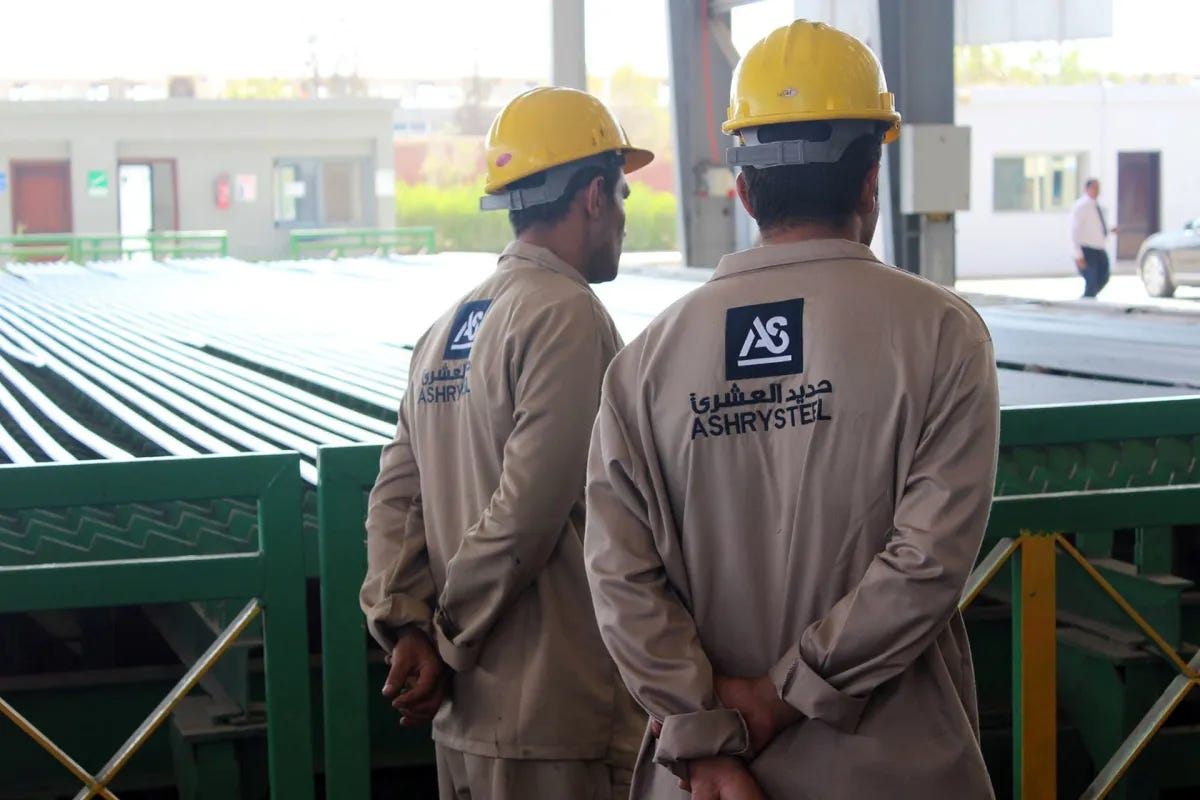
El-Ashry added that the mills had formally asked the Industry Ministry to regulate raw material flows between producers but received no response.
He didn’t, however, provide a factory list, employment figures, or evidence showing whether idle workers retained their wages. His own group’s Estar factory remains the only currently identifiable stoppage, with workers previously found standing idle across three production lines because the plant had no billet to process.
Interestingly enough, the figure of 22 is not a new count of affected factories. Rolling mill owners used the same number in 2019 after Egypt imposed an earlier billet tariff, before claiming in January 2020 that 20 of the 22 had stopped completely.
Nonetheless, Egypt’s total rebar production rose by 13.4% to 4.4 million tonnes during the first half of 2026, which points to an uneven redistribution of production toward integrated companies rather than a collapse across the entire industry.
A government investigation last year documented falling sales and profits among billet producers, yet their employment increased 4% in 2024. Decision 121/2026 requires a quarterly review of the tariff’s effects on related industries, but, so far, no review has been made public.
The state has thus protected one section of industrial capital and offered new licenses to another, while leaving workers’ income and employment contingent on a supply dispute in which they have no representation or enforceable wage guarantee.
Medical school admissions cut amid residency bottleneck
Egypt deliberately reduced public medical school admissions by about 10% while budget constraints delayed the appointment of three consecutive graduate cohorts, according to new reporting by Enterprise, revealing more details about the shift from near-universal public employment toward recruitment limited by government-defined need.
An unnamed government official told the outlet that raising the public university medicine cutoff from 93.12% to 94.06% produced the reduction. The decision followed recommendations from the Medical Syndicate and the committee coordinating health sector faculties, which warned that “universities were accepting more students than hospitals could train.”
Thresholds rose across those fields too: dentistry to 93.28%, physical therapy to 92.34%, and pharmacy to 92.03%.
The syndicate’s position on the underlying rationale is on the record in a September 2 statement responding to Prime Minister Mostafa Madbouly’s directive on medical college teaching hospitals.
It welcomed Madbouly’s move to accelerate teaching-hospital construction at private universities and to act against universities ignoring regulatory standards, framing it as consistent with a position it says it has pressed for years: that a college shouldn’t open or admit students without a functioning teaching hospital, since that’s where students actually learn to examine patients, diagnose disease, and handle emergencies, which are skills, the syndicate argues, no lecture hall can substitute for.
It backed the idea of a temporary fix—letting universities build their own hospitals and train students at Health Ministry facilities under strict protocols—but only as a bridge, not a permanent substitute, and renewed its call to freeze new admissions at any college that hasn’t met the teaching-hospital requirement.
Where the statement gets pointed is in what it says Madbouly’s directive left out: branches of international universities running medical programs in Egypt that admit students with scores as low as 50%. The syndicate wants these branches held to the same bar as Egyptian private and national medical colleges, arguing that the standard for producing a qualified doctor should be identical “in every medical college operating inside Egypt, whatever its affiliation.”
The squeeze isn’t only theoretical for future applicants; it’s already landed on doctors who cleared every hurdle years ago. The syndicate has been in active, repeated negotiations through 2026 over delays and grievances tied to doctors’ mandatory assignment and residency-placement postings, as covered by The Cairo Report, including a third meeting in mid-August between syndicate leadership and representatives of the May 2026 residency cohort specifically to hear grievances after an appeals window opened.
Independent MP Mohamed Abdallah Zein El-Din, Deputy Chair of the House of Representatives’ Suggestions and Complaints Committee, submitted a parliamentary question to the Prime Minister and Minister of Health on August 30 regarding the assignment of graduates to remote areas, urging a reassessment of placement practices for fields like physiotherapy, medicine, and nursing, and called for transparency in allocation criteria, requesting suitable housing and transportation allowances for affected graduates.
The cabinet has yet to respond.
Prison Watch: EIPR warns EU of rights crises, ECRF launches campaign for forcibly disappeared & more renewals
The Supreme State Security Prosecution renewed the detention of filmmaker Omar Salah Marei for another 15 days, marking the ninth such renewal, in connection with State Security Case No. 3383 of 2026, his wife, Nora El-Sayed, stated on August 31.

A day earlier, marking the United Nations (UN) International Day of Victims of Enforced Disappearance, the Egyptian Commission for Rights and Freedoms (ECRF) launched the “Stolen Time” campaign, demanding Egyptian authorities disclose the fate of more than 410 people the commission says remain forcibly disappeared.
The campaign, run under the banner #StopForcedDisappearance, focuses specifically on cases that have lasted longer than six months, up through cases exceeding ten years.
Since it began its work in 2015, the rights group says it has documented 5,150 people subjected to enforced disappearance in Egypt. It has confirmed the reappearance of 4,414 of them, leaving at least 410 whose fate remains unknown.
Of the 403 confirmed ongoing cases lasting more than six months, the campaign’s breakdown shows the scale skewing heavily toward the long term: 4 people disappeared between six months and a year, 4 more between one and two years, 22 between two and five years, 222 between five and ten years, and 151 for more than ten years. By the campaign’s own accounting, roughly 93% of documented ongoing cases have lasted more than five years.
This year’s campaign centers the stories of the long-term disappeared specifically and gives families a platform to share messages to missing relatives. It runs through the end of September, inviting participation through a petition addressed to the Egyptian government, submitted messages and stories, and campaign videos from activists and family members.
Meanwhile, Hossam Bahgat, executive director of the Egyptian Initiative for Personal Rights (EIPR), told the European Parliament’s Subcommittee on Human Rights on September 2 that international economic and financial support for Egypt, along with recent diplomatic initiatives, has not improved the country’s human rights record, but deepened the crisis amid a rise in systematic violations.
Bahgat was speaking at a session convened to present findings from an official European Union (EU) parliamentary delegation’s visit to Egypt in July, led by subcommittee chair Marie-Agnes Strack-Zimmermann’s counterpart, MEP Mounir Satouri.
EIPR’s presentation to the subcommittee outlined seven areas it says show Egypt’s human rights situation worsening over the past year, including political detentions and expanding indefinite pretrial detention continued, with thousands still held and new political arrests made, pretrial detention used as a tool against critical and opposition voices, and not a single presidential pardon issued for political prisoners over the past year.
It also mentioned the persistence of arbitrary measures against human rights defenders, including travel bans and asset freezes, imposed on three EIPR directors for close to six years, terrorism-list designations, and funding restrictions aimed at limiting independent civil society activity.
The rights group added that independent media sites remained blocked, alongside security prosecutions that keep Egypt near the bottom of international press freedom rankings.
Reporters Without Borders ranked Egypt 169th of 180 countries this past year, while the Committee to Protect Journalists has consistently listed Egypt among the world’s six worst jailers of journalists. Egypt ranked 135th of 142 countries on the rule of law index, 130th globally on Transparency International’s corruption index, and among the worst 10 countries on the World Economic Forum’s gender gap index.
Bahgat stated that as economic rights deteriorate, citizens continue to bear a heavy burden from rising inflation and the removal of subsidies on fuel and basic goods, while the state budget prioritizes debt repayment over spending on health, education, and wages. This, he said, has driven escalating labor protests.
Bahgat directly criticized a recent European Commission report which, he said, concluded, despite all of these neutral international indicators, that Egypt had made “tangible and credible steps” on human rights, steps the Commission said satisfied the precondition for releasing a new 1.5 billion euro tranche of a 5 billion euro loan this past July.
“Egypt is on a dangerous path. The systemic closure of legal and peaceful channels for dissent, organizing, expression, or political participation—compounded by acute poverty and stark inequality—is turning the country into a ticking time bomb,” Bahgat said. “This risk is particularly acute given that 60% of Egyptians are under the age of 30. This demographic majority has grown up under a ‘republic of fear,’ where life is defined by a constant struggle for survival and a total lack of future prospects.”
He concluded: “History teaches us that such conditions are the primary recipe for instability.”
Warraq islanders reorganize against expropriation
Update: Warraq Island residents have agreed to enter a new round of talks with Egyptian authorities over the future of their homes on the Nile island, after officials presented a new proposal that could, in principle, allow all residents to remain on the island, the “We Are Staying on Warraq Island” movement stated on September 5, following a meeting the previous day.
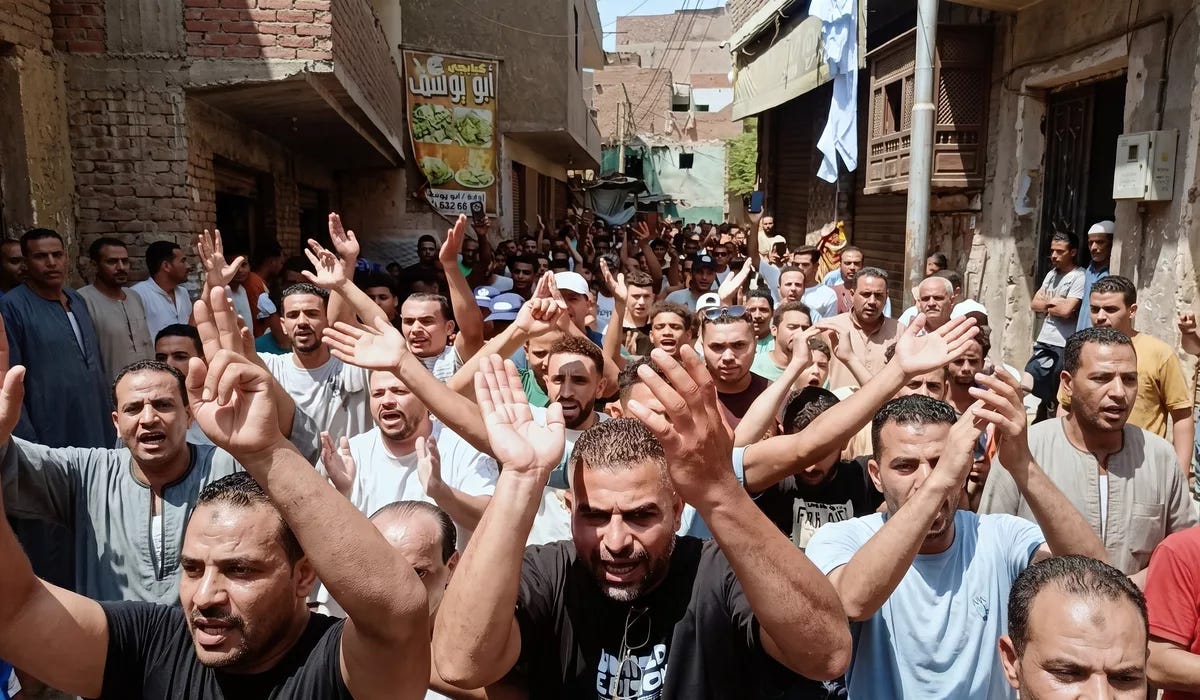
The group said residents voted by a majority of those attending to select representatives to meet officials and discuss the new proposal.
The group reiterated that its primary demand remained “a house for a house,” meaning residents should be able to build replacement homes on the island when their existing houses are removed, rather than being required to relocate to apartments or housing outside the island.
The group’s statement said two residents, Sabry Shoukry Mansour and Ayman Abdel Sattar Rashed, had been tasked with selecting the representatives who would take part in the talks.
It said the meeting with officials should take place on the island and should be limited to those agreed upon by the residents. The group also said its representatives should discuss only issues previously agreed upon by the residents.
The next general meeting was scheduled for Friday, September 11, at 5:30 pm in the island’s coastal area, near al-Fath Mosque, according to the statement.
The decision to negotiate follows contact between Egyptian officials and several islanders, per a group statement on August 31.
The statement said an official responsible for the Warraq Island file had informed some residents that the state was preparing a new proposal concerning the island’s residents and that the proposal would need to be discussed with representatives chosen by the residents themselves.
According to three founding members of the “We Are Staying on Warraq Island” group cited by Al Manassa’s Beesan Kassab, officials from Egypt’s National Security had recently presented a proposal that would theoretically allow all residents of the island to remain there.
Under the proposal, residents of the island’s densely populated “residential block” could remain in their homes, while residents of the more dispersed “scattered” areas would reportedly have three options: alternative housing outside the island, apartments in government-built residential towers, or land on which they could build homes in areas within the residential block that have come under government ownership.
The proposal would is a departure from an earlier plan discussed by former New Warraq City Development Authority head Osama Shawky, Kassab reported. That plan envisaged retaining residents of the residential block on about 300 feddans while offering residents of the scattered areas apartments in government housing projects.
Residents rejected the previous proposal, according to the report.
The newer proposal would potentially allow residents of the scattered areas who want to stay on the island to obtain plots of land for construction within government-controlled areas of the residential block, or either leave the island or move into government-built apartments.
Such an arrangement could, in theory, allow the islanders to remain on their land. But two of the three sources cited by Al Manassa said implementation could face difficulties given the residential block’s limited size relative to the number of residents, particularly if large numbers of people from the scattered areas chose to remain.
Kassab reported that the proposal details were not debated at Friday’s residents’ meeting. Instead, the meeting focused on whether to enter negotiations with the state, with residents ultimately agreeing to talks and to the formation of a negotiating committee.
A date for the committee’s meeting with National Security officials had not been determined, according to Al Manassa, and the residents had not yet reached a final position on the proposal.
At an earlier mass meeting, residents had rejected negotiations with state officials unless the government first accepted their central demand of “a house for a house”, according to Kassab, who added that it also resolved that any negotiations accepted by residents should be conducted with representatives of the presidency, the cabinet, or the National Security. Residents rejected negotiations with the New Warraq City Development Authority.
Jumia turned the disability quota into a revolving door
Egypt’s disability rights law promises that companies of a certain size must keep at least 5% of their workforce disabled, and that workforce must be allowed to stay employed, not just be hired once for the paperwork. What happened to one blind employee at Jumia shows how easily that promise collapses when a company’s only real obligation is to shareholders.
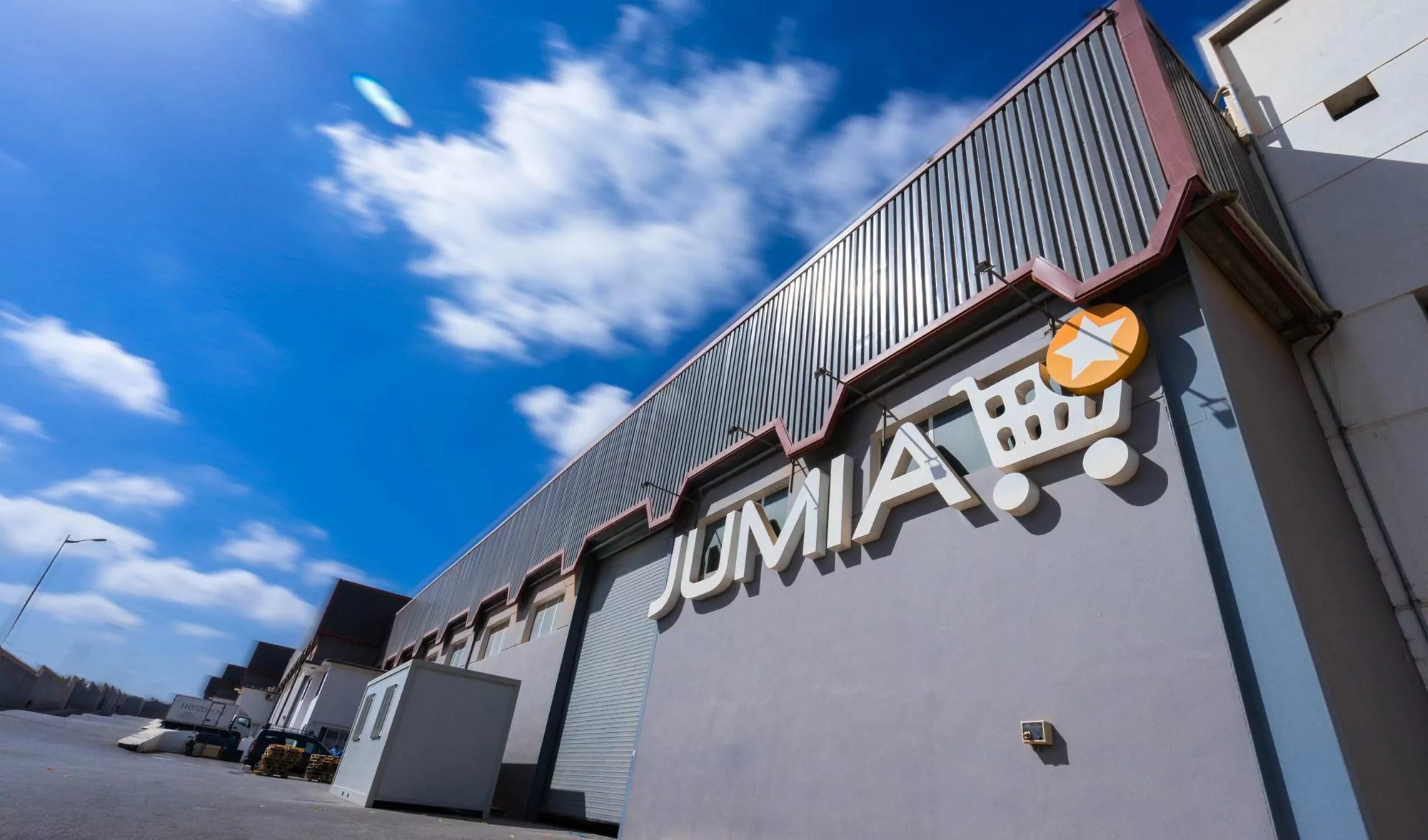
According to a case documented by the ECRF, she was dismissed from Jumia three separate times since 2024, each time without written notice and through the same mechanism: her contract was simply allowed to lapse.
The ECRF says this isn’t an isolated grievance but a tactic it has tracked “in more than one establishment”. The company hires enough disabled workers to satisfy the quota at a single moment, often timed to a government hiring initiative and the good press that comes with it, then quietly lets the contracts run out one by one. Non-renewal requires no justification and no advance notice. The entire burden of proving discrimination, and the entire cost of litigating it, falls on the worker.
Per the law’s diction, a quota met once looks the same on paper as a quota maintained for years, and so only the worker on the other end of the “non-renewal” can tell the difference.
The timing here is not incidental either. Her 2025 dismissal landed the same year Jumia cut roughly 7% of its workforce. Her third dismissal, this year, followed a May 2026 announcement that Jumia would cut an initial 10% of its roughly 2,000-person workforce as it rolled out AI across operations, logistics, finance, and marketing, Asharq Business with Bloomberg reported at the time. CEO Francis Dufay told Bloomberg TV the cuts were mainly “driven by AI,” with automation replacing work that used to require people.
“Artificial intelligence” is fast-becoming the term management reaches for when it wants a headcount reduction to sound like technological inevitability rather than a choice. It is a useful term because it forecloses the question a labor reporter should always ask: cut for whose benefit, and at whose expense?
She joined Jumia in 2019 through a referral from the Nasr City labor office, part of a wave of disability hires the company made following joint events with government agencies, the kind of hiring campaign that generates a press cycle and an image of compliance.
In 2024, she and several disabled colleagues were told, while collecting their pay and with no prior warning, that their contracts had expired and would not be renewed. One colleague, the ECRF states, had a resignation attributed to her that she denies ever submitting. The group was reinstitated following a labor office complaint.
The same thing happened again in 2025, forcing several affected workers to travel to the New Capital just to pursue their complaints.
This year, she was dismissed a third time. She was told by phone that her pay was only a partial installment, then informed shortly after that her contract was over.
When the employee’s family made the case public, Jumia’s first move was not to explain itself but to threaten legal action against the family for what they had posted. Only afterward did the company offer to help her “find work” elsewhere, a move the ECRF says badly misreads the company’s own legal position. Jumia is not a staffing agency, but the employer, bound directly by Article 22 of Law No. 10 of 2018, and the quota is not satisfied by pointing a worker toward the door and another employer beyond it, the ECRF emphasized.
Egypt’s 2018 disability rights law requires employers of 20 or more staff to keep at least 5% of their workforce disabled, with violations fined under Article 54 and personal liability for company leadership under Article 57. The 2025 labor law’s Article 88 converts a repeatedly renewed fixed-term contract into a permanent one, which is directly relevant here, given a relationship stretching back to 2019 and reinstated more than once. Internationally, the International Labor Organization (ILO) Convention 159 (ratified by Egypt in 1988) frames the right at stake as retaining work, not merely obtaining it, and the UN disability rights convention bars discrimination in “continuance of employment” by name.
None of this enforces itself.
The ECRF is demanding that Jumia reinstate the dismissed worker with full back pay, and that the Ministry of Labor inspect the company’s actual disability employment levels and contract records. It is also demanding an investigation into the disputed resignation, protection for the worker and her family against retaliation, and a review by the National Council for Persons with Disabilities of every company that expanded disability hiring after a government campaign to check whether that hiring lasted longer than the photo op.
Even more bread martyrs
Update: A worker was killed and a companion injured in a collision on the international coastal road in Kafr El-Sheikh on September 3, per Masrawy—the latest in a run of workplace and commuting deaths that opened the month exactly as the one before it had closed.
The same day, a woman was killed, and four female farm workers were injured in a tuk-tuk accident in Menoufiya, and four workers were injured when a small truck carrying laborers collided with the sidewalk in Gamasa city, Dakahliya. A day earlier, on September 2, a worker died after falling from scaffolding while on the job, also in Menoufiya, and a separate incident in Ismailia reportedly left a worker dead following an altercation over a transport vehicle, according to Youm7. Three days earlier, on August 29, a 16-year-old student and his father were assaulted at their shared workplace, with the student killed.
Egypt keeps no official monthly count of workers who die at work or while getting to it. The closest thing that exists is civil-society monitoring like the ECRF’s tally, and its August count makes clear the September opening week was a continuation of at least 51 worker deaths across 30 separate documented incidents in a single month. A tally that matches what The Cairo Report has been documenting for the past month.
The workers dying, in August and in the first days of September alike, are overwhelmingly in the informal and semi-formal economy—day laborers, farm hands, sanitation crews, construction workers—where enforcement of transport safety and workplace protection is thinnest. And the vehicles involved are overwhelmingly the same stopgap for the same unsolved problem. Workers ride in agricultural pickups, microbuses, and three-wheelers because no safer, subsidized transport exists to get them to work and back.
Meanwhile, all these workers have is a complaint hotline with the ECRF and a nascent campaign launched by the Center for Trade Unions and Workers Services (CTUWS).
Security Sector update:

So, what?!
The issue remains the absence of consequences strong enough to make employers and state agencies comply before workers lose income, health, housing, or their lives.
Across wages, pensions, safety, and job security, workers are left to enforce rights individually — through complaints, strikes, litigation, or public pressure — while companies and public bodies retain far greater room to delay, evade, or negotiate their obligations.
That imbalance is also the economic policy that keeps The New Republic’s export and investment model competitive by making insecurity cheap and by treating workers’ ability to survive as a cost to be managed rather than a right to be guaranteed.