



This issue of The Cairo Report follows the government’s slashing of corporate social insurance down payments to 5% to preserve factory cash flow, while leaving tens of thousands of pensioners to navigate bureaucratic gridlock for basic subsistence.
We cover the institutional maneuvering behind investors seeking an administrative veto over workers changing jobs, new private sector workplace regulations that preserve management’s unilateral power to write workplace regimes, and a public food holding subsidiary paying workers 41% below the statutory minimum wage.
Meanwhile, Giza’s waste collectors are forced to buy back discarded plastic bottles and aluminum cans from municipal recycling machines to sustain their livelihoods, four teenage and young workers are hospitalized after cooling failures inside an export-oriented packhouse, and the government quietly cuts subsidized fertilizer by another 600,000 tons to safeguard gas-squeezed corporate margins.
We also report on the release of an East Delta unionist after 874 days in pretrial detention, thousands of Warraq islanders defying administrative silence to defend their homes, and another round of arbitrary detentions targeting labor advocates and dissidents.
Investors revive decades-old effort to curb workers’ movement
Egyptian investor associations are preparing proposals for the Ministry of Labor that would restrict workers’ movement between factories, including requiring clearance from a worker’s current employer before another factory can hire them and expanding contractual obligations after going through employer-funded training.
A report by Al Borsa’s Amal Saadawi on August 23 documents a dispute among employers over whether Egypt’s shortage of skilled industrial labor should be addressed by increasing its supply and improving factory jobs, or by limiting workers’ ability to accept better offers.
The restrictive position came most clearly from Magd ElDin Ismail El Manzalawi, who heads the Industry & Scientific Research Committee at the Egyptian Businessmen’s Association and is the chairman of Tiba Manzalawi Group. El Manzalawi called for the Ministry of Labor to establish a system under which a factory would require clearance from the worker’s former employer before hiring them, while also calling for changes to employment contracts to “protect the money factories spend on training.”
Other employer representatives rejected that approach. Alaa El Sakty, deputy head of the Egyptian Federation of Investors Associations and head of its small and medium enterprises (SMEs) investors association, called instead for a national labor database. Mohamed El Morshedy, chair of the Obour Investors Association and owner of El Morshedy Spinning, Weaving, and Textiles, said that “factories should retain workers through fair wages, incentives, and stable conditions.” Egyptian Trade Union Federation (ETUF) head Abdel Moneim el Gamal also rejected restrictions and defended workers’ right to choose jobs offering better pay and greater security.
The employers advocating restrictions describe the problem as “labor poaching,” but their own accounts show workers responding to competition in the free markets they preach.
Abdel Ghany El Abasiry, chair of the May 15 Investors Association, said new factories around Ain Sokhna attract trained workers by offering higher salaries, accommodation and weekly transport. Meanwhile, Mohamed Hanno, an adviser to the chairman of the Alexandria Business Association, raised a different point, saying that “the distance between industrial zones and residential areas consumes a significant share of workers’ incomes” through transport costs.
In other words, workers are using a shortage of industrial skills to improve the price at which they sell their labor, which businessmen are irked by, and are now looking to pressure the government to put into law an employer-issued clearance that would weaken that leverage by allowing the factory offering the inferior package to obstruct a worker’s move to a competitor.
The legal argument for additional protection of training investment should, going by the country’s own laws, be void. Article 95 of the labor law already requires a worker trained at an employer’s expense to remain for the agreed period. A worker leaving earlier can, in some cases, be required to repay the training cost, and the provision sets no statutory floor or ceiling on the agreed period or formula for calculating the cost.
But the same law regulates departure in other ways, as workers on open-ended contracts must normally provide three months’ written notice. Yet Article 175 treats clearance as something the former employer must give a departing worker immediately upon request, alongside returning their documents and issuing an employment certificate. It does not make clearance a form of permission to obtain another job, which the investors are keen to apply.
Making that document a hiring condition would reverse its function because a certificate that the former employer is required to provide is at best an administrative veto over the worker’s next employment, and at worst a tool for employer retaliation.

The present campaign revives an employer demand that dates back at least two decades. During the expansion of garment exports under the Qualified Industrial Zones (QIZ) agreement, which gives Egyptian firms duty-free access to US markets under the condition that their products incorporate a mandatory minimum share of Israeli inputs, manufacturers complained that rising demand had produced a “war” over trained workers. In 2006, the late Nagy Abdelaziz reported for Al Masry Al Youm that labor demand in textiles and garments had increased by 20–25%, while a government-backed program had trained only 1,150 of the 8,600 workers initially sought.
Employers then complained that Labor Law No. 12 of 2003 contained no provision limiting a worker’s movement after training, and the deputy chair of the 10th of Ramadan Investors Association called for a “binding covenant among investors to restrict or restrict movement between factories.” At the time, one garment industry representative accused labor contractors of diverting entire busloads of workers to other plants, including a Turkish factory offering the contractor a higher commission.
Yet the report also stated plainly that workers moved between factories in search of higher wages.
The same structural explanations have also persisted. In 2008, textile industry representatives attributed “labor poaching” to declining wages, limited training and the failure to connect technical education to factory needs, while calling for expanded government-funded training programs. Similar reporting reappeared in 2017; this time, Al-Ahram’s Milad Youssef quoted an investor as saying, “factories poached trained workers from one another by raising salaries.”
At the same time, industrial housing has moved far more slowly. For instance, the 10th of Ramadan Investors Association was tendering infrastructure for a 25-feddan worker-housing project as early as 2010. Fifteen years later, the association said the project was “more than 95% complete” but still faced “disputes over water charges and other services.”
In reality, an “employer clearance” requirement would solve none of the problems these investors are facing. It would instead strip workers of the little leverage over their labor, as workers can presently use competition between factories to obtain higher wages, housing or transport.
Twenty years after investors first sought a voluntary pact against “labor poaching,” some are now asking the Labor Ministry to provide an administrative mechanism. And with the law already allowing employers to recover training costs in some cases, the new demand is less about protecting an otherwise unprotected investment than about whether a worker should need one employer’s cooperation to accept a better offer from another.
Giza’s bottle machines make collectors buy back their livelihood
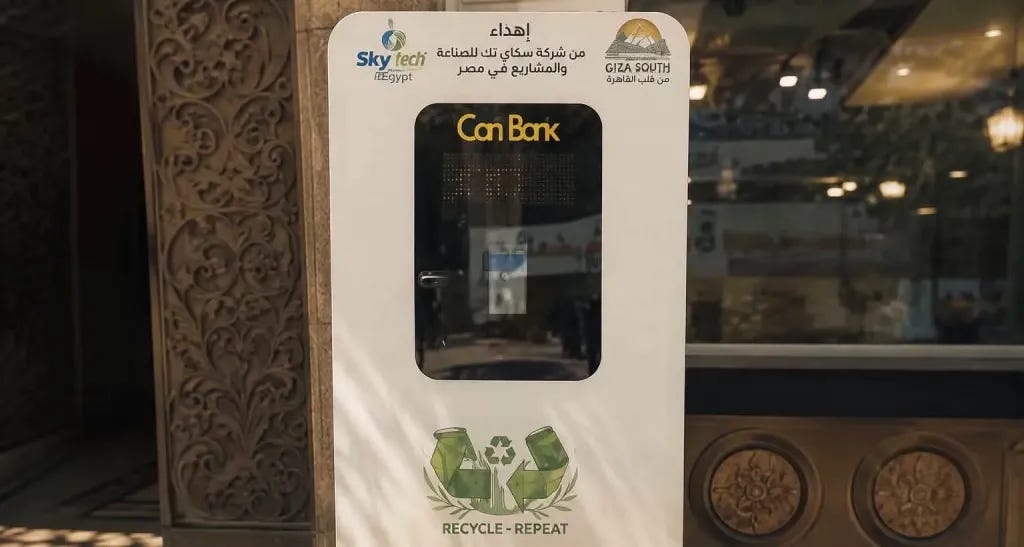
Egypt’s traditional waste collection system rests on an implicit bargain. Collectors remove household waste for little or no public payment and derive most of their income from sorting and selling reusable material. Some households pay small collection fees, while licensed contractors may receive limited contractual payments. But sales of plastic, aluminum, cardboard and other dry waste finance workers, vehicles and fuel.
Giza disrupted that arrangement last week when it installed machines in Dokki that accept plastic bottles and aluminum cans in exchange for money or mobile phone credit. Those are among the most valuable components of household waste, and once residents deliver them separately, collectors still remove food, diapers and contaminated material, but lose part of the income that finances the service.
The Giza governorate agreed on August 25 to give the area’s waste contractor a provisional claim over the machines’ contents, after workers warned that the pilot threatened their livelihoods and threatened to strike in the areas where machines were installed.
Shehata El-Moqaddas, who heads the waste collectors’ union, said the negotiations involved Local Development and Environment Minister Manal Awad, the Waste Management Regulatory Authority and Giza officials. Under the mechanism he described, a district representative will record the machines’ counters each day before the contractor buys the collected material for the amount credited to residents. The district would then issue a receipt, and the contractor would resell the bottles and cans to recycling factories.
Giza confirmed that the contractor would empty the machines and supply their contents to recycling factories, adding that the two Dokki machines are a pilot that “must be evaluated before nationwide expansion.”
The machines award one point for a small bottle and two for a large bottle or can, with every 100 points worth 10 Egyptian pounds ($0.20). Giza said “companies, sponsors and civil society institutions” would finance the rewards rather than the government. By comparison, El-Moqaddas estimated that operating one collection vehicle costs about 1,500 pounds a day.
The compromise may leave contractors a margin between the machine price and the recycling-factory price. It also requires them, according to El-Moqaddas’s account, to buy material they previously received through their collection routes, but there is no basis for concluding that the agreement preserves their previous income.
This is, however, an old conflict in a new machine. Cairo’s 2017 waste-buying kiosks paid residents for dry recyclables while leaving collectors responsible for the remaining waste, and at the time, El-Moqaddas said serving an apartment cost around 50 pounds a month, while collectors received 5–10 pounds and recovered the difference through recyclable sales. Two years later, the kiosk network fell from 26 outlets to 12 amid declining scrap prices and rising district fees.
Even the “Can Bank” machine now used in Dokki was initially presented as compatible with collectors’ work, and its Egyptian developer, ZeroPrime Technologies, was described in a 2019 puff piece as building machines that could produce sorted material for collectors to sell to factories. The government launched three similar machines in the New Capital in June 2026 and described them as a precursor to national expansion.
The settlement protects the licensed area contractor more clearly than the wider workforce. The government says that “the initiative is part of the governorate’s efforts to curb the phenomenon of nabashin,” or scavengers, and the “haphazard sorting of waste by collecting plastic bottles and cans at the source, thereby reducing scavenging and the associated costs of operating the equipment and labor required to remove the resulting waste.”
No strike ultimately took place, and collectors continued working while El-Moqaddas negotiated.
CRS tests the labor law’s dismissal rules
Port Said’s investment free zone is one of Egypt’s principal garment export centers. In 2024, the head of the Port Said Chamber of Commerce said that the zone accounts for 35% of the country’s apparel exports to the United States and the European Union, while the zone authority lists almost 35,000 Egyptian workers. Workplace rules have already become a zone-wide dispute this year after the investors association sought to add a compulsory daily hour to the workday for 500 pounds a month in January, before suspending—but not rescinding—the measure.
Against that background, the Center for Trade Union and Workers Services (CTUWS) said on 24 August that a Turkish company, CRS Denim, had investigated a growing number of workers for comparatively minor lateness and issued “final warnings of dismissal.” According to CTUWS, the notices threaten termination under Articles 156 and 157 of the labor law if the violation recurs.
The Turkish-owned factory is a significant exporter. CRS says its Port Said plant employs 2,200 workers and can produce six million pairs of trousers annually, and in 2023, a company representative told the Egyptian prime minister that it had invested $15 million and employed 1,850 Egyptians.
The legal issue, however, is not simply whether management may issue a “final warning,” as Article 139 recognizes a written warning as a disciplinary penalty, so adding the word “final” does not necessarily create an unlawful sanction. But Article 138 also requires the penalty to be proportionate and tied to the company’s approved disciplinary schedule, while Article 148 reserves disciplinary dismissal for the labor court and does not list routine lateness among its seven forms of serious misconduct.
Separately, Articles 156–157 create a different route. They allow either party to terminate an indefinite contract after three months’ written notice, provided the reason is “legitimate and adequate.” If the employer’s reason is later found unlawful, Article 165 gives the worker compensation of at least two months’ wages for every year of service. The warnings could therefore help management assemble a disciplinary record for ordinary termination without proving serious misconduct in court, leaving workers to challenge the stated justification after losing their jobs.
That route predates the new law, but its wording has widened. Article 110 of the repealed 2003 labor law expressly limited employer-initiated termination to serious misconduct or incompetence established under approved regulations, although the Court of Cassation allowed employers to use that civil termination route instead of seeking disciplinary dismissal, and Article 157 of the new law replaces the express limitation with the broader test of a “legitimate and adequate” reason.
The decisive missing document is therefore CRS’s disciplinary schedule. Article 137 requires any workplace with at least 10 workers to submit its rules to the local labor directorate for review and display them where workers can read them. In its statement, CTUWS asked whether CRS had complied but then assumed it had not. That remains unverified, despite the Port Said Labor Directorate having previously held a workplace seminar at CRS on equal pay, discrimination, and women’s rights.
The company’s wider record outside Egypt is also far from flattering. In 2025, CRS workers in Turkey stopped production over unpaid wages, and more than 900 were subsequently dismissed following a conflict over wages and union representation.
The immediate question is therefore not whether lateness is serious misconduct, because the law says it isn’t. It is whether employers can accumulate minor warnings and convert them into a “legitimate reason” for arbitrary termination.
New workplace rules for the private sector

The Ministry of Labor has introduced binding rules for the internal regulations of every private establishment employing at least 10 workers, adding protections against some common workplace abuses but preserving employers’ authority to write the rules governing their own workforces.
Labor Minister Hassan Raddad publicly launched Ministerial Decision 162/2026 on August 29, presenting it as a means of “protecting workers while preserving investment stability.”
The rules require contracts to be concluded in writing before work begins and prohibit employers from retaining workers’ identity cards or passports. Workplace regulations must address harassment, bullying and violence; prohibit discrimination in recruitment, training, pay and promotion; regulate wages, overtime and leave; and preserve any superior rights established through contracts, collective agreements or workplace custom. These provisions translate several protections already contained in the labor law into requirements that must appear in each establishment’s written internal rules.
The decision also nominally restricts disciplinary power, stating that “employers must notify workers of allegations, conduct a written investigation and allow them to respond before imposing sanctions.” It limits disciplinary deductions and preserves the principle that dismissal as a disciplinary penalty must be ordered by labor courts, and while it is a protection, it should not be confused with a general prohibition on employer-initiated termination: fixed-term contracts may still expire, and employers retain other termination, closure and downsizing routes permitted by the labor law.
The central question is who writes the workplace regime. The employer prepares the regulation and submits it to the relevant Labor Directorate, and officials must send it to the relevant trade union organization, which is state-aligned, within three working days; the union then has 15 working days to “give its opinion,” with silence treated as approval. The directorate reviews the text for legality and ultimately approves it before the employer displays it to workers. Consultation with the workforce is “encouraged whenever possible,” but their consent is not required.

The union role is therefore advisory, not a right of joint authorship or collective bargaining, which is especially important in establishments with between 10 and 49 workers, as they are covered by the new decision but cannot establish an enterprise union committee because Trade Union Law No. 213 of 2017 requires at least 50 workers.
Moreover, union consultation itself isn’t necessarily new. Article 58 of the former Labor Law No. 12 of 2003 already required employers with 10 or more workers to submit workplace regulations for administrative approval after seeking the relevant union’s opinion, and one of Hosni Mubarak’s many cabinets also issued a “model disciplinary regulation” under Ministerial Decision 185/2003. The new decision’s only substantive development is that it replaces reliance on a general model with mandatory parameters around which each employer constructs its own rules.
On the skewed balance of power, Enforcement is weak relative to the power being regulated. Violating the law’s workplace regulation requirement carries a fine of 2,000–10,000 pounds, doubled for a repeat offense but not multiplied by the number of affected workers. The same range can therefore apply to a small workplace and a major corporation. Raddad also announced a digital “tablet-based inspections” intended to centralize establishment and violation records.
The decision nevertheless creates useful procedural rights, as written contracts, documented investigations, and judicial control over disciplinary dismissal can make arbitrary management action harder. But their practical value depends on inspection, collective capacity, protection against retaliation, and timely access to the 38 specialized labor courts established in 2025.
The balance might be nominally regulated, but it remains decisively uneven.
Beheira Rice Mills faces complaint over pay
A company embedded in Egypt’s public food-supply system through the Holding Company for Food Industries (HCFI) is accused of paying workers with up to 17 years of service substantially less than the statutory minimum wage. On August 25, the CTUS said it had received repeated complaints from Beheira Rice Mills workers and reviewed salary statements, including one showing gross monthly pay of 4,690.94 pounds and take-home pay of 4,227.32 pounds.
The disclosed gross salary is 3,309.06 pounds, or 41.4%, below the 8,000 pounds floor that took effect on July 1. Article 5 of Law 75/2026 requires public sector and public business sector companies to make up the difference when fixed and semi-fixed monthly compensation falls below 8,000 pounds, so even if Beheira Rice Mills were classified as private, the 7,000 pounds private sector minimum would leave workers 2,309.06 pounds short.
The company’s contested ownership does not remove the apparent violation, but it helps explain how responsibility has been evaded. Beheira Rice Mills was privatized through an employee-shareholder arrangement in 1998.
At a 2021 parliamentary hearing, its chair said the purchasers never paid the sale price, leaving the shares pledged to the state-owned HCFI and the company operating under the Public Business Sector Law, but the National Organization for Social Insurance (NOSI) nevertheless classified it as private when disputing retirees’ entitlement to pension allowances, and parliament postponed the matter because the institutions “could not agree on the company’s status.”
All talk of whether it’s privately owned or publicly owned, operationally, the government treats Beheira Rice Mills as one of its companies, as it still falls under the HCFI, while company officials in 2023 have described seven mills capable of processing 20,000 tons monthly for the state food distribution system, and Supply Minister Sherif Farouk met its chair in August 2025 to “discuss modernization, operating efficiency, and financial support.”
Workers have challenged this division between public control and private liability before. In 2012, an open-ended strike stopped production at five company mills. Workers demanded higher bonuses, management’s removal, dissolution of the employee-shareholder association and the company’s return to the public sector.
The ownership arrangement has therefore separated control over production from accountability for workers’ income, as the Ministry of Supply and HCFI coordinate output, investment, and management. Yet wage and pension claims have repeatedly become disputes over whether the company is public or private. That distinction may determine which institution must pay, but it cannot make 4,690.94 pounds compliant with either wage floor.
NOSI cuts corporate arrears down payment to 5%
Update: Egypt’s National Organization for Social Insurance (NOSI) has cut the minimum down payment required to reschedule company and factory arrears from 15% to 5%, reducing the immediate cash burden on employers by two-thirds, and allowing employers whose earlier installment plans were canceled to seek another rescheduling.
The government’s social insurance organization announced the 5% threshold after an August 25 meeting with the 10th of Ramadan Investors Association, where representatives of more than 100 member factories attended. NOSI chair Major General Gamal Awad said the measure would help companies settle their obligations while maintaining production.
For every 1 million pounds owed, the required initial payment falls from 150,000 pounds to 50,000 pounds, leaving the employer with 100,000 pounds more in immediate liquidity. No reduction of the principal was announced.
The implementation record is less clear than the headline because NOSI’s statement presents the lower threshold as approved, while the investors association described it as a proposal for a new system. However, the underlying decision requires at least 5% immediately after an installment request is approved and amends the authority’s 2023 rules.
That decision goes beyond lowering the deposit. Employers whose previous plans were canceled may apply again if they pay the missed installments and the current monthly contributions covering the same period. NOSI may pursue the bank guarantee or other collection measures if the employer defaults again, while the authority chair “may reconsider individual cases according to their circumstances and payment record.”
The new measure extends a concession introduced in 2021, when Major General Gamal Awad allowed debts above 1 million pounds to be paid over as many as seven years and smaller debts over five years, subject to the former 15% down payment. It also allowed a compliant debtor to receive a temporary six-month insurance certificate, enabling the company to continue transactions that require proof of insurance compliance.
Ostensibly, Article 121 of Social Insurance and Pensions Law No. 148 of 2019 imposes an additional monthly amount on late contributions, calculated by reference to average Treasury bill and bond yields in the preceding month plus 2%, while Article 79 of the law’s executive regulations says approval of an installment plan does not remove NOSI’s right to collect those additional amounts until payment.
The investors association nevertheless said that the additional sums would be paid in installments “without interest.”
The debts are not solely an employer-side accounting matter. Article 115 makes an employer responsible for remitting both its own contribution and the portion deducted from workers’ wages. Arrears can consequently include money already withheld from workers, although NOSI did not disclose how much of the affected debt represents worker deductions, employer contributions or statutory additional amounts.
The law formally protects workers from an employer’s failure to register or pay, as Article 141 requires NOSI to provide the full statutory benefits even when the employer did not enroll the worker, and then recover the resulting capitalized liability from the employer. But where NOSI cannot verify the contribution period or insured wage, the same article permits an initial pension or compensation calculation based on the undisputed record—or the legal minimum where the wage cannot be established. Article 127 also makes the worker’s insurance file the basis for assessing benefits.
Employer default therefore does not automatically cancel a worker’s legal entitlement. It can still leave the worker proving service dates and wages, receiving a lower provisional amount, or waiting while the record is corrected. The four-week deadline that Article 130 sets for settling benefits begins only after the claimant supplies the required documents.
Less than three weeks earlier, The Cairo Report documented the unraveling pension-processing crisis, which continued beyond the government’s self-imposed August deadline.
At the time, Major General Gamal Awad said the authority had cleared 42,054 of 45,987 accumulated files, but only 17% of 167,500 new applications submitted after the digital system’s launch had met the promised 72-hour turnaround. NOSI attributed many unresolved cases to “missing documents and fragmented employment records,” effectively requiring individual pensioners to repair gaps in records that the social insurance system had failed to preserve or integrate.
On August 28, three days after NOSI announced it was making concessions to capital and reducing upfront payment on employer debts, MP Ehab Mansour, deputy chair of parliament’s Manpower Committee, described the pension system crisis as a “catastrophe”, saying some pensioners “cannot afford food” or had “stopped buying medicine,” while others borrowed to cover daily expenses.
Mansour said officials had told Parliament in June that 76,000 people were affected and promised 10,000 pound payments to 41,000 of them before Eid, yet NOSI has not reconciled that total with Major General Awad’s 45,987 accumulated files.
Mansour said NOSI’s August press conference, in which Major General Gamal Awad lashed out against critics, had provided no clear figure for how many pensioners remained unpaid or which categories were affected, adding that he had “submitted about 1,000 requests to the government, mostly involving retirement, survivors’ and disability pensions, delayed funeral grants and other insurance problems.”
When pensioners faced delayed income, unusable records and missed deadlines, the response was an accountability dispute: NOSI defended its figures, critics accused it of manipulating them, and lawmakers sought a fact-finding committee that has yet to produce a tangible result.
On the other side of the skewed power balance, when more than 100 factories presented an employer liquidity problem, NOSI immediately produced a concrete repayment concession, reopened canceled plans, and publicized the decision.
The authority offered organized employers a general remedy for money they owed, while pensioners remained dependent on individual petitions for income already owed to them.
Four Agro Green workers hospitalized due to working in extreme heat
Four workers aged 16, 19, 21, and 22 were hospitalized on August 25 after an air conditioning failure inside Agro Green’s sweet potato factory in Gamasa’s Fourth Industrial Zone, Northern Egypt. Emergency responders recorded general weakness and exhaustion, and transferred the workers to Gamasa Central Hospital.
The incident occurred inside a capital-intensive export operation whose commercial model depends on temperature control. Agro Green says it was established in 2018 with 10 million pounds in paid-up capital, cultivates approximately 5,000 acres, and exports sweet potatoes, onions, and green beans.
Notably, the company adds that its produce is maintained at or below 14 degrees Celsius throughout the supply chain using refrigerated transport, temperature-controlled ports, packing centers, and insulated packaging.
While that claim concerns the crop rather than working conditions, it nevertheless establishes that cooling, monitoring, and temperature management are central operating systems, not optional amenities, inside the company’s export chain.
In 2023, the head of the Gamasa industrial zone visited the company and promoted the facility’s technology and export standards, and the government formally inaugurated its expanded factory in October 2025, only 10 months before the hospitalizations.
The 300 million pound plant occupies 11,000 square meters and has a reported annual capacity of 30,000 tons of prepared, refrigerated, and packaged vegetables. The government said its entire output was destined for Britain, the Netherlands, and France and credited it with “3,000 direct and indirect job opportunities.”
Transport and Industry Minister Lieutenant General Kamel El-Wazir inaugurated the plant alongside Agriculture Minister Alaa Farouk and the Industrial Development Authority chair. El-Wazir presented it as a model of the government’s industrial and export strategy, while the state-backed Ebdaa’ initiative said Agro Green had received support under its industrial projects program.

The company’s commercial position has continued to strengthen as working conditions deterioate.
Last month, Adel Ellithy, managing partner at Agro Green, said Egypt’s proximity to Europe and a 20%–30% price advantage had driven the growth of its sweet potato exports. He described the Gamasa packhouse as “state of the art” and emphasized “certifications, traceability and compliance with increasingly strict European-buyer requirements.”
A previous corrective action auditing report for the Agro Green packhouse in Gamasa adds another layer.
The audit, conducted on December 17 2025, recorded seven health and safety findings: first aid boxes without lists of trained first aiders, a blocked fire assembly point, a blocked extinguisher, unmarked emergency exit aisles, inaccurate evacuation maps, an unguarded washing machine belt, and four electrical panels without hazard signs.
The audit recorded no heat or ventilation violations, but it does show that a company facility entered its first year after inauguration with unresolved safety corrections.
As The Cairo Report covered in last week’s dispatch, Egypt’s heat protections leave workers choosing between physical danger and possible income loss. Agro Green demonstrates how the same problem operates indoors.
East Delta unionist released after 874 days without trial
A union official at the state-owned East Delta Transport and Tourism Company was released on August 26 after spending 874 days in custody over notarized authorizations connected to opposition politician and former presidential candidate Ahmed Tantawy.
The authorities accused Ahmed Abdel Fattah of “joining a terrorist organization, spreading false news and misusing social media,” which are ready-made charges that the regime uses for almost all political prisoners.
The CTUWS stated that a court ordered Abdel Fattah’s release on August 21, five days before the order was finally implemented. He had remained in Badr 1 Prison, with his last detention renewal issued on July 19.
Security forces arrested Abdel Fattah at his home on April 4, 2024, before taking him to a National Security office. At the time, officers questioned him about authorizations he had signed for Tantawy’s presidential candidacy and the proposed Hope Current Party. He appeared before the Supreme State Security Prosecution two days later and entered pretrial detention.
During one of his hearings, Abdel Fattah told prosecutors: “I do not know why I was arrested. All I did was sign an authorization at a mobile notary office,” according to Al Manassa’s Ahmed Khalifa. His lawyer later said the case contained no seized material or other evidence supporting the accusations, while detention renewal sessions were conducted virtually from his place of imprisonment.
The authorizations were part of the legally prescribed process for establishing a political party in which the Hope Current Party needed 5,000 notarized founder authorizations from at least 10 governorates, but had obtained only about 1,000 by April 2024 amid arrests and obstruction at notary offices.
The same case had already been used against lawyers associated with Tantawy’s presidential campaign by September 2023, months before Abdel Fattah’s arrest, and his detention formed part of that political campaign.
Abdel Fattah was assistant secretary general of East Delta’s workplace union committee and a member of CTUWS’s committee defending union freedoms. During detention, the company withheld half his pay and left his family with no more than 2,000 pounds a month.
East Delta was established in 1961 and is a subsidiary of the state-owned Holding Company for Maritime and Land Transport and operates under Public Business Sector Law No. 203 of 1991. Presidential Decree 343/2022 placed the holding company and its subsidiaries under the transport minister’s authority.
The company also has a history of worker mistreatment, conflict over pay, and worker protests. In 2016, for example, 17 drivers staged an after-hours sit-in over arrears, and seven of them said that management responded by selecting them for dismissal, prompting a hunger strike.
But the most direct precedent came in 2020, when East Delta workers in Mansoura stopped routes over unpaid wages and incentives, 10 months of driver arrears, no medical care, and failure to implement the minimum wage. The holding company instructed East Delta to file police “proof-of-condition” reports against workers participating in the stoppage.
Abdel Fattah was still imprisoned when the transport minister, Lieutenant General Kamel El-Wazir, announced on August 17 that East Delta had moved from a 50 million pounds loss in 2021/22 to a 35 million pound profit in 2025/26, presenting the result as evidence of “successful restructuring and public investment,” according to the holding company’s general assembly.
Yet Abdel Fattah’s family had spent more than two years absorbing the financial consequences of an untried politically motivated state accusation.
Government slashes fertilizer subsidy, again
The government has cut the share of domestic fertilizer production reserved for subsidized distribution from 37% to approximately 30%, reducing the Agriculture Ministry’s annual allocation by 600,000 tons, or 25%, from 2.4 million to 1.8 million tons.
The reduction took effect in August and was intended to offset higher natural gas costs for fertilizer manufacturers.
The change would remove the equivalent of 12 million 50-kilogram bags from subsidized distribution each year, marking the latest stage in a sustained contraction of the system. In 2021, the government required producers to deliver 55% of their output through Agriculture Ministry channels, but the share had fallen to 37% by September 2025, while the export allocation rose to 53% and another 10% was reserved for the domestic free market. Based on the newest figures, the subsidized share has fallen from 55% to 30% in less than five years, a relative reduction of more than 45%.
The government, however, has not abolished fertilizer support in a single decision. It is dismantling it through quantity and eligibility while preserving a controlled price for the fertilizer that remains.
While Asharq Bloomberg has described 4,500 pounds per ton as the continuing subsidized farmer price, official cooperative prices published in July were 290 pounds for a 50-kilogram bag of urea and 285 pounds for nitrate, equivalent to 5,800 pounds and 5,700 pounds per ton. Therefore, 4,500 pounds appears to be a base or factory transfer price rather than the amount currently paid.
Higher gas costs also create a genuine pressure on production. The price supplied to fertilizer plants rose to $8.50 per million British thermal units in April, while gas represents about 60% of nitrogen-fertilizer production costs. Still, transferring that cost to agriculture is a distributional choice, as manufacturers receive more output to sell commercially or export, while farmers receive less fertilizer at the controlled price.
That transfer became more pronounced this month when the government abolished the 10% duty on nitrogen fertilizer exports, removing a charge that had itself replaced a fixed $90 per ton levy after fertilizer exports had already risen 10% to approximately $1.71 billion during the first half of 2026. The state has therefore simultaneously made exports cheaper and released another 600,000 tons from domestic subsidized delivery.
Egypt’s fertilizer industry combines public ownership, listed capital and Gulf sovereign investment. The state remains a major shareholder in companies including Abu Qir and MOPCO, while Saudi and Emirati state funds hold substantial stakes. The government is consequently acting at once as gas supplier, regulator, shareholder, and export gatekeeper, protecting the commercial position of enterprises in which the state and Gulf capital share an interest, while reducing the quantity reserved for small producers.
Corruption is the name of the game in the Delta

On Monday, 30 March, the shareholders of Delta for Fertilizers & Chemical Industries gathered for their ordinary general assembly. On the agenda were discussions of preliminary expenditure estimates to get the factory back on its feet. Delta has now held the same meeting for six consecutive years while the factory gates stayed shut, without distributabl…
Officials have argued that subsidized demand is only 2.1 million tons annually and that the previous 2.4 million-ton allocation created a 300,000-ton reserve, but the 1.8 million-ton allocation would nevertheless fall 300,000 tons below even that administratively defined requirement.
On the labor side of this, agriculture and fishing employed nearly 6 million people in the first quarter of 2026, and when fertilizer becomes less accessible, farmers can buy it at the higher market price, apply less, change crops, or reduce other costs. Hired and seasonal labor is among the costs they can adjust, making lower employment, shorter working periods, or pressure on wages plausible consequences. Higher cultivation costs can also move through food prices and reduce the real wages of workers far beyond agriculture.
This is the material meaning of the subsidy’s continued dismantling. The state is maintaining its name and nominal price while reducing the volume, narrowing access, and freeing a larger share of production for commercial sale and export, while manufacturers gain room to recover higher gas costs and earn foreign currency; small farmers, agricultural laborers, and food consumers absorb more of the adjustment.
Warraq islanders reorganize against expropriation
Update: On Tuesday morning, August 25, thousands of Warraq Island residents went to the headquarters of the New Warraq City Development Authority to receive an official written response to their demands, which they had submitted the previous week.
Their primary demand was the allocation of a plot of land within the island to build fully serviced alternative housing for its residents.
However, officials refused to meet with them or respond to their demands for the second time in a row, amidst growing anger that prompted the residents to announce a large meeting on Friday evening, August 28, to determine new “legal and peaceful” steps to take.
Per the residents’ statement, security forces stationed at the Authority’s headquarters asked those present to select a limited number of representatives to enter and meet with an official. However, the residents categorically rejected this offer, insisting that their demands be met in writing, as they had explicitly stipulated when they submitted them the previous week.
Faced with the crowd’s persistence, the security forces insisted they lacked the authority to make a decision on the matter and asked the residents to wait until an official came down to speak with them. However, the wait dragged on without anyone coming down or any official response being received, in a “deliberate act of ignoring the residents”.
After hours of waiting, the demonstrators returned via the main railway line on the island, heading towards the Grand Mosque, where they offered prayers and chanted slogans, including “We won’t leave our homes, even if it means our death,” expressing their determination to remain on the island.
Following the incident, calls by the “We Are Staying in Warraq Island” movement circulated for a large meeting of the residents on Friday evening at 5:30 p.m. at the end of the main railway line, near the home and shop of Haj Ali Yahya.
The appeal, addressed to all residents, emphasized the importance of unity and peaceful, organized participation to express their “inherent right” to remain on the island.
The meeting was held with hundreds of Warraq islanders present; however, its outcomes have not been announced.

Prison Watch: More renewals
State Security Prosecution renewed the detention of teacher and union leader Mohamed Zahran and activist Nael Hassan for another 15 days, as the Criminal Court also renewed the detention of lawyer Essam Refaat, activist Mostafa Ahmed, and Mohamed Allam, known as Rivaldo, for another 45 days, rights lawyer Nabeh El-Genadi stated on Facebook.
On August 27, the Egyptian Initiative for Personal Rights (EIPR) called on Attorney General Mohamed Shawky to launch an immediate investigation into the fate of Abdullah Ramadan, who is being detained without legal justification, despite a final court order for his release issued on Sunday, August 9.
Ramadan was detained for ten days in Port Said before being transferred to the Zagazig police station, his place of residence, in preparation for implementing the release order. He remained in detention there until EIPR lawyers learned on August 26 that Ramadan had been taken to an unknown location, the rights group stated.
In tandem, filmmaker Omar Salah Marei has now been detained for over 100 days, which prompted the release of a joint statement from local, regional, and international human rights organizations demanding his release.
The Egyptian Commission for Rights and Freedoms (ECRF) stated on August 24 that the Second Circuit of the Criminal Court renewed the detention of union leader Shadi Mohamed and five others in case No. 1644 of 2024, State Security Investigations, known as the “Palestine Solidarity Banner,” for another 45 days.
The six detainees in this case have exceeded the maximum threshold for pretrial detention last May.
Two days later, the ECRF stated that the Second Terrorism Circuit Court in Badr reviewed eight different cases, deciding to postpone them to specific dates and times, the most prominent of which is another “Palestine Solidarity” case in Alexandria, No. 2469 of 2023, State Security, involving 14 defendants.
The court decided to postpone the aforementioned case to a session on November 8th. The postponement was granted to hear the testimony of the first prosecution witness, as well as to take the necessary medical measures regarding defendants 11 and 14 named in the referral order and to prepare medical reports on their condition.
State Security also renewed the detention of 32 individuals in State Security Case No. 5635 of 2026, known as the “Shia Case” for another 45 days.
Detained rights lawyer Mohamed Abou El-Diyar’s wife, Wafaa Gaber, published an appeal on Facebook to President Abdel-Fattah El-Sisi asking for his release.
Security Sector update:
So, what?!
What this week’s cases demonstrate, or continue to confirm, is the deliberate asymmetrical design of the state’s regulatory and legal apparatus. When organized capital faces rising costs or structural friction, state institutions immediately manufacture liquidity cushions and administrative flexibility: NOSI slashes debt down payments by two-thirds for factory owners, the cabinet dismantles fertilizer quotas and export duties to insulate industrial margins, and investor associations lobby the Labor Ministry for a formal veto over workers seeking higher wages elsewhere.
When labor and working communities assert their material interests, however, that same state machinery converts statutory protections into procedural obstacles. Retirees are left to absorb systemic administrative failures through individual petitions, food sector workers at Beheira Rice Mills are denied the legal minimum wage under the fog of disputed ownership, and waste collectors are reduced to repurchasing their own raw materials from state-owned machines. Across export packhouses, industrial zones, and displaced neighborhoods, the pattern remains uniform: capital receives systemic relief and institutional shelter, while ordinary citizens bear the full physical, legal, and financial burden of “economic adjustment.”