




This issue of The Cairo Report follows a state that is increasingly willing to mobilize public land, public institutions, and public money to underwrite private accumulation, while making the rights of those who keep those systems running conditional, delayed, or disposable.
It covers the first allocation round under the state’s lease-to-own industrial-land scheme, subsidized-bread outlet workers paid a fraction of the minimum wage through a state-created company, Warraq residents reorganizing against a decade-long expropriation campaign, and more than 1,400 young doctors pushed out of their residency placements by a system that refuses transparency.
Meanwhile, university employees are still fighting to collect court-ordered entitlements, textile workers are turning a management lockout into a legal battle, and at least 28 workers were killed in a single week while travelling to work or on the job.
The state becomes landlord & financier
Update: The lease-to-own scheme has now moved from an announced mechanism to an actual allocation round. On August 14, the Industrial Development Authority (IDA) launched its first offering under the model: 540 industrial plots covering more than 5.7 million square meters across 20 industrial zones in 15 governorates, with applications accepted through the state’s digital industrial platform until August 31.
The plots are directed toward pharmaceuticals, engineering and automotive industries, electronics, chemicals, food processing, building materials, and textiles and garments, meaning the state is not merely making land available, but attempting to direct private investment toward sectors it has selected as strategically necessary.
At the same time, the IDA has resumed its campaign to reclaim “idle industrial land,” reporting seizures this week in the governorates of Minya and Beni Suef from beneficiaries who had exhausted extensions without building or starting production. According to the IDA, periodic monitoring and repossession will now become a permanent mechanism across industrial zones, with reclaimed plots reoffered through the same digital platform.
While such a policy could have potentially been a meaningful intervention against land hoarding, the state has decided that its endpoint would be conditional privatization rather than durable public ownership.

The state is not retaining the land and collecting ground rent from successful factories indefinitely, it is using eventual ownership as a reward for operational capital, and what remains absent from the policy is any corresponding social bargain for workers, besides the carrot on the stick of “more jobs created by the private sector.”
Moreover, this week’s announcement has eased its rhetoric that investors may seek ownership after just one year of actual, verified factory operations, opting instead for more vague terms, allowing investors to seek ownership “after proving actual operation and obtaining an operating licence and industrial register.”
Bread outlet workers paid a third of minimum wage
Workers selling subsidized bread at outlets run by El Masryeen for Distribution & Services say they receive between 2,000–3,000 Egyptian pounds a month ($40–60), less than half the legally mandated wage floor, while some have as many as 10 years missing from their social insurance records, according to the Egyptian Commission for Rights and Freedoms (ECRF), which said it had received complaints from dozens of outlet workers, including women supporting households in Cairo and Giza.
The company’s legal form has complicated this dispute for a decade. In 2016, the Council of State’s General Assembly for Legal Opinion and Legislation held that El Masryeen’s workers were not covered by the government’s then 1,200 pounds minimum wage, because the company was incorporated as a joint stock company under Companies Law No. 159 of 1981, despite having been created to distribute subsidized goods. Such companies are described as “private-law legal persons,” even when public institutions create and own them, which places their workers under labor law and internal personnel bylaws rather than the government employment system.
That opinion, however, only settled that one government wage decision did not apply to the company, but it did not carve out a permanent wage-free zone, since the same legal reasoning that excluded these workers from the state payroll system now places them under Labor Law No. 14 of 2025, which requires covered establishments to implement state-mandated decisions regarding wages, including the 8,000 pounds minimum wage.
El Masryeen’s ownership structure highlights how thoroughly public the arrangement is despite its private-law shell. Founded in 2007 to separate subsidized bread production from distribution, its capital was originally held entirely by state institutions: Nasser Social Bank controlled 70%, while the National Bank of Egypt, the Social Fund for Development, and a Ministry of Social Solidarity aid committee each held 10%, yet the company remains under the Ministry of Supply and Internal Trade’s umbrella.
The company distributes subsidized bread through more than 1,100 outlets and roughly 120 mobile vehicles across Cairo and Giza, alongside other essential goods like sugar and cooking oil, according to its chair.
Furthermore, the insurance gaps compound the wage violations rather than sitting apart from them, as Egyptian law requires employers to register workers with the National Organization for Social Insurance (NOSI) within two weeks of hiring, and a decade of missing contribution periods erodes the service history that determines pension eligibility and other entitlements down the line, meaning workers who are already underpaid today are also being quietly stripped of the nominal safety net that wage should be building for later.
The wider arrangement centralizes control and fragments accountability because El Masryeen is the employer, the Ministry of Supply oversees the subsidized distribution system, the Ministry of Labor is ostensibly responsible for enforcing labor standards, and NOSI holds the records. Each institution can point elsewhere, while workers are left navigating a chain of agencies to recover what should have been guaranteed through ordinary employment.
Warraq islanders reorganize against expropriation
On August 15, around 60 Warraq island residents launched a new organizing movement called “Baqoun fi Jazirat al-Warraq” (We Are Staying on Warraq Island), according to Al Manassa’s Beesan Kassab. The organization, unlike earlier groups like the “Warraq Families Council,” started as a small core group that vetted members before opening membership to any homeowner opposed to leaving.
Its first action was determined the day before, when residents convened to agree on a list of demands to present to the head of the New Warraq City Development Authority, Abdelrahman Atallah, on August 18, with a week-long grace period.
Per the group’s founding statement, obtained by Kassab, the demands include, designating land inside the island for a new, fully serviced residential zone for Warraq residents; organized (not zone-restricted) entry of construction materials, rejecting the security-proposed compromise of restricting materials to specific areas only; in-island services for death certificates, birth registration, vaccinations and family care; restoring the post office; removing construction debris; and affordable sewage-truck access.
One of the organizers of the movement told Kassab that they reject the security proposal to limit construction material entry to pre-approved zones, and demand organized access across the island, to everyone.
This move follows weeks of reignited clashes between security forces and Warraq islanders, triggered by the injury of two residents near the Qallini ferry crossing in Warraq al-Hadar in early August, according to Kassab’s reporting for Al Manassa. Per Kassab’s coverage, a police officer had assaulted a young man earlier that day after he refused to hand over his car keys, part of ongoing efforts to stop construction materials from reaching the island, and the two residents were hurt trying to intervene.
Islanders said the clash grew out of anger over the assault, which spread on Facebook, compounded by security barriers restricting access to the ferry.
The clashes continued, and by August 6, security forces had arrested three residents on accusations of “trafficking in construction materials,” which are barred from entering the island. Dozens of residents responded on August 9 by halting the operation of two ferries used to carry building materials to government project sites, demanding the men’s release along with other concessions.
Security forces released the three men that evening, and residents suspended their protest at midday on August 10 as negotiations opened with the Interior Ministry, Kassab wrote.
Ferry operations resumed as talks continued over residents’ demands: an end to checkpoint restrictions at the Qallini and Damanhour crossings, permission to bring construction materials onto the island, a state-funded emergency doctor at the hospital residents built and fund themselves, and a fix for a worsening sewage problem tied to government project work.
Those talks concluded with representatives from the security apparatus agreeing to allow limited quantities of construction materials into a designated “residential block,” roughly 300 feddans containing most of the island’s housing, conditional on advance permits and a site inspection, Kassab reported.
The compromise built on a plan first floated last year by the former head of the New Warraq City Development Authority, Osama Shawky, splitting the island into the residential block and a lower-density “scattered areas” zone where the state would proceed with its own projects, offering residents alternative apartments in exchange.
A source present at the negotiations told Kassab that many residents still reject swapping their family homes for apartments. In the same talks, security agreed to residents’ demands for street lighting and renewed access for sewage-truck operators, while residents rejected a verbal proposal to relocate the vehicle ferry to a dock also used for construction-material barges, seen as a move toward tighter searches.
But within a day, the Authority released a statement denying that any such compromise had been reached, stating that reports that construction materials had been allowed onto the island were false, calling them an attempt by “unknown websites and pages” to “stir controversy and confusion” among residents.
The contradiction deepened on August 13, when Mada Masr’s Amira El-Fekki reported that executive authorities had begun attempting to relocate one of the island’s ferries just two days after the negotiations that ended the sit-in.
Notably, in late June, the Second Terrorism Circuit at the Badr Courts Complex renewed the pretrial detention of 19 building materials merchants from Qalyubiya for 45 days under Supreme State Security Case No. 10709 of 2025, arrested in December 2025 for supplying building materials to the residents of Warraq Island.
Warraq Island residents have been fighting an increasingly violent campaign to expropriate their land for over nine years.
Al-Warraq, the largest of the Nile’s islands and home to a longtime farming and fishing community in northern Giza, has been the site of an escalating standoff between residents and the Egyptian state since police shot and killed a resident during eviction-related confrontations in July 2017.
Part of the dispute also traces back to Cabinet Decision No. 20/2018, which established a new urban community on the island’s land, followed by a series of expropriation decisions transferring territory to the New Urban Communities Authority (NUCA) for the “New Warraq City” project.
In July 2022, the State Information Service (SIS) unveiled the project under a new name, “Horus City,” with a projected cost of roughly 17.5 billion pounds, expected total revenue of about 122.54 billion pounds, and annual revenue of 20.422 billion pounds over 25 years, encompassing eight investment zones, a commercial district, upscale housing, a central park, marinas, a riverfront, a cultural zone, and a tourist corniche.
In July 2026, the Housing Ministry reported the state had cleared or acquired roughly 993 of the project’s 1,295 feddans, more than 76% of the total.

Residency bottleneck threatens hundreds of young doctors
Update: Following weeks of mounting outrage and organized pressure from residency doctors and the Egyptian Medical Syndicate, the Ministry of Health and Population opened an appeals window on August 13 for doctors affected by the 2026 basic residency placement round (niyabat).
The General Administration for Placement Affairs said appeals can be submitted through the dedicated portal until August 18, noting that appeal requests cannot be withdrawn once filed.
The appeals process comes after Egyptian Medical Syndicate head, Dr. Osama Abdel-Hai, and Secretary-General, Dr. Abu Bakr El-Qadi, held a third meeting this week with representatives of the affected cohort, following the opening of the appeals window. The syndicate reiterated its full support of the doctors’ demands and is pressing the ministry to address “failures in planning the round”.
Over 1,400 doctors, roughly 30 percent of applicants, exhausted all their placement preferences without being assigned a position. That compares with a historical shortfall rate of 6 to 10 percent in previous rounds, the syndicate stated.
Doctors affected by the round have said the ministry never published the number of available positions by specialty or institution before registration opened, meaning applicants ranked their preferences without knowing how many slots actually existed in each specialty. The ministry also failed to publish minimum acceptance thresholds after results were released, which has made it impossible to independently verify the fairness of the process.
Syndicate officials attributed the spike largely to the ministry’s decision to merge the December 2025 and May 2026 placement rounds into a single combined round, without a corresponding increase in the number of available positions.
The syndicate laid a list of demands to the ministry, including practical solutions for doctors who exhausted their preferences, based on real institutional needs and available slots, alongside a genuine appeals mechanism; a full survey of actual staffing needs across all hospitals, specialties, and health authorities; advance, transparent publication of available positions before registration opens; fixed, clear, and transparent criteria for organizing future placement rounds; and firm, pre-announced scheduling for placement rounds, with no repeat of delays, cancellations, or forced mergers that disrupt doctors’ professional and academic planning.
The syndicate said it holds the ministry responsible for the disruption, and that it will continue pressing for fair solutions and safeguards against a repeat in future rounds.
Under the appeals process, the ministry said a doctor who receives a new placement through the appeal will permanently forfeit their original assignment and cannot revert to it, except in cases where a doctor exhausts all preferences during the appeal itself, in which case they retain their original placement.
Given what it called the “exceptional nature” of the merged 2026 round, the ministry said it will allow candidates to formally withdraw from their assigned residency position without penalty until October 31, waiving the deprivation clause normally imposed under Article 9 of Ministerial Decree No. 525 of 2012.
It added that starting November 1, any withdrawal request, or failure to report for duty in the assigned governorate within the required period, will trigger the full penalties under Article 9, with no further exceptions.
Assiut University workers caught in a 463 million-pound blame game
Thousands of faculty members, teaching assistants, and other employees at Assiut University are caught between two institutions arguing over who should pay them, even as court judgments have already established their entitlement to millions of pounds.
At the center of the dispute is approximately 463 million pounds in judicial awards, according to correspondence from Finance Minister Ahmed Kouchouk to Assiut University President Ahmed El-Minshawy reported by Veto’s Sami Gad Al-Haq on August 4. The letter reportedly said the university could meet the value of final and enforceable judgments from its special funds, citing university resources of about 663 million pounds based on data attributed to the Central Bank of Egypt (CBE) and the university’s accounting unit.
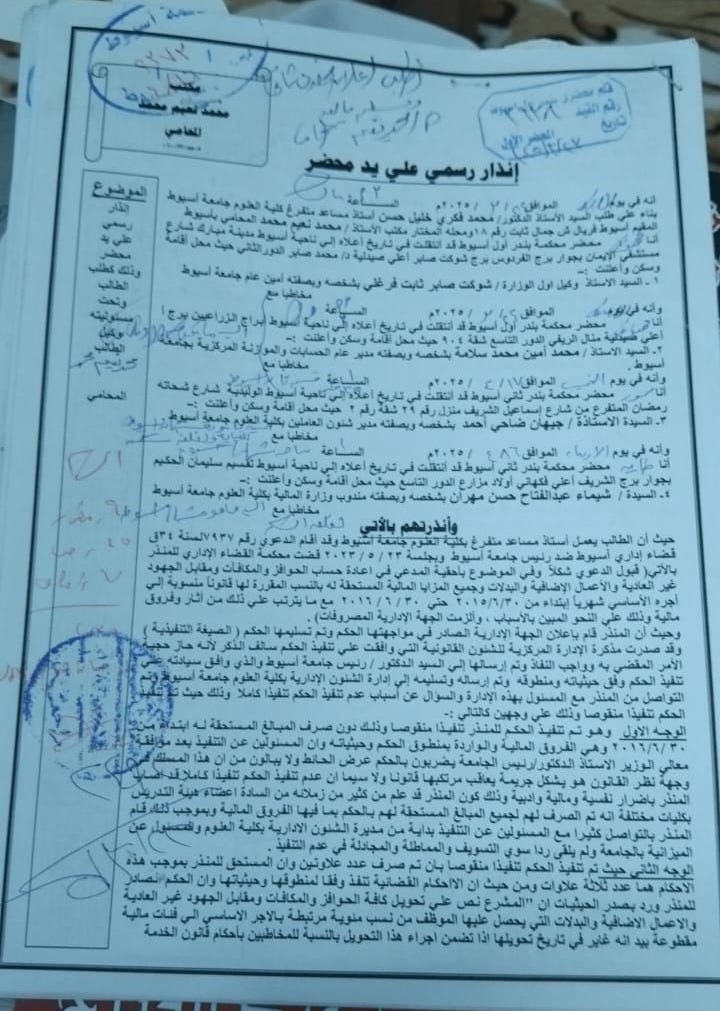
The ministry valued the judgments at 463 million pounds and said the university could pay the amount in installments, provided that the judgments were final and enforceable. The university was also instructed to verify the executive forms of the judgments, confirm that all avenues of appeal had been exhausted, and account for any sums already paid.
Meanwhile, Assiut University Secretary-General, Shawkat Saber, told Veto’s Gad Al-Haq that the Finance Ministry should pay the 463 million pounds because faculty members and teaching assistants hold financial positions funded through the state’s general budget. He said the university had approached the Finance Ministry seeking funding for the judgments, but that the ministry instead directed the university to use its special funds.
In an August 5 statement, Assiut University rejected the suggestion that its administration was engaged in a confrontation with Kouchouk, adding that reports attributing statements to its secretary-general about a “challenge” to the minister were false and did not represent the university’s position.
On the judgments themselves, the university said it had already taken the necessary steps toward paying the entitlements of faculty members and teaching assistants covered by court decisions, as judgments were being compiled in preparation for completing the payment process, which would be made according to the order in which they were received.
However, several faculty members, of a reported 3,000–4,000, have told Gad Al-Haq that obtaining a judgment was only the beginning of their struggle.
Mohamed Abdel-Wahab, a retired professor at the Faculty of Science and former dean of the College of Sugar Technology and Integrated Industries, said he obtained a judgment concerning the recalculation of allowances, bonuses, and financial incentives, together with retroactive financial differences.
According to Abdel-Wahab, the university did not implement the retroactive portion and cited its own financial resources as a reason for not making the payment. He also said some professors pursued further legal action against university financial officials after the judgments were not implemented.
Speaking to Gad Al-Haq, former Faculty of Education Dean Adel El-Nagdy said that he was also among the faculty members who obtained a judgment against the university, which awarded him approximately 75,000 pounds in quality-related incentives, and that he submitted the enforceable form of the judgment to the university; a payment that has yet to be made.
University employees, including nursing staff and other workers, also made payment demands.
One employee, Mohamed Abu Faris, said that he and colleagues had obtained final judgments awarding delayed entitlements that still had not been paid.
The Veto report also cited the case of a university hospital nurse who continued receiving only limited payments despite an employment-related decision in her favor.


On August 9, Gad Al-Haq reported that it had obtained financial documents showing 65 transactions during 2024 totaling approximately 1.23 million pounds associated with the financial account of a college dean, as thousands of faculty members and employees wait for their basic fought-for rights.
Factory lockout escalates into legal battle
Update: The standoff at Misr El Amria Spinning & Weaving Co. has escalated from a shop-floor strike into a formal legal confrontation after management locked out the workforce under the pretext of “facility maintenance and inventory checks.”
Faced with closed gates, suspended company transport, and a heavy security cordon outside the complex, workers organized collective filings, submitting complaints to the Ministry of Labor’s directorate to register the company’s unilateral suspension of operations.
The workers’ legal counter-offensive relies directly on the labor law, as Article 111 of the statute explicitly provides that when an employee reports to the workplace ready to carry out their duties but is prevented from doing so for reasons attributable to the employer, they are legally deemed to have worked and remain entitled to their full wage, and because routine maintenance, warehouse auditing, and civil defense reviews do not constitute an unforeseen force majeure, documenting the lockout through official reports establishes proof that the employer prevented entry, preempting management attempts to treat the shutdown as an unauthorized worker absence or grounds for wage deductions.
As previously covered by The Cairo Report, behind the administrative pretexts lies an unresolved wage dispute at the flagship textile firm owned by Banque Misr, one of the country’s primary state-owned financial institutions, and the strike, which had crossed its second week before the lockout, was sparked by management reneging on commitments made by its executives regarding the statutory 12% annual allowance.
While management sought to suppress payroll costs by calculating the percentage solely against basic salaries, workers are demanding it be computed against their insured wage, which is apportioned as 7% added to the basic wage and 5% as a variable allowance, alongside retroactive backpay for accumulated differentials.
With the dispute now formally lodged with the labor directorate, the outcome will test whether the protections codified in the labor law offer any real barrier against state-backed industrial lockouts, or allow it to become a method through which an employer can impose its interpretation by exhausting the workers who challenged it.
Prison Watch: More renewals, more tadwir
The Supreme State Security Prosecution renewed the pretrial detention of activist Nael Hassan in Case No. 4373 of 2026 on August 10, according to his lawyer, Mahienour El-Massry.
El-Massry stated that Hassan is not receiving family visits because he has no relatives able to visit him, and despite his legal team having submitted a request approximately one month ago for permission to visit him in detention in their capacity as his lawyers, no authorization has been issued.
On the same day, Supreme State Security Prosecution renewed the pretrial detention of Mohamed Zahran, founder of the Teachers’ Independence movement, for 15 days pending investigations in Case No. 5773 of 2026.
According to his defense team, the charges stem from two social-media posts. One called for a meeting of teachers to discuss mechanisms for implementing court rulings concerning the end of state oversight of the Teachers’ Professional Syndicate. The other commented on the public focus on football matches while issues of social injustice and economic hardship remain unresolved.
In parallel, the Egyptian Initiative for Personal Rights (EIPR) renewed its call for the immediate release of Mohamed Waleed, a 21-year-old student with severe dwarfism accompanied by a skeletal disorder and complete obstruction of both nasal passages, who has spent more than two years in pretrial detention for expressing solidarity with Palestine.
On August 10, the Second Circuit of the Badr Criminal Court adjourned Waleed’s trial once again for another two months, and while it allowed Waleed, who is charged with “leading a terrorist group,” to remain outside the defendants’ cage during the hearing, the court rejected his lawyer’s request for his release, the EIPR stated.

The organization stressed that Waleed’s detention poses a serious risk to his health and life and is calling for an urgent investigation into why he has remained imprisoned despite his medical condition. The EIPR previously called for his release in June 2026, when it said he had already spent two years in pretrial detention in Case No. 2806 of 2024.
Waleed is being held at Wadi El-Natrun Rehabilitation and Correction Center, while his trial takes place at the Badr security complex, approximately 150 kilometers away.
EIPR says he is transported to and from court in metal prison vehicles while shackled. Because of his physical condition, he cannot climb the vehicle’s steps without assistance. The organization says the journey has severely exhausted him during previous hearings and that he lost consciousness because of high temperatures and poor ventilation. It added that he has been unable to undergo several urgent surgeries involving his spine, jaw, and nose during his detention.
Days later, Mokhtar Tantawy’s mother and legal team filed a new complaint with Egypt’s Public Prosecutor, demanding information about his whereabouts after he was taken to an undisclosed location, El-Massry stated. The complaint, filed on August 13, is registered under No. 90864 of 2026. It follows an earlier complaint filed on August 2 under No. 84408 of 2026 concerning his detention.
According to the lawyers, immediately after the first complaint was filed on August 2, Tantawy was transferred to an unknown location. His family and lawyers say they have not been able to determine where he has been held since then. A decade ago, Tantawy was sentenced to 10 years in prison in Case No. 3034 of 2016, South Cairo, when he was 21. Despite having completed his sentence, Tantawy has not been released.
Instead, he has repeatedly been subjected to what is commonly described in Egypt as tadwir (recycling), being released or ordered released in one case and then facing new charges, often involving the same or similar allegations, in another case, per El-Massry.
She added that Tantawy has been “recycled” five times, and prosecutors ultimately ordered his release in each of those cases.
His latest release order was issued on July 25 in Case No. 10081, Nasr City Third, but it was never implemented.
Even more bread martyrs
Update: At least 28 workers were killed, and another 70 were injured while traveling to work or while on duty across the country this week, based on The Cairo Report’s tracking.
The largest disaster was the Dawawis road crash in Ismailia, where two vehicles carrying agricultural day laborers collided on August 11, killing 19 workers, most of them children between 10 and 18, and injuring 29 others. Their wages ranged between 100 and 200 pounds per day.
Mada Masr’s Ahmed Ashmawy and Haitham Gabr visited Ezbet al-Dawoudiya in Wadi El-Mullak, where they reported that the vehicle carrying some of the workers killed was on its way to work at mango farms belonging to the Armed Forces’ National Service Projects Organizations (NSPO) in the Abu Sultan area of Ismailia, which collided with another vehicle coming from the Bahr al-Baqar village, also carrying young agricultural laborers.
The Center for Trade Union & Workers Services (CTUWS) published a report on August 12 documenting at least 8 accidents on the Dawawis road involving workers between January 2020 and August 2026, which killed 21 workers and injured 133 others, to varying degrees.
Two days after the Dawawis disaster, on August 13, another fatal occupational accident occurred in Bahr El-Baqar, where three workers died via asphyxiation after falling into a sewage pit in the Husseiniya district, according to Al-Shorouk.
On the same day, another three workers asphyxiated to death while cleaning a sewage chamber on the Al-Awamir–Beit Dawoud road near Al-Kisra Bridge in Gerga, Sohag.
Later on August 13, a quarter-ton pickup truck carrying workers overturned near kilometer 16 of the Abu Simbel–Aswan road, killing one worker and injuring 19 others, per Masrawy’s Ehab Omran.
Masrawy also reported on another quarter-ton pickup truck that overturned while carrying workers on the 30 June Axis, south of Port Said, on the same day, injuring 16 people.
On August 14, a sanitation worker, El-Sayed Salem Hussein, died after being struck by a passenger car while on the job near the Mansoura Stadium area.
At least eight people sustained various injuries on August 16 when a truck carrying workers collided with a private car on the Suez-Ain Sokhna road, according to Cairo24. In tandem, Masrawy’s Gamal Mohamed reported that six workers were injured as a result of a collision between a tricycle and a horse-drawn cart near the village of Bahdal, Minya.
On 9 August, a rockfall inside a tunnel at the underground mining site in the Sukari mine in the Eastern Desert, operated by AngloGold Ashanti, killed one worker, Abdel Rahman Nabil Mahmoud, 26, and injured five others, Asharq Bloomberg reported.
Security Sector update

So, What?!
If anything, this week reminds us of the actual social bargain behind The New Republic’s development model: public land is made available to private capital on favorable terms, while workers and residents face a system of exceptions.
Bread-distribution workers are treated as private-sector employees when they demand the minimum wage, Warraq residents are treated as obstacles and security threats when they defend their homes, and university employees with final court rulings are told to wait while institutions trade responsibility.
The same hierarchy reaches its most brutal form in the workplace, since the deaths of agricultural and sanitation workers are not isolated accidents alongside an otherwise functioning system, but they are the material consequence of an economy that can subsidize ownership, police construction materials, and lock out strikers, but will not reliably pay, insure, transport, or protect the people whose labor keeps it moving.