




This issue of The Cairo Report covers 15 developments, including: an escalating residency bottleneck threatening the future of young doctors; a protest by temporary workers at Helwan University over withheld wages; at least nine workers martyred for bread, and another who set himself on fire after receiving a demolition order for his kiosk; an industry ministry move accelerating the conversion of public land into private industrial property; medical supply companies intensifying pressure on the government to rewrite their existing supply contracts; workers suing their employers for arbitrary dismissals; and the EIPR suing the Minister of Interior, among others, for compensation over a death in custody.
That’s just the start.
Right to Health committee launched in Alexandria
The Socialist Popular Alliance Party’s Alexandria chapter launched a Right to Health committee on August 4, citing “dire social conditions, the significant decline in the health sector budget, the repeated violations suffered by citizens while receiving treatment in both the public and private health sectors, and the widespread financial and administrative irregularities within the system.”
“The committee has been on the party’s list of priorities for months now, along with a Right to Housing committee, but the El-Shatby University Hospital case prompted us to speed things along,” committee head Farahat Suleiman told The Cairo Report.
Suleiman said that the party’s chapter in Dakahliya also launched a Right to Health committee, with a joint meeting set for next week to activate it. The party’s central chapter in Cairo will “follow soon”, he added.
The committee’s work will focus on three pillars, the party stated: raising awareness of patient rights; receiving complaints and providing legal support through a 24/7 hotline; and proposing legislative amendments to address gaps hindering citizens’ access to their right to treatment.
“The Ministry of Health suffers from severe shortcomings, to the point of failure, in safeguarding people’s rights, granting them those rights, or raising awareness about them. Because if we did raise people’s awareness, they [the Ministry of Health] would be in trouble,” Suleiman stated. “This is on top of the fact that there’s already a shortfall in state allocations to the health and education sectors, as mandated by the constitution.”
“The problem amounts to administrative failure, but it’s not, for instance, a problem of deliberate negligence,” he emphasized.
When asked about the legislative work the committee is setting out to do, Suleiman explained that pre-existing laws are not being enforced to begin with.
He pointed out that Prime Minister’s decree No. 1063 for the year 2014, which obligates all hospitals, public or private, to provide emergency and trauma patients with free treatment for up to 48 hours, is not being implemented, despite the fact that the cost of such an arrangement, per the decree, is covered from the budget allocated to state-funded patient treatment.
The committee concluded its founding statement by inviting “all segments of Alexandrian society (individuals and organizations)” to volunteer and participate in its work.
“There is a lot of work to be done. Any organizations open to working with us are welcome,” Suleiman stressed.
The state becomes landlord & financier
Egypt’s Ministry of Industry has formally activated a lease-to-own scheme for industrial land, turning a proposal announced earlier this summer into an operational mechanism which fundamentally changes how manufacturing capital acquires space, and reinforces the state’s role as the primary architect and financier of the country’s industrial base.
Under the new rules, investors can lease public industrial land for between seven and 21 years, and the annual rent is set at 5% of the land’s assessed value per square meter. Crucially, after just one year of actual, verified factory operations, the investor can apply to purchase the plot outright, and rent paid during that first year is deducted from the purchase price; the investor then pays 25% of the remaining balance upfront, and finances the rest over three annual installments.
This scheme sharply lowers the initial capital barrier for manufacturing, as by effectively deferring the cost of land acquisition, the state allows better-capitalized firms to deploy their liquidity toward machinery, construction, and working capital rather than immobilizing it in real estate. The requirement for one year of actual operation before a purchase can be triggered is also ostensibly designed to curb land hoarding and speculation, which are persistent problems in Egypt’s industrial zones.
But the policy is not just a leasing arrangement; it is a state-subsidized capital finance mechanism where the government supplies the underlying asset, charges a low carrying cost, credits that cost toward equity, and then provides seller financing for the bulk of the purchase price. The material endpoint is the conversion of public land into private industrial property, with the public assuming the market-making risks.
This model raises several immediate structural questions. First, there is a valuation problem: rent is fixed at 5% of the initial assessment, the land is only revalued after the seventh and 14th years if the investor has not yet opted to buy, and if public investment in surrounding infrastructure raises the market value of the plot during that first year, the investor who exercises the purchase option will capture a publicly generated windfall that they played little to no role in.
Second, the published terms place no binding, long-term obligations on the quality of the industrialization they subsidize, and while the policy emphasizes “serious” investors and actual operation, it imposes no enforceable requirements regarding job quality, wage standards, domestic value-added production, technology transfer, or environmental safeguards. Once the land passes into private ownership, the state’s leverage over how that asset is used diminishes significantly.
The policy fits the broader model of The New Republic in which the state does not simply withdraw from production—on the contrary, it uses its control over land, infrastructure, licensing, and credit to select and incubate private capital.
Textile company locks the gates on striking workers
Update: Management at Alexandria’s Misr El Amria Spinning & Weaving Co. shut down its production departments indefinitely, citing “maintenance and inventory-taking” after workers had maintained a strike for the past 12 days. Workers arriving at the plant found the gates closed, company transport suspended, and Central Security Forces vehicles deployed outside, according to Al Manassa’s Ahmed Khalifa.
The closure effectively transforms an industrial dispute into a management lockout. The strike, which began on July 28, was triggered by management’s decision to calculate a statutory 12% special allowance based on basic rather than insured wages, effectively shrinking the payout, and by declaring an open-ended “maintenance” period, management is attempting to reverse the power balance of the strike in an attempt to break it and force a return to work on management’s terms.
The tactic is not new for the company, as in October 2015, management responded to a protest over unpaid bonuses and allowances by announcing a month-long, renewable factory closure, also officially justified as “maintenance.”
Man self-immolates after being evicted from his kiosk
A 60-something upholsterer, known simply as Abu Abdou, self-immolated on August 1 to protest the decision to remove his kiosk in the Al-Manakh district of Port Said. The incident occurred while the head of the Al-Manakh district, Shaimaa El-Ezaby, led a field team to notify kiosk owners of, and carry out, demolition orders for seven existing kiosks in the area, approved as part of the area’s redevelopment plan, overseen by the governor, Major General Ibrahim Abu Limon.

Kiosk owners engaged in a heated debate with El-Ezaby after they were instructed to vacate immediately to “allow development work to proceed”. In frustration, the upholsterer poured gasoline over himself, threatening suicide to halt the demolition, before actually setting himself ablaze.
A May report by The Socialist’s Taher El-Sheikh documented 19 recorded cases of workers resorting to suicide between January and April, comprising three attempted suicides and 16 fatalities.
Geographically, the cases were distributed as follows: seven in Cairo, four in Giza, two in Alexandria, two in Damietta, and one each in Sharqiya, Beheira, and New Valley. Fifteen of the cases were male, and four were female.
Four cases, El-Sheikh wrote, stemmed from financial or economic hardship, while 13 were attributed to psychological factors (such as depression and frustration arising from various causes); the reason was not specified in two cases.
The Port Said upholsterer was sent to the intensive care unit in Al-Salam Hospital. On August 6, Masrawy’s Tarek El-Refaie reported that Abu Limon had paid Abu Abdou a visit at the hospital to check on him.
Helwan University workers protest withheld wages
Dozens of temporary workers at Helwan University staged a protest on 2 August in front of the university president's office, objecting to the withholding of their July salaries, after refusing to sign new employment contracts that strip them of long-held rights, Mada Masr’s Ahmed Ashmawy reported, citing sources among the protesting workers. Some workers also filed official incident reports at a police station, the sources said.

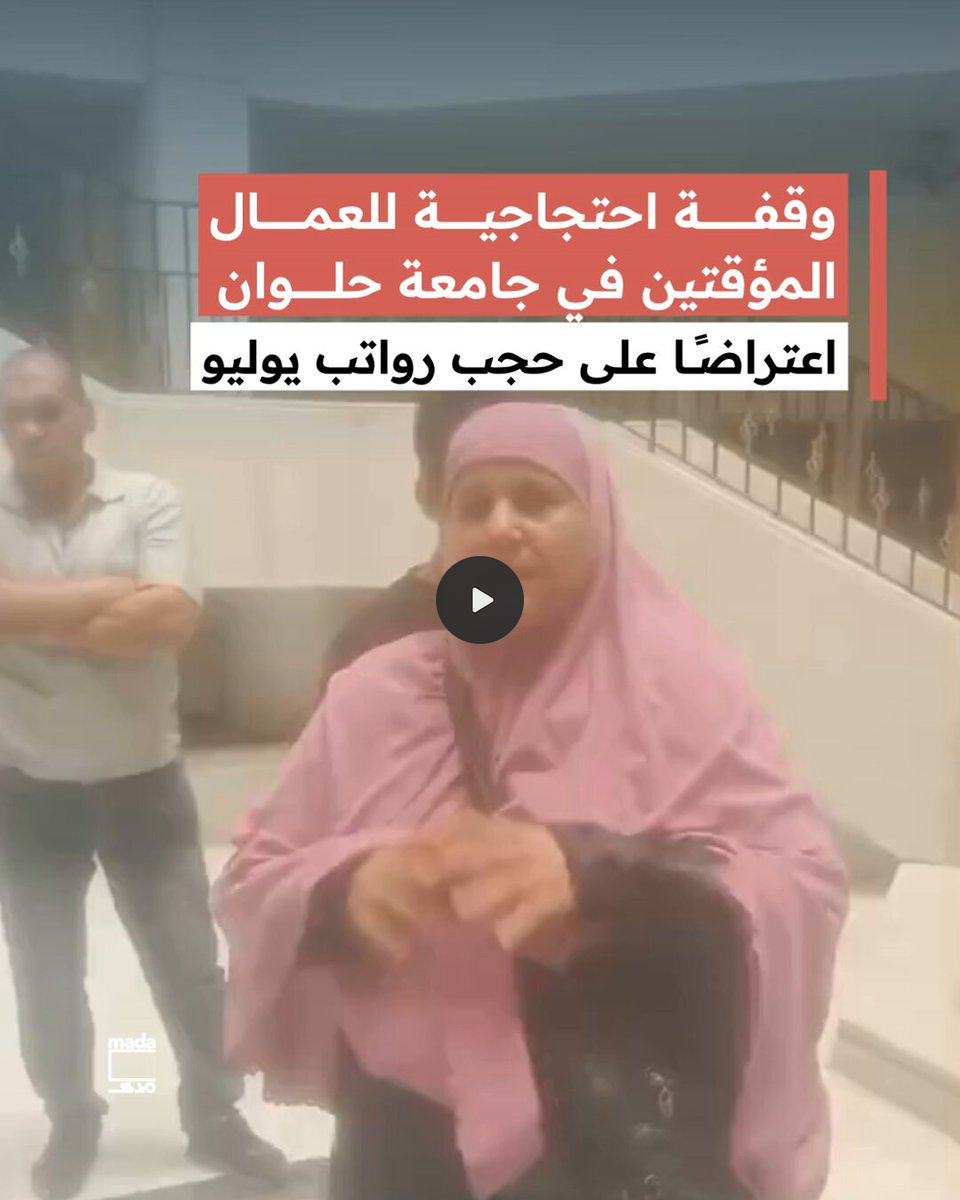
The Egyptian Center for Rights and Freedoms (ECRF) identified the dispute’s core as the new contract’s sixth clause, which it said effectively forces workers to preemptively waive rights that the law or courts might otherwise grant, despite some having worked more than a decade under regularly renewed contracts, which the commission argued had already established legal standing.
Article six of the new contract, a copy of which was obtained by Ashmawy, states that workers under the agreement are not considered employees of “the first party [the university]” and therefore cannot claim permanent status, terms rejected by more than 100 workers in support and administrative roles.
When the new contracts took effect in early July, the university administration disabled attendance fingerprint systems for those who refused to sign, and by the July 22 payday their wages had been withheld. After days of failed talks with administration, the workers decided to organize the protest, sources told Ashmawy.
The workers base their demand on Article 187 of the executive regulations of the Civil Service Law, which stipulates that temporary workers contracted between May 2012 and June 2016 be moved onto a seasonal-wage payroll upon written request, and that anyone who spent three years on that payroll be appointed at the lowest fixed-wage grade, provided the contract was concluded before June 30, 2016.
The ECRF condemned the university’s actions and voiced solidarity with roughly 80 affected workers.
It characterized the wage withholding and disabled attendance system as breaches of good-faith labor practice and of legal wage protections, and said the measures violate rights to work, fair pay and job security guaranteed under Egypt’s constitution and international conventions it has ratified, including those of the International Labour Organization (ILO).
The ECRF added that a contractual relationship built on coercion cannot reflect free will, and that such conduct is particularly inappropriate from a government body.
In March 2025, hundreds of temporary Helwan University employees refused to sign new contracts, arguing the terms would reclassify them as “daily” laborers and strip them of fixed wages, social insurance, and other benefits.
Restaurant workers sue for their rights
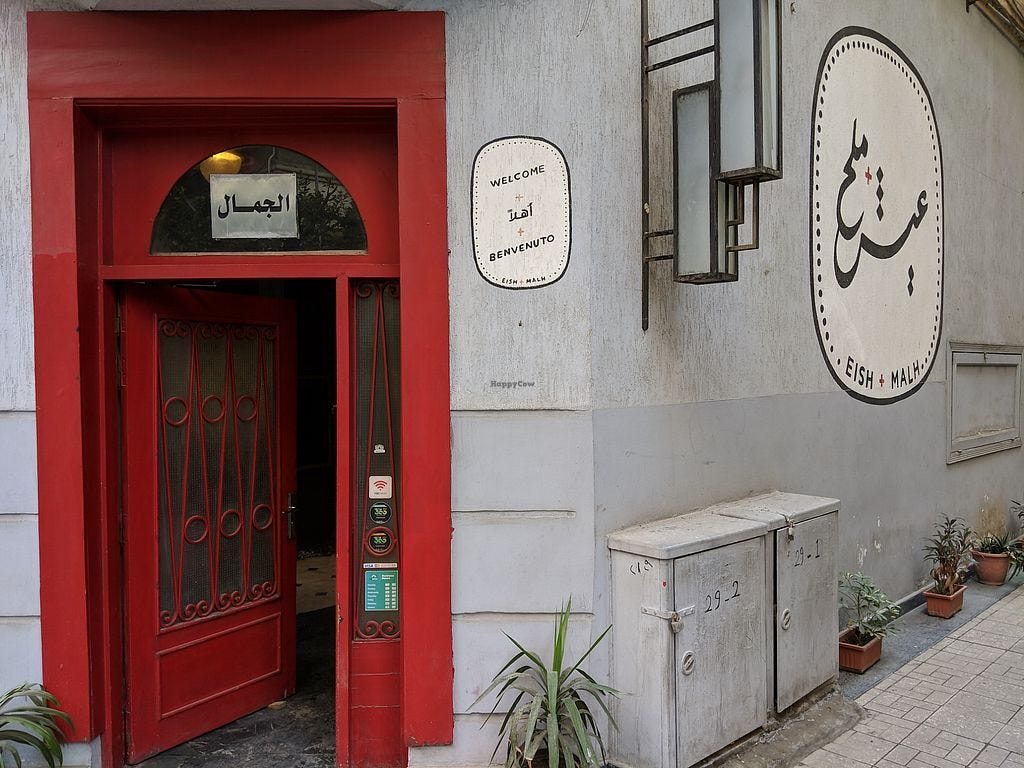
“A group of colleagues and I were unfairly fired. The owner didn’t give us contracts, and when she let us go, she refused to pay our dues or return our paperwork. The situation is very difficult, and we’re all suffering,” Ahmed Sameh, a worker at Eish w Malh, a restaurant in Downtown Cairo, wrote in a public Facebook group on July 31. “When we filed a complaint with the labor office, she replied, ‘Let the labor office help you.’ It’s been 20 days now, and we can’t go to work because of the paperwork.”
Both the ECRF and the the Center for Trade Unions and Workers’ Services (CTUWS) released statements confirming they had received a series of complaints from the workers via their hotlines.
The workers also told the ECRF they had sought an amicable settlement through the relevant labor office, but that the attempt went nowhere as the restaurant’s owner declined to respond or take the legal process seriously, raising questions, the ECRF said, about labor inspection bodies’ capacity to intervene quickly in such disputes.
The ECRF and the CTUWS argued the case is not an isolated dispute but reflects a recurring pattern in the services, restaurant, and commercial sectors, where informal employment arrangements are widespread, and thousands of workers are employed without written contracts or social insurance, leaving their continued employment or dismissal subject to employers’ unilateral will.
While labor law obligates employers to draft written contracts, the ECRF noted, the absence of one doesn’t negate the existence of an employment relationship under law, which workers may prove through other means, though in practice, many workers, particularly younger employees and those at small and medium-sized businesses, accept jobs without contracts under economic pressure, leaving them vulnerable to arbitrary dismissal, unpaid wages, uninsured employment, and the withholding of personal documents as leverage.
The CTUWS said it would continue providing legal support to the affected workers and following up on the complaints with relevant authorities.
Earlier in July, a chef at Eish w Malh also went public with similar claims, telling Cairo24’s Mohamed El-Gebaly in a phone interview that he had been arbitrarily dismissed and denied his financial dues, to which he filed a police report.
Residency bottleneck threatens hundreds of young doctors
Dozens of doctors from the 2026 medical residency intake have expressed their rejection of and objection to “irregularities in the results of the latest residency placement movement,” calling on the relevant authorities to urgently and transparently review the results in a way that ensures justice and equal opportunities for all doctors who applied.
The doctors said that the number of positions announced at hospitals reached approximately 6,324, while around 5,300 doctors applied for the movement. They noted that approximately 1,400 doctors were left without placements, raising several questions about the mechanisms for distributing positions and hospitals’ staffing needs.
They also pointed out that this intake is among those with the fewest applicants compared with previous residency placement movements.
This was confirmed by Ahmed Zahran, a board member of the Egyptian Medical Syndicate, who attributed the situation in part to delays in announcing the residency placement movement.
Speaking on the “Kol Al Ab’ad” program on Extra News on August 4, Zahran said the movement had originally been scheduled to be announced in December 2025. The delay, he said, resulted in greater competition for the available positions.
He explained that the December 2025 and May 2026 placement movements were subsequently combined into a single main movement. When the results were announced, doctors encountered “the highest rate of applicants being left without any of their selected choices ever recorded.”
According to Zahran, approximately 30% of doctors who submitted their preferences failed to secure any of the residency positions they had selected. He contrasted this with previous years, when the rate was generally between 6% and 8%.
The doctors also called for clarification of the reasons behind the high number of doctors left without placements, particularly given the existence of announced positions based on hospitals’ needs. They stressed that access to the movement’s detailed data is essential to maintaining confidence in the procedures.
The doctors also criticized the failure to announce the actual staffing needs for each specialty before applications opened. They explained that applicants selected their preferences without knowing the number of positions available in each specialty or institution.
They also pointed to the failure to announce the minimum acceptance threshold for each specialty after the results were released, saying this made it more difficult to review the results and verify the integrity of the procedures.
The doctors said that some hospitals had requested specific numbers of doctors to address staffing shortages. However, according to the statement, they were surprised that only one doctor was accepted in some positions.
Similarly, Zahran highlighted cases in which doctors with scores of 85% or 86% applied for specialties such as intensive care, which he described as among the specialties most in need of doctors in Egypt, yet were not assigned those positions.
The 2026 residency doctors outlined five key demands, reconsidering the results of the current residency placement movement; increasing the number of announced positions to match hospitals’ actual needs; re-examining and reviewing the results of the entire movement transparently; announcing all data and criteria used to distribute the positions; and ensuring equal opportunities and justice for all doctors who applied.
Several prominent figures, including former secretary generals of the Egyptian Medical Syndicate, Dr. Ehab El-Taher and Dr. Mona Mina, voiced their discontent with the status quo and their solidarity with the resident doctors.
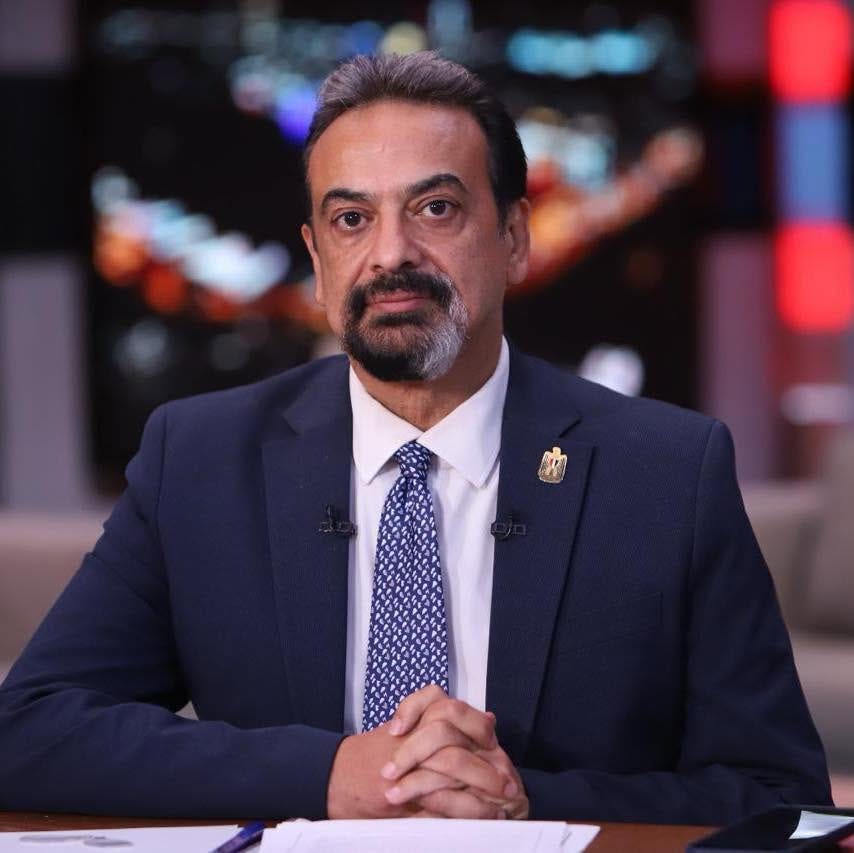
“When we met the Ministry of Health’s spokesperson, Dr. Hossam Abdel Ghaffar, he said, and I quote him verbatim, ‘Any doctor has the right to pursue their own best interests wherever they may lie, whether inside or outside Egypt.’ Essentially, the man is telling us, in a polite, polished way, that we are not welcome in Egypt!” Amir Saleem, a 2026 resident doctor affected by the bottleneck, wrote on Facebook
“It isn’t just about jeopardizing the futures of so many doctors; patients are inevitably affected too, when a hospital is staffed by only a single doctor. Take, for instance, a new hospital that the minister himself inaugurated: it was allocated a very small number of staff, roughly one doctor per specialty, even though it has capacity for 350,” Saleem added. “The irony is that, right after our assignment results were released, that very same hospital put out an advertisement to recruit new doctors. Doesn’t that prove they’re in dire need of new doctors?”
Resident doctors launched a campaign to air their grievances.
In tandem, the “takleef” crisis, triggered by the Ministry of Health and Population’s 2023 placement round for dentistry and physical therapy graduates, in which the ministry assigned roughly half of each graduating class under the government’s new “needs-based” placement system, remains ongoing.
The decision sparked outrage among graduates, many of whom argue the policy is being applied retroactively to students who enrolled under a system that guaranteed placement for all graduates. They have since filed a lawsuit against the health ministry, as previously covered by The Cairo Report.
Engineers Syndicate conditionally accepts Palestinian graduates
The Engineers Syndicate Council approved, on August 3, the registration of Palestinian graduates holding engineering degrees from accredited Egyptian universities and institutes, subject to the same registration requirements applied to other non-Egyptians.
Syndicate head Mohamed Abdel-Ghani, an independent, told Al Shorouk’s Mohamed El-Kemeily that Engineers Syndicate Law No. 66 of 1974 and its executive regulations govern registration procedures for any non-Egyptian engineer wishing to work in Egypt. He added that the syndicate includes engineers of various nationalities, all registered under the same law, and emphasized that these regulations apply to everyone without exception.
As such, Palestinians have not been granted any exceptional privileges beyond exemption from the three-month prior-residency requirement.
Pension blackout turns into an accountability war of words
Update: The government’s self-imposed August deadline to end the pensions crisis under its new system has now expired, and what Prime Minister Mostafa Madbouly promised in June would “all be fixed by August” has instead matured into an escalating confrontation between the state’s National Organization for Social Insurance (NOSI), its citizens, and more or less, its parliament, over who should pay the price of a botched transition.
The focus this week shifted decisively from technical troubleshooting to formal accountability. Inside parliament, Tagammu Party MPs announced that their demand for a fact-finding committee into the “pensions system failure” has secured the 60 signatures necessary to force its consideration, with the bloc now seeking a meeting with House Speaker Hisham Badawy to push for the committee’s formation. At the same time, Reform and Development Party MP Rawya Mokhtar, who is the deputy chair of the Manpower Committee, stated that her committee will convene to “seek accountability if the promised resolution does not materialize.”
For its part, NOSI has responded to the missed deadline by shifting the goalposts. NOSI chair Major General Gamal Awad said this week that the authority has ostensibly “cleared 42,054 of 45,987 accumulated files,” leaving 3,733 pending, most of them, he claims, awaiting documents from the citizens themselves. But his own figures demonstrate why the crisis persists: of the 167,500 new pension applications processed since the digital system launched in late March, only 17 percent met the promised 72-hour turnaround time. The new goal, Awad said, is to raise that compliance rate to “85% by year-end.”
NOSI’s official explanation for the delay remains focused on the past, since according to Awad, the primary obstacle is not the new platform itself, but “historical data, missing papers, and fragmented employment records” spanning decades that must be reconciled. But for the pensioners trapped in the backlog, the distinction is meaningless because the digital transformation sold as a leap toward efficiency has instead weaponized the state’s own archival failures, making citizens’ legally guaranteed entitlements contingent on paperwork the authority itself failed to preserve or integrate.
The tension spilled into the open on Monday, when Awad held a combative press conference dismissing critics of the system and insisting that NOSI offices were functioning normally, which triggered an immediate reaction from the secretary general of the Pensioners Union who cast doubt on the accuracy of Major General Awad’s statements, saying they were based on manipulated numbers and faulty math, while the CTUWS rebuked NOSI’s chairman for treating the denial of basic rights as a public-relations nuisance.
The contrast with the state’s broader financial priorities has not gone unnoticed. At the very moment NOSI was explaining why it could not reliably pay domestic pensioners in domestic currency, the government used the “Egyptians Abroad Conference” to unveil its latest scheme under the title “Your Pension Tomorrow in Dollars,” a new retirement savings product launched to attract expatriate remittances, whereby a state that remains unable, or unwilling, to make its basic social protection system function for retirees at home, is flaunting its capability of designing financial instruments to draw foreign currency from the diaspora.
If anything, the latest development on this front is a test of whether Egypt’s show parliament can turn rhetorical escalation into actual accountability.
Piece-rate school teachers paid less than the minimum wage
In a routine intervention leading up to the new academic year, MPs offered soft criticism of the government’s reliance on informal, precarious labor to manage its public education crisis, particularly its treatment of contract-less teachers who have become essential to keeping the country’s public school system running. The Egyptian Social Democratic Party’s Ehab Mansour, deputy chair of parliament’s Manpower Committee, stated that piece-rate teachers who earn on a per-lesson basis are subjected to “severe injustice,” revealing that their salaries of 50 Egyptian pounds ($1) per class are reduced to roughly 36 pounds after deductions.
Mansour also pointed out that some teachers are assigned 30 lessons a week but are only compensated for 20. The result, he noted, is that the total monthly income for these essential workers falls far short of “half the minimum wage”—a glaring disparity at a time when the government has announced a nominal minimum wage increase to 8,000 pounds.
“These are the people holding the educational process together,” Mansour said, “yet they are paid wages that cannot sustain a family, and are often denied the full compensation for the hours they actually work.”
The debate also surfaced chronic administrative dysfunction, as Mansour disclosed that some piece-rate teachers had gone entirely unpaid from November through February of the previous academic year, a delay caused by bureaucratic hurdles and missing signatures. He noted that payment was only expedited after he threatened to withhold approval of the Education Ministry’s final accounts during a Budget and Planning Committee session.
While stopping short of any actual legislative action, the interventions mark a shift in how the teacher shortage is being addressed politically. Rather than framing the issue solely as a deficit of personnel, estimated at 665,000 as of last year, MPs are rhetorically targeting the exploitative nature of the state’s stopgap solutions. Another MP, Mohamed Abdel Hamid, added his voice to Mansour’s, demanding a “time-bound, formal plan to regularize the status of piece-rate teachers,” in addition to establishing a national database tracking their numbers, specializations, and experience, and granting them priority in permanent hiring.
Despite the mounting parliamentary pressure, the Ministry of Education has not announced any revisions, payment mechanisms, or regularization plans in response. For the tens of thousands of teachers preparing to return to overcrowded classrooms, the structural reality remains unchanged, where the state expects them to perform the essential labor of public education, but refuses to grant them the security or the salary of permanent employees.
Healthcare procurement squeeze: Medical suppliers push for repricing mechanism
In line with last week’s drug-pricing automation, medical supply companies are intensifying pressure on the government’s Unified Procurement Authority (UPA) to rewrite their existing supply contracts.
Industry representatives argue that the currency slide has rendered their agreed-upon prices structurally unviable, warning that continuing to supply public healthcare facilities at a loss “threatens the broader medical supply chain,” according to Enterprise, and that the UPA has yet to take “any practical steps” to implement a promised repricing review. Firms operating in the healthcare sector have been pursuing such changes since at least April of this year, when they were said to be preparing to submit a memorandum to the government, and are reportedly set to meet the authority to “discuss repricing supplies within the current fiscal year’s budget,” as the UPA had previously promised to review prices but has yet to act.
The push marks a transition in the industry’s demands because companies are no longer just asking for the settlement of old debts, but for the overhaul of how the state procures medical supplies in an inflationary environment, and repricing those contracts will most definitely pass on to citizens who are seeking healthcare, in a country where out-of-pocket healthcare expenditure already accounts for over 60% of all healthcare expenditure.
The repricing demand is unfolding against the backdrop of a significant, albeit incomplete, easing of the state’s arrears crisis. The UPA’s debts to medical suppliers, which peaked at roughly 50 billion pounds last year under Major General Bahaa El Din Zeidan, are in the process of being whittled down following a series of negotiated settlements and government cash injections.
While industry figures have praised the UPA for supposedly fulfilling its commitment to regularize payments, the core contradiction remains: timely payments on loss-making contracts do not resolve the industry’s financial squeeze, and the cost of imported raw materials, shipping, and insurance has surged alongside the dollar, meaning that the prices negotiated in earlier UPA contracts no longer cover the actual cost of production or importation.
Business confidence rises, layoffs continue
Egypt’s non-oil private sector continues to contract, but the government is taking comfort in improved macro indicators, even as individual businesses shed workers and reduce their buying to survive the pinch.
According to S&P Global’s latest Purchasing Managers’ Index (PMI) report, Egypt’s headline PMI rose to 46.8 in July, up from June’s 41-month low of 46.0, and while any reading below 50.0 indicates a month-on-month contraction—meaning July was the seventh consecutive month of decline for private sector firms—the government and investors are focusing on the broader picture. For the wider economy, the true zero-growth line on an annual basis sits at 32.0. Therefore, July’s 46.8 reading implies an annual GDP growth rate of roughly 4% at the start of the third quarter, confirming that the macro economy is expanding year-on-year, even as individual businesses struggle.
The report highlighted that “business confidence” actually reached its highest level since mid-2022, largely driven by a temporary dip in global oil prices and softening price pressures. However, this optimism at the top obscures the grinding reality for the workforce and the supply chain.
Faced with sluggish market conditions, maritime shipping delays, and a lack of new projects, businesses saw new orders fall for the seventh straight month, leading to a continued drop in total factory output.
To cope with this suppressed demand and high operational costs, firms continued to cut jobs in July. While the pace of layoffs “slowed to a marginal pace” compared with previous months, the reduction in personnel—combined with ongoing raw-material shortages—created supply bottlenecks, and the result was that unfinished work piled up at the second-fastest rate in nearly three years because businesses simply did not have the hands or the materials to complete the orders they did receive.
In response to weaker demand, companies slashed their purchases of raw materials and inputs at the sharpest rate since September 2023, as for the first time in five months, around a third of surveyed firms chose to draw down their existing stockpiles, opting to run leaner inventories amid tight liquidity and scarce materials.
Ultimately, the July PMI reflects an economy bifurcated by austerity: business sentiment and GDP projections are recovering on paper, while the private sector on the ground relies on layoffs, depleted inventories, and backlogged work to navigate the contraction.
Lower unemployment rate, built on women’s unpaid work
Egypt’s official unemployment rate fell to 5.8% in the second quarter of 2026, down from 6.0% in the first three months of the year, the latest Labor Force Survey by the Central Agency for Public Mobilization and Statistics (CAPMAS) shows, but it offers a less celebratory account than the headline suggests: unemployment rose for women and urban residents, labor force participation fell, and more than 2.3 million people, nearly two-thirds of them women, were counted as employed despite receiving no wage at all.
The survey, covering April through June, puts the labor force at 35.636 million people, up 224,000 from the previous quarter. Employment rose by 274,000 to 33.561 million, while the number of unemployed people fell by 51,000 to 2.075 million.
Yet the rate conceals more than it reveals because unemployment measures people who are without work, available to work and actively seeking a job, but it does not count those who have stopped looking, cannot afford the search, or are prevented from entering the labor market altogether, and labor force participation slipped from 47.6% to 47.5% during the quarter, women’s participation fell from 21.5% to 21.2%, while men’s rose to 72.8%.
Male unemployment fell from 3.6% to 3.4%, and female unemployment rose from 14.3% to 14.4%, more than four times the male rate. Urban unemployment also rose from 8.4% to 8.8%, even as rural unemployment dropped from 4.2% to 3.5%. The official decline therefore rests disproportionately on rural labor-market figures, while women and city-based workers saw their position worsen.
Some 79.7% of unemployed people held intermediate, post-intermediate, or university qualifications, underscoring the continued failure of the labor market to absorb those who have passed through secondary and higher education. The state’s unemployment rate narrative also leaves unaddressed the mismatch between formal credentials and the low-paid, informal, or insecure work that is actually available.
CAPMAS’s headline may therefore be accurate in its narrow statistical sense since more people were counted as employed and fewer were counted as unemployed. But the survey describes a labor market in which paid work remains unequal, educated workers remain excluded, women are being pushed out of the formal labor force, and a substantial share of “employment” consists of unpaid labor. Thus, the question is not only how many jobs were created, but what kind of work the state is counting as a job.
Even more bread martyrs
Update: Over the past week, a string of accidents across several Egyptian governorates has killed and injured dozens of workers, both on the road to and from job sites, and inside factories and confined workspaces.
The most recent incident came on August 8, when a three-wheeled vehicle carrying farm laborers overturned on the Eastern Desert Road in Minya, injuring 15 workers with fractures and various wounds, according to Masrawy reporter Gamal Mohamed.
Two days earlier, August 6, a vehicle carrying workers overturned on the desert road near the Wadi Tunnel in Al-Saff, Giza, as the workers were returning from a job with a private contractor, killing seven and injuring six, Masrawy’s Mohamed Abu Bakr reported.
Days before, on August 2, Masrawy’s Mohamed Mahrous reported that a pickup truck carrying workers overturned near the entrance to Nemsa village on the Western Desert Road in Esna, Luxor, killing two workers at the scene and injuring 12 others with fractures, bruises and various wounds. The injured were taken to Taiba Specialized Hospital in Esna, and the public prosecution opened an investigation into the cause of the crash, according to Mahrous.
A further crash was addressed in a statement from the CTUWS, which said a minibus carrying two factory workers collided with a trailer on the international coastal road in Port Said, injuring 14 workers who were all taken to Al-Zohour Hospital for treatment.
Separately, on August 4, a fire broke out inside a garment factory in the industrial zone of 10th of Ramadan City, Sharqiya, leaving 38 workers with smoke-inhalation injuries, Masrawy’s Yasmin Ezzat reported. The fire was brought under control before it could spread to production lines or neighboring factories, according to Ezzat. Medical teams treated 10 of the injured at the scene for minor inhalation symptoms, while 28 others were transferred to the 10th of Ramadan University Hospital and the Health Insurance Hospital for further care. A police report was filed, investigators opened a probe into the fire’s cause, and forensic examiners were assigned to inspect the site and assess the damage.
CTUWS responded to the fire the same day, saying it was following the incident “with considerable concern.” The organization said the fire, coming so soon after the spate of transport accidents, pointed to a “genuine breakdown in occupational health and safety oversight”. The organization argued the fire raised fresh questions about industrial facilities’ compliance with fire-prevention requirements, evacuation and emergency planning, the adequacy of early-warning systems, and worker training on handling hazards.
“Worker safety is not a luxury, but a legal and moral obligation resting with employers and regulators,” the CTUWS stated on the fire, adding that it would not stop raising the issue “as long as officials do not tire of negligence.”
Two days later, on August 6, a sanitation company worker died, and two colleagues were injured after being overcome by toxic fumes while carrying out maintenance inside a sewage chamber in Shakshouk village, Abshway district, Fayoum, Masrawy’s Hussein Fathy reported.
According to Fathy’s account, the fumes were produced by decomposing waste inside the enclosed space.
The same economic pressures pushing Egyptians into informal and often hazardous labor at home are also driving some to risk their lives seeking work abroad. Residents of Kom El-Mahras village in the Abu Qurqas district of Minya told Cairo24’s Mohamed El-Nady that three young men from the village, construction workers, including armored-concrete carpenters and builders, survived the sinking of an irregular migration boat off the Libyan coast.
A follow-up report by Veto Gate’s Ahmed Alam El-Din detailed the case of another young man from the same village, identified as Heshmat Marzouk Heshmat, whose family circulated his photo on social media after losing contact with him following the boat’s sinking. According to El-Din, the family said they had received no confirmation of his fate as search operations continued, and his image had become, in El-Din’s words, a symbol of the anguish being experienced by the families of those still missing.
The news came less than a week after the European Union (EU) disbursed 1.5 billion euros, part of a broader 4 billion euro “macro-financial assistance program,” which is largely a quid pro quo where Egypt is provided with foreign currency to act as Europe’s gatekeeper and curb irregular migration.
Prison Watch: Renewals, negligence, EIPR sues interior minister
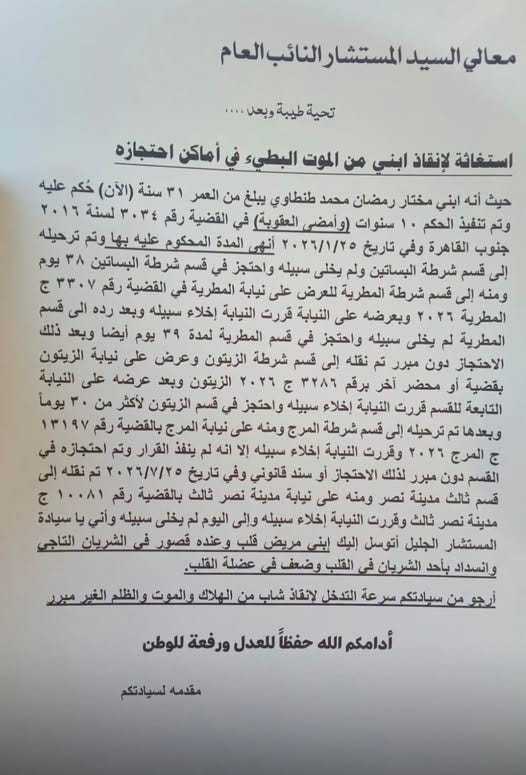
On August 2, lawyer Mahienour El-Massry stated that she and Mokhtar Tantawy’s mother had submitted a complaint, registered as No. 84408 of 2026, to Egypt’s public prosecutor requesting implementation of a previous decision to release him after he had completed his full sentence.
According to El-Massry, Tantawy had instead been moved from one case to another, a practice commonly referred to as “tadwir” [recycling] into new cases. She said he had received five separate release decisions.
El-Massry also said Tantawy’s health condition was serious and that his family feared he could be forcibly disappeared again and placed in a new case involving the same allegations.
The following day, three prominent cases were renewed by State Security Prosecution.
According to the Egyptian Center for Economic and Social Rights (ECESR), the Cairo Terrorism Court’s First Circuit, sitting at the Badr Courts Complex, ordered on August 3 the renewal of journalist and writer Sayed Saber’s pretrial detention for 45 days.
ECESR said the decision was issued by the court’s deliberation chamber in connection with Case No. 6499 of 2024.
The center said its lawyer, who is representing Saber, asked the court to release him or replace pretrial detention with precautionary measures, arguing that the legal grounds for continued detention were absent under Articles 134 and 201 of Egypt’s Code of Criminal Procedure.
ECESR also said Saber’s health had deteriorated significantly. According to the center, he suffers from chronic illnesses and has undergone two major heart surgeries, including one at the Badr Medical Center. The center said his lawyers argued that continued detention posed a serious risk to his life.
Similarly, the ECRF also reported on August 3 that the Supreme State Security Prosecution had renewed the detention of lawyer Mohamed Abu El-Diyar, coordinator of the Committee for the Defense of Prisoners of Conscience, for another 15 days, ECRF reported, in Case No. 4502/2026, on charges of spreading false news and joining a terrorist group.
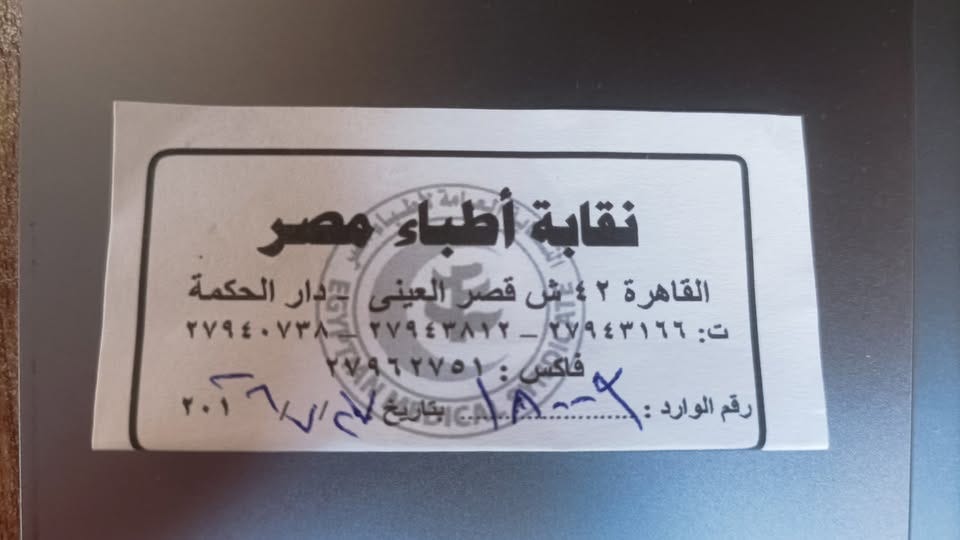
On the same day, the Supreme State Security Prosecution renewed the detention of filmmaker Omar Marei in Case No. 3835 of 2026. A day earlier, his wife, Nora El Sayed, said she submitted a formal request to the head of the Egyptian Medical Syndicate on July 27 concerning her husband’s health.
El-Sayed said the request was registered under No. 18003 and was submitted after Marei had spent nearly three months in pretrial detention.
She clarified that Marei suffers from health problems requiring specialized medical follow-up and that the treatment plan he had been following before his arrest had been interrupted. El-Sayed argued that healthcare for detainees is a right and not a privilege, calling on the Medical Syndicate to take appropriate action within its mandate to help ensure that her husband receives the medical evaluation and care his condition requires.
Meanwhile, a group of teachers supporting Mohamed Zahran, founder of the Teachers’ Independence movement, detained three weeks ago over a Facebook post, whose detention was covered by The Cairo Report, submitted a petition to Egypt’s National Council for Human Rights (NCHR), calling on the institution to intervene in his case and seek his release, citing concerns over his health and the circumstances of his pretrial detention.
Zahran has been held in pretrial detention in connection with Case No. 5773 of 2026 with the State Security Supreme Prosecution.
The petition links Zahran’s case to his trade-union activity and involvement in public affairs. Its signatories argue that the case raises concerns about rights to union organization, freedom of expression and participation in public life.
On August 4, Hilal Abdel Hamid, a member of the General Assembly of Teachers, said that a group of teachers had created a petition-signing form to express solidarity with Zahran and demand his release, Al-Horria News reported.
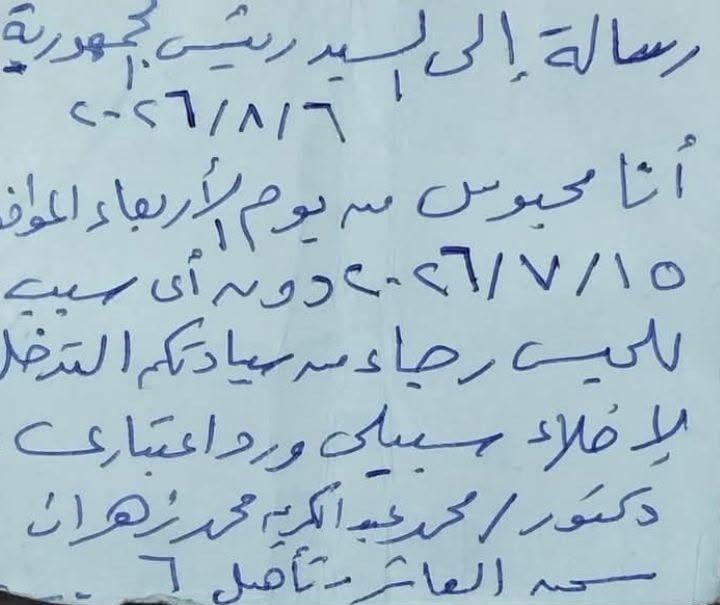
On August 6, Zahran’s son published a message from his father from inside detention. In the message, addressed to the president, Zahran said he had been detained since Wednesday, July 15, “without any reason for detention,” and appealed for intervention to secure his release and restore his reputation.
According to his son, Zahran is 59 years old and is no longer able, in his family’s view, to withstand harsh detention conditions, particularly amid high temperatures. His son said that during a visit he learned that his father had been transferred to a hospital for three days, increasing the family’s concerns about his health.
Separately, the ECRF reported on August 3 that the Supreme State Security Prosecution had ordered the release of lawyer Nada Mahmoud Ibrahim.
According to ECRF, Mahmoud had been detained for more than two years in connection with Case No. 1410 of 2024 before the Supreme State Security Prosecution, where she had faced a charge of publishing false news.
The commission did not provide further details about the terms of her release.
On August 6, the Egyptian Initiative for Personal Rights (EIPR) stated that one of its lawyers had filed a civil lawsuit seeking compensation for the mother of Mohamed Qandil, a 23-year-old man known as “Mohanad,” who died after being assaulted for roughly seven hours by four fellow detainees inside a police station in Tanta.
The EIPR accused the authorities of failing to protect him despite the room being monitored by surveillance cameras.

The defendants are the Minister of Interior (MOI), the assistant minister for public security, the director of Gharbia security, and the head of the Second Tanta Police Station, all sued in their official capacities.
The court held its first hearing on July 30. The government’s lawyer requested time to review the case file, and the court consequently adjourned proceedings until October 8.
The EIPR stated that Mohanad spent about a month in detention before dying following the assault. Witnesses reportedly told investigators that four detainees restrained and beat him after growing angry that he repeatedly needed to use the cell’s toilet because he was feeling unwell.
According to the EIPR’s account, Mohanad was detained following a dispute over right of way with a judge. He voluntarily surrendered to police after the judge filed a complaint accusing him of insulting the judge and attempting to kill him. Mohanad denied the allegations during questioning, but prosecutors ordered his pretrial detention.
Surveillance footage from the detention room reportedly showed Mohanad walking unsteadily over detainees sleeping on the floor before collapsing. According to the EIPR’s account, one detainee restrained and choked him while others took turns beating him.
The detainees accused of assaulting Mohanad were subsequently convicted. The Second Tanta Misdemeanors Court sentenced each to one year in prison with hard labor, with a 5,000-Egyptian-pound bail to temporarily suspend enforcement. The defendants appealed, but the appellate misdemeanors court upheld the ruling on May 28, 2025.
The EIPR stated that Mohanad’s parents worked distributing household gas cylinders and had no health or social insurance. As they grew older and developed health problems, the organization said, Mohanad became their sole provider and caregiver.
The organization argues that compensation for his mother would be an appropriate form of redress for a family that had already suffered hardship on several fronts.
The EIPR also pointed to Article 106 of Egypt’s Prisons Organization Law, arguing that the Interior Ministry has a statutory duty to guard detainees, which extends beyond preventing escapes to protecting detainees from harm, whether inflicted by detention-facility personnel or by other detainees.
Security Sector update:

So, what?!
This week’s dispatch shows that The New Republic can move quickly when capital needs a new guarantee, a new asset, or a new source of foreign currency, but all of a sudden becomes procedurally helpless when workers, pensioners, and patients need rights enforced. Industrial land is converted into a subsidized route to private ownership; medical suppliers press for contracts that can absorb inflation; and a dollar pension product is unveiled for Egyptians abroad. Meanwhile, retirees are told to produce records the state failed to preserve, temporary university workers are asked to sign away the possibility of secure employment, and young doctors are left to compete for posts that hospitals themselves say they need filled.
There are, however, continuing attempts to turn individual injury into collective demands: the Right to Health committees, Helwan workers’ protest, the 12-day-and-counting textile factory strike, and the teachers’ petition for Mohamed Zahran all insist that breakdowns presented as isolated administrative problems are political choices. Their significance lies less in any immediate concession than in refusing the state’s preferred framing: that people should navigate these systems alone, case by case, document by document.