


Egypt’s austerity is a feature as old as Mohamed Anwar Sadat’s economic Open Door Policy, known as al-Infitah, but it has deepened over the past decade with four International Monetary Fund (IMF) loans since 2016. Each loan demanded the same package in exchange for disbursement: float the currency, cut the subsidies that kept bread, fuel and electricity affordable, and extend the tax base.
The pound’s devaluation in 2016 and again in 2024 roughly doubled the cost of food and fuel without doubling anyone’s wage; the subsidy cuts that came with it removed the floor under both.
The public sector shrank as its wage bill was cut, and it was the largest formal employer of Egyptian women, one with maternity leave, insurance, and a wage a court could enforce.
When it contracted, women did not move into equivalent private jobs. Instead, they fell into informal work, stripped of what meagre protections they had, and left to carry a second weight: an economy on its last legs, propped up as much by their unpaid work in the home as by their informal labor in sweatshops and grape fields.
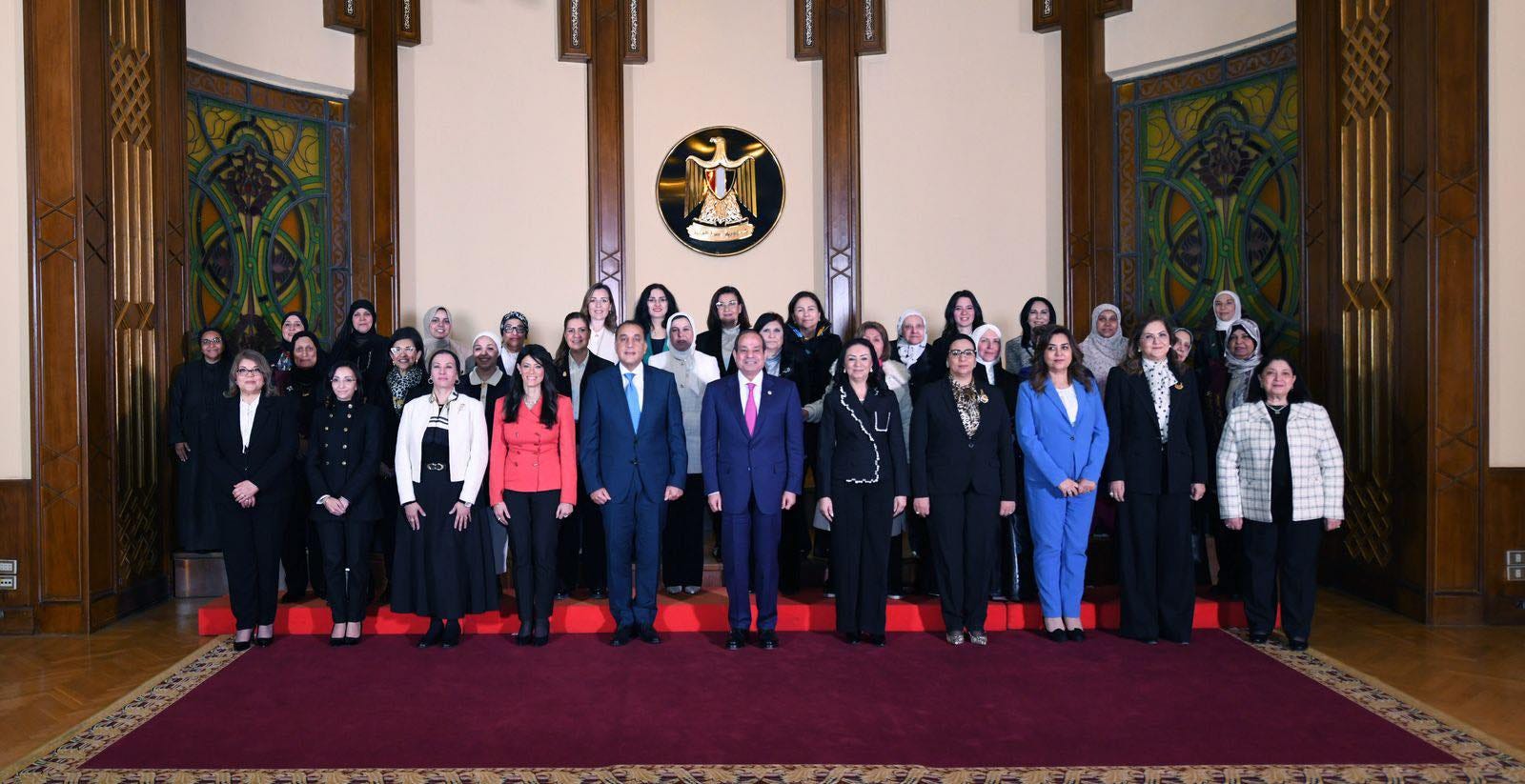
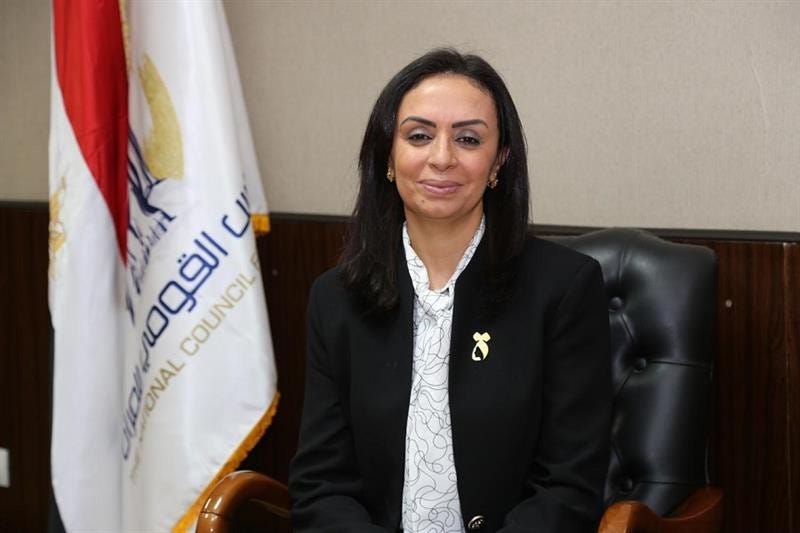
And yet, marking the National Day of Egyptian Women in 2022, Maya Morsi, then president of the National Council for Women (NCW) and current Minister of Social Solidarity, described the period as a “golden age for women in Egypt,” crediting the leadership of President Abdel-Fattah El-Sisi and his efforts to “empower women across every sector.”
The NCW is a state body; its members are appointed by El-Sisi and its leadership reports to him directly, a fact Morsi stated often, describing a “political will” that comes straight from the president.
Morsi’s claim rested on an inventory of legislation: Article 11 of the 2014 constitution, binding the state to equality and to protecting women from violence; Law 50 of 2014, writing sexual harassment into the penal code; Law 177 of 2020, shielding complainants’ identities; Laws 141 of 2021 and 185 of 2023, elevating harassment to a felony and raising its fines, with aggravated treatment for workplaces and public transport; the National Strategy for the Empowerment of Egyptian Women 2030; and Labor Law 14 of 2025, replacing a code that had stood since 2003.
But the rights legislation of this period, and the World Bank cash transfers beside it, were built on top of the same contraction rather than in place of it. It was compensation for a wage the same restructuring had already withdrawn.
This is the mechanism the empowerment decade sits on, and it is the reason the legislation cannot outrun what produced the need for it.
In this deep dive, I test Morsi’s claim against that mechanism: who reaches the labor market, what happens to a woman who speaks about violence done to her, and what the state does when its own record of care becomes a liability.
What women earn
On the morning of August 11, two pickup trucks carrying agricultural day laborers collided on a connector road in Ismailia’s Al-Dawawis area, killing at least eighteen, most of them children between ten and seventeen. They were traveling from Sharqiya to a farm in the next governorate, earning under two US dollars for an eight-hour shift. Six of the dead were siblings. A sixteen-year-old survivor told AFP outside Al-Qassasin hospital that she’d been asleep, exhausted because the day starts at five, and that her sister died beside her asking for their mother.
Days earlier, on the Belbeis–Abu Zaabal road, a pickup carrying women agricultural workers overturned, injuring 22. The New Woman Foundation (NWF) stated that the Ismailia deaths would repeat within the week. Transport accidents recur because the protections around agricultural workers are fragile, oversight is weak, and employment arrangements are fragmented. Formal rights to occupational safety, health and social protection exist on paper; without enforcement mechanisms, they mean nothing in practice.
Both crashes are routine.
Informal labor accounts for close to 67% of employment in Egypt and nearly the whole of the agricultural sector, according to the International Labor Organization (ILO), and between eight and thirteen million people work as irregular day laborers. The vehicle, the hour, the wage, and the age of the passengers are the standing conditions of the work.
This is the population the empowerment decade addresses at its base, and the place to begin reading its ledger.
Start with who reaches the labor market at all.
The ILO put women’s labor force participation in Egypt at 16.5% in 2024 against 71.3% for men; the Central Agency for Public Mobilization and Statistics (CAPMAS) puts it slightly higher, at 16.9% against 70.3%. The gap of almost 55% exceeds the Middle East and North Africa (MENA) average and dwarfs the 15% across the Organization for Economic Co-operation and Development (OECD) countries. Close to 18% of the women who did enter the market were unemployed in 2024, against just under 5% of men.
Across the fifteen years to 2024, women’s share of the labor force fell by around 8%, from 23% in 2010—the shape of the golden age at the level of the aggregate, a decade of women being pushed out of the formal labor force and into precarious work.
For the minority who stayed, agriculture is one of only three sectors where women form a majority of those employed, at 57.9%, with an hourly wage of 10.93 Egyptian pounds against a national average of 13.9. The figures come from the ILO’s 2018 study of the gender pay gap in Egypt; now two devaluations old, but the only figures available, and there’s no reason to think the gap it measured has closed.
That study put the monthly wage gap at 20% and the hourly gap at 4.1%; inside the private sector the gap ran to 75% at the bottom of the skill scale and 25% at the top, while the public-sector range ran from 10 to 25%.
The ILO’s own reading was that discrimination drives the outcome rather than qualification, since 41% of employed women held university degrees against 15% of men. Of all farm laborers, 94% work without insurance or a contract, 45% of whom are women.
Beneath the wage gap sits a category of work priced at zero. Two thirds of the 2.3 million people whom the CAPMAS Labor Force Survey counted as employed while earning nothing are women, most of them, per the survey’s own category, unpaid family workers: a woman on her father’s or her husband’s land, counted by the state as employed, holding no wage, no contract, and no claim on the household income her labor produces.
The labor law’s machinery
Labor Law 14 of 2025 took effect on September 1 of that year.
It lifted paid maternity leave from three months to four and removed the restriction tied to length of service, protected women against dismissal during pregnancy and maternity leave, wrote definitions of workplace bullying and harassment into the code, recognized digital platform workers, and struck out the clause that had kept women in agriculture outside the law’s recognition. That clause dated to the 1981 code and was carried forward by Article 4 of the 2003 one, which excluded domestic workers and similar categories, therefore swallowing most women doing agricultural work.
Development and environment researcher Abdelmawla Ismail, writing for the Network for Development, noted that the new recognition did not actually specify rights for these women agricultural laborers in its place. Agricultural workers hold a theoretical right to form their own union organizations under the law, for example, but administrative restrictions continue to obstruct its exercise, though women and men in the sector have won union committees in several governorates regardless.
The Egyptian Initiative for Personal Rights (EIPR) read the same text before ratification and asked the president to withhold his signature: alongside the improved definitions and new protections, it warned the law opens a door to arbitrary dismissal and still excludes domestic workers after years of promised inclusion. Two days after the text left parliament, the General Authority for Health Insurance issued a directive placing women on part-time and daily contracts outside the breastfeeding hour granted to new mothers.
None of this happened in an economy standing still.
Since 2016, Egypt has entered four loan programs with the IMF and is now among its largest borrowers; across the ten years to 2024, eight of them under an IMF program, external debt rose from around 46 billion dollars to roughly 168 billion. Not a single loan was paid down, but the same conditions were met four times over.
Food prices rose by 103% between 2015 and 2019, and cumulative inflation for the poorest ran to 81%. Women’s labor force participation, over the same period, fell to among the lowest levels recorded anywhere.
Against that, the state offers Takaful and Karama, the conditional cash transfer program built with the World Bank in 2015, expanded at every tranche since, and never independently evaluated. Even so, since launch, the maximum Takaful allowance has risen by only 15.2%.
EIPR argues that the recent European Union (EU) loan follows the same method: quantitative targets for beneficiaries and microloans, with no scrutiny of whether either works, or of the interest rates trapping borrowers, mostly women, in debt. The substitution is the point. The wage the public sector once paid a woman is withdrawn, and in its place arrives a conditional transfer, alongside a loan she must repay.
Article 11’s own text shows why the guarantee doesn’t hold.
Alongside “equality,” which was celebrated as a “victory” by some Egyptian women’s rights activists, the law commits the state only to helping a woman reconcile her duties towards her family with the requirements of her work, assigning the household to her in the same paragraph that declares her equal, and leaving the mechanism of reconciliation undefined and therefore unenforceable.
A guarantee written this way survives as a statement of intent, and the courts have treated it as one.

Who does the law protect?
Four years after Article 11, parliament passed the anti-cybercrime law of 2018, Law 175, which criminalizes content that undermines “Egyptian family values” without defining them.
The prosecutions that followed selected their defendants by class.
In April 2020, authorities arrested Haneen Hossam, a Cairo University student with around 900,000 TikTok followers, after she invited her women followers to earn money broadcasting live video on another platform; Mawada al-Adham was arrested in the same wave.
Both were convicted that July of violating “Egyptian family values” and inciting debauchery, acquitted on appeal in January 2021, then re-charged with human trafficking. Hossam was sentenced in absentia to ten years and Al-Adham to six, before Hossam’s sentence was cut to three at retrial.
At least 11 other women with large followings faced comparable charges from 2020 onward; Al-Adham, Egyptian media reported, had refused a virginity test requested during the investigation.
Human Rights Watch (HRW) documented defense lawyers’ request that the Constitutional Court define the phrase “Egyptian family values,” and its rejection; the prosecutor general framed the campaign as a “defense of national societal security”.
Seventeen-year-old Menna Abdelaziz filmed herself after being brutally beaten in 2020, naming the men who had assaulted her. The state held her simultaneously as a complainant in a sexual assault investigation and as a suspect in morality offences arising from her own videos.
Amnesty International documented an eight-hour interrogation in which prosecutors drew on statements from the men she was accusing to charge her with violating family principles and inciting debauchery. She spent close to four months in custody and was released on September 17, 2020 after a sustained public campaign, and only after that pressure were five of the men she named eventually sentenced.
The pattern reaches victims who never went viral at all: Amal Fathy was sentenced to two years in 2018 for a Facebook video describing being harassed, and witnesses who answered the NCW’s own public call to come forward in the 2020 Fairmont rape case were instead arrested, held for five months, and subjected to forced examinations; punished for having spoken publicly rather than reported privately.
By February 2026, Egypt’s harassment legislation, on paper, exceeded most in the region.
Law 141 of 2021 made verbal harassment a felony carrying two to four years and a fine of 100,000 to 200,000 pounds, rising where the offender stalks the victim; Law 185 of 2023 set a floor of seven years where the offence occurs in a workplace or on public transport, or where two or more offenders act together. Harassment on a bus is, in Egyptian law, the aggravated form.
On February 8, Mariam Shawky was harassed by a man on her usual bus route from Suez to Maadi. A man who, she said, had been following and harassing her, and who threw rocks and metal at her for not responding to his catcalling. She confronted him and called for help on the street and on the bus; passengers formed a human shield around him instead.
Officers at a police station declined to intervene immediately, and she eventually filed her report that day at the Khalifa and Mokattam partial prosecution office, with EIPR joining her legal team.
The Interior Ministry announced his arrest, while the bus company denied the incident had occurred on one of its vehicles, a denial the Ministry of Transport later reissued.
On February 10, the prosecution released him on bail of 1,000 pounds, roughly twenty dollars; his family announced a defamation suit, and his lawyer requested a psychiatric evaluation of Shawky.
Then the public trial opened.
Hassan Shakoush, a Mahraganat singer with millions of followers, went live on TikTok to observe her lip and ear piercings and conclude that “a respectable girl would wear nothing in her mouth,” the start of a wave of moral accusation.
Outlets published fragments of the investigation stripped of context; one asked in a headline whether Shawky suffers from mental illness, then changed it after backlash.
The transport company’s denial circulated under headlines implying the assault had been invented, and coverage of the bail release omitted its condition, leaving readers with an impression of acquittal.
Eleven feminist institutions issued a joint statement criticizing “parallel media trials of survivors”. Eman Ouf, who heads the women’s committee at the Journalists Syndicate, told The New Arab that some of the coverage was systematic and misleading, presenting the survivor as a liar.
Shawky lost her job. Journalists followed her home once she stopped answering her phone. Her lawyer expects future employment to be difficult, since her name now returns those headlines in a search. She received death threats, including messages promising to kill her and telling her she would be mourned by nobody.
On March 24, the Mokattam misdemeanours court acquitted the accused for insufficient evidence and rejected the related civil suit; a finding that, in Egyptian law, means the charge went unproven rather than that the incident failed to occur, and one open to appeal by either side.
EIPR and the Egyptian Commission for Rights and Freedoms (ECRF) called on the public prosecution to appeal. The acquitted man told the press afterwards that he had trusted the Egyptian judiciary and had been anxious only because of public opinion.
He is able to trust it for a reason.
Seven Fairmont suspects left the country while the prosecution waited weeks to order arrests; the two who remained were released for insufficient evidence, while the witnesses stayed under a travel ban and in detention for five months.
Ahmed Adel, the only officer charged over the virginity tests inflicted on seven women detained in March 2011, was acquitted on every count by a military court, in a verdict holding the examinations never occurred and carrying no right of appeal; the same institutional reflex that let Raslan Fadl continue practising for a year after his conviction for the manslaughter of thirteen-year-old Sohair al-Bata’a, and serve three months once he surrendered.
In the rare cases where an aggressor does face consequences, it is because of public pressure rather than institutional will: Ahmed Bassam Zaki was sentenced to eight years after more than fifty women accused him publicly, the largest online campaign of its kind in Egypt.
The numbers behind these individual outcomes are stark.
A 2015 survey by the United Nations Population Fund (UNFPA) with the NCW and CAPMAS, the most recent of its kind, found that close to eight million women in Egypt experience some form of violence each year at the hands of family or strangers, and that only 75,000 of them reported it to the police.
For violence on public transport specifically, just 0.2% of women who experienced it sought any intervention at all, including a police report; 5.6% instead took longer routes or arranged company to avoid it.
On April 30, the EIPR released a report titled “The golden age for women?” The Rights of Egyptian Women between the Vision and Reality Since 2014. It found that 10% of women subjected to online blackmail reported it, 10% of those reports led to arrests, and 35% of the arrests produced a first-instance conviction, roughly one conviction for every 300 cases.
Earlier this year, Omnia Sweidan, a physician and filmmaker, wrote a Facebook post on the violence and harassment she witnessed as a resident in Al-Shatby University Hospital in Alexandria in 2020.
She named four incidents: the sexual assault of a nineteen-year-old delivering her first child; a rape survivor who arrived accompanied by a police officer to be examined and receive contraception and HIV medication, and was refused treatment over what she was wearing and the fact that she smoked; a woman in labor slapped by a doctor for crying while nurses shamed her; and a woman six months pregnant, with a bruise around her eye and an account of a fall, whose umbilical cord hung outside her body with the fetus wrapped in cloth. She also described a critically ill pregnant woman who was refused care because she could not prove she was married.
The post went viral within hours, and thousands of women, doctors, and health workers across Egypt came forward with their own accounts of humiliation, coercion, neglect, and abuse in maternity and gynaecology wards; among them a woman whose sister died after a surgical error during childbirth was mishandled.
Journalist Rasha Maher told The New Arab she waited three days in a delivery room after a uterine rupture in late 2024, was insulted by staff, asked repeatedly for tips, and found the bathrooms flooded with blood and insects.
The next day, security forces raided Sweidan’s home in Damanhour and took her to an undisclosed location; she was questioned in Alexandria on charges of spreading false news and misusing social media, and released on 20,000 pounds bail (roughly 400 dollars). The Egyptian Medical Syndicate stated it had received no official complaints about the incidents she described, and urged anyone with claims to file them through official channels.
She was convicted by the Alexandria Economic Misdemeanour Court of spreading false information liable to disturb public order, spread fear and cause harm, and of using a social media account to commit the offence; a sentence of six months with hard labor, suspended for three years, and a fine of 20,000 pounds.
She was acquitted of a further charge over the reputation of hospital staff; the verdict remains open to appeal. These allegations should have triggered an independent investigation focused on patient safety, HRW stated. Instead, the authorities turned their machinery against the messenger.
None of this is a gap in a system, but the system working precisely as designed.
So, what?!
The state is legislating energetically on behalf of women while tightening their movement and criminalizing their presence in the public sphere. It has transferred grassroots organizing to a council whose members it appoints, giving it full control over the council’s function. This is state feminism occupying the ground where a women’s movement should have stood. That is why a woman in 2026 can have four laws, a national strategy, a hotline, and a council, and still no reliable justice or protection.
The cabinet’s 2021 draft of the personal status law made the pattern explicit: it expanded male guardianship, denied women the capacity to contract their own marriages, and allowed male relatives to annul them, until more than 300 feminist organizations and public figures forced it to be shelved.
A judicial committee’s 2025 revision documented verbal divorce and adjusted custody while leaving guardianship, unequal access to divorce, and protections against domestic violence untouched; in the judgement of feminist organizations, a restructuring in name only.
Referred to parliament on May 25, it has united constituencies that agree on almost nothing in calling for its withdrawal; even Jawaher El-Taher of the Centre for Egyptian Women’s Legal Assistance (CEWLA), who credits it with real gains on polygamy and custody, objects to its reliance on a single school of jurisprudence and its silence on refugees and dual nationals. Marriage, divorce, custody, and guardianship are being redrafted, once again, by a committee no woman had a part in choosing.
Legislation drafted by an apparatus falls to that apparatus to enforce, and one that prosecutes women’s speech, examines their bodies by force, releases the men accused of assaulting them, and withdraws the wage that made their livelihood possible will enforce selectively, in its own interest.
That is where the golden age actually sits: a legislative inventory over unchanged institutions, financed by the programs that emptied women’s pockets, administered by a council appointed from above once the movement that once pushed from below was choked.
Any gain that has come about to better the conditions of women in the past decade is the result of people coming together, organizing, and pushing for change themselves.
