


In the New Republic, the boundary between the state, the security apparatus, and capital does not exist—it has been structurally abolished. To demand a raise, to protest unpaid wages, or to describe a crime in the workplace is, in a twisted inversion of reality, a security breach.
This week’s issue of The Cairo Report examines how that breach is managed through the prism of four distinct workplaces: a privately owned steel factory in Suez, the newsroom of Egypt’s oldest political party, a private security company, and the obstetric ward of a state university hospital in Alexandria.
The employers and antagonists in these disputes include a heavily protected mogul who’s also an intelligence apparatus proxy and established his empire in Sinai as a militiaman, a security firm owner holding a major general’s rank, a party chairman, and the Ministry of Interior’s media apparatus.
Mediating wages with State Security
Hundreds of workers at Misr National Steel’s factory in Ataqa, Suez, staged a protest on June 14, their two core demands included a meaningful annual raise and the disbursement of profit shares that management had withheld for nearly five years.
The immediate trigger for the protest was management’s announcement of a 3% annual raise in total wages, which, in the current prolonged inflationary spiral, amounts to a real wage reduction. Workers had expected no less than 15%, the benchmark set by comparable factories in the metallurgical sector.
A senior employee with over fifteen years of experience who spoke to The Cairo Report said he earns a gross monthly salary of 9,000 EGP (~180 USD), explaining that a 3% raise translates to roughly 270 pounds a month, “barely a kilogram of frozen meat,” he said.
Furthermore, according to three workers who spoke to Mada Masr’s Ahmed Ashmawy, a representative of the State Security apparatus arrived at the factory shortly after the protest began, to sit at the negotiating table alongside management and worker representatives. The session ended with workers receiving a vague promise that their demands would be “relayed to the company owner,” a classic administrative stalling tactic. The workers suspended their protest, but the message was delivered: a dispute over a 270-pound raise is a matter of national security.
The company’s ownership structure is more interesting than most. One of the shareholders, Gamal El-Garhy, is a man who rose in the steel business by positioning himself at the intersection of state privatization and military expansion in heavy industry. Born into a family that traded in reinforcing steel rods, he moved from trading into production, and later expanded into what is now known as El‑Garhy Steel. His big break came from the mid‑2000s privatization boom when, in 2006, he led a consortium that acquired 82% of the debt-ridden, state-owned Suez Steel in one of the era’s emblematic privatization deals, outmaneuvering 27 other competitors, including Gulf capital, and cementing his status, as glowing media profiles would later put it, “the pioneer of Egypt’s steel industry.”
His political trajectory is equally telling. In 2013, following the violent dispersal of the Rabaa and Nahda sit‑ins, El‑Garhy was arrested, accused of harboring ties to the Muslim Brotherhood, and charged with “inciting attacks on police stations,” which he denied, and was ultimately acquitted. The episode did not end his career, and rehabilitation soon followed. Gamal El-Garhy re‑emerged as a loyal economic partner of the post‑2013 order, continuing to expand his group and joining state‑linked boards and investment pushes, including recent moves to increase his group’s shares in financial services giant EFG Hermes, fully reintegrating into the New Republic’s business establishment.
His rehabilitation, however, required doing business directly with the military. In 2016, the National Service Projects Organization (NSPO)—the Egyptian military’s main economic arm—acquired the same 82% of Suez Steel he had purchased from the state 10 years prior. NSPO’s buyout included the 40% stake held by El‑Garhy. He exited a now military‑dominated firm, but he did not leave the sector. Part of the proceeds were used to finance his group’s acquisition of the Ataqah, which Suez Steel had previously controlled. Thus, Ataqah was carved out of a now military asset and sold into El‑Garhy’s private portfolio in a military‑brokered restructuring of the steel industry map.
The ownership structure grew even more explicitly political in 2025 when Organi Group snapped up 26.25% of the Ataqah plant for 1.9 billion pounds. Ibrahim Gomaa Al‑Organi is the quintessential regime‑made oligarch: a former fugitive and militiaman turned state proxy in Sinai and Gaza.
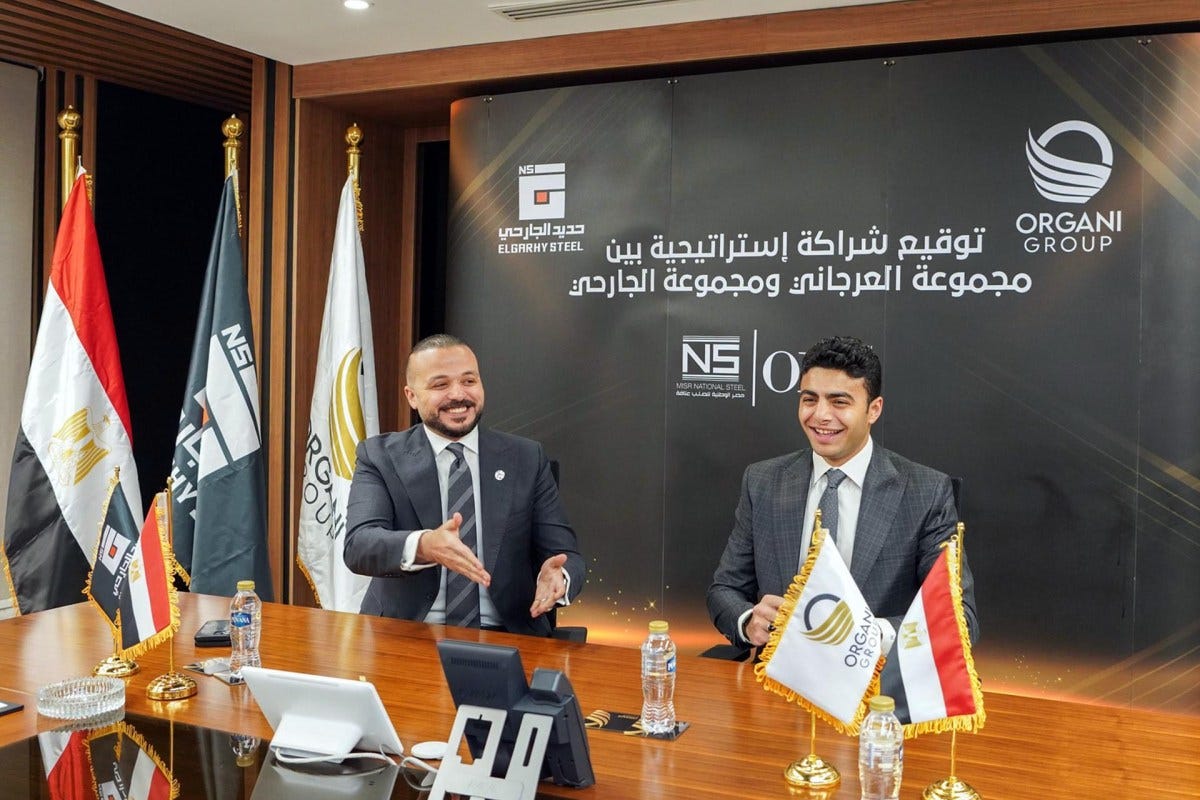
Al-Organi’s proximity to the New Republic’s security and intelligence apparatus yielded total economic supremacy. His conglomerate, which includes Sons of Sinai and Hala Travel, came to monopolize and exploit “coordination” of Gaza crossings, immensely profiting off the plight of Palestinians trying to escape genocide.
Read more: The Argany Peninsula & Kings of famine
Under those conditions, the presence of a State Security officer at the bargaining table is not an anomaly. The officer is not there to mediate between “management” and “workers,” but because the structure is, itself, a security project.
Weaponizing resignation forms
Al-Rwad, a Security Services and Cash Transport Company, arbitrarily dismissed 23 workers across several branches. According to the Egyptian Commission for Rights and Freedoms (ECRF), Al-Rwad, like many employers under the old Labor Law, had required workers to sign the pre-signed resignation “Form 6,” alongside signed promissory notes, as a non-negotiable condition of employment under the pretext that the job involved handling cash and valuables.
Management verbally declared a sudden “crisis,” placed workers on unpaid leave, and summarily fired them, while refusing to return the blank-signed promissory notes. The workers now carry no legal claim to their jobs or severance, while the company holds instruments that can be activated to initiate legal proceedings against them at any moment, a coercive structure backstopped by the security apparatus, since the owner of Al-Rwad holds the rank of major general.
When 11 of the dismissed workers went to file police reports documenting the company’s retention of their personal documents, officers stonewalled them. A single report was eventually filed for five of the workers, only to be promptly shelved.
The Ministry of Labor is perfectly aware of how Al-Rwad operates. In 2025, the ministry’s own bulletin celebrated a mediated settlement at the East Nasr City labor directorate between Al-Rwad and four workers who had filed complaints of arbitrary dismissal. The ministry publicized the return of those workers’ entitlements as a bureaucratic triumph, deliberately ignoring, or at the very least, not investigating the fact that the company was structurally relying on illegal blank-signed promissory notes.
Al-Wafd investigated its journalists for asking to be paid
Al-Wafd is the official newspaper of the ostensibly “liberal” Wafd Party, Egypt’s oldest political formation. Last week, the syndicate committee for the newspaper convened an emergency meeting to address the systematic collapse of their working environment. Among their grievances were the withholding of salaries, which management had been paying late, in arbitrary installments, and selectively disbursing funds to some employees while ignoring others. Workers also documented a broader institutional decay, from failing internet infrastructure to inadequate physical workspaces and a deliberate campaign of dismissals designed to squeeze colleagues out without formal severance.
When the journalists exercised their legal right to stage a protest against the salary delays, the response from party chairman El-Sayed El-Badawi was to refer the 22 protesting journalists to a formal disciplinary investigation, instructing that the results be presented to the party’s executive office for punitive measures.
Under Egypt’s Labor Law No. 14 of 2025, the right to peaceful protest and collective action is explicitly guaranteed. El-Badawi’s investigation referral was, in itself, a legal violation. But in the New Republic, the law is nothing if not subordinate to the logic of control. The situation escalated until Journalists’ Syndicate Chairman Khaled ElBalshy intervened directly with El-Badawi, brokering an agreement to freeze the investigation proceedings. To save face, the freeze was backdated to appear as though it preceded the syndicate’s intervention.
The freeze basically halted the punishment, but it did not force Al-Wafd to disburse the unpaid salaries that triggered the protest in the first place. The party chairman’s instinct was perfectly aligned with the broader politics of labor relations.
From testimony to trial in six days
On Saturday, June 21, the Public Prosecution referred physician and filmmaker Omnia Swedan to criminal trial under Case No. 5830/2026 on charges of “spreading false news” and “misuse of social media,” for the crime of describing systemic obstetric violence she witnessed at the workplace, particularly El Shatby University Hospital in Alexandria. In exactly six days, the state transformed a whistleblower demanding institutional reform into a criminal defendant.
Swedan’s referral to trial is the culmination of just under a week of aggressive state retaliation. Following her initial Facebook testimony on June 15, police arrested her from her home, she was disappeared for 24 hours, then interrogated by the East Alexandria Prosecution based on a complaint filed by the legal counsel of Alexandria University Hospitals. On June 17, she was released on a punitive bail of 20,000 pounds. Simultaneously, her Facebook account was deactivated, and her original testimony was scrubbed from the internet.
Erasing her words was not enough, the state had to rewrite her reality. Immediately following her release on bail, a virtually identical news item blanketed Egyptian state-aligned and state-owned press, all claiming that “prosecution investigations” revealed Swedan suffered from a “chronic mental illness” and was driven by an “emotional charge,” which somehow led her to hallucinate “normal medical procedures” as harassment.
An investigation by the independent fact-checking platform Matsda2sh revealed the mechanics of the character assassination: the text was drafted by a Ministry of Interior-affiliated security agency and distributed directly to editors via a dedicated WhatsApp group, with explicit instructions to publish exactly as provided, without review, entirely bypassing beat reporters covering the prosecution.
Omnia Swedan’s testimony documented her 2020 internship at El Shatby's obstetrics and gynecology department. She described a physician physically violating a 19-year-old during a cervical exam to "discipline her for screaming," while nurses laughed, recounted a doctor slapping a laboring woman across the face, a rape survivor with a ruptured uterus denied care because staff judged her clothing and the fact that she had cigarettes, the routine use of episiotomies without consent, the manual forcing of placentas, and unnecessary cesarean sections justified by senior colleagues because it pays better. The goal, Sweidan said, was not to defame individuals or incite panic, but to demand a “serious, professional and earnest review of workplace conditions and protections for female patients and junior physicians.”
Sweidan’s post cracked a dam. Several physicians and patients immediately began sharing corroborating accounts of systemic violence across Egyptian hospitals, triggering the one thing the New Republic cannot tolerate: an unmanaged public reckoning.
Read more: The care that’s missing from Egypt’s maternity wards
As for the institutional response, the Dean of Alexandria University’s Faculty of Medicine dismissed the urgency of the claims, emphasizing that the incidents “date back more than six years” and reserving the university’s “legal right” against unfounded allegations, while the Doctors’ Syndicate washed its hands of the matter, demanding that anyone with information submit a formal paper complaint through official channels.
This architecture of suppression seems to be standard operating procedure at El Shatby Hospital. In March 2020, the hospital’s director reported Dr. Alaa Shaaban Hamida to State Security, leading to her arrest after a nurse had used the physician’s phone to report a suspected case of COVID-19.
Furthermore, an Arab Reporters for Investigative Journalism (ARIJ) report published just one day before Swedan’s arrest confirmed exactly why women in Egyptian institutions are forced into silence, finding that 62% of surveyed female journalists had experienced harassment but only three out of the surveyed journalists filed complaints, the report detailed a system where institutions protect abusers and whistleblowers face coordinated defamation and job loss.
So What?!
Egypt is not in any way exceptional. Every government in the world manages labor dissent. What makes the New Republic’s architecture distinctive is not its brutality, but its efficiency and its honesty about what it is doing.
Prime Minister Madbouly said last week that “the state cannot, and it is not its role to continue creating jobs,” and he was not wrong as a description of what is happening. He was wrong only in implying the state has retreated from economic life. The state has not retreated, it is merely repositioning itself. It no longer shows up to create jobs, build hospitals, or enforce labor law as part of what was ostensibly a “social contract” under previous regimes. It does show up, however, reliably and at speed, when those jobs, hospitals, and laws produce people who speak too loudly.
That repositioning is measured in the quality of care available in hospital wards, in the job safety of journalists who cover their own workplaces, in the wages of workers whose legal entitlements are withheld because management calculated, correctly, that no one would make them pay. It is measured in the silence of every woman who saw Omnia Swedan’s testimony, recognized her own experience in it, and then watched what happened to Swedan and decided not to speak.
Separately, the ILO convention adopted in Geneva this month establishes that platform workers have the right to human review of automated dismissals, to know why they were fired, and to work free from violence and harassment. Egypt will now decide whether to apply it. But for Egyptian workers, the question of an international convention’s application is irrelevant. The primary question, whether the Egyptian state is willing to apply its own existing law, is already answered in these cases.