


The first half of November saw Egypt’s ruling order lay bare the anatomy of a development model running in reverse. Foreign direct investment in the form of coastal land sale to Qatar, new tranches of European macro-financial assistance, delayed IMF reviews, and an unprecedented domestic borrowing blitz all converged in two weeks to reveal an economy mortgaging finite public assets and future tax revenues just to stay current on past debts. On the ground, residents facing expropriation in Matrouh, households crushed by a fresh spike in housing costs and accelerating inflation, workers striking for unpaid wages and lost health coverage, and the ratification of a controversial Criminal Procedures Code all signaled that the cost of “stability” is being shifted relentlessly downward. At the regional level, Cairo’s push to position itself as a primary contractor for reconstruction in Gaza and southern Lebanon underscored the grim logic of disaster capitalism.
Debt Relief by Liquidating the Mediterranean Coast
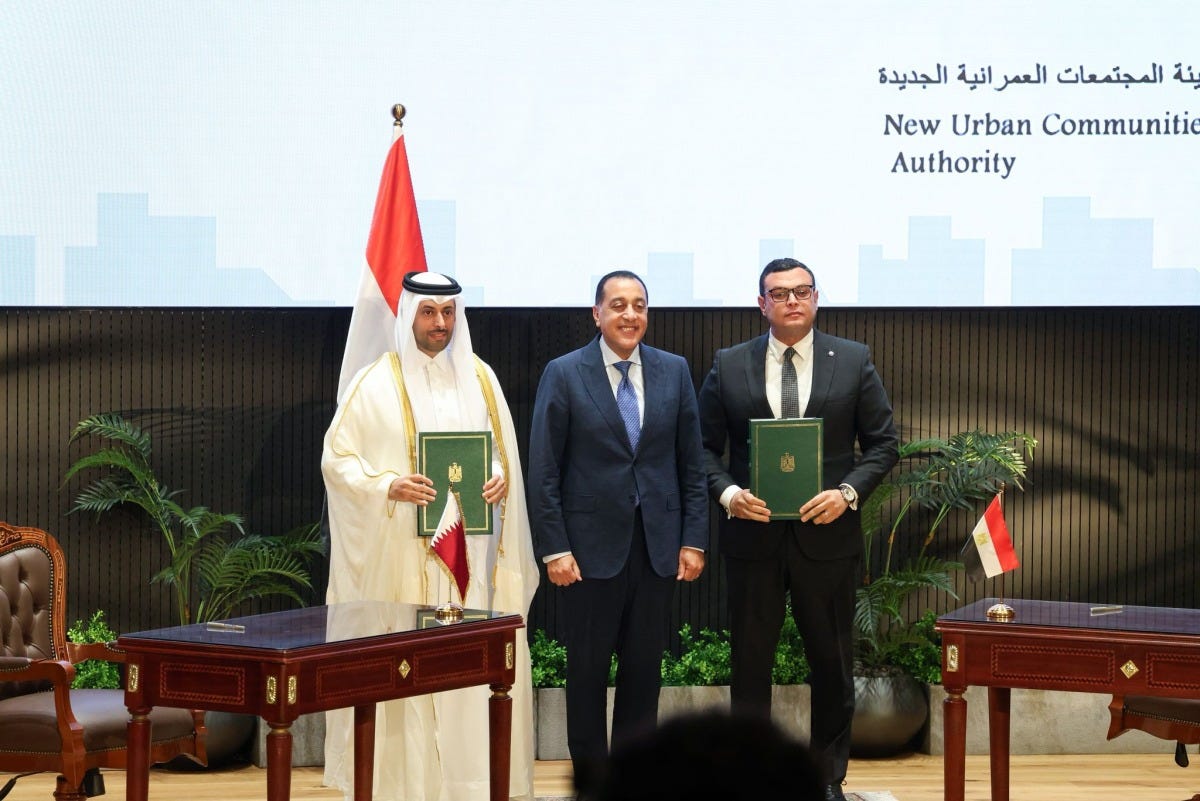
In an effort to quickly raise foreign currency, Egypt finalized its second-largest real estate deal on November 6, 2025. Qatar’s sovereign wealth fund, through its real estate arm Qatari Diar, signed an agreement with the New Urban Communities Authority (NUCA) to develop 4,900 acres (20 million m²) of prime Mediterranean coastline at Alam El Roum in Matrouh Governorate, valued at USD 29.7 billion.
The structure of the deal is:
USD 3.5 billion in cash to the New Urban Communities Authority (NUCA) for land transfer, due before December 31, 2025
USD 1.8 billion worth of residential units to be transferred to NUCA post-construction for resale
15% profit share to NUCA after full cost recovery by Qatari Diar
This project, which covers approximately 7 km of shoreline, aims to “establish a vibrant year-round destination” that includes “world-class hotels, international and local marinas, luxury residences, and dynamic tourist, commercial, and administrative districts.” According to Baker McKenzie, the law firm that advised the Egyptian government on the deal, “the initiative expected to attract substantial Foreign Direct Investment.”
The deal marks a continuation of the ongoing process of liquidating coastal assets. In February 2024, Egypt sold $35 billion in development rights for Ras El Hekma to the United Arab Emirates. Both Ras El Hekma and Alam El Roum, acquired by Gulf sovereign wealth funds, feature prime Mediterranean coastal land; finite and irreplaceable resources transferred to Gulf investors in exchange for substantial one-time foreign currency infusions.
The transaction’s purpose distinguishes it from conventional foreign direct investment. A few days following the signing of the deal, Prime Minister Mostafa Madbouly stated that “the majority of proceeds from the Qatar investment deal will be directed toward reducing public debt.” This explicit designation of revenues for debt reduction, rather than productive investment, capital accumulation, or development, reveals the transaction’s function as debt service refinancing.
In addressing concerns about local residents and the effects of land expropriations for the project, Madbouly reassured, “No citizen will be negatively affected by these procedures.”
However, one longtime resident expressed frustration to reporters, noting that while the New Urban Communities Authority contracted with Qatari Diar for EGP 49 million per acre, residents are offered only EGP 300,000; a shocking ratio of 163 to 1.
Another local conveyed the community’s position, “We don’t oppose the development plan as long as we receive fair compensation.”
But regardless, the social ramifications materialized immediately. On November 12, 2025, just one day after the Prime Minister’s statement, residents of a village in Alam El Roum, Matrouh, confronted a demolition team that was accompanied by security forces, resulting in one local being injured.
Rent Shock, Housing Crisis, & the Return of Inflation
On November 10, 2025, Egypt’s Central Agency for Public Mobilization and Statistics and the CBE announced that inflation had accelerated to 12.5% in October, up from 11.7% in September. This marked the first inflation increase in five months.
The surge was primarily caused by a significant rise in housing prices, which increased by 27.1% year-on-year in October, up from 18.2% in September. This spike was influenced by a controversial new rent law that permits landlords to raise rents by as much as 20 times the previous amount in certain cases.
Quid Quo Pro Diplomacy: The EU-Egypt Memorandum of Understanding
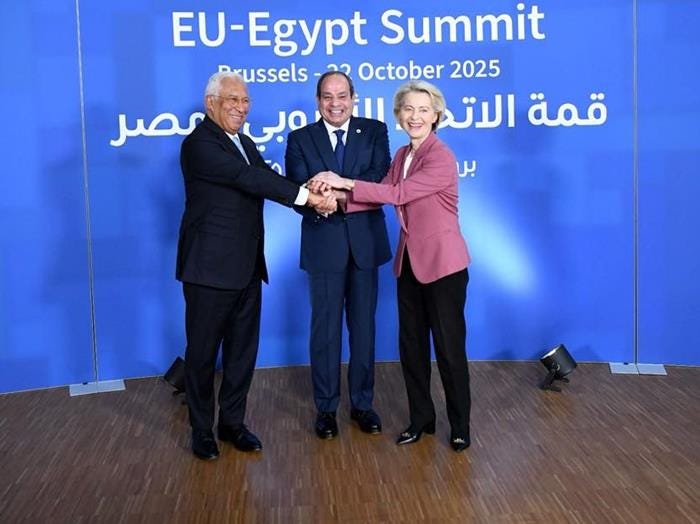
On November 2, 2025, Parliament approved Presidential Decree No. 554/2025, authorizing the second phase of the European Union’s Macro-Financial Assistance (MFA) program, which was sealed during Sisi’s visit to Brussels in October.
This follows the disbursement of €1 billion under the first phase in late 2024. According to the agreement’s Memorandum of Understanding (MoU), the EUR 4 billion concessional loan will be disbursed in three tranches: EUR 1 billion (December 2025), EUR 1.5 billion (June 2026), and EUR 1.5 billion (December 2026), with total maturity up to 30–35 years, a 10-year grace period during which only interest is paid, and principal repayment in 20 equal installments from years 11 to 30.
The Egyptian Initiative for Personal Rights issued a detailed analysis of the MFA program, revealing a critical perspective on both the intention and potential impact of the EU’s conditionality framework. The report traces the origins of the loan to the EU-Egypt strategic partnership and situates its terms as a direct continuation, and in some cases, an intensification of neoliberal reform programs. The loan, contingent on Egypt’s compliance with 60+ detailed economic and financial reforms, is chiefly focused on enforcing exchange rate flexibility and accelerating the privatization of major public assets, including water resources. According to EIPR, such measures sidestep crucial reforms around transparency, tax justice, and budget oversight, and risk worsening poverty and inequality due to the social impact of currency devaluation and rising living costs.
Politically, the EU’s decision to loosen its standard requirements around human rights and democratic accountability in Egypt is unprecedented, EIPR explains. The MoU shifts attention entirely to economic conditionality, a move EIPR criticizes as donor-driven and lacking true local accountability. The analysis highlights that promised reforms, such as publishing databases of state-owned enterprises and boosting competition, appear largely superficial, often transferring monopolistic power to private or regime-connected interests rather than opening up markets or protecting vulnerable groups.
On social protection, EIPR points to the quantitative, rather than qualitative, expansion of social programs such as “Takaful and Karama,” and microfinance, warning that many micro-lending schemes increase debt hardship, especially for women, without meaningful oversight or evaluation. These programs, the report argues, are more about scaling numbers than improving welfare outcomes, and perhaps most critically, the EU requires that the state provide income and poverty data to “relevant government bodies and selected international partner institutions,” further aiding and abetting the state’s practices of not publicly sharing poverty rates since 2020.
The conditionality for Egypt’s “green transition” similarly privileges foreign interests and European market demands over domestic environmental justice or welfare. EIPR notes that while renewable energy initiatives get funding, the focus is on large export-oriented projects, such as green hydrogen, that serve European interests while domestic consumption remains reliant on fossil fuels, situating Egypt merely as a production site in Europe’s green energy supply chains.
Encouraging the involvement of the private sector in water resources is singled out as dangerous for a country already facing acute water scarcity, with little guarantee of equitable access or robust accountability.

In summary, EIPR’s analysis exposes the EU loan as embedding a technocratic, externally-imposed agenda that privileges macroeconomic stability, privatization, and investor confidence, while neglecting transparency, genuine democratic reforms, and protections for Egypt’s poor and marginalized. The criticism, rightfully so, reflects deep skepticism that the conditionality attached to the loan will actually generate inclusive, sustainable development or meaningful improvements for the majority of Egyptians.
Land Expropriations
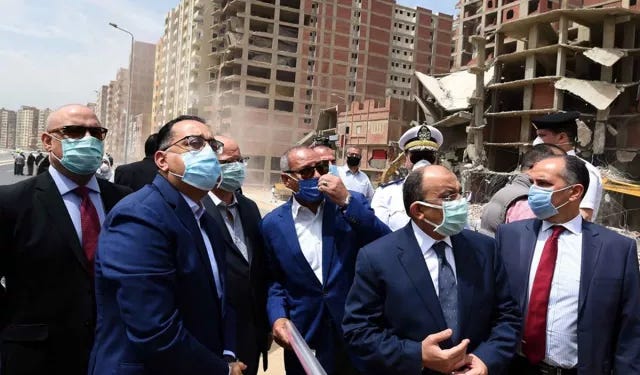
On November 4, 2025, the official gazette published three major Ministry of Transportation decrees authorizing land expropriations across multiple governorates under “public utility” designations:
Decree 674/2025: Expropriation of lands in Dishna, Qena Governorate, for the Dishna Axis bridge over the Nile, pursuant to Prime Ministerial Decree 4143/2022.
Decree 675/2025: Expropriation of lands in the Arab El Raml area, Monufia Governorate, for bridge constructions on the Cairo-Alexandria agricultural road, pursuant to Prime Ministerial Decree 561/2023.
Decree 689/2025: Expropriation of lands in Historic Cairo for Ring Road expansion from Autostrad to Marioutiya, pursuant to Prime Ministerial Decree 4505/2022.
Each decree specifies that expropriations apply to properties whose owners “failed to sign” or “were unable to sign” voluntary property transfer forms, using administrative framing that obscures coercion or inadequate compensation offers.
The Ministry of Transportation, led by Lieutenant General Engineer Kamel Al-Wazir, generally favors awarding construction contracts to the Armed Forces Engineering Authority to execute such projects without public tenders.
Selling a ‘Development Boom’ & the Politics of ‘Stability’
On November 5, 2025, the Cabinet approved the establishment of “Feerum Egypt,” a joint venture between Egypt’s state-linked and politically connected Samcrete Egypt and Poland’s Feerum S.A. for grain storage silo manufacturing, targeting 80% local manufacturing within three years with 1.4 million tons annual capacity.
During the Egyptian-Gulf Investment and Trade Forum, Prime Minister Mostafa Madbouly announced a “comprehensive development boom.” He highlighted the government’s commitment to significant infrastructure investments and the creation of “more than 20 new cities,” with major projects like the New Administrative Capital and New Alamein City leading the way. Madbouly emphasized that the government has put in place “numerous incentives” specifically aimed at attracting foreign investment, particularly from Gulf nations.
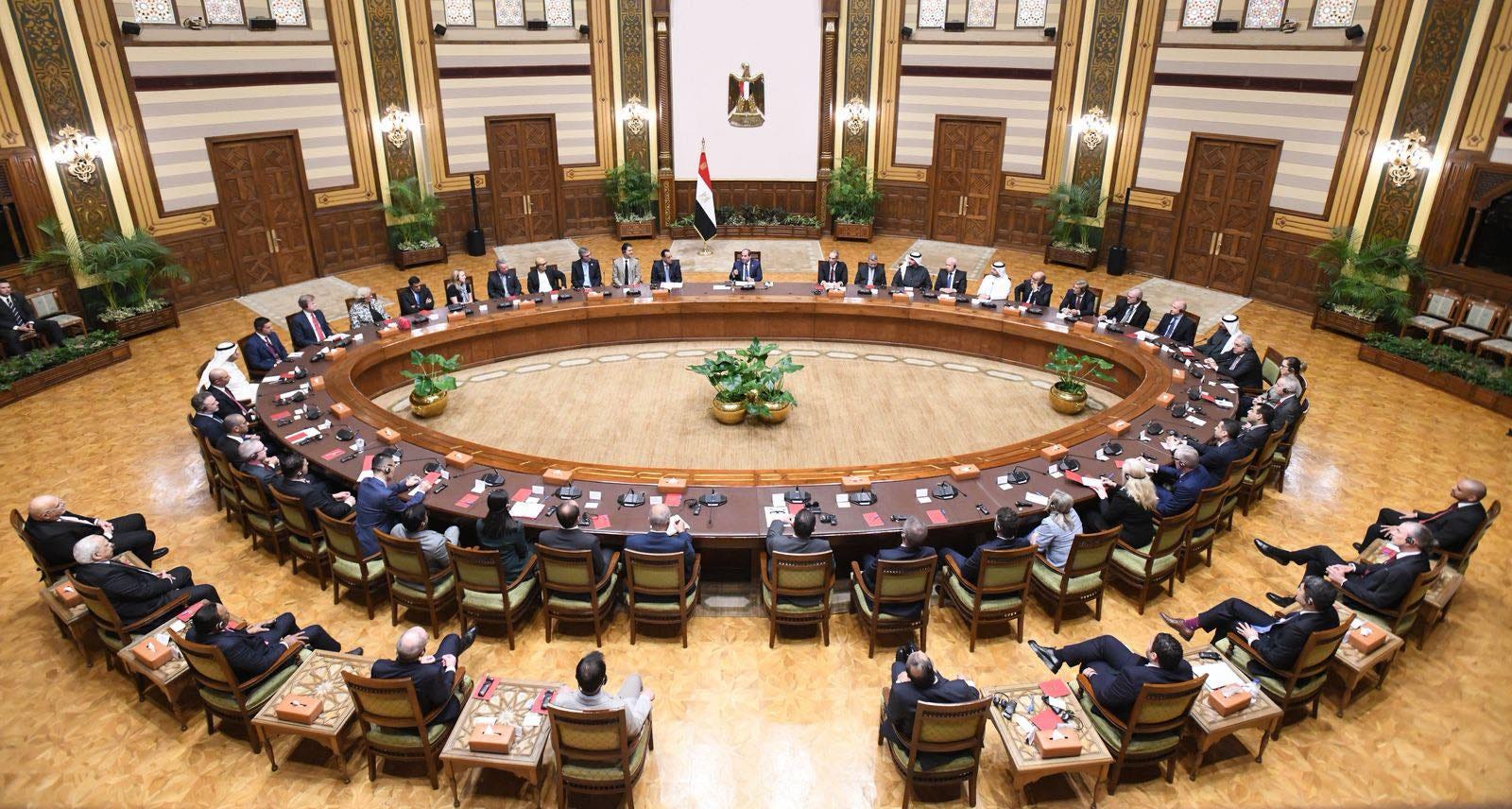
That same day, President Abdel Fattah El Sisi personally reinforced this narrative. He met with leaders of 52 major Egyptian and international outsourcing companies, announcing the signing of 55 new agreements projected to create 75,000 new jobs in the IT sector over the next three years. Sisi’s remarks framed Egypt’s “stability despite regional challenges” as a citizen achievement, a formulation that subtly attributes investment climate preservation to public acquiescence rather than state policy, thereby preemptively delegitimizing popular economic grievances as threats to national security.
Moreover, Egypt and Saudi Arabia signed a memorandum of understanding for cooperation in the roads and transportation sector, signed by Transport Minister Kamel Al-Wazir and Saudi counterpart Saleh al-Jasser.
On 12 November, President Sisi ratified a new Criminal Procedures Code, despite documented objections from Egyptian lawmakers, the Egyptian Initiative for Personal Rights, the Egyptian Front for Human Rights, and the International Commission of Jurists (ICJ). Critics warn that the law codifies abusive practices in violation of the right to a fair trial, including the right to the presence and assistance of a lawyer during questioning, all in a context where political prisoners and activists already face sweeping repression.
Privatization Failure & IMF Delays
On November 13, the International Monetary Fund’s Director of the Communications Department, Julie Kozack, announced the IMF mission would supposedly arrive in early December to conduct the fifth and sixth Extended Fund Facility reviews and first Resilience and Sustainability Facility review, while noting persistent “structural challenges, including a low tax-to-GDP ratio, elevated public debt, high financing needs, energy-related fiscal risks, and a strong state footprint in the economy.”
Earlier in November, former Deputy Prime Minister and economist, Ziad Bahaa El-Din stated that the Egyptian government has not yet reached a final agreement with the IMF on the fifth and sixth reviews, noting deep disagreements regarding military asset divestment, with the government having “not yet begun to resolve” promised sales of military-affiliated and sovereign entity assets “despite repeated talk about offering them to major investors or on the stock exchange”.
The government planned to offer at least 10 companies in 2025, including major military-owned companies operating in the civilian economy. As of mid-November 2025, zero had been offered.
Debt Spiral & the Borrowing Blitz
In early November, the Ministry of Finance published its October Financial Monthly Report. The 88-page document reveals Egypt’s debt servicing has reached a mathematically unsustainable threshold. During the first quarter of fiscal year 2025/26 (July-September 2025), the state collected EGP 644.876 billion in revenues while paying EGP 695.254 billion in interest on existing debt, a consumption rate of 107.8%.
In effect, the state now borrows not to fund development, infrastructure, or social services, but simply to pay creditors from previous loans. The government recorded a primary surplus of EGP 178.714 billion during the same period, a figure the ministry cites as evidence of “fiscal discipline.”
But this surplus exists only by accounting convenience; it excludes interest payments from calculations. When interest, an obligation, is included, Egypt ran an overall deficit of EGP 516.540 billion in just three months.
Finance Minister Ahmed Kouchouk acknowledged as much during an appearance on TV, acknowledging that interest had indeed consumed 107.8% of revenues, but quickly reframed the narrative, saying “revenues are also growing at massive rates. Tax revenues increased 35% without any new tax burdens.”
However, days following the minister’s remarks, the Ministry of Finance announced that the Egyptian government plans to borrow EGP 2.52 trillion during Q2 of the current fiscal year, the largest quarterly domestic borrowing in Egyptian history, at catastrophic interest rates.
The EGP 2.52 trillion quarterly borrowing, combined with the current USD 161 billion in total external debt, is bound to entrap the state in a debt refinancing cycle; borrowing to service existing obligations while interest payments consume the majority of government revenue.
Labor Action
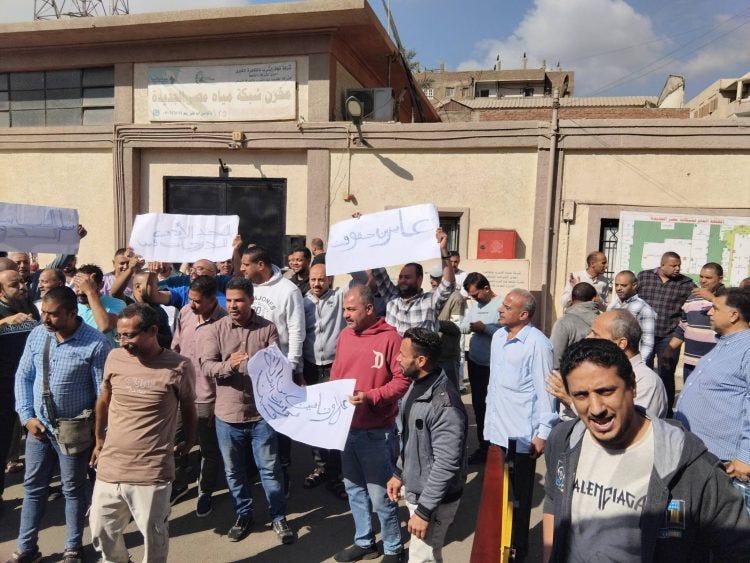
Cairo Drinking Water & Wastewater Company – Employees at various branches of Cairo’s Drinking Water and Wastewater Company staged synchronized sit-ins and strikes.
United Company of Pharmacists – Employees staged a sit-in to protest a staggering 40% cut in their salaries, management’s refusal to pay overdue dues to dismissed workers, mass layoffs, and the suspension of health insurance services. Previously earning between EGP 4,000 and EGP 5,000, their salaries have plummeted to around EGP 2,500. Their main demand is the enforcement of a minimum wage of EGP 7,000. Reports indicate that salary payments have been delayed for three years, with raises being put on hold indefinitely. Additionally, social security contributions have been withheld, leading to a lapse in health insurance coverage for over a year, even though deductions from their salaries continue.
UNIRAB Polvara Spinning & Weaving Co. – Roughly 1,200 workers at UNIRAB Polvara spinning and weaving company in Alexandria walked out in protest after the state insurance authority cut off their health coverage (for unpaid contributions). The strike’s sole demand was the immediate restoration of medical insurance and services for employees. Management tried to quell the walkout by asking for time to resolve the issue, but the workers refused to end the strike until concrete action was taken. On the same day, the company agreed to settle its insurance debt by the end of December and reinstate coverage, and the strike ended on that promise.
Mffco Helwan – A group of 400 workers pressed their grievance over unpaid wages. They filed formal complaints at the labor office, demanding enforcement of the new minimum-wage law and payment of all owed wage differentials. The Egyptian Commission for Rights and Freedoms (ECRF) later condemned the company’s repeated refusal to apply the wage decree and noted that management had continued punishing protesting employees.
In short, State and management responses combined temporary palliative measures, extended bureaucratic delays, security intimidation, and, in some cases, direct retaliation against strike participants. Several actions ended with management promises rather than concrete implementation, suggesting ongoing tensions likely to resurface. The documented strikes represent a broader pattern of labor unrest amid economic pressures, with workers challenging both private company managements and state-owned enterprises’ failure to respect labor rights and implement legally mandated wage standards
✍️ Dig deeper: Simmering Discontent in the Workplace
Geopolitics, Reconstruction Diplomacy, & Disaster Capitalism
Egypt’s domestic policies cannot be separated from its regional role, especially in the tumultuous context of the Gaza genocide and the ensuing spillover into Lebanon. Egypt maneuvered to position itself as a key player in post-war reconstruction, an opportunity to gain international aid, contracts for its companies, and diplomatic prestige.
Gaza Reconstruction Plans: Egypt is gearing up to capitalize on Gaza’s reconstruction. The Egyptian Federation for Construction is forming a coalition of 50 companies for a $70 billion rebuilding project over ten years. Major Egyptian construction firms, often linked to the military, will aim to lead the contracting efforts. Cairo’s stance is clear; with the Israeli bombardment of the Gaza Strip temporarily halted due to a fragile ceasefire, the international community should channel aid through Egypt to restore Gaza’s housing, infrastructure, and economy.
By convening donors in Cairo, Egypt seeks to ensure contracts for Egyptian companies in Gaza’s rebuilding, mirroring its approach in Gaza in 2014 and 2021, when Egyptian engineering battalions repaired some wreckage and local firms exported building materials. Given Egypt’s economic woes, Gaza reconstruction is seen as a potential stimulus, much as its role in post-2003 Iraq and post-2011 Libya.
However, throughout the genocide, the Egyptian government enforced a tight closure of the Rafah crossing, collaborating in the siege under the rationale of national security. In turn, the state has been found complicit by United Nations Special Rapporteur Francesca Albanese’s report “Gaza Genocide: A Collective Crime”. The report was covered by Egyptian state-owned media, emphasizing that many Western countries armed and shielded Israel, quoting the report’s finding that the genocide “would not have occurred” without third-party aid. Yet, conspicuously, Egyptian coverage never mentioned Egypt’s own role.
Egypt’s leadership likely sees reconstruction as a way to square that circle.
Lebanon’s Spillover: Egypt convened the first Egyptian-Lebanese Joint Higher Committee in six years, hosting Lebanese Prime Minister Nawaf Salam in Cairo. During the meeting, Egyptian Prime Minister Moustafa Madbouly assured his counterpart that Egyptian construction firms were “on standby and ready to begin reconstruction work in southern Lebanon, the moment a political deal is sealed and Israeli attacks stop.”
Alongside pledges for economic support, officials also condemned Israeli violations and reaffirmed backing for Lebanon’s sovereignty under the United Nations Security Council’s Resolution 1701, signaling Egypt’s dual role as both diplomatic broker and active benefactor in rebuilding efforts.
Reconstruction in Gaza, Lebanon, and maybe even Sudan, when the conflict comes to an end, is a textbook case of disaster capitalism; profiting from rebuilding what wars and crises destroy. The ethical dimension is uneasy, especially in Gaza, where Egypt’s own policies helped maintain the blockade that impoverished the Strip. But from Cairo’s realpolitik view, helping rebuild an Arab region solidifies Egypt’s sub-imperial function and brings in hard currency contracts.
Institutional dysfunction & the governance baseline
The state’s decisions trace the contours of a regime that no longer even pretends that borrowing, privatization, and asset liquidation will fund productive transformation. Instead, debt service has become the central organizing principle of fiscal policy, with infrastructure, social protection, and foreign policy all subordinated to the imperatives of creditors, donors, and allied capital. The EU’s technocratic conditionality, Gulf real-estate speculation, IMF pressure on privatization, and Egypt’s own militarized mega-projects converge in a single trajectory; an economy that extracts more from workers, dispossesses communities from their land, and restricts political space, all while claiming the mantle of reform and stability.
Spot on. This cycle of debt and asset stripping feels like a repeating algorithm.