


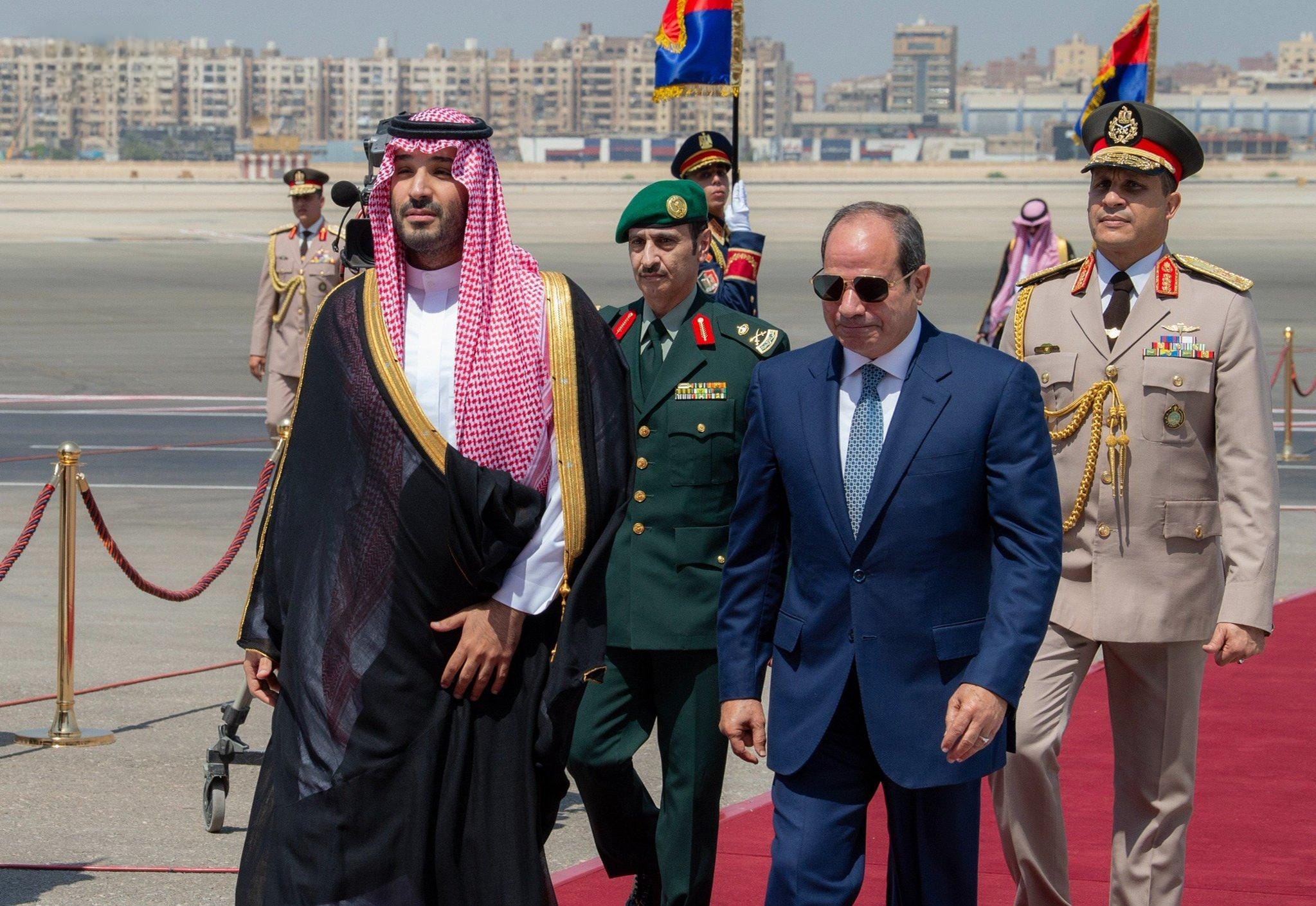
Mohammed bin Salman (MbS) met Abdel Fattah El-Sisi in Cairo on September 15, with maritime security on the agenda, and the easiest way to misunderstand the trip, as many have done, is to ask whether Riyadh wants Cairo to join another offensive in Yemen.
It might be more useful to ask what Saudi Arabia needs Egypt not to do.
The Saudi crown prince arrived in Cairo after Ansar Allah—commonly known as the Houthis—had led a rapid offensive that consolidated control over Mokha, Perim Island, positions overlooking Bab el-Mandab, and later took the country’s entire Red Sea coastline, radically improving the movement’s ability to threaten the southern entrance to the Suez Canal.
After capturing Mayyun Island at Bab el-Mandab, the Houthi movement Ansar Allah declared passage safe for everyone except Saudi Arabia, which is an offer that invites Egypt to separate the interests of the Suez Canal from those of its Saudi ally, and for Riyadh, preventing Cairo from acting on that difference is worth paying for.
After a closed bilateral session between the Egyptian and Saudi rulers, followed by expanded talks, the Egyptian presidency’s account singled out the need to guarantee the “freedom and security” of navigation through Hormuz, Bab el-Mandab, and the Red Sea. Sisi also declared support for “measures taken by the Kingdom to safeguard its security and stability.”
The two countries approach the shipping crisis with different needs: Egypt sits at the canal through which Red Sea traffic reaches the Mediterranean, while Saudi Arabia has become more dependent on Red Sea exports to its west following Iran’s blockade of the Strait of Hormuz to its east.
An arrangement that brings ships toward Suez while excluding Saudi vessels would offer Cairo something Riyadh cannot accept for itself, and Ansar Allah’s declaration is, among many things, an attempt to exploit that difference.
After the balance of power in Yemen changed, reports emerged that a Houthi offer of official maritime coordination had reached Egyptian institutions through the International Chamber of Shipping in London and the maritime chamber in Alexandria, but the New Arab, citing an unnamed senior Egyptian source, said the Suez Canal Authority refused formal communication because it could amount to “implicit recognition” of the Houthis as the go-to authority in Yemen, and referred the matter to the security agencies.
And while it remains unconfirmed, routing such a proposal through security agencies gives the Egyptian government room to bargain in both directions, leaving officials free to seek practical assurances about passage without committing the canal authority to an agreement, and the official relationship remains something Cairo can grant later or continue to withhold, but its value to Riyadh comes from the fear—and very unlikely possibility—that Egypt might just agree to the Houthi proposal.
For Ansar Allah, an agreement with the Suez Canal Authority would help turn the ability to interrupt trade into an accepted role in organizing it, and Cairo would have to treat the movement as a counterpart with whom the operations of a key international shipping route are arranged.
This would leave the Saudis having to contend with an Egyptian relationship it had not negotiated and is largely excluded from.
Still, there is nothing hypothetical about these governments holding talks with Ansar Allah. Riyadh had previously conducted its own diplomacy with the Yemeni movement, hosting a delegation in 2023 that met defense minister Khalid bin Salman. Separately, Egypt has reportedly maintained direct contacts with the Houthis in January 2024 to reduce attacks that were driving traffic away from Suez.
By September 2024, the New Arab reported that Cairo was preparing to receive a Houthi delegation, and that those arrangements were being made in coordination with Saudi Arabia.
But whether Saudi Arabia wants to make sure the Egyptian government pursues an independent path when dealing with the Houthis is less important, and more disconnected from the reality on the ground today, because once shipowners, insurers, or other governments, such as China, decide that a vessel must be cleared with Ansar Allah before moving through Bab el-Mandab, then the Houthis would have acquired something more useful than a rhetorical declaration of legitimacy. It has become part of the machinery governing an international trade route.
Egypt has a particular reason to contemplate that machinery because it has already paid heavily for insecurity farther south. Between July 2024 and March 2025, Suez Canal transit receipts fell 54.1% to 2.6 billion US dollars, from about 5.8 billion dollars in the same period a year earlier, as Red Sea insecurity diverted shipping away from the route.
The canal had only recently begun to show signs of recovery. According to the Suez Canal Authority’s numbers, the rebound began in the final quarter of 2025, and from the start of 2026 through February 8, 1,315 vessels generated 449 million dollars in canal revenue, compared with 368 million dollars over the same period a year earlier—an increase of about 22%.
The latest Houthi offensive therefore threatens Egypt in a very specific way; they don’t need to touch Suez in order to diminish its value—they only need enough coercive power at the canal’s southern approach to make another route preferable.
Cairo has understood this for some time, and again, while extremely unlikely, Sisi’s ability to authorize such an agreement still gives him something to bargain with when faced with Saudi requests not to engage diplomatically with the movement.
Nevertheless, it didn’t take long for that price to start seeing the light of day. Two days after the MbS touched down in Egypt, Al Manassa cited a senior Ministry of Finance source saying that Saudi Arabia had given preliminary approval to roll over its 5.3 billion dollar deposit at Egypt’s Central Bank, which is due at the beginning of October, while the two governments are said to have reached an agreement for over 10 billion dollars in new Saudi investment.
Under Sisi, Saudi, and more broadly Gulf sponsorship has always been most politically valuable when it buys time. Whether it's time before a foreign currency squeeze, time before debt service exhausts constant maneuvers, or time before domestically unpopular policies must be imposed on Egyptians.
And while grossly asymmetrical, this relationship is not without its own benefits to Saudi Arabia. Be it the benefit of geography, foreign policy and political alignment, or the suffocation of all perceived domestic political openings, lest it become an undesirable example for the Saudi Arabian population.
The latter’s time was during the aftermath of the 2011 uprising, but as of late, it has been mostly a nexus of geography and foreign policy alignment that has moved the needle in Riyadh when it comes to how it approaches Cairo.
MbS touched down in the Egyptian capital while Saudi oil infrastructure was under extraordinary pressure. The Kingdom’s East–West Pipeline, designed to move oil toward Yanbu and bypass Hormuz, was hit during the latest offensive, while the Ansar Allah advance placed growing pressure on Saudi Red Sea exports.
Egypt, meanwhile, has the canal at the northern end of that same route and a government permanently hungry for foreign currency.
With all of this in mind, the obsession with whether Egypt will “join the war” exaggerates what Egyptian military participation would actually solve, or whether it would even be of much value.
When Saudi Arabia launched its attack on Yemen in 2015, Egypt contributed 12 F-16 Block 52 aircraft and deployed at least four naval vessels toward Bab el-Mandab and the Gulf of Aden.
Egyptian political scientist and scholar Hossam el-Hamalawy has argued that Egyptian aircraft in the 2015 Yemen attacks were eventually sent home after problems involving communications, ground control, guided munitions, and aerial refuelling made integration with the Saudi-led coalition’s operations difficult.
Similarly, retired US Army colonel David Witty, citing government officials who served at the US Embassy in Cairo, wrote that Egypt’s lack of access to the coalition’s secure communications resulted in its air force being told to “pack up and go home,” adding that this represented “true humiliation for a country that sees itself as having the most effective Arab military in the region.”
Such humiliation, as Witty put it, led to Egypt finally signing a bilateral communications agreement (CIS MOA) that protects and regulates the use of sensitive American avionics and communications systems in January 2018 after successive regimes had resisted doing so on grounds of “sovereignty.“
But the hardware problem is really a political problem in a khaki uniform.
In his book, Counterrevolution in Egypt, el-Hamalawy traces the armed forces’ chronic over-centralization and compartmentalization to decades of coup-proofing: since becoming a republic, Egyptian rulers wanted an officer corps that could not easily coordinate independently of the president. He traces the same institutional defect as far back as Egypt’s 1962–1967 intervention in Yemen, where Egyptian commanders later described an army attempting conventional operations against mobile guerrillas in difficult terrain and compensating for its inability to adapt with overwhelming firepower.
His more recent work on military fragmentation and interoperability makes the connection even more explicit: a military system built around bureaucratic caution, divided commands, and distrust of autonomous officers is poorly suited to modern warfare, which largely depends on rapid coordination and delegated initiative.
There is a useful paradox here.
The Egyptian military can become more powerful inside Egypt while becoming of little, if any, value past its borders, and there is nothing contradictory about that. A coercive institution optimized to protect a political order does not automatically become an institution optimized to fight wars.
For years, as scholar Yezid Sayigh has repeatedly displayed in his work, Egypt’s officer corps has accumulated political authority, economic privileges, land, businesses, and control over civilian institutions, while at the same time, the command culture that protects the regime from autonomous centers of military power discourages exactly the initiative and horizontal coordination that a serious expeditionary force requires.
Here, el-Hamalawy’s work refuses the generic assumption that more weapons equals more military might or capability.
That is also why Egypt’s gigantic weapons arsenal can be politically rational even when it’s militarily dysfunctional. Buying from Washington, Rome, Istanbul, Paris, Moscow, Berlin, or Beijing creates diplomatic relationships, procurement constituencies, and spectacles of “state sovereignty“ and power.
An army can be extremely successful at preserving its own position in society without being especially good at combined systems warfare.
Saudi Arabia has every reason, and firsthand experience, to understand that difference.
That is why, besides the geographic and economic aspects, the most valuable Egyptian contribution to Riyadh is therefore unlikely to be another dozen aircraft.
It is Cairo’s ability to give Saudi policy regional backing, to deny the Houthi-led government an independent diplomatic breakthrough with another Arab state, and most importantly, to avoid building a separate arrangement for the maritime route on which Suez depends.
That does not mean Egypt has no reason to speak with the Houthis—it means precisely the opposite. Egypt has more reason to do so than almost any other state.
For Saudi Arabia, Bab el-Mandab is a security frontier and increasingly an oil export problem, but for Egypt, it is effectively one of two gates to a revenue-producing asset, and while those interests overlap, they are not in any way identical.
If Cairo were to conclude that the cheapest way to restore predictable Suez traffic is to establish a practical accommodation with the authorities in Sana’a, Egyptian and Saudi interests could very quickly diverge, and every successful voyage under such an arrangement would do something a decade of Saudi strikes have failed to do: turn Ansar Allah’s military control into accepted administrative power.
That is why it would be irrational to read the MbS visit primarily as a prelude to Egypt’s return to the Yemeni battlefield. The more interesting possibility is almost the reverse.
The Saudi de facto ruler came to make sure Cairo does not need to, and has no incentive to, solve its Red Sea problem without Saudi Arabia managing such a solution.
Excellent analytical review for the concurrent and the future situation