


The Palestinian and Egyptian struggles have been linked against occupation and imperial domination long before the Nakba.
Egyptians and Palestinians have had their blood drained to feed the same machine since World War I; Egyptian peasants’ stolen lives laid the structural foundations for an occupation of Palestine that still shapes the region a century later.
The British occupied Egypt decades before they did Palestine, and at the onset of the First World War, that occupation was formalized when they took full military and political authority over the country. When the Ottoman Empire entered the war in 1914, Britain moved to prevent Egyptians—technically Ottoman subjects—from being conscripted to fight against it.
The British declared martial law, deposed the nationalist-leaning Khedive Abbas Helmy II, replaced him with his more cooperative uncle Hussein Kamel under the title “Sultan,” and officially declared Egypt a British protectorate.
Initially, the British did not want to risk provoking the people, so they explicitly exempted the Egyptian population from military service, acknowledging the deep religious and cultural ties between Egyptians and the Ottoman Caliphate. They promised that Great Britain would take upon itself the sole burden of defending Egypt. As is the case with every promise an occupier makes, this promise, predictably, collapsed.
Facing devastating imperial setbacks on multiple fronts—notably in the Dardanelles, the siege of Kut al-Amara in Mesopotamia (modern-day Iraq), and the grueling Sinai campaigns—the British military machine grew desperate for manpower.
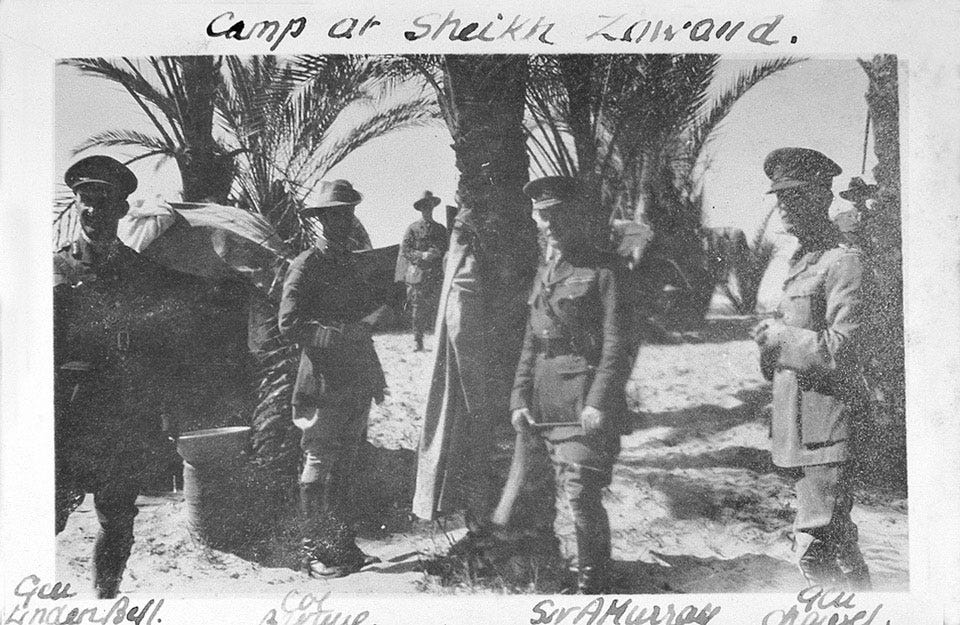
In March 1917, the British war minister wrote to General Archibald Murray, commander of the Egyptian Expeditionary Force, bluntly stating that every corner of the Empire had to share the burdens of war and that he was “not convinced” Egypt was doing its part.
Now officially having full authority over Egypt, the British could change the laws to better align with their interests. Continuing to avoid any resistance from the people, the British opted to take advantage of a legal loophole instead of forcing conscription outright.
They amended the Egyptian Military Conscription Law on October 20, such that an Egyptian peasant, if selected by the official military draft, could receive complete exemption from compulsory service in the official army if they “volunteered” for one year in one of the ongoing auxiliary services with the Egyptian Labor Corps.
These men held no military ranks, had no uniforms, received no military training, and were given no compensation because they “volunteered.” The British, as they usually do, absolved themselves of any accountability and used the bodies and lives of these men as disposable fuel for their war.
One might rightfully question: where were the local authorities, how come the Egyptian government didn’t intervene? This could not have happened without their kind collaboration with the occupier, collaboration they continue to honor to this day, now with different sponsors. It would have been impossible to deliver the massive quantities of labor demanded by the British Expeditionary Force without the active collaboration of the Egyptian administrative class.
The British formed an alliance that the peasantry referred to under the singular, oppressive moniker “the Authority” (al-Sulta), according to Khaled Fahmy’s Stealing History: The Egyptian Army in World War I, published in Bidayat.
The local collaborators were the heart of the machinery of conscription because British soldiers could not physically round up the peasants in the field.
The state pressured provincial governors, district commissioners (ma’murs), and village headmen (‘umdas) to deliver strict quotas of men. In his book The Egyptian Labor Corps: Race, Space, and Place in the First World War, Kyle J. Anderson details that the demographic of men being conscripted was deliberate, and that conscription itself functioned as a class-cleansing tool in the countryside.
The men being conscripted were poor peasants who had no choice but to comply, which further reveals the insidious lie that this was “voluntary.” Wealthy and middle-class families could afford to pay fees to legally buy exemptions for their sons, which meant it was landless peasants the local authorities used to meet their quotas.
Local authorities used intense intimidation and violence to force “volunteers” into the corps. Anyone who tried to resist legally was crushed by the administration.
In his article, Fahmy tells the story of Abbas Ismail, an Azharite intellectual from the village of Al-Hamamiyya, who attempted to draft a legal petition on behalf of local peasants refusing to volunteer for the British.
In response, a local Egyptian district commissioner fabricated a police report within ten minutes, claiming: “Since Abbas has declared that the signatories do not wish to volunteer, it is implied that anyone whose name does not appear on the petition wishes to do so. Since Abbas’s own name is missing and he meets the requirements, his statement is deemed a personal expression of his desire to volunteer.”
Abbas was then instantly arrested and detained.
A people occupied, exploited, and impoverished cannot “volunteer” to labor for the occupier. They never had the option to refuse “volunteering,” and when they exercised their agency to resist, they were still forced into it through sly bureaucratic procedures.
The British intentionally did not use force, and they also intentionally weaponized local authorities to shield themselves from any resistance or consequence, in a classic tactic where the occupier dresses their domination and violence in the language of logic and law, and enacts it through bureaucracy and procedure to uphold the image of “civility.”
This “procedure,” executed through the collaboration between the occupier and local authorities, built a joint system for extracting imperial demand. According to Anderson’s book, they successfully mobilized over 325,000 Egyptian men between 1917 and 1918, stripping the countryside entirely of its working-age population.
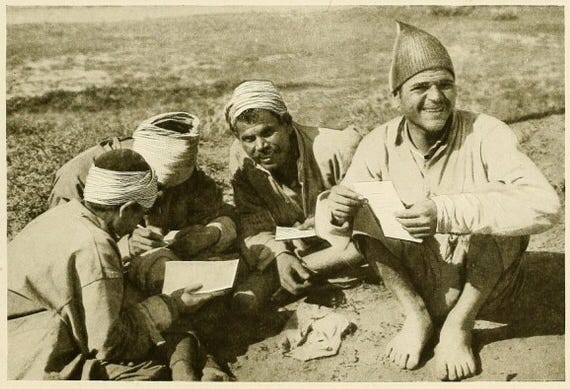
Anderson detailed that the Egyptian Labor Corps was the structural backbone of the British military’s campaigns in Sinai and Palestine. Massive logistical operations were required to sustain a modern army across a very dry climate.
Egyptian workers served as transport laborers, laying down hundreds of miles of military railway tracks and water pipelines across the dry, harsh desert sands. They performed brutal manual labor, unloading heavy cargo and military equipment from transport ships. They were also deployed to dig trenches, construct infrastructure, and manage logistics directly behind the front lines.
This vast network of labor eventually stretched from the rural villages of the Nile Valley to the hills of Palestine, Aqaba, Mesopotamia, Salonika, Mudros, and even the Western Front in France.
It was the coerced hands of Egyptian workers, sweaty and blood-stained, that carried British forces into the occupation of Palestine.
General Archibald Murray, the commander of the British forces, openly acknowledged that the Palestine campaign could not have achieved its “glorious consummation” without the Egyptian Labor Corps.
Despite their civilian status, these half a million men were subjected to horrific working conditions under a strict, inescapable regime of British military law and discipline, forced to labor through extreme climatic hardships. And, on the front lines, they were frequently exposed to combat conditions, resulting in tens of thousands of deaths from enemy shelling and rampant disease.
Fahmy explains in his article how the laborers, to survive this physical and mental trauma, relied on various coping mechanisms, including theater, drugs, religion, strikes, and mutiny, and famously adapted the Egyptian folk song “Ya Aziz Einy,” changing the lyrics on the front lines to mourn “My country, oh my country, the Authority took my boy.”
The true human toll of this joint extraction system was catastrophic, yet it was largely ignored by the British administration, which did not prioritize keeping accurate tallies of native casualties.
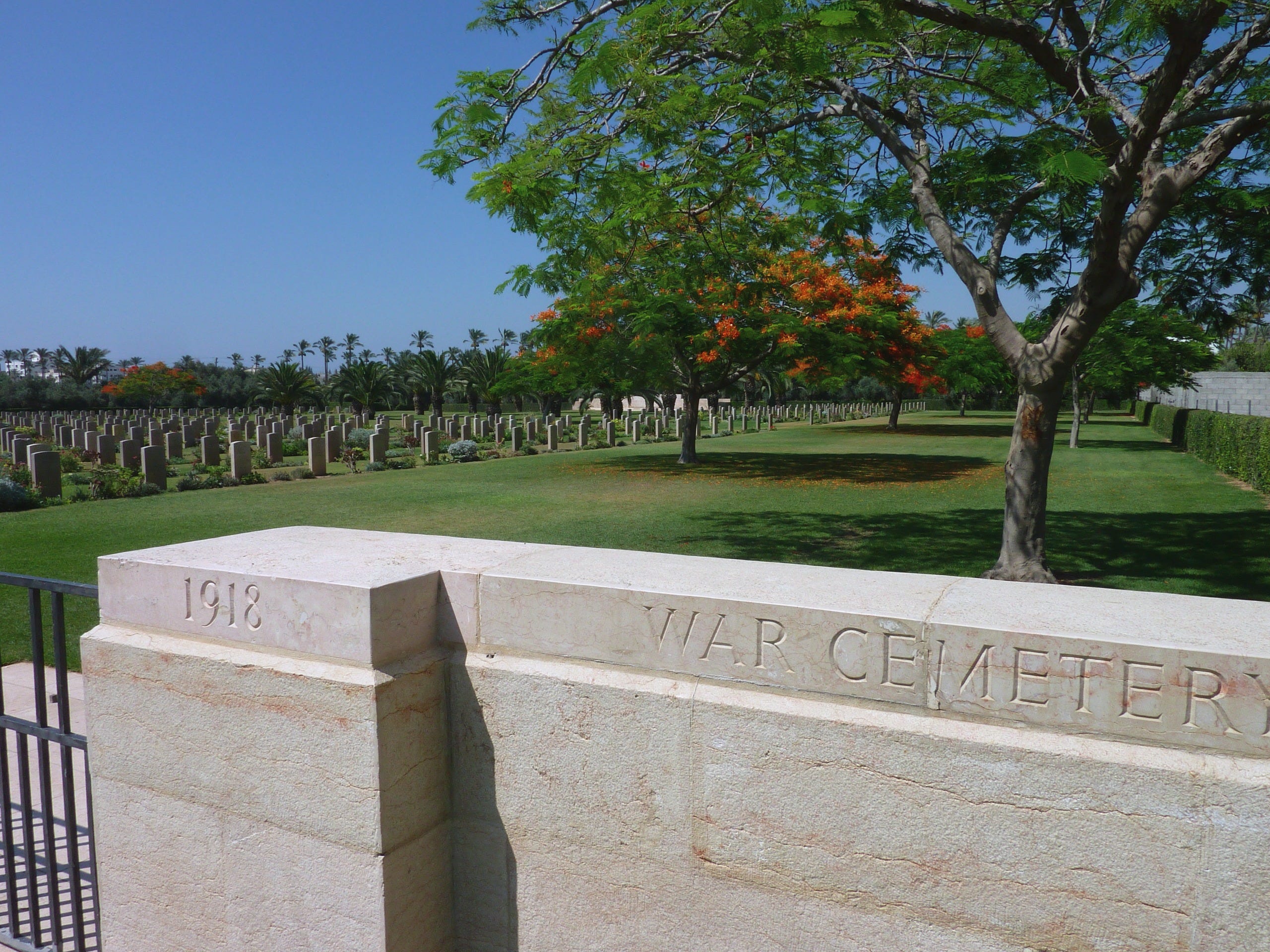
Over 2,200 Egyptian laborers are officially commemorated under Commonwealth War Graves Commission headstones stretching from Port Said to France, according to Anderson.
However, it is estimated that at least 10,000 more workers were killed and lie in completely unmarked graves, spanning the desert sands from Rafah back to the quiet rural Egyptian villages they desperately tried to reach.
The story of the brutalized flesh of the half-million peasants who were dragged from their fields, from their homes, and from their families’ arms is forgotten and untold.
Their memory most probably strongly sits in the quiet, lifelong agony of survivors like the grandfather of translator Dr. Shukry Megahed, who spent his remaining decades missing an eye and carrying a British bullet lodged in his shoulder.
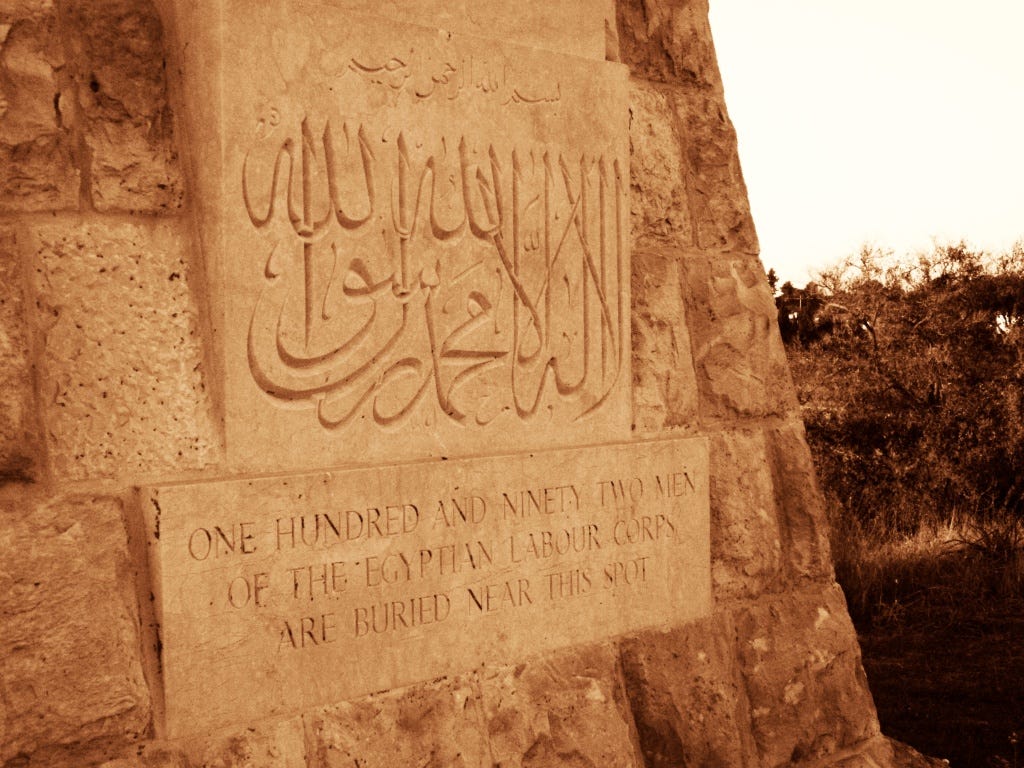
It lies buried in the ten thousand unmarked graves that stretch silently from the Nile Delta, through the burning sands of Sinai, and deep into the soil of Palestine.
To look back at the Egyptian Labor Corps is to confront the joint history of Egyptian and Palestinian struggle, one written in blood and colonial enslavement, a toll that Egyptians and Palestinians were made to pay for themselves, through British fiscal deception.
By forcing the Egyptian state to write off a wartime claim worth at least $360 million today, the British Empire ensured that impoverished Egyptian taxpayers financed the violent extraction and killings of their own children.
It is precisely within this landscape of violence that the historical struggles of Egypt and Palestine become irrevocably bound. The Egyptian Labor Corps was the engine of British conquest in the Levant, and the infrastructure of modern Palestine’s colonial subdivision was built by the stolen labor and drained bodies of Egyptian peasants.
The Egyptian peasant and the catastrophe of the Palestinian nation meet on the same soil, and the colonization of Jerusalem and the subsequent imposition of British mandatory rule over Palestine were, in no small part, bought with the blood of drafted Egyptians who had no stake whatsoever in the empire’s war.
The dispossession of the Palestinian and the racialized subjugation of the Egyptian peasant are not separate events, but twin outputs of the same imperial machine.
Understanding and learning this history is a rejection of both British colonial amnesia and the sanitized nationalisms of the modern Egyptian state.
While the United Kingdom continues to dodge accountability, the modern Egyptian military elite actively attempts to plunder this subaltern tragedy, falsely packaging a history of coerced, traumatized civilian laborers as a glorious chapter of uniformed military triumph to legitimize its own domestic authority.
This is precisely why we must hold a relentless commitment to remembering that the liberation of the Nile Valley and the liberation of the Jordan Valley have always been, and always will be, bound by the very same tracks.

If novelty is trendy ?
Is it still novel