


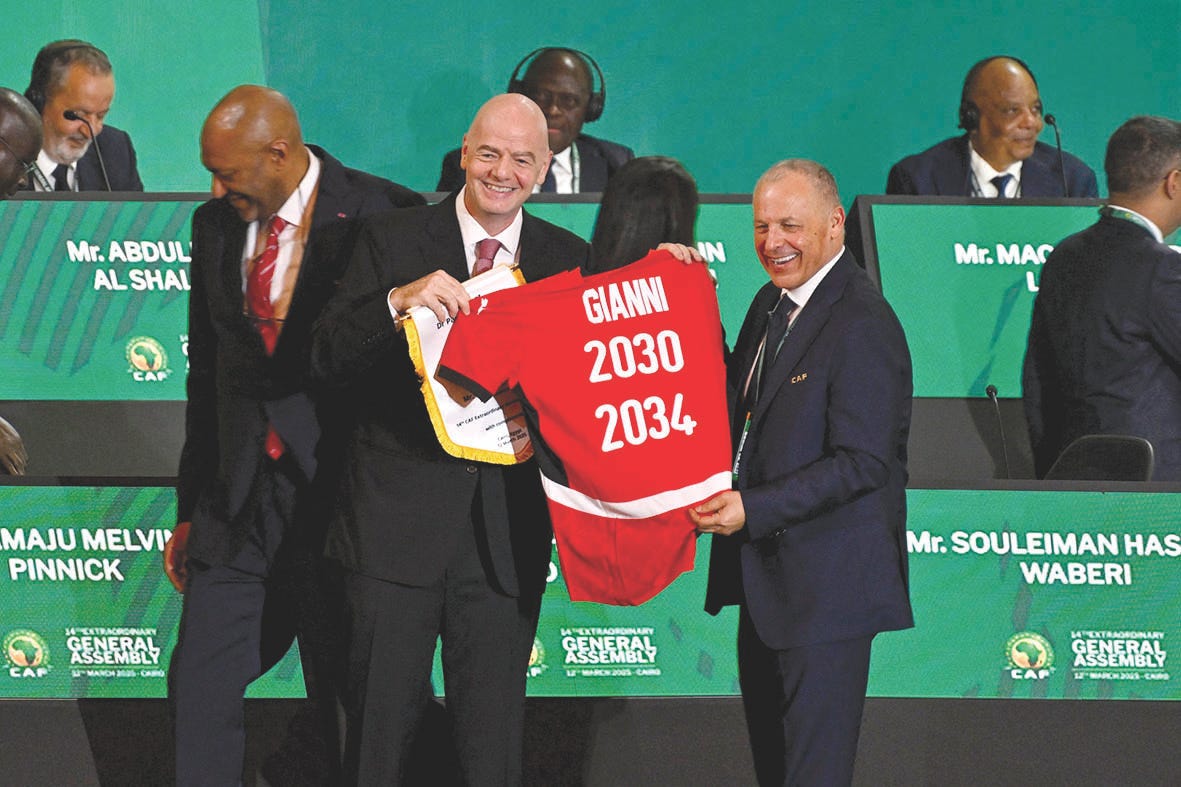
The Egyptian Football Association’s (EFA) support for Gianni Infantino during FIFA’s current governance crisis defends an institutional order Egypt helped construct.
After opposition from European, Asian, and South American confederations forced FIFA to abandon its plan to place major commercial rights in a new company and sell a 20% stake to private investors, the EFA praised Infantino’s retreat as evidence of “true leadership” and renewed its confidence in him.
EFA president Hany Abo Rida then joined five other Arab federation heads in an August 13 statement backing Infantino. The Confederation of African Football’s (CAF) executive committee had already announced its “unanimous” support, although a source familiar with the meeting who spoke with The Cairo Report under the condition of anonymity said “only three or four officials spoke explicitly in the FIFA president’s favor,” and that “Egypt is one of his main backers, if not his main backer, in Africa.”
The wider story, however, is that since Infantino became FIFA president in 2016, Egyptian institutions have helped remove one CAF president, dismantled its long-term commercial rights agreement, and embedded FIFA personnel inside its administration.
In return, FIFA invested at least 6.65 million US Dollars in the EFA’s headquarters and technical center, gave Egyptian officials continued access to its governing bodies, and considered Egypt within the Saudi-led effort to secure hosting the World Cup.
A recent Politico investigation placed a little-known Italian lawyer, Mario Gallavotti, at the center of Infantino’s political operations, including FIFA’s intervention in CAF, the organization’s Saudi relationship, and contacts surrounding Egypt’s monopoly case against Qatar’s beIN Sports.
Yet Egypt’s role predates Gallavotti’s arrival in Infantino’s office. Cairo was already helping reshape CAF’s leadership.
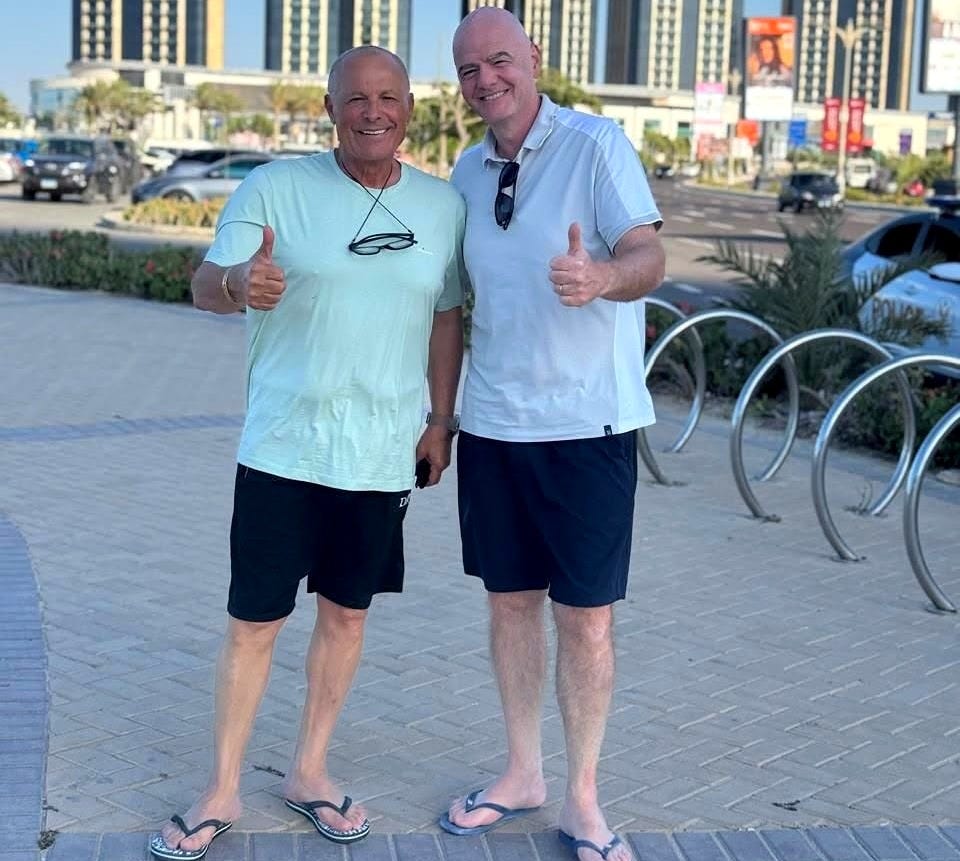
In 2017, Infantino and the EFA worked toward the removal of Issa Hayatou, who had controlled CAF for 29 years and had been the subject of multiple corruption scandals.
Hayatou had supported Bahrain’s Sheikh Salman bin Ebrahim Al Khalifa against Infantino in FIFA’s 2016 presidential election, and his choice weakened his position after Infantino won and contributed to the emergence of Madagascar federation president Ahmad Ahmad as a challenger.
Egypt supplied much of Ahmad’s African campaign machinery. Following the vote, Abo Rida said the EFA had backed Ahmad “with the Egyptian government’s support” and described the result as proof that Egypt had “recovered its power in Africa.”
Ahmad spoke to Egyptian media after the win and said that “Abo Rida had a huge role” in helping him defeat Hayatou.
Infantino publicly denied supporting either candidate before the election. Abo Rida subsequently acknowledged that the FIFA president had “operated behind the scenes” to remove Hayatou.
Ahmad won by 34 votes to 20. The result removed one of Infantino’s most powerful opponents and replaced him with an official whose campaign depended on the FIFA president’s allies.
The FIFA ethics committee later investigated Infantino and secretary general Fatma Samoura for improperly influencing the election. Senior African officials alleged that the duo privately offered to accelerate FIFA development payments if federation presidents supported Ahmad.
Nonetheless, the result strengthened Abo Rida. Less than two months later, he was rewarded with a seat on the FIFA Council, winning 50 votes to his opponents’ four.
Infantino gained a friendlier CAF administration, and Egypt gained a stronger broker inside FIFA.
Ahmad’s administration soon became engulfed in allegations of financial misconduct and sexual harassment.
In March 2019, Amr Fahmy, then-secretary general of CAF and cofounder of Ultras Ahlawy, filed a complaint with FIFA against Ahmad, alleging bribery, misuse of funds, and harassment. Shortly after this complaint, CAF dismissed Fahmy from his position. Later that June, French authorities questioned Ahmad regarding a sportswear contract, but he denied any wrongdoing.
CAF’s executive committee then asked FIFA to intervene, and a joint statement appointed Samoura as FIFA’s general delegate for Africa between August 2019 and January 2020. FIFA also commissioned a forensic audit.
Her authority covered CAF’s operational management, governance, administrative procedures, and competitions.
Gallavotti accompanied Samoura to Cairo and was described as “one of her principal collaborators.” At the time, he administered the secretariats supporting FIFA’s disciplinary, appeal, audit, and ethics committees.
A regional official later told Politico that Gallavotti “appeared to control the confederation between 2018 and 2021,” despite holding no CAF position.
Gallavotti remained visible in Cairo.
In October 2019, he spoke at an International Association of Football Lawyers congress alongside CAF deputy secretary general Anthony Baffoe, CAF’s head of compliance, and former sports minister Ashraf Sobhy.
The promised audit, conducted by PwC, reportedly found missing documentation, “highly suspicious transactions,” and misuse of CAF’s development funds. FIFA declared the mission successful but never published the full report.
FIFA’s ethics committee eventually banned Ahmad for financial misconduct. The Court of Arbitration for Sport (CAS) later reduced the sanction from five years to two.
FIFA had entered CAF as Egypt was simultaneously dismantling the confederation’s most important commercial agreement.
CAF had extended French agency Lagardère Sports’ control over its leading media and marketing rights from 2017 through 2028. Lagardère, in turn, gave those rights to Qatar’s beIN Sports, and the guaranteed value was approximately 1 billion dollars.
The Egyptian Competition Authority (ECA) said CAF renewed the agreement without an open tender, bundled competitions and territories, restricted broadcast technologies, and prevented other Egyptian companies from competing. Its submission to the Organization for Economic Co-operation and Development (OECD) described the arrangement as an “abuse of CAF’s dominant position.”
As the case was taking place, Egypt had joined the Saudi-led blockade of Qatar, and the interests of Egyptian broadcasting companies seeking African rights later fitted the regional confrontation with Qatar.
Egypt’s General Intelligence-owned Sports United, then-named Presentation Sports, initially sought a Middle East and North Africa sublicense from Lagardère. After those rights went to beIN, Sports United offered CAF 1.2–1.25 billion dollars for the global package.
However, that offer came after CAF had already awarded the rights to beIN.
CAF cancelled its Lagardère contract in November 2019, during FIFA’s Cairo mission. It cited the Egyptian regulator, Egyptian judgments, and parallel regional competition proceedings.
At the time, Qatari officials raised concerns with FIFA about Gallavotti’s contacts with Egyptian regulators, according to Politico.
Lagardère later contested the termination, and CAF ultimately paid the company a 50 million dollar settlement.
For a while, Egyptian law had managed to break the old rights system.
African football absorbed the financial liability. Meanwhile, Egypt’s domestic media and sports market was becoming more concentrated around the security state.
The FIFA mission ended on January 31, 2020. Less than two weeks later, Egypt and CAF signed a new headquarters agreement.
The agreement retained CAF in Cairo for 10 years with automatic renewal. Parliament approved it, and President Abdel Fattah El-Sisi ratified it through Presidential Decree 149 of 2020.
CAF received international legal personality, immunity, and privileges similar to those granted to diplomatic missions and international organizations. Egypt undertook to provide services and tax and customs exemptions.
In December 2023, CAF, the Sports Ministry and the Administrative Capital for Urban Development (ACUD) agreed to construct a new headquarters in the New Administrative Capital.
Sisi personally ordered the headquarters built by the military-owned ACUD.
FIFA separately financed the EFA complex in 6th of October City, which Infantino inaugurated in 2021, and FIFA now presents it as a regional hub for African football administration.
These assets sit within a domestic system that controls nearly every point of contact with Egyptian football.
Tazkarti, the only platform through which supporters can obtain match tickets and biometric Fan IDs, belongs to intelligence-owned United Media Services (UMS), which Sports United, that controls major broadcast, commercial and advertising rights, and Estadat that manages stadiums, are subsidiaries of, while ACUD sponsors the national team.
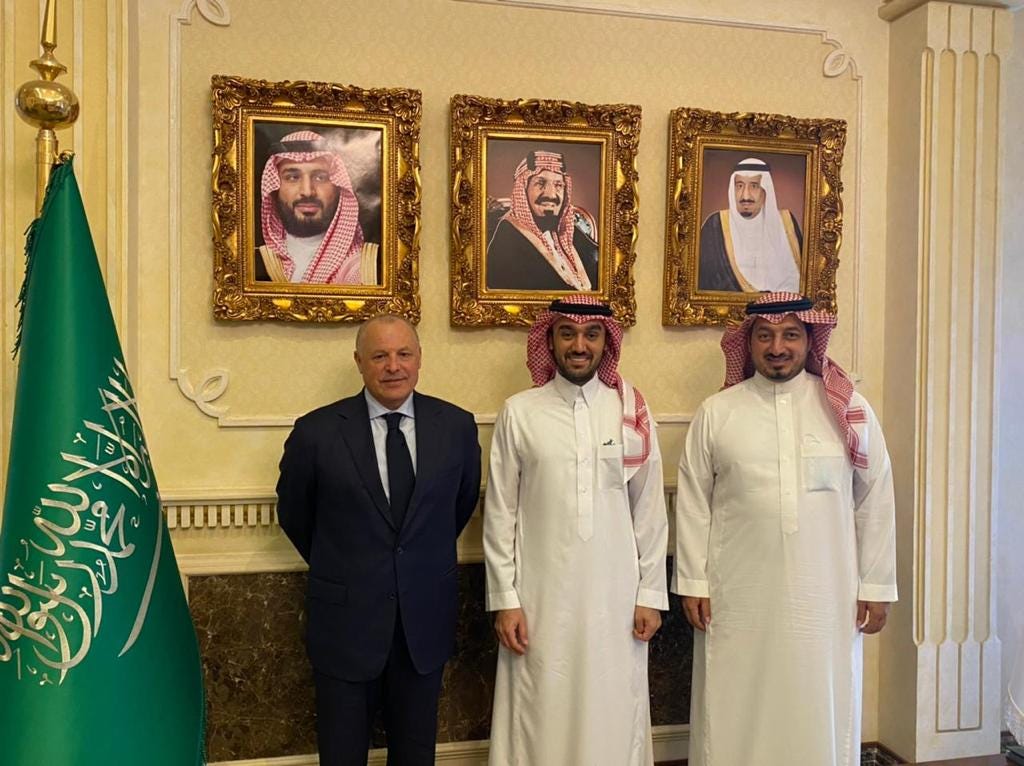
Gallavotti’s Saudi work adds another layer to Egypt’s value.
According to Politico, he arranged talks between Italian and Saudi football officials in Rome in April 2021 over a joint 2030 World Cup bid, which Egypt was also a part of. Saudi Arabia needed partners from other confederations because Qatar had hosted the 2022 tournament, and FIFA’s rotation rules presented an obstacle to another Asian World Cup eight years later.
Italy ultimately rejected the plan and Italian federation president Gabriele Gravina later said political tensions surrounding the kidnapping, torture and killing of Italian researcher Giulio Regeni in Egypt by state security officers, alongside concerns over Saudi Arabia’s human rights records, made the proposed coalition untenable.
The rejection is said to have damaged Italy’s relationship with Infantino’s administration. Riyadh then explored a different combination with Egypt and Greece, with the Saudi capital reportedly offering to finance new stadiums in Egypt and Greece in exchange for staging approximately 75% of the tournament in Saudi Arabia.
The plan was later abandoned in 2023, as Saudi Arabia pursued the 2034 tournament alone and received its hosting rights, alongside the unopposed 2030 bid by Morocco, Spain, and Portugal.
Gallavotti also helped develop FIFA’s commercial relationship with the Saudi state. That relationship now includes a four-year Aramco sponsorship covering the 2026 men’s and 2027 women’s World Cups.
Abo Rida, meanwhile, became the vice president of the Saudi-based Union of Arab Football Associations, connecting FIFA’s African voting base to Saudi’s sports diplomacy and soft power projection.
The method used to remove Hayatou reappeared in a rather more direct form when CAF chose Ahmad’s successor.
Abo Rida announced in November 2020 that he would not seek the CAF presidency, despite claiming that he received support from several federation heads. He instead pursued another FIFA Council term, all for the sake of “keeping Egypt’s seat at the table,” according to his statement.
Infantino then brokered an agreement under which Augustin Senghor, Ahmed Yahya, and Jacques Anouma withdrew for South African billionaire Patrice Motsepe. Senghor and Yahya received CAF vice-presidencies, while Anouma was offered an advisory role.
Anouma initially called the arrangement undemocratic, before he was given the position of Motsepe’s “special adviser.”
Motsepe entered office unopposed in 2021 and won another uncontested term in Cairo in March 2025, with FIFA describing his re-election as evidence of CAF’s “unity and strong collaboration with FIFA.”
That unity was constructed in part through negotiated withdrawals, development finance, public assets, and officials moving between FIFA, CAF, and national federations.
It is important to note, however, that CAF’s 54 votes do not belong automatically to Infantino or any one individual official, and neither Egypt nor Motsepe can guarantee every secret ballot. Corruption in African football has been rampant for decades.
But Cairo provides much of the infrastructure through which African football is governed.
The costs are spread more widely, of course. For example, CAF’s associations carried the Lagardère settlement after Egyptian authorities brought forward a lawsuit—one that was, at least in part, politically motivated.
The immediate beneficiaries are clearer: Egypt’s state-linked and intelligence-owned sports companies and the officials positioned between them, FIFA’s leadership, CAF’s administration, and regional football diplomacy.
Egypt is not a passive recipient of FIFA patronage. It supplied electoral alliances and regulatory pressure and also consolidated corporate intermediaries and public property that helped build Infantino’s African order.
Similarly, Infantino’s order required governments willing to finance infrastructure, associations dependent on development funds, commercial rights that could be centralized, and local brokers capable of assembling votes and state support.
Thus, the EFA is now defending the system from which it gained its position, and the material arrangements that made that position possible.