


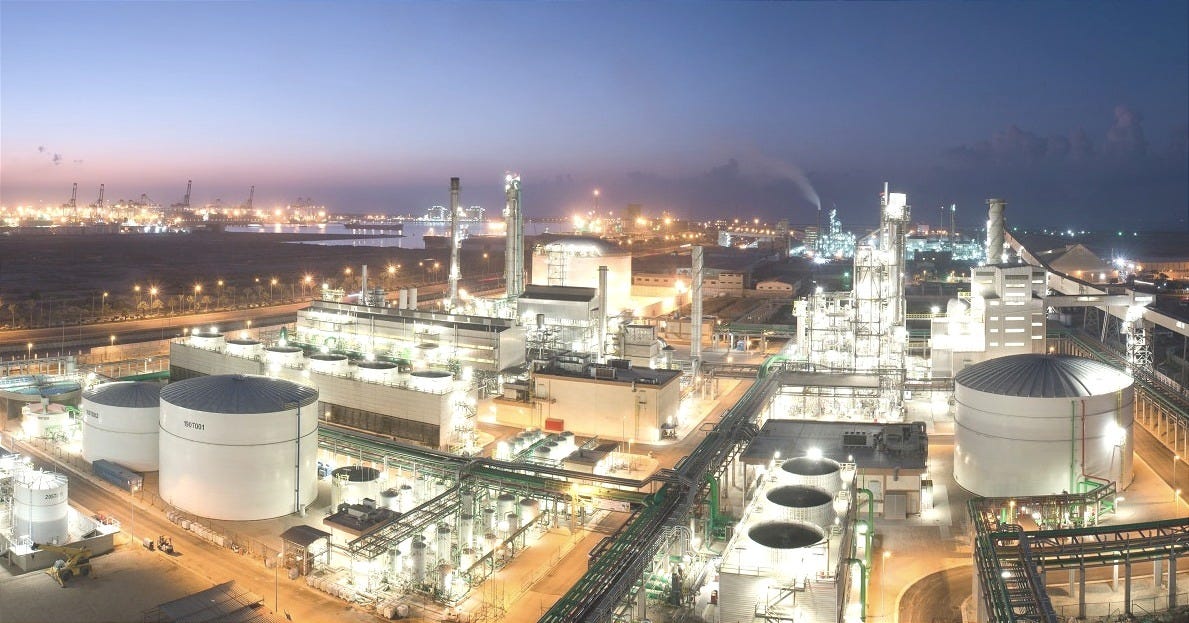
On Monday, 30 March, the shareholders of Delta for Fertilizers & Chemical Industries gathered for their ordinary general assembly. On the agenda were discussions of preliminary expenditure estimates to get the factory back on its feet. Delta has now held the same meeting for six consecutive years while the factory gates stayed shut, without distributable profits or workers’ profit‑sharing, and not a single ton of fertilizer was produced.
The Central Auditing Organization (CAO), Egypt’s state auditor, produced a report on the company for fiscal year 2024/2025, a copy of which was obtained by The Cairo Report. Its findings make one thing hard to deny, and it’s that this was not simply a story of technical failure. It’s a story of a shutdown turned into an opportunity for managers, contractors, and state officials, while workers paid the price.
To understand how six years of inactivity became normal, it’s important to understand what Delta was built to do—and whose labor made that role possible.
Why Delta Mattered & Who Bore Its Costs
The history of Delta Fertilizers reaches back further than the company’s current legal form. The company was founded in Suez in 1946 under El Nasr for Fertilizers & Chemical Industries. After the 1967 war with Israel, operations in Suez were halted. In 1969, the ammonium nitrate factory was relocated from Suez to Talkha, beginning production there in 1975. The urea complex (Talkha II) followed in 1980, with a capacity of 1,725 tons of urea and 1,200 tons of ammonia per day. The ammonia unit was later uprated in practice to 1,275 tons per day, which is the baseline used in current revamp plans. Delta Fertilizers itself was formally incorporated in 1998 as a spin-off from El Nasr, with the Talkha complex as its core asset.
However, Delta Fertilizers was not just another state-owned plant; it was developed to anchor the supply of fertilizer for Egyptian agriculture. The company was dubbed the “Colossus of the Delta” because of its role in keeping farmers supplied and fertilizer prices in check. The company’s own operating logic rested on the public obligation that most output was to serve the domestic market, not simply chase export revenue.
But the same state that treated the plant as strategic also treated the people inside and around it as expendable.
The factory stood on prime Delta land, and for decades, workers and residents bore the cost of its operation. A study of workers at the plant found that between 1987 and 1995, 3,787 out of 9,600 workers developed occupational illnesses, including choking attacks, lung disease, nerve damage, and heart disease, associated with exposure to ammonia and other pollutants from the plant. Outside the gates, monitoring data showed the plant discharging industrial wastewater with nitrate concentrations far above legal limits through drainage outlets into nearby Nile waterways. At the same time, memos from the Agricultural Research Administration documented daily emissions of highly toxic nitrogen oxides that damaged nearby crops and sometimes even resulted in acid rain during winter, leaving parts of the surrounding farmland barren.
That was the social bargain at Delta. Workers and nearby communities absorbed poisoning, degraded land, and dangerous labor so the plant could perform a public function. When the plant broke down in 2020, the question became whether that public function would be restored or abandoned.
From Breakdown to Shutdown
In April 2020, primary reformer tubes in the ammonia plant failed, and the convection section partially collapsed. The damage shut down both the ammonia and urea units completely. Technical assessments put the direct damage to the failed tubes at around €4.5 million, with total plant damage estimated at roughly EGP 80-90 million. Company officials initially projected a six-month repair period, which was later overtaken by a much longer shutdown.
In July 2020, the Chemical Industries Holding Company approved a comprehensive development plan for the major production lines at an estimated cost of about $350 million (roughly EGP 5.6 billion at the time), to cover ammonia, urea, nitric acid units, and a new urea granulation system, which the general assembly ratified in August of that year. A few months later, in December, the Ministry of Public Business Sector announced it would take a very different route whereby Delta’s production would be moved to El Nasr Fertilizers in Suez, while Delta's Talkha land—215 feddans plus another 19 adjacent feddans—would be cleared for housing and real estate development under a proposed compound to be named "Pearl of Talkha".
The proposal was presented as administrative rationality. In practice, it meant uprooting production and severing most of the workforce from the factory, where only around 500 of roughly 2,500 workers would be transferred to Suez.
On 31 December 2020, an extraordinary general assembly approved the transfer of production units to Suez and authorized the board chair to form a technical committee, determine which units could be moved, and appoint an investment bank to prepare a bankable feasibility study. According to the CAO report, that study was never produced, despite the general assembly’s explicit mandate.
What followed was not a financed reconstruction plan but a prolonged administrative holding pattern that kept the factory closed while leaving room for land speculation and contracting.
However, the shutdown did not fall on an intact workforce. By 2020, management had already spent years weakening the people most capable of resisting what came next.
A Workforce Already Weakened Before the Crisis
The 2020 breakdown hit a workforce that had already been cut down.
In 2015, the state diverted the factory’s natural gas supply to electricity generation three times, without warning, to manage recurring power shortages elsewhere. Each diversion stopped production. Workers protested because their wages were tied to output, and every shutdown cut into income while deepening fears of redundancy.
Those fears were justified. Between 2015 and 2016, the workforce fell from about 7,000 workers to around 3,500, with 94 daily-wage workers dismissed outright. By 2020, further attrition had brought the total to approximately 2,500.
By the time the April 2020 accident occurred, the company was already carrying heavy losses. EGP 860 million in 2017, falling to EGP 484 million in 2019, with projections of further decline in 2020. Some of that pressure came from the 2016 currency devaluation, which the company itself said imposed EGP 187 million in losses, and some came from selling subsidized fertilizer below cost, but most of these losses came from years of deferred maintenance that had made breakdowns routine.
That same period—in November 2017 and May 2018—saw the urea unit shut down for repeated ammonia emissions exceeding legal limits.
So when workers heard management describe the events of December 2020 as routine machinery replacement, they were not hearing a neutral technical explanation. They were hearing a familiar prelude to factory shutdown and job loss.
The Survey, the Deception, & the Sit-In
Workers were confronted with the arrival of a survey committee—from the General Survey Authority and accompanied by an Armed Forces officer—in early December 2020, who carried a closure order dated 1 April, authorizing the land handover as part of the planned liquidation and transfer process, and the first step toward building the “Pearl of Talkha” compound.
The workers gathered in front of the administration building and confronted the board chair. According to worker testimony later given to State Security prosecutors, he told them the activity concerned “ordinary machinery replacement.”
The workers did not believe him. They knew no serious development had taken place in years. They also knew what a land survey meant in a factory whose closure had suddenly been tied to a transfer plan, and once it became clear that the premises were being measured for handover and possible conversion into a residential-commercial compound, they began a sit-in.
From 2 December, the sit-in was underway, with negotiations continuing between workers, management, and the union committee over the following weeks. During the sit-in, one union member distributed burial shrouds to fellow workers—a blunt symbol of what they believed was being done to their jobs and to the factory itself.
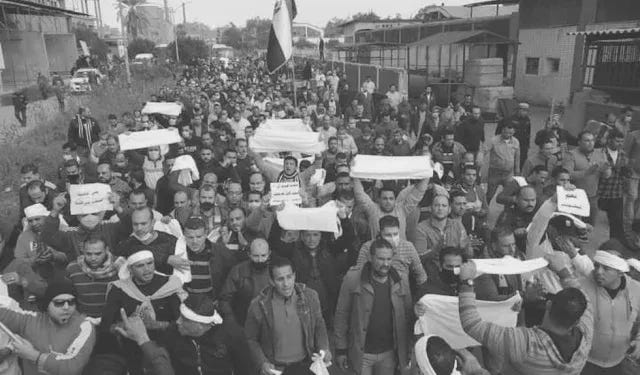
The state’s answer was, of course, repression. Between 31 December 2020 and 2 January 2021, security forces arrested at least 13 workers from their homes, including members of the trade union committee. National Security officers questioned workers on whether they intended to transfer to Suez or accept early retirement. In early January 2021, workers appeared before the State Security Prosecution in Case No. 1 of 2021 on charges including incitement, disrupting production, sabotage, and organizing the sit-in. Eight were ordered into a 15-day remand.
Ironically, the production they were accused of disrupting had already been halted for eight months.
The sit-in nonetheless achieved something important. On 1 April 2021, former Public Business Sector Minister Hisham Tawfiq publicly announced the reversal of the relocation decision. An extraordinary general assembly in April 2021 formalized that reversal, recommitted the company to developing the Talkha site, and once again mandated the same bankable feasibility study that had gone unproduced since 2020, to identify financing sources.
The workers succeeded in blocking the immediate transfer to Suez. What they did not win was a real reconstruction plan.
Reconstruction Deferred
The April 2021 assembly required a bankable feasibility study. According to the CAO report, no such study was found in the company’s records.
What the company did produce was a chain of consultancy contracts. In February 2022, the company signed a €4.5 million Front-End Engineering Design (FEED) contract with thyssenkrupp Uhde for the ammonia plant, but the contract did not enter into force until March 2024. When Uhde later announced the deal publicly as a new milestone, it obscured the two-year delay between signature and activation.
In July 2022, it contracted Uhde for a comprehensive mechanical inspection at EGP 30.809 million, with the contract’s activation also delayed—it only entered into force in November 2022, and the final report was not delivered until June 2023. In August 2023, it signed with Stamicarbon, a Netherlands-based leading global licensor of urea process technology, for a first-phase urea development study at EGP 9.272 million. A second, substantially larger phase was contracted to Stamicarbon in September 2024, at EGP 609.9 million (€11.303 million). Stamicarbon's combined work eventually produced a full urea development cost estimate of €155.546 million.
Uhde's 2023 mechanical inspection report found that out of 543 pieces of equipment, 205 were acceptable, 268 required repairs of varying depth, and 70 needed full replacement. Drawing on those findings, Uhde's final FEED report—delivered in late 2024—then priced full ammonia development at €273.809 million. Uhde warned that integrated plant performance could not be guaranteed unless the development was executed comprehensively and in one phase.
These contracts generated real technical information. They did not, however, force a financed decision.
The CAO says a major investment bank formally expressed readiness to arrange foreign-currency financing for full development, yet found no evidence that the offer was seriously evaluated, negotiated, or formally rejected.
Instead, in January 2025, the board chose a cheaper “short-term” path: a maintenance-first strategy aimed at restarting the plant as cheaply as possible, then waiting for a strategic investor to finance expansion. The March 2025 general assembly approved that approach.
The study used to justify it assumed that 100% of urea and ammonia output would be exported at international prices, at about $420 per ton of urea and $380 per ton of ammonia, disregarding the company’s legal obligation to sell a large share of urea to the Agriculture Ministry at subsidized prices. It also used inconsistent exchange‑rate assumptions across euros and dollars, and the CAO explicitly criticizes these assumptions for artificially boosting the project’s apparent profitability.
The result was predictable. The estimated cost of the first‑phase restart rose from about €96.5 million to roughly €140 million before the plant had produced a single ton, and the total cost of full rehabilitation is now estimated at over €500 million across all production lines, exceeding the initial $350 million comprehensive option that the board had turned down.
And delay was not neutral. The CAO concluded that the longer the current repair path takes, and the more its cost rises, the less justifiable it becomes relative to the previously studied comprehensive revamp—especially given the absence of performance guarantees under the repair scenario.
The Insurance Claim Management Never Filed
The most consequential finding in the CAO report is not about consultants or feasibility papers. It is about insurance.
After the April 2020 accident, company management did not notify Misr Insurance. Their justification was that the incident was not a conventional fire. The CAO found that the insurance policy, renewed in January 2020 and valid through 2025, explicitly covered boiler explosions and similar machinery failures. Delta’s own financial regulations required immediate notification.
By failing to file the claim, management forfeited compensation that the CAO valued at around EGP 1.968 billion, without even seeking the insurer’s interpretation, relying only on its internal view that this was “not a fire.”
At the exchange rates prevailing when the accident occurred in April 2020, that amount—roughly €125 million at the time—would have been sufficient to cover the first-phase repair later estimated at €96.5 million. By the time the board adopted that route in early 2025, currency depreciation had eroded the EGP value dramatically, but the comparison remains meaningful. The insurance claim, had it been filed and paid at the time, would have changed the company's financial trajectory entirely.
Instead, the holding company covered the company’s needs through successive loan injections that eventually reached EGP 6.295 billion. By March 2025, accumulated losses had reached EGP 5.476 billion.
The CAO also found that later insurance renewals continued to limit coverage to fire only, despite earlier board instructions to broaden protection. The board gave the instruction, but company management did not implement it, and no accountability followed whatsoever.
The failure to file the claim was not just a missed administrative step. It shifted the burden of the accident away from insured capital and onto the public company and the workers whose labor it was built on.
How the Shutdown Became a Procurement Pipeline
The maintenance route did more than postpone a final decision. According to the CAO, it turned an idle plant into a dense stream of direct‑award contracts, inflated prices, and consultant fees that continued to grow even as production remained at zero.
According to the CAO report, the Egyptian Maintenance Company (San Misr) received core mechanical maintenance contracts through direct award rather than public tender. In cooling‑tower components, the CAO found that San Misr’s prices were 74% higher than those of a competing firm and that the underlying equipment was in fact sourced from a specialist manufacturer, which Delta could have contracted directly, thereby avoiding San Misr’s markup; the board nonetheless approved the higher‑priced offer.
In scaffolding rental, San Misr billed EGP 59,816 for a single 53‑meter item that a competing firm would have done for EGP 8,308, leaving an unjustified difference of EGP 51,508 on that item alone. In total, the CAO calculates that the company bore roughly EGP 2.7 million in unjustified price differences across insulation and scaffolding works. For lining water‑treatment tanks, management chose a contractor charging EGP 13,150 per square meter over a rival offering EGP 11,825, which the CAO estimates added about EGP 1,014,971 in unnecessary cost without any documented justification.
In 2024, the company formed a specialist technical committee to evaluate bids for a major mechanical maintenance contract. The committee explicitly rejected San Misr on technical and pricing grounds, noting that San Misr lacked experience in fertilizer plant core units, offered no operational guarantees, and submitted a massive proposal that would cost the company €165.8 million—far exceeding the €130 million offers Delta had already secured directly from original suppliers. The board overruled the committee and awarded the contract anyway. Again, the CAO found no documented justification.
Even when tenders were formally held, the process remained dubious. Specifications were altered mid-process without proper notice to bidders—in one instance, the CAO found that a supplier's bid magically included modified items before the company had even officially modified the purchase request to include them. Invitations were sent through WhatsApp in violation of procurement regulations. Suppliers who illegally submitted bids without the required initial financial guarantees were quietly given 48 hours after being awarded the contract to pay them. A structural engineering consultancy was appointed by direct award at EGP 200,000 per month (plus an extra EGP 50,000 for an additional engineer and EGP 40,000 per month for an inspection engineer) plus unspecified expenses, despite lacking chemical-industry experience. When the company later asked for a contractually required 5% performance guarantee, the consultant refused, and the matter was handled through undocumented arrangements with the company simply waiving the requirement without any justification.
In total, EGP 108.13 million moved through direct contracting without competitive tender.
This is the heart of the story. Once production stopped, the plant did not stop generating value, and while workers lost wages, profit-sharing, and job security, the shutdown years still generated contracts, and management still found ways to keep money moving upward and outward through consultancies, direct award, and inflated contracts. Production stopped—extraction did not.
Hiding Losses, Denying Workers
Between January and May 2025, the company capitalized roughly 95% of total wages—about EGP 178.49 million—under “projects under execution” instead of recording them as operating expenses. The CAO noted that this treatment was not supported by evidence of which employees were actually working on overhaul projects, and warned that pushing almost all wages into capital costs in a non‑operating plant distorts both the true size of operating losses and the real economics of the rehabilitation program.
In effect, payroll costs inside an idle plant were shifted onto the investment side of the books, softening the appearance of losses in the financial statements presented to the general assembly.
That accounting choice had material consequences for workers. Under Egypt’s Companies Law No. 159 of 1981, employees of joint-stock companies are entitled to a share of at least 10% of distributable profits, but this cash distribution is capped at the value of their total annual wages. For companies in the public business sector—such as Delta Fertilizers—governed by Law No. 203 of 1991 (as amended by Law No. 185 of 2020), employees are entitled to a share between 10-12% of distributable profits, which must be paid to them before any distribution to shareholders or the board, and without the previous cap on the total value of annual wages. In a normal production year, that can amount to months of additional income for workers living on modest base pay.
Delta has had no distributable profits for six consecutive years so far. Workers who survived the workforce cuts of 2015 and 2016 and who held through the 2020 and 2021 struggles have received nothing in profit-sharing since the plant stopped.
The CAO also documented other irregularities. EGP 7.3 million allocated to a resource-planning software project and $241,000 in SAP licensing transferred to the holding company in April 2020, only weeks after production had ceased; EGP 11.162 million in professional association fees collected since 2014 and never remitted; EGP 6.66 million in catalyst materials lent to El Nasr Fertilizers and never returned; and EGP 46.7 million in receivables from El Nasr still outstanding.
The wage reclassification scheme shows that even after production stopped, workers’ labor costs were still being used to manage the books against their own interests. Even idle, the workforce is treated as something to be managed on paper, exploited, and extracted from, rather than people with a claim on the factory they kept alive.
Workers Had Seen This Pattern Before
The CAO report explains the shutdown years, but not why workers recognized the pattern so quickly. For that, the story has to go back to 2011.
In October 2011, Delta workers launched a sit-in lasting more than ten days, naming abuses that ranged from company buses catching fire on public roads to millions spent on luxury cars for management, vehicles gifted to the Dakahlia governor, a side plant drawing on the company’s utilities without paying, and retired consultants collecting large monthly stipends for work no one could identify.
In November 2011, workers formed an independent union. In March 2012, they helped found the Independent Unions Federation of Dakahlia. The message was clear enough—the official, state-affiliated union structure was not defending them, so they built their own.
In the post-2013 order, the state under Sisi moved quickly to clamp down on independent unions, using administrative orders and, later, Trade Union Law 213 to block their registration, force them to “regularize” under government‑controlled structures, and treat many independent committees as effectively illegal. Arbitrary dismissals of labor leaders became more common, and workers who protested working conditions or organized peaceful sit‑ins increasingly faced arrests, prolonged pretrial detention, and even military trials, as in the Alexandria Shipyard case, where 26 workers were referred to a military court in 2016 for “incitement to strike” and “refraining from work.” This signaled what could happen to organized industrial dissent in Sisi’s New Republic.
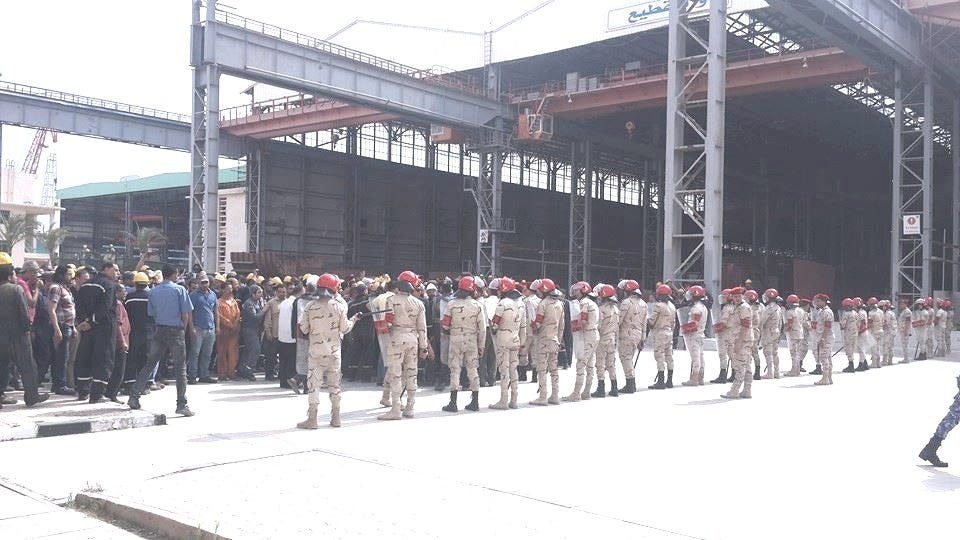
Yet the conflicts at Delta did not disappear. By the time the transfer plan arrived in December 2020, workers were confronting it under far harsher political conditions than those of 2011. Even so, they still managed to force a reversal of a decision that had already been endorsed by the state and formalized through company and general assembly procedures.
Abolish the Ministry, Keep the Logic
In February 2026, the government abolished the Ministry of Public Business Sector and shifted its holding companies into a new cabinet-level economic cluster, under a ‘State-Owned Enterprises Unit’ tasked with restructuring and stake offerings. The move was presented as administrative modernization, but its practical implications remain contested and have yet to produce clear decisions on the ground.
This, however, misses the real problem demonstrated by the Delta case. Public ownership on paper does not protect a factory when decisions are made over workers’ heads, losses are pushed onto the company, and contracts keep flowing without accountability. Changing the supervising ministry may change the chain of command. It does not change who pays and who benefits.
That is the larger lesson of the Delta file. It is not enough to keep an enterprise nominally public if the people who work in it and depend on its output have no real power over its future. Under those conditions, state ownership can still become a way of socializing losses while preserving room above for contracting, patronage, and politically protected mismanagement.
So, What?!
The Delta plant can still be repaired. The technical path exists. Financing options exist. The workforce that defended the factory still exists. What has repeatedly failed is the way the factory has been governed.
For years, workers were asked to accept the language of necessity, shutdown, relocation, study, maintenance, and restructuring. But each stage moved risk downward and opportunity upward. Workers lost wages, profit-sharing, and security. The company absorbed debts and losses, even as managers and contractors kept collecting fees and moving money through an idle plant.
That is the real meaning of the Delta file. A factory built to serve agriculture and sustained by workers’ labor was treated as land to be repurposed, contracts to be distributed, and accounts to be managed from above. The scandal is not only that corruption took place. It is that the people who produce the value of the plant had no control over what was done in its name.
The question now is whether Delta will be rebuilt for those who work it and depend on its output, or left to those who have already spent six years cannibalizing it and feeding off its stoppage.
The answer to this matters because the Delta Fertilizers story is not a one-off scandal. The shutdown and everything that came after is merely an instance in a longer pattern of patronage, opacity, and top-down decision-making that can be seen in the rest of the operating logic of the current regime, in which those who run the country treat citizens as an administrative asset while expecting them to absorb the consequences.