


The argument over China’s export economy has hardened into three familiar positions. One, advanced in Foreign Affairs, warns that Chinese “overcapacity” could transmit deflation and industrial dislocation throughout the world. A second, expressed in Beijing’s official rebuttal, maintains that Western governments are relabeling Chinese productivity as unfair competition. A third sees an increasingly dangerous contest between American and Chinese mercantilism.
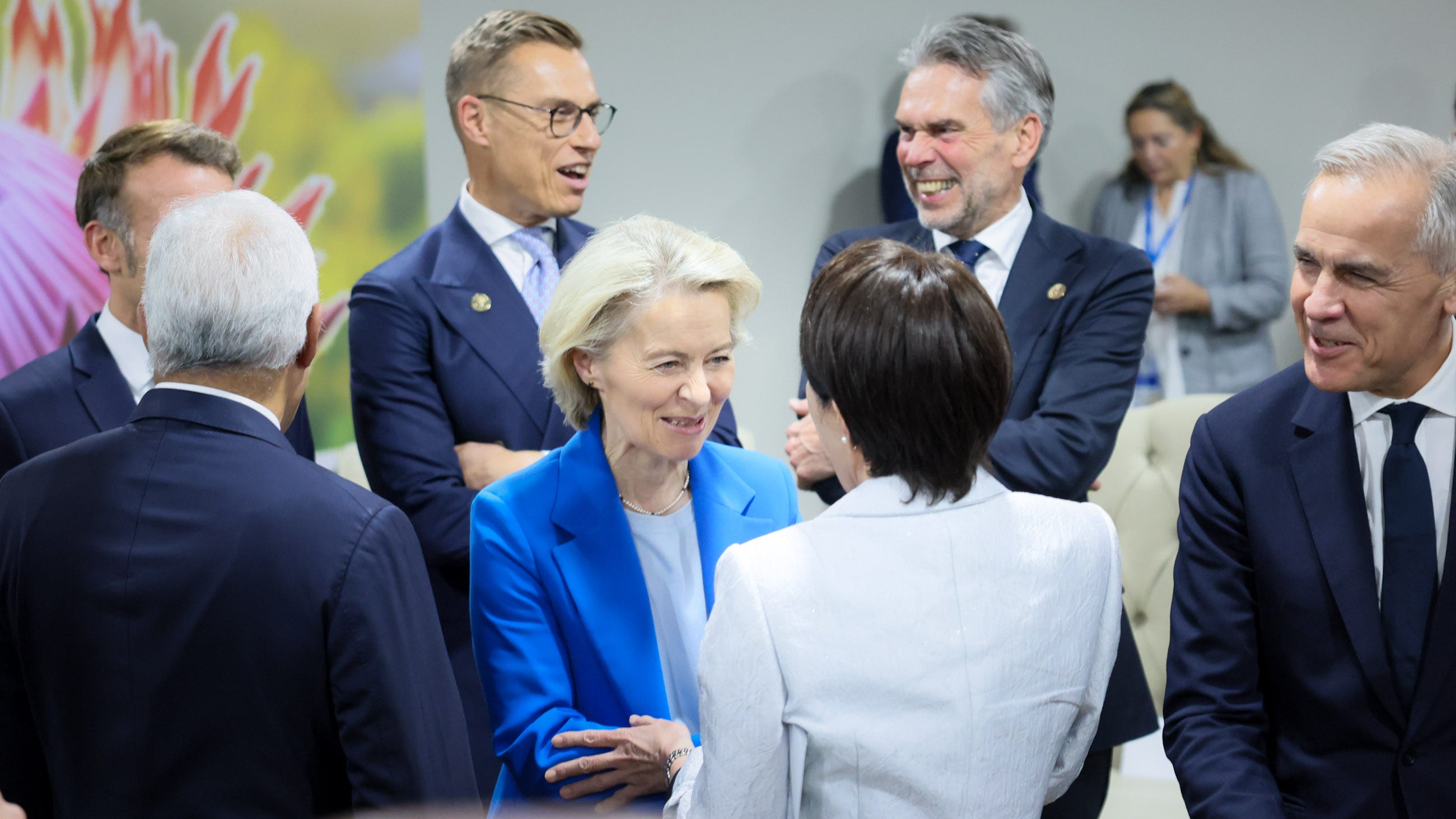
A recent breakthrough at the G20 finance ministers’ meeting in Asheville, USA, was in many ways more revealing than its participants intended. China prevented the adoption of a consensus communiqué, but every other member present endorsed a US-authored statement calling on countries with persistent surpluses to reduce their reliance on—mostly Chinese—exports.
In turn, China objected to the relevant sections, leaving Washington to issue a nonbinding chair’s statement. The result was the widest international alignment against China’s trade model that the United States has yet assembled.
One conventional reading is that Washington has begun turning its bilateral trade war into a multilateral one, which is correct, but incomplete. However, the most recent G20 matters for another reason, as the nations in the meeting seem to have publicly acknowledged a crisis of underconsumption while refusing to identify the social relation producing it.
Its proposed solution is to redistribute demand among states without redistributing power within them.
The G20 statement calls on surplus economies to remove policies that constrain domestic consumption. In the next sentence, it instructs deficit economies to increase savings and pursue fiscal consolidation. Elsewhere, it identifies regulation, labor market “frictions” and insufficient labor mobility as obstacles to growth, while repeatedly affirming the “leading role of private investment.”
Essentially, Chinese households are expected to consume more so that China becomes less reliant on foreign markets, while wage earners in deficit- and debt-ridden economies are expected to consume less so their governments can balance their budgets and service their debts. Everywhere, meanwhile, labor is expected to become more mobile and markets more accommodating to capital.
This strategy is incoherent in every sense. It is also the class logic of the proposed adjustment.
The G20 has recognized underconsumption only where it threatens the profitability and industrial position of other national capitals. It does not object to suppressed consumption as such, but it objects to the geopolitical distribution of its consequences.
China’s imbalance is nevertheless real. Its productive capacity has grown faster than domestic demand, while its goods surplus approached 1.2 trillion US dollars in 2025. When US tariffs restrict access to the American market, Chinese production is redirected toward Europe, South America, and the developing world. Governments facing stagnant growth understandably fear the loss of industries that cannot withstand the combination of Chinese scale, infrastructure, state credit, and technological advance.
But “overcapacity” is also too treacherous a term to use in this specific instance. There can be too many electric vehicles for profitable sale while there remain far too few affordable vehicles, batteries, and solar panels for a global ecological transition. Capitalism, of course, measures excess against effective demand rather than human need. The shortage may lie not in society’s use for the goods but in people’s purchasing power and in the absence of public systems capable of allocating production outside the market.
Beijing is also right that export success cannot be reduced to “low wages” or “subsidies,” as the US and the European Union (EU) suggest. Chinese industry has achieved genuine gains in productivity, logistics, engineering, and scale. Foreign capital has shared in much of those spoils.
According to China’s formal position paper, foreign-invested companies accounted for 27% of Chinese exports, 16% of its goods surplus in 2025, and the labor-intensive share of exports fell from 20.7% in 2012 to 15.1% in 2025.
The image of an economy competing solely through cheap labor is obsolete.
Nor should the preservation of Western manufacturers’ profit margins be confused with the defense of society, as low-cost Chinese capital goods can accelerate electrification and industrial development, particularly in countries that Western finance has supplied mainly with debt, austerity, and a program that simply makes clean technology scarcer and more expensive; protecting certain capitals at the expense of global development.
Yet Beijing’s defense avoids a central question: if Chinese productivity is so high, why must so much of its output find purchasers abroad?
Weak Chinese consumption is most commonly attributed to “consumer caution,” as if households had developed an unfortunate cultural preference for saving, but the more realistic explanation would obviously be material. Households receive too small a share of the output they produce, while inadequate pensions, healthcare, unemployment protection, and housing security compel precautionary saving.
Even the IMF’s recommended reforms implicitly concede the point. It proposes stronger social benefits, more progressive taxation, greater taxation of capital, and full urban status for migrant workers. The fund estimates that granting urban status to 200 million rural migrants could by itself raise consumption by 0.6% of GDP, and a 2024 Rhodium Group study similarly concluded that low household income and its unequal distribution—not merely high saving—constrain spending.
In other words, China’s external surplus is partly the international expression of an internal class settlement.
That settlement has produced achievements that any serious discussion cannot dismiss. China’s transformation brought modern infrastructure, technological capability and an enormous rise in living standards.
In 2022, the World Bank estimated that nearly 800 million people escaped its historical extreme poverty threshold over four decades, and these outcomes distinguish China from the neoliberal stagnation imposed on much of the developing world.
But development has not, in any way, given workers democratic authority over accumulation. The Chinese state bureaucracy directs credit and protects strategic industries, yet wage earners do not collectively determine investment, wages, or the disposition of the surplus.
The hukou system, for instance, still divides the labor force by access to social provision. In the first half of 2026, China had 192.3 million rural migrant workers, while enterprise employees averaged 48.2 hours of work a week, which is about five hours above the global average.
Labor representation remains institutionally confined to the official union structure—the All-China Federation of Trade Unions (ACFTU)—rather than independent organizations.
The brutality of this model is bureaucratically organized: long hours, migrant inequality, and workplace discipline are inputs into national development, all of which contribute to real accomplishments, without ever converting state direction into workers’ power.
A genuine rebalancing would therefore require a transfer of income and authority toward labor in the form of higher wages, shorter hours without lost pay, universal services, equal rights for migrant workers, and organizations capable of contesting managerial and state decisions.
Beijing hesitates because such reforms would not merely change the composition of GDP, but they would alter the balance of class power on which the accumulation model rests.
However, recognizing China as capitalist does not make it equivalent to the United States.
The US still commands the financial architecture of the world economy, maintains an unparalleled alliance system, and possesses coercive capacities far beyond China’s. In 2025, the US accounted for roughly one-third of global military expenditure, compared with China’s 12%, according to the Stockholm International Peace Research Institute (SIPRI), and its arbitrary sanctions, export controls, and control of strategic technologies can impose costs far beyond its territory.
Also, Washington’s campaign is not the self-defense of an innocent free market economy against an intrusive state that unfairly subsidizes its industry. The US finances research, subsidizes semiconductors, uses military procurement to sustain industry, and closes markets when its technological leadership is threatened. Its objection is not to state intervention but to the success of a rival state’s intervention.
American capitalism administers its own form of brutality and violence. Communities have been exposed to deindustrialization as corporations moved production in search of lower costs, while labor law and employer resistance helped reduce US union membership to 10 percent of workers in 2025, with private sector membership at 5.9%.
The same state now invokes those abandoned communities to legitimize tariffs without restoring the organizations through which workers could control the protected industries.
China, by contrast, is a later-rising capitalist power whose industrial strength emerged from a revolution that destroyed the old landed order, created substantial public capacity, and was followed decades later by capitalist restoration under continued party-state rule. It does not possess the global privileges accumulated by the United States, but in much of the so-called “Global South,” it can provide investment, machinery, and diplomatic room unavailable under Western dominance.
Yet subordinate origins do not make every subsequent expansion emancipatory. Chinese firms pursue markets, profit, and strategic advantage; the state secures access to resources and trade routes—often at a brutal cost—while workers remain excluded from sovereign authority over production. China is neither an equal replica of the American empire nor is it a socialist alternative to it. It is a rising state-organized capitalism confronting a still-dominant imperial one.
The rivalry is obviously unequal, but its costs can still be mutual—and they will be pushed downward.
Tariffs can sometimes preserve a plant, create bargaining space for industrial policy, or prevent the destruction of strategically necessary capacity because “free trade” is not a neutral principle.
The “liberal” order managed to successfully integrate production by allowing capital to search the world for weaker unions and worker representation, lower wages, repressive work environments, and cheaper resources.
But tariffs are also not inherently pro-worker. So the relevant question is not whether trade is restricted, but who controls the protection and receives its benefits.
In 2023, a US International Trade Commission study found that American importers bore nearly the full cost of the tariffs imposed from 2018 to 2021. Steel protection increased domestic production, but higher input prices reduced output in downstream industries, ultimately creating winners and losers within American capital while passing substantial costs to consumers and producers.
The greatest danger may lie outside the countries writing the rules.
If wealthy economies close their markets, Chinese producers will redirect exports and relocate assembly toward states with cheaper labor or preferential access to Western consumers. Developing countries will be courted as industrial partners while simultaneously being used as outlets for displaced production.
Egypt offers a preview.
During the first half of 2026, it imported 10.4 billion dollars in goods from China while exporting 840.8 million dollars. Machinery and electrical equipment made up 4.1 billion dollars of the imports, but vehicles, steel, plastics, and chemicals also entered in large quantities, according to the Central Agency for Public Mobilization and Statistics (CAPMAS) figures.
Cheap machinery can expand Egyptian productive capacity; finished imports can eliminate Egyptian jobs. Chinese investment can transfer technology—or become an enclave based on subsidized land, weak labor protections, and assembly for re-export.
Yet the G20 simultaneously advises deficit countries to consolidate their budgets. The implied division of labor is perverse: China should raise demand to reduce its surplus, while indebted peripheral economies should suppress demand to satisfy creditors.
This is a classical imperial hierarchy of consumption where the strongest states debate how global demand should be distributed, while weaker ones are instructed to make themselves cheaper.
Wage earners are not missing from production so much as they are from power.
Most G20 states have correctly perceived that the world economy cannot indefinitely absorb production through one country’s exports and another’s debt. But it remains incapable of proposing the obvious solution: give the people who produce the world’s wealth a larger claim on it and authority over how it is used.