



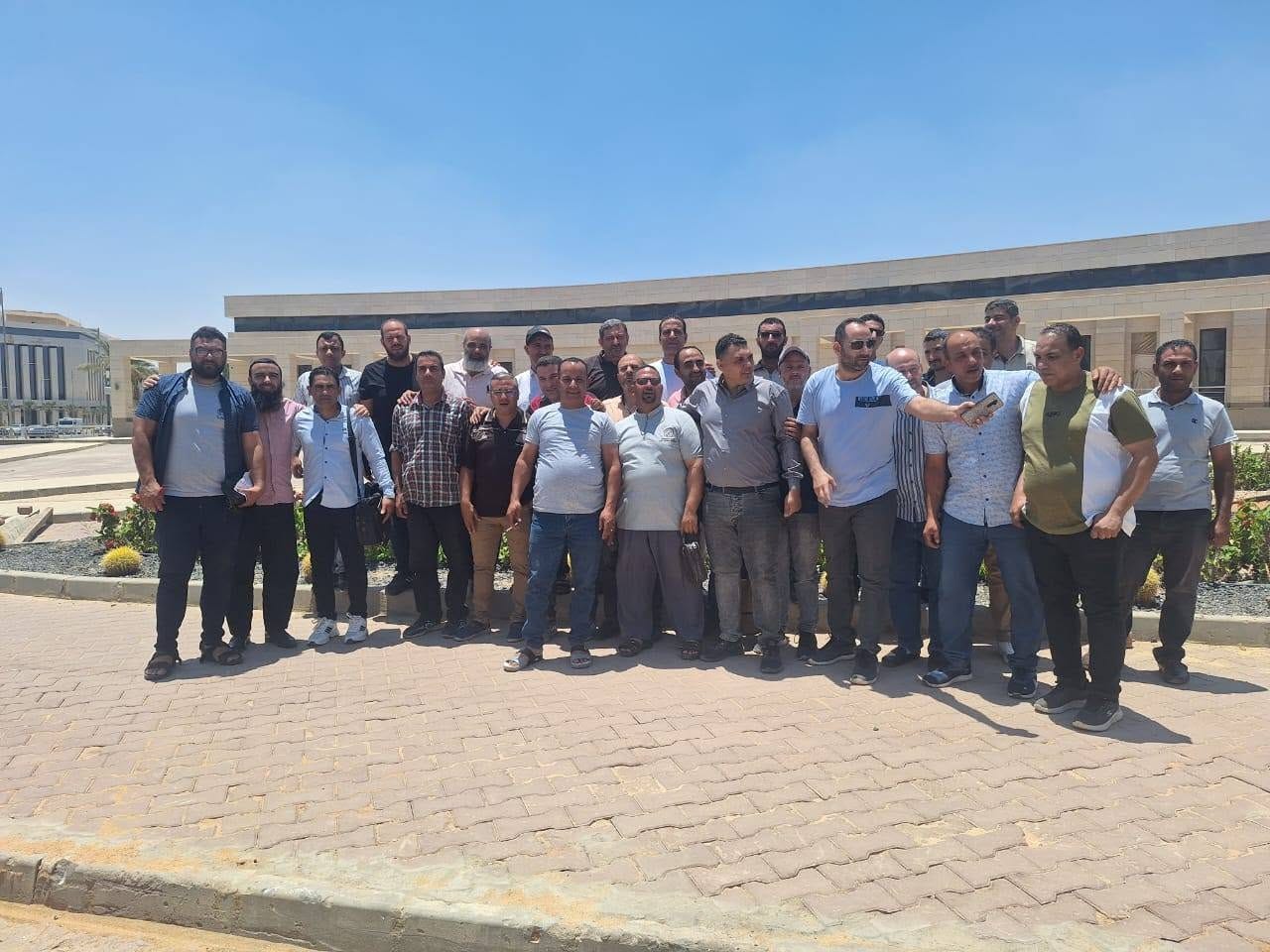
On August 8, 250 public-school teachers employed by Matrouh’s Education Directorate and currently seconded to their home governorates submitted a letter titled “Collective Resignation” to Education Minister Mohamed Abdel-Latif, following Matrouh Governor Major General Mohamed El-Zamlout’s refusal to renew their secondments and his decision to order them back to the governorate.
The letter stops short of recording 250 completed individual resignations, but it explains that the teachers’ frustration has led them to consider resigning collectively, before concluding that, unless the authorities find a solution, they are submitting their collective resignation.
Teachers coordinating the campaign for the renewal of the secondments confirmed to The Cairo Report that the letter had been submitted, but said neither the ministry nor the governorate had responded, and the situation remains unresolved.
“We are not threatening anyone, we are not harming anyone, we are not hurting anyone,” Hassan Saleh, one of the group’s most visible spokespeople, said in a Facebook video in June, two months before the resignation letter was drafted. “The people who wrote that they would resign did so out of sheer exhaustion. We don’t have the energy to go back to Matrouh again.”
The 250 signatories are employed by Matrouh but currently work in their home governorates under ministerial secondment decisions. According to their letter, those secondments had already been renewed for two, three or four years before El-Zamlout refused to approve the next annual renewal and ordered them back to Matrouh. Some say they served in the governorate for as long as 18 years before being seconded home, and testimony from members of the campaign puts their service in Matrouh at between 15 and 22 years before they were seconded closer to their families.
The current group of teachers also overlaps with several recruitment cohorts, since many were appointed to work in Matrouh in 2017 under three-year arrangements accompanied by promises that they would later be allowed to return to their home governorates, while others entered the system earlier and have served considerably longer, as previously covered by The Cairo Report.
The dispute has passed through more than one administrative stage. In October 2025, some 67 teachers petitioned the education minister to implement Secondment Decree No. 1018 after completing the required approvals, with only the former Matrouh governor’s signature outstanding.
Ostensibly, the approvals and secondment decisions the teachers held came from a five-member Ministry of Education committee that reviewed cases during June.
The expectation that new recruitment would release longer-serving teachers did not come only from the campaign. On September 3, 2025, Matrouh announced that 189 newly recruited teachers would enter its schools, and 12 days later, then-governor Khaled Shuaib said the new cohort would allow teachers who had spent years in remote areas to be moved, bringing them greater “psychological stability.”
The present blanket restriction therefore cuts against the staffing logic the governorate itself publicly articulated less than a year earlier.
From blanket restriction to official policy
At a June 24 Executive Council meeting chaired by El-Zamlout, Matrouh formally decided not to renew outbound secondments in the education and health sectors while welcoming teachers, doctors and nurses seconded into the governorate to “cover local shortages,” turning an unexplained administrative delay into stated governorate policy.
But the same petition from the teachers says the claim collapses under its own arithmetic; other teachers covered by the very same ministerial decision had their transfers carried out, while colleagues doing the same jobs under the same order did not.
The governorate has not demonstrated that these particular teachers correspond to particular vacancies, a campaign representative told The Cairo Report, adding that the Education Directorate had not notified any teacher of a shortage in their specialization at a named school or educational district.
Instead, the representative said, the decision was applied collectively, without an individual assessment of each teacher’s specialization, posting, health, or family circumstances.
It’s worth noting that El-Zamlout inherited this dispute. He was appointed governor in February 2026, replacing Major General Khaled Shuaib, who held the post for over six years.
The crisis, after all, got heated in October 2025, when the teachers found themselves not knowing who to blame.
In a letter to Shuaib, the Undersecretary of the Ministry of Education and Technical Education in Matrouh, and the Director of Organization and Administration, the teachers described a bureaucratic hall of mirrors; the ministry’s undersecretary, the teachers’ syndicate head, and the local administration director all said the governor had blocked the decision. The governorate’s own office pointed instead to the director of education.
“Where is the transparency? We want an answer: who stopped the decision, and why?” they concluded the letter.
It took eight months for the local authorities to state the policy publicly.
The mechanism is not new either, in 2016, then-governor Major General Alaa Abu Zeid refused to transfer 120 teachers recruited through the 30,000-teacher competition, citing a deficit of more than 3,000 teachers and saying they would be released only once the ministry supplied replacements. A decade later, Matrouh is again using teachers’ mobility as the balancing item for an unresolved staffing deficit.
Saleh, in the same June video, cut through the administrative fog to name what he saw as the real issue: money.
“By God, people, the solution is simple,” he said. “That the competent authorities in Matrouh communicate with the cabinet and the education minister to secure the funding to appoint or second teachers to Matrouh. That’s the whole issue. What, a financial allocation for teachers? That’s the whole matter we’re even talking about here?”
Despite appealing to the state in his video, Saleh incidentally put the state’s priorities in stark relief. “Egypt, which in recent years defeated the danger of terrorism, built new cities like New Alamein and the New Capital, new settlements, a new port, and more, built a world-class road network, huge roads, electricity, and we cannot fund 200 teaching posts—200 teachers?”
More than a month after imposing the blanket restriction, the Executive Council on July 28 ordered a subject-by-subject inventory of teacher vacancies.
In the same meeting, it sought qualified secondary-school teachers for Qarat Um al-Saghir, which is widely regarded as one of the most isolated permanent settlements in Egypt’s Western Desert, by offering financial incentives and accommodation, which only goes to show that the restriction preceded any public accounting of the vacancies it was supposedly designed to fill, while the governorate’s own policy acknowledged that staffing remote schools requires material inducements.
The human cost of bureaucracy
What reads, in ministry memos, as a staffing-allocation dispute is, for the teachers living it, a slow dismantling of family life.
Outside the governorate building on July 14, one teacher, seconded from Matrouh, married and settled elsewhere, described the position she’d been put in. “
We tried knocking on every door, no one is listening to us,” she said. “We are teachers, seconded from Matrouh, and some of us are originally from Matrouh but married elsewhere, in Alexandria, in Cairo, in Kafr El-Sheikh. We tore down our homes for whom, people? We tore down our homes for whom? We were surprised by a decision that we should be separated from our homes, from our children.”
Another teacher, speaking outside the Matrouh Teachers Club the same day, put a number on his own sacrifice: 22 years commuting from Alexandria. But he was quick to point past himself, to colleagues he said were worse off.
“There are people coming from Cairo, people in Beheira, people in Menoufia, sick people, others besides me who are widowed, others whose families are scattered,” he said. “These people were living here in Marsa Matrouh, if the secondment isn’t renewed, they’ll move their lives there, and they have no homes or places to live here. So where are these people supposed to go?”
He described an ultimatum some of the women in the group had faced from their own husbands: “either marriage or staying seconded, if you want to work, then that’s it, divorce.”
For one teacher, the stakes were framed not just as hardship but as a legal question. In an appeal posted to Facebook and addressed directly to the governor, she framed her hardship as a constitutional and humanitarian claim, invoking the constitution’s “protection of family cohesion.”
“I’m speaking to you as a mother before anything else, and as a wife before anything else,” she said. “My husband is here in Gharbiya, and you seconded me to Gharbiya, even though I spent very many years in Matrouh, working hard, and I didn’t cause any trouble. But once my husband is here in Gharbiya governorate, this falls under the family reunification law, and that’s a law in the constitution. We didn’t invent anything.”
Without the renewal, she said, she would return to Matrouh entirely alone, managing diabetes with no family nearby, after her doctor had urged her to come in for a checkup. “Is this reasonable?” she asked.
She was invoking Articles 10 and 11 of the constitution, which require the state to protect family cohesion and enable women to reconcile work and family responsibilities. They do not, however, constitute a self-executing “family reunification law” or automatically entitle a public employee to a particular posting, but they strengthen the case for an individualized humanitarian assessment.
These accounts are not outliers within the group. Teachers cite herniated discs and knee damage from years of weekly commutes. Some describe working through cancer treatment. The ECRF stated that the group’s average monthly salary is around 7,300 Egyptian pounds, under the country’s mandatory 8,000-pound minimum wage, while their housing and transport allowance sits at just 500 pounds a month, against room rents that start at 900.
However, more recent figures provided by the campaign illustrate the arithmetic facing even the better-paid teachers. A representative put current monthly pay at an average of around 8,500 pounds, while renting an apartment in Matrouh costs at least 5,000 pounds and transport another 2,000 pounds a month.
On those figures, housing and travel alone would consume more than 82% of take-home pay, leaving around 1,500 pounds for food, utilities, healthcare, and every other expense. Some teachers make four inter-governorate journeys a week, each of roughly 250 kilometres—approximately 1,000 kilometres in total. The group includes teachers with bone disorders, cancer and other serious illnesses; some say the treatment they require is unavailable in Matrouh, while older members can no longer manage prolonged travel, the campaign representative said.
The state seeking to order them back is also, by its own pay scale, making them finance the cost of that return from their own wages.
A pattern of escalating resistance
The teachers have not been passive. When mainstream media did not report on their issue, they created their own Facebook page in October to make themselves heard. They traveled to the Ministry of Education in Cairo in mid-June to press their case.
By early August, the campaign had lasted over a month, punctuated by collective visits to the governorate headquarters on July 14 and July 27, and ECRF said it had received collective complaints from around 250 teachers, moving the dispute outside the ministry’s internal chain of command and into a legal and rights-advocacy channel.
The campaign is seeking either the renewal and implementation of the secondment decisions or permanent transfers out of Matrouh. If the authorities maintain their silence, a campaign representative said, the teachers intend to begin a hunger strike, follow through on their resignations and challenge the policy before court.
Separately, on August 9, the Matrouh Teachers’ Syndicate, representing the governorate’s teaching workforce more broadly, announced that Matrouh City Council’s property administration had ordered it to vacate its own headquarters within a week on July 25, while also demanding payment for the building’s continued use.
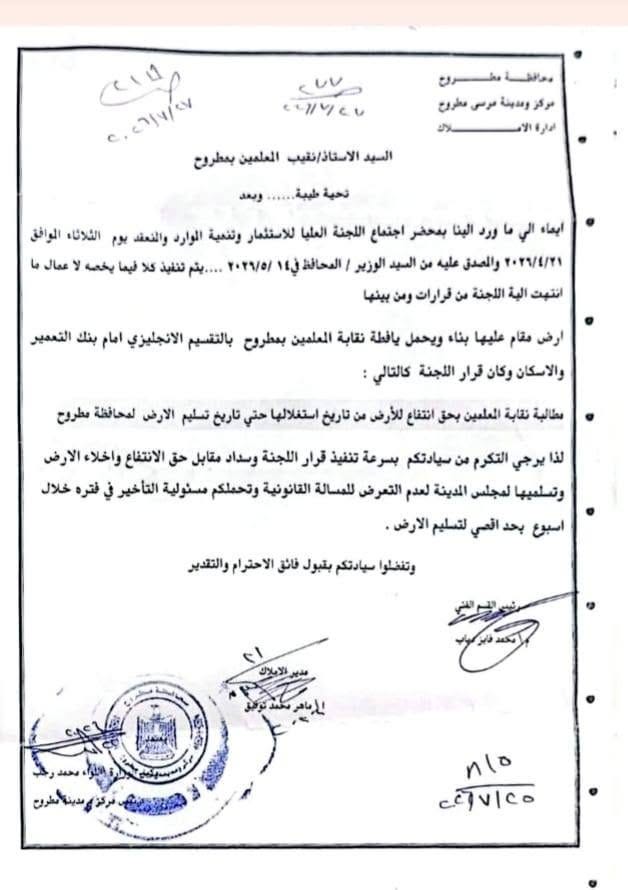
The syndicate says it has occupied the building, along with the attached teachers’ club, since the 1960s. It has filed an urgent appeal with the Alexandria Administrative Court, with a hearing scheduled for August 16.
The two disputes are not the same fight. But they share a governorate, a workforce, and a pattern: local authorities pressing claims against the very institutions and people meant to be running the region’s schools.
So, what?!
Nothing happens in a vacuum of resources, and this case is no different. Egypt’s national teacher shortage is real and severe.
In October 2024, Abdel Latif said the deficit had initially stood at approximately 460,000 teachers and then risen to around 655,000 after the creation of 98,000 additional classes, claiming at the time that 90% had subsequently been “covered” through a combination of recruitment, hourly paid teachers and increased teaching loads for existing staff.
“Coverage,” in other words, did not mean filling 90% of the gap with permanent, secure jobs.
Moreover, no national aggregate answers the decisive local question of what is Matrouh’s present deficit by school, district and subject, and how many members of this group match those vacancies?
A shortage measured in the hundreds of thousands is not solved, and cannot be honestly explained, by holding a few hundred individual teachers hostage to their postings years past the terms they signed up for.
Nowhere is it clearer that The New Republic’s precarity as policy is working as intended.
That is the question Saleh returned to: not whether Matrouh needs teachers, but whether the state will fund the stable workforce it says the governorate requires. Instead, the present policy treats teachers’ mobility and family lives as the balancing item for a shortage created and managed above them.